What Is a Real Estate Agent in Yonkers, NY — and Do You Need One?
By Judy Zhou, Keller Williams Realtor®
Key Takeaways
- In Yonkers, where median home prices hover near $600,000, a 5-6% commission generates $30,000 to $36,000 in total agent fees on a typical sale.
- Buyers who skip representation to "save" on costs frequently overpay by far more than the agent commission would have cost.
- The right Yonkers agent prices offers with hyperlocal comps, negotiates against seasoned brokers, and navigates co-op board requirements that disqualify unprepared buyers every month.
- A Yonkers agent must know which neighborhoods are appreciating fastest and spot deal-killing issues like shared easements or unreleased liens before inspections begin.
Yonkers real estate is competitive, complicated, and not forgiving of rookie mistakes.
A real estate agent in Yonkers, NY is a licensed professional who represents buyers or sellers in property transactions across Westchester County's largest city, where median home prices hover near $600,000 and the market spans everything from downtown condos to luxury waterfront real estate along the Hudson. The right agent does more than open doors. They price offers using hyperlocal comps, negotiate against seasoned listing brokers, and navigate New York's co-op board requirements that disqualify unprepared buyers every month. The wrong agent costs buyers tens of thousands in overpayment and sellers months of stale listing time.
The national commission rate for real estate transactions typically falls between 5% and 6%, according to data aggregated by Coursera's real estate salary guide. In the Yonkers market, that commission structure means a $600,000 home sale generates roughly $30,000 to $36,000 in total agent fees, split between listing and buyer sides. That is real money. Buyers who skip representation to "save" on costs frequently overpay by far more than they would have spent on an agent, as Hidden Costs: Why NYC Buyers Without Agents Pay More makes clear.
For a ny real estate agent working the Yonkers corridor, the job is not generic. It requires fluency in Westchester County's co-op approval process, knowledge of which Yonkers neighborhoods are appreciating fastest, and the ability to spot deal-killing issues like shared easements or unreleased liens before a buyer sinks money into inspections.
What Does a Real Estate Agent in Yonkers, NY Actually Do?
A real estate agent yonkers ny operates as either a buyer's agent, a seller's agent, or (less ideally) a dual agent representing both parties. Each role carries distinct legal obligations and practical responsibilities that determine whether a transaction closes cleanly or collapses at the eleventh hour.
A buyer's agent in Yonkers is responsible for identifying suitable properties, running comparable sales analyses to determine fair offer prices, negotiating purchase terms, managing inspection contingencies, and guiding the buyer through co-op board applications or condo board review processes. The co-op piece is where unprepared agents fail. Yonkers has a meaningful stock of co-op apartments, particularly along Central Park Avenue and in the northwest section. Co-op boards require extensive financial disclosures, personal reference letters, and interview attendance. An agent who has never navigated a Yonkers co-op board package will leave buyers scrambling, and board rejections are not appealable.
A seller's agent (listing agent) handles pricing strategy, marketing, showings, offer evaluation, and buyer qualification screening. The pricing piece is where most Yonkers listings go wrong. Agents who rely on Zillow Zestimates instead of pulling active comparables from the Hudson Gateway MLS routinely overprice homes. The property sits for 60 to 90 days, accrues price reduction stigma, and ultimately sells below what a correctly priced listing would have fetched. The data pattern is consistent: homes that require a price reduction sell for less than homes priced right from day one.
Dual agency exists in New York but carries inherent conflicts. The agent representing both buyer and seller cannot advocate fully for either side. New York law requires written disclosure and informed consent before dual agency can proceed. Buyers and sellers should understand exactly what they are giving up before signing a dual agency agreement. The agent cannot reveal the seller's bottom-line price to the buyer, nor can the agent reveal the buyer's maximum offer to the seller. In practice, dual agency benefits the agent (who collects both sides of the commission) more than either party.
Beyond the transaction mechanics, a competent Yonkers agent provides local intelligence that no algorithm can replicate. Which streets in northwest Yonkers have the best school assignments? Where are the flood zone boundaries near the Saw Mill River? Which buildings along Warburton Avenue have pending litigation or special assessments? This is the granular, street-level knowledge that separates a licensed agent from an effective one.
The day-to-day workload of a buyer's agent in Yonkers illustrates why representation matters. A single transaction might involve 15 to 25 property showings over several weeks, three to five rounds of offer revisions, coordination with a mortgage loan officer to ensure the buyer's pre-approval holds, scheduling and attending a home inspection that costs $400 to $700, reviewing the inspection report for structural red flags, and then renegotiating the purchase price based on findings. The agent also coordinates with the real estate attorney (required in New York) to manage contract drafting, rider negotiations, and title commitment review. For a co-op purchase, add the board package preparation, which can run 100 pages or more and requires tax returns, bank statements, reference letters, and a detailed net worth statement. A buyer attempting this without professional guidance will spend dozens of hours and still miss critical steps.
Are you weighing Yonkers against Bergen County for your next purchase?
Why Yonkers Is a Distinct Market From the Rest of Westchester
Yonkers is not Scarsdale. It is not White Plains. It is not Rye. Treating Yonkers as a monolithic "Westchester suburb" reveals an agent who does not understand the market.
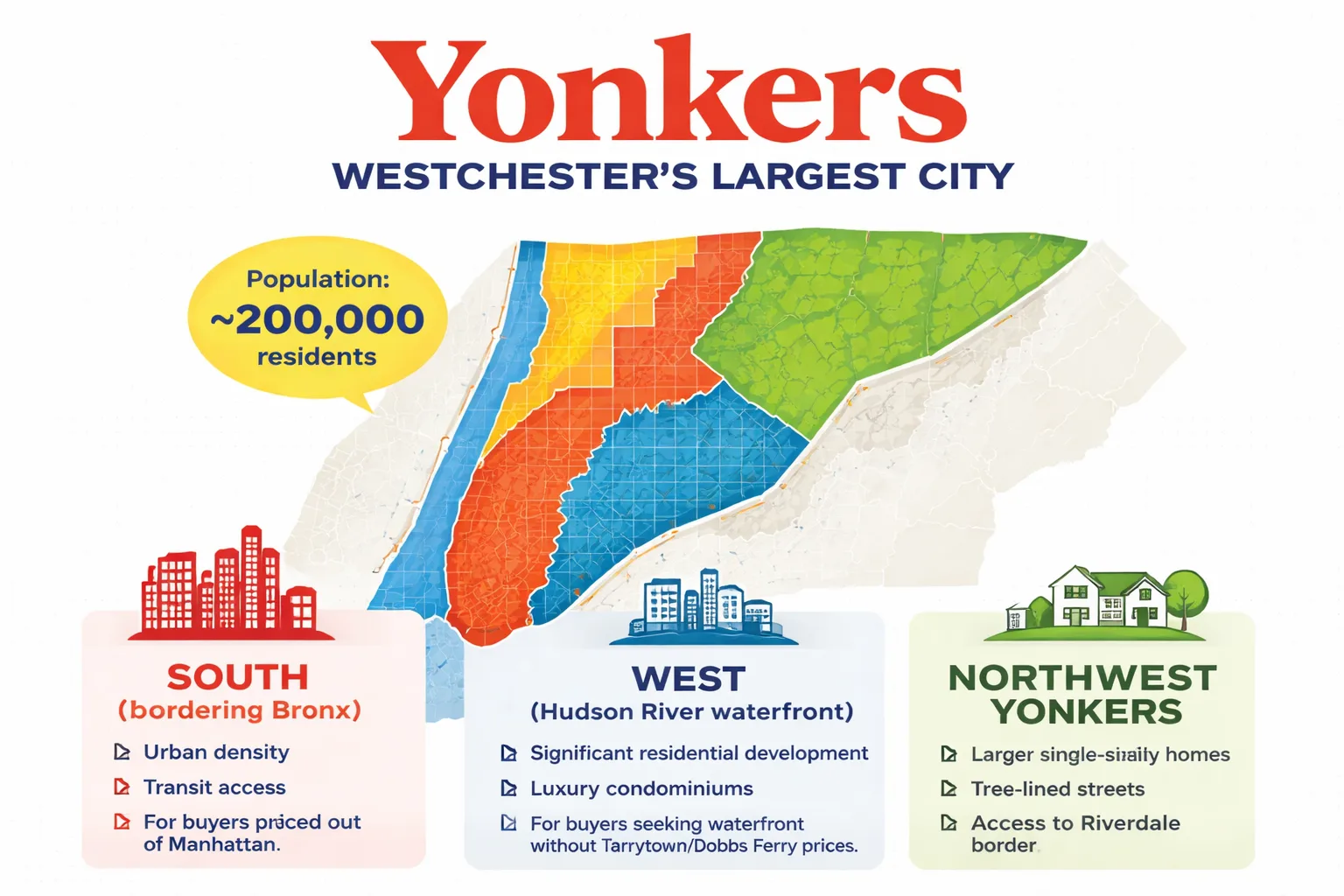
Yonkers is Westchester County's largest city by population, with roughly 200,000 residents spread across neighborhoods that vary dramatically in character, price point, and buyer profile. The city borders the Riverdale section of the Bronx to the south, creating a natural transition zone for buyers priced out of Manhattan but seeking urban density and transit access. To the west, the Hudson River waterfront has seen significant residential development, including luxury condominium projects that attract buyers who want waterfront real estate without paying Tarrytown or Dobbs Ferry prices.
The neighborhood breakdown matters enormously for any agent working this market:
Northwest Yonkers attracts buyers seeking larger single-family homes, tree-lined streets, and access to the Riverdale border. Price points here range from $500,000 for modest colonials to $1.5 million-plus for renovated properties with Hudson River views. The buyer profile skews toward families prioritizing school districts and space. Streets like Midland Avenue, Lawrence Street, and the areas near Trevor Park attract buyers who want suburban feel with urban proximity. The housing stock includes pre-war colonials, Tudor revivals, and mid-century split-levels, each with different maintenance profiles and renovation costs that a competent agent will flag.
Downtown Yonkers has undergone substantial redevelopment, with new transit-oriented construction near the Yonkers Metro-North station. Condo prices here are competitive with parts of Jersey City and Long Island City, drawing younger commuters and investors. Rental demand is strong, which makes downtown condos attractive for buyers considering investment property opportunities. Projects like iPark on the former Otis Elevator site and the Chicken Island redevelopment have transformed the downtown landscape, bringing hundreds of new residential units online. These developments offer modern amenities (gyms, doormen, rooftop decks) that older Yonkers housing stock lacks, but they also carry common charges and potential assessments that buyers must factor into their carrying cost calculations.
Central Park Avenue (Route 100) functions as Yonkers' commercial spine, lined with co-op buildings, retail, and restaurants. This corridor offers the most affordable entry points into the Yonkers market, with one-bedroom co-ops sometimes available below $200,000. The trade-off is co-op board scrutiny and higher monthly maintenance charges that can exceed $1,000 per month for modest units. Buyers focused on affordability must understand that a $180,000 co-op with $1,200 monthly maintenance has a total carrying cost closer to what a $350,000 condo with $400 monthly common charges would require. The agent's job is to translate these numbers so the buyer sees the real cost, not just the sticker price.
The buyer profiles most active in Yonkers during 2026 reflect broader regional trends. Manhattan commuters priced out of Brooklyn and Queens are looking north. International buyers, particularly from Chinese-speaking communities, are exploring Yonkers as an alternative to Fort Lee and Edgewater, where prices have risen sharply. Investors are targeting downtown condos and multi-family properties near transit for rental income. Each profile requires different agent expertise. A buyer seeking a luxury waterfront condo needs an agent who understands new construction developer negotiations. A buyer seeking a co-op on Central Avenue needs an agent who can navigate board packages. These are not interchangeable skill sets.
How to Choose the Right Agent for Yonkers Real Estate
The single biggest mistake buyers and sellers make in Yonkers is selecting an agent based on a friend's recommendation or a shared language without independently verifying the agent's transaction history in the specific neighborhood and property type being pursued.
This happens frequently. A buyer relocating from Manhattan asks a colleague for a referral. The referred agent has done 30 transactions in lower Westchester but zero in Yonkers. The agent does not know which Yonkers co-op boards are notoriously strict. They cannot distinguish between a fairly priced listing on Waldo Avenue and an overpriced one on nearby Bronxville Road. The buyer overpays or loses the property to a better-represented competing offer.
The vetting checklist should be ruthless and specific:
1. Verify local transaction history. Ask the agent to show you their last five closed transactions in Yonkers. Not Westchester generally. Yonkers specifically. If they cannot produce five recent Yonkers closings, they are learning on your dime. The New York State Department of State licenses real estate professionals and maintains a public database where anyone can verify an agent's license status and brokerage affiliation. Check it.
2. Test co-op and condo expertise. If the target property is a co-op, ask the agent to describe the board application process for a specific Yonkers building. A competent agent will know which buildings require interviews, what financial ratios the boards expect, and how long approval typically takes. Vague answers signal inexperience.
3. Assess bilingual capability if relevant. For buyers from Chinese-speaking communities, bilingual English-Chinese service is not a luxury. It is a functional necessity for understanding contract terms, negotiation nuances, and legal obligations. Word-of-mouth recommendations within WeChat groups are common but insufficient. Verify the agent's professional licensing and transaction history independently, regardless of community referrals.
4. Evaluate market analysis skills. Ask the agent to walk through a comparable market analysis for a specific Yonkers property. They should pull active, pending, and sold comparables from the past 90 days, adjust for differences in condition and location, and arrive at a defensible value range. If the agent defaults to Zillow estimates or cannot explain their methodology, walk away.
5. Check for dual agency disclosures. Understand before signing any agreement whether the agent or their brokerage might represent both sides. In New York, buyer agency agreements are now subject to enhanced disclosure requirements. Read every clause. Understand what you are agreeing to before committing.
The cost of choosing wrong is not theoretical. Buyers have overpaid by $40,000 or more on Yonkers properties because their agent failed to pull accurate comparables or missed the optimal timing for an offer. Sellers have lost months of market exposure because their agent overpriced the listing to win the business, then chased the market down with successive reductions.
A concrete example illustrates the stakes. Consider a buyer targeting a three-bedroom colonial in northwest Yonkers listed at $675,000. The listing has been on the market for 45 days, which in a healthy market signals possible overpricing. A competent buyer's agent pulls comparable sold properties from the past six months within a half-mile radius and finds that similar colonials in similar condition have closed between $610,000 and $635,000. The agent advises an opening offer of $615,000 with inspection contingencies and a mortgage commitment deadline. The seller counters at $645,000. The buyer accepts at $630,000. An unrepresented buyer, or a buyer with an inexperienced agent, might have offered full asking price or close to it, overpaying by $45,000. On a 30-year mortgage at current rates, that $45,000 translates to roughly $250 per month in additional payments, or $90,000 over the life of the loan. The agent's commission, paid by the seller, cost the buyer nothing. The agent's expertise saved the buyer $45,000 in purchase price and $90,000 in lifetime interest.
Yonkers vs. Nearby NJ Markets: Which Side of the River Makes Sense?
Cross-border comparison is where this conversation gets practical for Manhattan commuters and investors weighing options on both sides of the Hudson.
Yonkers, Fort Lee, Edgewater, and Englewood all serve a similar buyer profile: professionals who work in Manhattan, want a reasonable commute, and seek more space than NYC prices allow. But the financial and lifestyle trade-offs differ in ways that matter.
Commute times are deceptively similar on paper but different in practice. Yonkers offers Metro-North service to Grand Central in approximately 30 to 35 minutes. Fort Lee and Edgewater rely on bus service to the Port Authority, which can take 40 to 60 minutes depending on traffic and time of day. Englewood offers bus routes plus proximity to the Tappan Zee Bridge for reverse commutes. The reliability differential matters. Metro-North runs on a fixed schedule. Bus traffic across the George Washington Bridge is unpredictable.
Property tax burden is the comparison that catches buyers off guard. New Jersey has the highest property taxes in the nation, and Bergen County towns like Fort Lee and Englewood carry substantial tax loads. A $800,000 home in Fort Lee may carry $14,000 to $18,000 in annual property taxes. A comparably priced home in Yonkers may carry $10,000 to $13,000. That $3,000 to $5,000 annual difference compounds over a holding period. For buyers evaluating NJ property tax rates by town, the numbers are eye-opening.
Price per square foot favors Yonkers for single-family homes but can favor NJ for luxury condos. Downtown Yonkers condos are competitively priced against new construction in Edgewater, though NJ waterfront developments often offer more amenities. Buyers seeking luxury waterfront real estate should compare specific buildings rather than relying on borough-wide averages.
Co-op vs. condo availability differs significantly. Yonkers has substantial co-op inventory, which lowers entry prices but introduces board approval risk. Fort Lee also has co-ops, but the NJ side has more condo-heavy developments, particularly in Edgewater and Jersey City. Buyers who want to avoid board scrutiny entirely should lean toward condo markets.
The table below summarizes the key trade-offs:
| Factor | Yonkers, NY | Fort Lee, NJ | Edgewater, NJ | Englewood, NJ |
| Typical Manhattan commute | 30-35 min (Metro-North) | 40-60 min (bus) | 40-55 min (bus/ferry) | 45-60 min (bus) |
| Median home price (approx.) | $580K-$620K | $650K-$700K | $550K-$600K | $600K-$680K |
| Property tax on $800K home | $10K-$13K | $14K-$18K | $12K-$16K | $15K-$20K |
| Dominant property type | Single-family + co-ops | Condos + single-family | Luxury condos | Single-family |
| Co-op board risk | Moderate to high | Moderate | Low (mostly condos) | Low |
For buyers actively weighing both sides, the NJ home buying process differs from New York's in several structural ways, including attorney review periods and contract contingencies. New Jersey uses a three-day attorney review period unique to the state. New York does not. Understanding these procedural differences is essential for anyone considering properties on both sides of the river.
How Does Agent Licensing Differ Between NY and NJ?
A real estate agent licensed in New York cannot legally represent clients in New Jersey transactions, and vice versa. This sounds obvious, but it trips up cross-border buyers constantly.
An agent with a NY real estate agent license can show and sell Yonkers properties. An agent with a nj real estate agent license can handle Fort Lee, Edgewater, and Englewood transactions. Some agents hold licenses in both states, which eliminates the need for referrals when a buyer is exploring options on both sides of the Hudson. This dual-licensure is particularly valuable for Manhattan commuters who are genuinely undecided between Yonkers and Bergen County.
For buyers specifically seeking an agent who can operate across both markets, verifying dual licensure is straightforward. Both New York and New Jersey maintain online license verification databases through their respective state real estate commissions. Ask the agent for their license numbers in both states and verify them independently.
The practical advantage of a dual-licensed agent extends beyond convenience. When a buyer is comparing a Yonkers co-op to a Fort Lee condo, the same agent can provide a true apples-to-apples analysis of total carrying costs, commute trade-offs, and resale potential. Two separate agents, each advocating for their own market, will naturally bias the comparison toward the side that pays their commission.
The licensing process itself differs between the two states in ways that affect agent competency. New York requires 77 hours of pre-licensing education and a passing score on both the national and state portions of the licensing exam. New Jersey requires 75 hours of pre-licensing education and a similar exam structure. Both states require continuing education for license renewal. However, the substantive content differs. New York coursework emphasizes co-op transactions, which are rare in New Jersey. New Jersey coursework emphasizes the attorney review period and the state's unique disclosure requirements. An agent licensed in only one state will have formal training gaps for the other state's transaction types. Dual-licensed agents have completed both curricula, which gives them a structural knowledge advantage when advising cross-border buyers.
When Does Skipping an Agent Actually Make Sense?
Rarely. That is the honest answer.
The contrarian argument goes like this: in the age of Zillow, StreetEasy, and Redfin, buyers and sellers have access to the same listing data as agents. Why pay 5% to 6% in commission for information that is publicly available?
This argument fails on multiple levels. Listing data is not the same as market intelligence. Zillow's Zestimate has a median error rate that can swing tens of thousands of dollars in either direction. StreetEasy shows what is listed, not what comparable properties actually sold for after accounting for seller concessions, closing cost credits, and post-inspection price renegotiations. The comparable sales data that agents pull from the MLS includes pending sales and sold data that public portals do not fully capture.
The scenarios where skipping an agent might make sense are narrow. A buyer purchasing new construction directly from a developer might negotiate without buyer representation, though developers' sales agents represent the developer's interests, not the buyer's. A seller with extensive real estate experience who has priced dozens of properties might consider a flat-fee MLS listing service to gain exposure while handling showings and negotiations personally. Even in these cases, the savings rarely justify the risk for non-professionals.
For co-op transactions in Yonkers, skipping an agent is effectively impossible. Co-op boards require a buyer's agent to submit the board package, attend the interview (in some cases), and serve as a point of contact for the managing agent. A buyer attempting to purchase a co-op without representation will find that managing agents and listing brokers simply will not engage.
The financial math also favors using an agent. On the buyer side, the seller typically pays both the listing and buyer agent commissions in New York transactions. The buyer's representation is, in effect, already paid for. Declining buyer representation does not reduce the purchase price. It simply leaves the buyer unrepresented in a transaction where the other side has professional advocacy.
A specific risk for unrepresented Yonkers buyers involves the contract itself. New York real estate contracts are prepared by attorneys, but the terms of the deal (price, contingencies, deadlines, included fixtures) are negotiated by the agent before the attorney drafts the contract. A buyer without an agent may accept verbal commitments from the listing agent that never make it into the written contract. The listing agent represents the seller. Any promise the listing agent makes to an unrepresented buyer carries no legal weight unless it appears in the contract. An experienced buyer's agent ensures that every negotiated term, from the inclusion of the dining room chandelier to the seller's agreement to repair the roof, is documented in the contract rider before the attorney review period begins.
What Should You Expect to Pay an Agent in Yonkers?
Commission structures in Yonkers follow New York State norms, with some variation by property type and transaction complexity.
For residential sales, the total commission rate typically ranges from 5% to 6% of the sale price, according to commission data aggregated by Coursera. This commission is paid by the seller at closing and split between the listing broker and the buyer's broker. On a $600,000 Yonkers home sale at 5.5% commission, the total commission is $33,000, with $16,500 going to each side (before the broker's own split with the agent).
For buyers, the key financial consideration is not commission (which the seller pays) but the broader transaction costs. New York closing costs for buyers include title insurance, mortgage recording tax, appraisal fees, and attorney fees. These costs typically run 2% to 4% of the purchase price. Understanding the full title fees and closing costs picture before making an offer prevents budget shocks at the closing table.
For luxury transactions, commission rates may be negotiable below 5% on higher-priced properties, particularly above $1.5 million. However, lower commission rates can reduce the incentive for buyer agents to show the property, potentially limiting the buyer pool. Sellers considering commission reductions should weigh the savings against reduced market exposure.
Commercial real estate transactions operate on different fee structures. Commercial brokers may charge a percentage of the sale price (typically 4% to 6%), a flat fee, or an hourly rate for advisory services. Investors exploring commercial property investment opportunities in the Yonkers market should clarify fee structures before engaging a broker.
Rental transactions in Yonkers typically involve a broker fee equal to one month's rent, paid by the tenant, though this varies by listing. Some landlords offer to pay the broker fee to attract tenants in softer rental markets.
The commission conversation has shifted following the NAR settlement that took effect in 2024. The settlement decoupled listing and buyer agent commissions on MLS listings, meaning sellers are no longer required to offer compensation to buyer agents through the MLS. In practice, most Yonkers sellers continue to offer buyer agent compensation to maintain market exposure, but the amount is now negotiable rather than standardized. Buyers should discuss commission expectations with their agent at the outset of the relationship. The buyer agency agreement, now required in New York, specifies the buyer's agent's compensation and whether the buyer is responsible for any gap between what the seller offers and what the agent charges.
What Are the Legal Risks of Using the Wrong Agent in Yonkers?
New York real estate law is unforgiving, and an agent who does not understand the procedural requirements can expose clients to financial losses that dwarf any commission savings.
New York requires real estate attorneys for all residential transactions. The agent and the attorney work in tandem, but their roles are distinct. The agent negotiates the business terms (price, contingencies, timeline). The attorney drafts and reviews the contract, examines the title commitment, and manages the closing. An agent who attempts to give legal advice, or who fails to flag issues that require attorney attention, is committing malpractice.
Specific legal risks in Yonkers transactions include:
Title defects. Yonkers has older housing stock, and title issues are common. Unreleased mortgages from prior owners, mechanic's liens from incomplete renovation work, and boundary disputes from decades-old surveys can all delay or kill a transaction. The agent's role is to ensure the title commitment is ordered early and to flag any exceptions listed on the title report for the attorney's review.
Property disclosure obligations. New York requires sellers to provide a Property Condition Disclosure Statement or a $500 credit to the buyer in lieu of the disclosure. An agent who fails to ensure this requirement is met exposes the seller to liability.
Fair housing compliance. Yonkers is a diverse city, and fair housing violations carry severe penalties. Agents must not steer buyers toward or away from neighborhoods based on race, national origin, familial status, or any other protected class. An agent who says "you would feel more comfortable in this area" may be violating federal and state fair housing laws. Competent agents provide objective information about neighborhoods and let buyers decide.
Escrow handling. Earnest money deposits in New York are typically held by the listing broker's escrow account or the seller's attorney. An agent who mishandles escrow funds, or who fails to ensure the deposit is properly receipted and held, exposes both the buyer and the brokerage to financial risk.
For buyers from Chinese-speaking communities, the legal risks are amplified by language barriers. Contract terms that seem standard to native English speakers can be opaque to buyers working in a second language. An agent who provides bilingual service must accurately translate not just the words but the legal implications. A mistranslated contingency clause can cost a buyer their entire earnest money deposit. This is why bilingual capability, when relevant, is not a convenience but a risk mitigation tool.
How Judy Zhou Serves Buyers and Investors in the Yonkers-NJ Corridor
For buyers and investors navigating the Yonkers-to-New Jersey corridor, having a single point of contact who understands both markets is not a convenience. It is a strategic advantage.
Judy Zhou is a licensed Realtor® with Keller Williams Town Life Realty in Tenafly, NJ, with active licenses in both New York and New Jersey. Her practice spans luxury homes, investment properties, and commercial real estate across both states, with over $35 million in sales volume. She offers bilingual English-Chinese service, which is particularly relevant for international buyers and Chinese-American investors exploring Westchester County homes for sale alongside Bergen County options.
The cross-market expertise matters in practical terms. A buyer weighing a downtown Yonkers condo against a new construction unit in Fort Lee can get a single, unbiased comparison from an agent who has transacted in both markets. The analysis includes not just price and commute but property tax implications, co-op vs. condo structures, school district assignments, and resale trajectory. Two separate agents, each licensed in only one state, cannot provide this level of integrated analysis.
Judy's background includes recognition at Coldwell Banker, where she earned the International President's Elite (2024) and International Diamond Society (2025) awards before joining Keller Williams. Her transaction experience covers the property types most relevant to Yonkers and NJ corridor buyers: single-family homes, condos, co-ops, multi-family investment properties, and commercial real estate.
For investors specifically, the 2026 New Jersey housing market outlook and Yonkers market trends point toward continued demand from Manhattan commuters priced out of NYC proper. Investors evaluating rental properties near transit, whether in downtown Yonkers or Bergen County transit-adjacent towns, benefit from working with an agent who can analyze cash flow projections, tax burdens, and rental demand across both markets simultaneously.
The bilingual capability addresses a specific gap in the market. Many Chinese-speaking buyers rely on community referrals and WeChat groups to find agents, which can work but carries risks when the referred agent lacks deep local expertise. Judy's approach combines community connection with verifiable credentials, dual-state licensure, and a transaction track record that buyers can independently verify through state licensing databases.
For buyers considering new condo developments near me in either the Yonkers or NJ markets, having an agent who can evaluate developer reputation, assess construction quality, and negotiate developer incentives is essential. New construction transactions involve different contracts, different timelines, and different risks than resale purchases. An agent who understands both sides of the river can identify which developments offer genuine value and which are priced above market.
The investment real estate agency perspective also matters for buyers considering multi-family properties in Yonkers. Two-family and three-family homes near transit stops can generate rental income that offsets carrying costs, but the financial analysis requires understanding Yonkers rent levels, vacancy rates, and maintenance costs. An agent with investment property experience can build a pro forma that reflects reality, not optimism.
The Bottom Line on Yonkers Real Estate Agents
A real estate agent yonkers ny is not a luxury. For most buyers and sellers in this market, professional representation is the difference between a transaction that builds wealth and one that erodes it.
The Yonkers market rewards preparation and punishes shortcuts. Co-op boards reject unprepared buyers. Listing agents exploit unrepresented buyers. Property-specific issues, from shared easements to unreleased liens to flood zone designations, surface during due diligence and require an agent who knows how to respond. The agent's job is not to open doors. It is to protect the client's financial interests through a process that is legally complex, financially significant, and emotionally taxing.
Choose an agent with verified Yonkers transaction history, demonstrated co-op and condo expertise, and the licensing breadth to support cross-border comparison if the search extends to New Jersey. Verify credentials independently. Test market knowledge before signing anything. And understand that the commission, in most transactions, is already built into the price. Declining representation does not save money. It simply removes the advocate who would have protected it.
The right real estate agent in Yonkers is an investment in outcome quality. The wrong one is a liability. The difference is measurable in tens of thousands of dollars and months of avoidable stress.
FAQ
Can a real estate agent licensed in NJ show properties in Yonkers, NY?
No. New York and New Jersey require separate real estate licenses. An agent licensed only in New Jersey cannot legally show, list, or represent clients in Yonkers transactions. Buyers exploring both markets should work with a dual-licensed agent or accept that they will need separate representation on each side of the Hudson.
How long does a typical Yonkers home purchase take from offer to closing?
A typical Yonkers home purchase takes 45 to 75 days from accepted offer to closing, depending on financing, inspection outcomes, and property type. Co-op transactions take longer due to board package preparation and review, often extending to 60 to 90 days. Cash transactions can close in 30 days or less.
Are Yonkers co-op boards as strict as Manhattan co-op boards?
Yonkers co-op boards vary by building but are generally less stringent than prime Manhattan co-ops. However, they still require financial disclosures, reference letters, and in some cases interviews. Buyers should expect to provide two years of tax returns, proof of assets, and personal and professional references. A competent agent will know the specific requirements for each building.
What is the difference between a real estate agent and a Realtor® in Yonkers?
A real estate agent is licensed by the state to represent buyers and sellers. A Realtor® is a licensed agent who is also a member of the National Association of Realtors and bound by its Code of Ethics. All Realtors® are agents, but not all agents are Realtors®. The designation indicates additional professional standards and ethical obligations.
Should I use the same agent to buy in Yonkers and sell in NJ?
If the agent holds licenses in both New York and New Jersey, yes. A dual-licensed agent can coordinate simultaneous transactions, manage timing dependencies, and provide integrated financial analysis. If the agent is licensed in only one state, they will need to refer the other transaction to a colleague, which adds a layer of separation between the client and the transaction.
What questions should I ask a Yonkers listing agent before making an offer?
Ask about the seller's timeline, whether there are competing offers, how long the property has been listed, whether there have been price reductions, and what the co-op or condo board requirements are if applicable. Also ask about any known issues with the property, pending assessments, or litigation involving the building or HOA.
About the Author
Judy Zhou, Keller Williams Realtor®
Judy Zhou is a Realtor® with Keller Williams Town Life Realty in Tenafly, NJ, serving New Jersey and New York with $35M+ in sales volume. Licensed in both NJ and NY, she specializes in luxury homes, investment properties, and commercial real estate, offering seamless bilingual English-Chinese service. Before joining Keller Williams, she earned Coldwell Banker's International President's Elite (2024) and International Diamond Society (2025) awards.
Get a free cross-market consultation with a dual-licensed agent who knows both sides of the Hudson.