What Real Estate Agents in Brooklyn NY Actually Do for Buyers

By Judy Zhou, Coldwell Banker Realtor®
Key Takeaways
- A Brooklyn real estate agent texts three building managers, flags pre-market listings, and pulls six months of comps by 7:48 a.m., work that never appears in commission disclosures.
- NYC’s 70% renter population creates intense competition where unrepresented buyers routinely lose deals they never knew existed.
- Compass controls 80% of Manhattan listings through private channels, with homes selling 34% faster and fetching 4.6% more when accessed via agent networks.
- Buyers without expert representation face documented disadvantages in price discovery and transaction completion in Brooklyn’s fast-moving market.
It's 7:48 on a Wednesday morning. Before most buyers have opened their laptop, a real estate agent in Brooklyn NY has already texted three building managers, flagged a pre-market two-bedroom in Carroll Gardens for a client who's been searching for four months, and pulled the last six months of comparable sales on a Bed-Stuy block her buyer is eyeing. None of this shows up in a commission disclosure. None of it is visible to the buyer. But all of it is the difference between closing and losing in one of the most competitive housing markets in the United States.
Brooklyn's housing market moves faster than almost anywhere in the country, and buyers who attempt to navigate it without a dedicated agent routinely lose deals they didn't even know they were competing for. A skilled real estate agent in Brooklyn NY operates as a data analyst, negotiator, project manager, and local diplomat simultaneously. According to the NYC Comptroller's office, New York City has roughly 1.1 million homeowners, representing about 30% of all households. The remaining 70% rent, which means the competition for every purchaseable unit is intense. Research on information frictions in real estate markets confirms that buyers without expert representation face measurable disadvantages in price discovery and transaction completion. Compass controls roughly 80% of Manhattan's brokerage market and uses a three-stage listing strategy (Private Exclusive, Coming Soon, Public) that the company claims helps homes sell 34% faster and fetch 4.6% more money, according to reporting by the New York Post. That strategy means many listings never reach the public market at all. Without an agent plugged into those private channels, buyers are seeing only a fraction of available inventory.
Why Brooklyn Buyers Need a Local Real Estate Agent
Brooklyn is not a single market. It is a constellation of dozens of micro-markets, each with its own price dynamics, building stock, and buyer profile. A brownstone in Park Slope and a condo in DUMBO might sit ten minutes apart by subway, but they operate under entirely different rules of valuation, financing, and negotiation.
The data is stark. According to the NYC Comptroller's homeowner housing market report, the city's homeownership rate of 30% trails the national average by a wide margin. That gap translates directly into buyer competition: more renters chasing fewer purchaseable units. Brooklyn absorbs a disproportionate share of that pressure because it offers more square footage per dollar than Manhattan while maintaining proximity to the central business district.
A buyer who attempts to self-navigate this market faces three structural disadvantages. First, they lack access to off-market and pre-market inventory. The New York Post reports that Compass's private listing strategy, which has spread across the industry, means a growing share of desirable properties are shown to a curated agent network before they ever appear on StreetEasy or Zillow. Second, Brooklyn's building stock is dominated by co-operatives, a property type that requires board approval, financial scrutiny, and a submission package that can run 100+ pages. Third, bidding wars in neighborhoods like Williamsburg, Crown Heights, and Bed-Stuy frequently involve all-cash offers, escalation clauses, and waiver of contingencies that an unrepresented buyer is unlikely to structure correctly.
The agent's value begins before the first showing. It starts with a financial pre-qualification conversation, a neighborhood strategy session, and a candid assessment of what the buyer's budget will actually purchase in their target areas. That foundational work determines whether the search is realistic or doomed.
Consider the mechanics of a typical Brooklyn bidding war. A two-bedroom condo in Clinton Hill lists at $899,000. Within 48 hours, the listing agent has collected twelve offers. Three are all-cash at or above asking. Two waive the financing contingency entirely. One offers $950,000 with a 40% down payment and a two-week close. The buyer who comes in at asking price with 20% down and a standard mortgage contingency is not in the running. An experienced agent knows this before the showing even happens. They advise the buyer on whether to compete, how to structure the offer to stand out without overpaying, and when to walk away from a deal that has escalated beyond rational valuation. That judgment call is the single most valuable thing an agent provides, and it is impossible to replicate with a Zillow search.
The competitive pressure also varies dramatically by neighborhood and price tier. Entry-level one-bedroom co-ops in neighborhoods like Crown Heights and Prospect Lefferts Gardens see intense competition from first-time buyers using FHA loans, while luxury condos in DUMBO and Brooklyn Heights compete for a smaller pool of high-net-worth buyers. The agent's strategy shifts accordingly. For the entry-level buyer, speed and offer cleanliness matter most. For the luxury buyer, discretion, building reputation, and long-term resale analysis take priority.
What Does a Brooklyn Real Estate Agent Actually Do?
The day-to-day work of a buyer's agent in Brooklyn falls into six distinct phases, each with specific deliverables and decision points. Here is what actually happens behind the scenes.
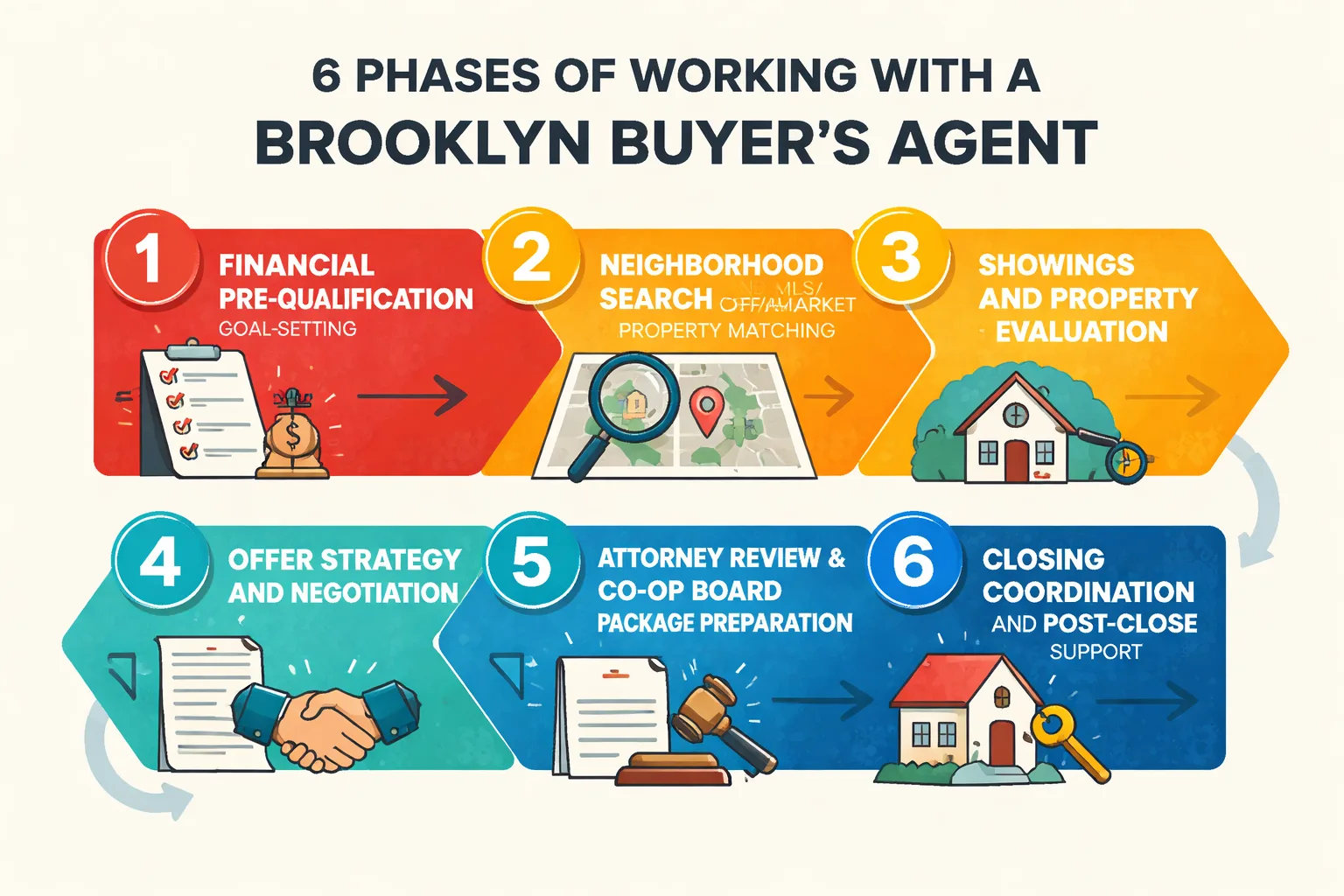
Phase 1: Financial Strategy and Search Parameters
Before touring a single property, the agent conducts a pre-search consultation that establishes the buyer's purchasing power, financing timeline, and non-negotiable criteria. This is not a casual conversation. The agent reviews the buyer's pre-approval letter, discusses down payment sources, flags any financial red flags that could derail a co-op board application, and maps the buyer's priorities against neighborhood realities.
A buyer who wants a two-bedroom under $800,000 with outdoor space in Park Slope needs to hear, immediately, that the budget is more realistic for a one-bedroom or a different neighborhood. That honesty saves months of wasted showings and emotional burnout.
This phase also includes a candid conversation about total purchasing capacity, not just the sticker price. The agent calculates the full cost of ownership: mortgage principal and interest, property taxes, common charges or maintenance fees, insurance, and a reserve fund for repairs. In Brooklyn, property taxes vary significantly between condo and co-op structures. Condos are taxed as individual units, while co-op shareholders pay maintenance that includes the building's underlying property tax. A $700,000 co-op with $1,200 monthly maintenance may actually cost more per month than an $800,000 condo with $400 in common charges and separate tax bills. The agent runs these numbers before the first showing so the buyer understands the true monthly carrying cost, not just the list price.
Phase 2: Property Sourcing and Market Intelligence
Agents access the Real Estate Board of New York's (REBNY) RLS system, which feeds listings to the major portals, but the real value is in what doesn't appear online. Pre-market listings, pocket listings, and private exclusives circulate through agent networks before public release. An experienced agent texts, calls, and meets with listing agents across the borough to surface opportunities before they hit the open market.
The agent also pulls comparable sales data for any property the buyer is seriously considering. This is not a Zillow estimate. It is a line-item analysis of recent sales within a tight radius, adjusted for square footage, condition, floor level, and building type. The goal is to determine whether the asking price reflects market reality or aspirational seller optimism.
Consider how this works in practice. A buyer is interested in a one-bedroom co-op in a pre-war building on Eastern Parkway. The asking price is $525,000. The agent pulls the last 12 months of sales in that building and within a three-block radius. They find that similar one-bedrooms with the same square footage and floor level have sold between $475,000 and $510,000. The unit in question has been renovated, but the renovation quality is mid-grade, not luxury. The agent advises the buyer that an offer of $490,000 is defensible based on the comps, and that the asking price reflects a 5-10% premium that the seller is unlikely to achieve in the current market. That analysis takes 30 minutes to produce and saves the buyer $35,000. No algorithm does this.
Phase 3: Showings and Property Evaluation
Brooklyn's building stock includes co-ops, condos, townhouses, brownstones, and new developments. Each property type demands a different evaluation lens. A co-op buyer needs to understand the building's financial health, the underlying mortgage, maintenance fee trends, and flip tax policies. A condo buyer needs to review the offering plan, sponsor unit percentages, and any pending litigation. A brownstone buyer needs a structural assessment that goes far beyond a standard home inspection.
The agent accompanies the buyer to showings, asks the listing agent pointed questions about the property's history, and identifies red flags the buyer would miss. Water stains in a basement. A recently patched ceiling. A building with a high percentage of sponsor rentals. These are signals, not deal-breakers, but they inform the offer strategy.
For co-op buildings specifically, the agent investigates the building's financial statements. What is the underlying mortgage balance and when does it mature? Has the maintenance increased in the past three years, and if so, by what percentage? Does the building have a reserve fund, and is it adequate for planned repairs? A building with a thin reserve fund and a maturing mortgage may be facing a maintenance increase or special assessment in the near future. That information directly affects the buyer's long-term cost of ownership and should be factored into the offer price.
For new construction condos, the agent reviews the offering plan's sponsor disclosure pages. What percentage of units has the sponsor sold? If the sponsor still controls more than 50% of the units, the buyer is entering a building where the sponsor effectively controls the board, and the buyer's interests may not align with the sponsor's. Are there pending lawsuits against the sponsor or the building? What warranties does the developer provide, and for how long? These questions are not hypothetical. They are standard due diligence for any new construction purchase, and an agent who has reviewed dozens of offering plans knows exactly where to look.
Phase 4: Offer Construction and Negotiation
This is where the agent earns their commission. In a competitive Brooklyn market, an offer is not just a number. It is a package that includes price, down payment amount, financing contingencies, inspection contingencies, proposed closing date, and a personal cover letter to the seller.
The agent advises on which contingencies to keep and which to waive, based on the competitive landscape. They contact the listing agent to understand the seller's priorities. Some sellers want the highest price. Others want a fast close. Others want a buyer who will sail through a co-op board process without drama. The agent tailors the offer to the seller's actual motivation, not a generic template.
In multiple-offer situations, the agent's relationship with the listing agent can be the deciding factor. Listing agents prefer to work with buyer's agents they trust to deliver clean deals. That trust is built over years of transactions, and an unrepresented buyer has zero access to it.
The offer package itself is a strategic document. The agent includes a pre-approval letter from a reputable lender (not a generic online pre-qualification), a proof of funds letter for the down payment, and a cover letter that introduces the buyer without being overly emotional. The agent also specifies a proposed closing timeline that aligns with the seller's needs. If the seller has not yet found their next home, a flexible closing date may be more valuable to them than a higher price. The agent uncovers this information through direct conversation with the listing agent, then structures the offer accordingly.
Phase 5: Due Diligence and Attorney Coordination
New York is an attorney state. Every real estate transaction involves a buyer's attorney, a seller's attorney, and a contract negotiation that typically unfolds over 5-10 business days. The agent coordinates with the buyer's attorney to ensure the contract reflects the negotiated terms, that due diligence items (inspection, title search, co-op financial review) are completed within the attorney review period, and that any issues surface before the contract is binding.
For co-op purchases, the agent also manages the board package preparation. This is a comprehensive financial disclosure that includes two years of tax returns, bank statements, reference letters, employment verification, and a detailed net worth statement. The agent reviews every page before submission because a single inconsistency can trigger a board rejection.
The board package is where deals silently die. A buyer submits tax returns that show a deduction the board finds unusual. A bank statement shows a large unexplained deposit. A reference letter is from a personal friend rather than a professional contact. The board requests an interview, and the buyer arrives unprepared for questions about their renovation plans, their pet policy, or their reasons for choosing the building. The agent prepares the buyer for every one of these scenarios. They review the package for consistency, coach the buyer on interview questions, and ensure that the financial narrative is coherent and defensible.
Phase 6: Closing and Post-Close Support
The agent coordinates the final walk-through, confirms that the seller has completed any agreed-upon repairs, and verifies that the closing figures match the contract terms. They attend the closing, which in New York involves a marathon session with attorneys, title company representatives, and the lender's attorney. After closing, the agent remains a resource for utility transfers, renovation contractor referrals, and neighborhood integration.
How does buying in Brooklyn differ from Manhattan?
Buyers who have purchased in Manhattan often assume the Brooklyn process is identical. It is not. The differences are structural, financial, and procedural.
Manhattan's market is dominated by co-ops and condos in large buildings managed by professional management companies. Brooklyn's market is far more fragmented. It includes small co-op buildings with self-managed boards, converted townhouses with unique structural issues, and new condo developments with varying levels of sponsor involvement. Each transaction type requires a different playbook.
Co-op Board Requirements
Brooklyn co-op boards tend to be smaller and more personal than Manhattan boards, but that does not mean they are easier. A small Brooklyn co-op board may have five members who all live in the building and have strong opinions about who moves in. The financial requirements can be idiosyncratic. Some boards require 25% down. Others want 30%. Some require post-closing liquidity equal to two years of maintenance. Others want three years. The agent knows these requirements before the buyer wastes time on a building they cannot qualify for.
The interview process also differs. Manhattan co-op boards often conduct formal interviews with standardized questions. Brooklyn boards may conduct a more conversational interview, sometimes over dinner or in a shareholder's apartment. This informal setting can actually be harder to navigate because the board is evaluating the buyer's social fit, not just their financial qualifications. The agent prepares the buyer for both formats and advises on how to present themselves authentically without oversharing.
Closing Costs and Transfer Taxes
Brooklyn closing costs differ from Manhattan in several practical ways. The transfer tax structure is the same (1% for properties under $1 million, 1.425% above), but the practical costs of title insurance, attorney fees, and building-specific fees vary by neighborhood and building type. New condo developments in Brooklyn often charge sponsor fees that can add $5,000 to $15,000 to closing costs, and these are non-negotiable. Buyers should understand these costs before making an offer, not at the closing table. For a detailed breakdown, the Title Fees Closing Costs guide covers the specific line items buyers should expect.
The mansion tax also applies in Brooklyn. Any residential property sold at $1 million or above triggers an additional 1% mansion tax, paid by the buyer. For a $1.2 million brownstone, that is $12,000 added to closing costs. Many first-time Brooklyn buyers are unaware of this tax until the attorney presents the closing statement. The agent should flag this cost during the search phase so the buyer budgets for it.
Neighborhood Expertise That Actually Matters
An agent who knows Brooklyn understands the difference between north and south Park Slope, why Clinton Hill and Fort Greene trade at different price points despite sharing a border, and which blocks in Bed-Stuy are experiencing genuine renovation activity versus speculative pricing. This is not trivia. It directly affects the buyer's investment.
Consider waterfront luxury real estate in Brooklyn. Neighborhoods like DUMBO, Brooklyn Heights, and parts of Williamsburg command premium prices for harbor and skyline views, but the building stock varies dramatically. A new construction condo with full amenities in DUMBO may cost $1,500 per square foot, while a pre-war conversion in Brooklyn Heights with similar views may trade at $1,100 per square foot but carry higher maintenance fees due to aging infrastructure. The agent helps the buyer weigh those trade-offs with real numbers, not marketing brochures.
For buyers considering new construction, the New Condo Developments Near Me resource tracks active projects and their offering plans. Understanding developer reputation and project financials is critical when buying pre-construction, and the New York Real Estate Developers overview provides context on which developers have a track record of delivering on schedule.
Neighborhood expertise also means understanding the trajectory of emerging areas. A buyer looking at properties in Crown Heights should know that the Franklin Avenue corridor has seen sustained commercial growth over the past five years, while blocks further east may still be in earlier stages of transition. The agent helps the buyer distinguish between neighborhoods with genuine momentum and those where prices have been inflated by speculative flipping. This distinction affects both the purchase price and the long-term appreciation potential.
For investors evaluating Brooklyn properties alongside opportunities across the river, the New Jersey Real Estate Investment guide provides a framework for comparing cash flow and appreciation potential between the two markets. Brooklyn's rental market is strong, but property taxes and acquisition costs are higher than in many New Jersey markets, and the investment analysis should reflect those differences.
How to Choose the Right Real Estate Agent in Brooklyn NY
Not all agents are equal. The barrier to entry for a real estate license is low, and the percentage of agents who have actually closed transactions in Brooklyn's competitive market is smaller than most buyers assume. Selecting the right agent requires a structured interview process, not a referral from a friend who bought a house in New Jersey.
Verify the License and Transaction History
Every agent in New York must hold a valid license issued by the Department of State. Buyers can verify an agent's license online, but license verification only confirms the agent is legally permitted to practice. It says nothing about competence. Ask the agent how many transactions they closed in Brooklyn in the past 12 months, what neighborhoods they primarily work in, and what property types they specialize in. An agent who primarily sells single-family homes in Staten Island may not be the right fit for a co-op purchase in Brooklyn Heights.
The New York State Department of State has also increased enforcement actions against agents who violate fair housing laws. Newsday reported on the state seeking to suspend or revoke licenses of agents cited in housing discrimination probes, marking the first such enforcement action in over 20 years. Buyers should ask whether the agent has any disciplinary history and should verify clean records through the DOS license portal.
For buyers who also hold property interests in New Jersey, working with an agent who holds dual licenses in both NY and NJ can streamline cross-border transactions. The requirements for a real estate agent license nj differ from New York's, and an agent who understands both regulatory frameworks can identify opportunities and pitfalls that a single-state agent would miss. This is particularly relevant for buyers relocating from New Jersey or investors building a portfolio across both states.
Ask the Right Questions
The interview should include these specific questions:
1. How many buyers have you represented in Brooklyn in the past year? 2. What neighborhoods do you know best, and why? 3. How do you access off-market and pre-market inventory? 4. What is your strategy for multiple-offer situations? 5. How do you help buyers prepare for co-op board interviews? 6. Do you have experience with international buyers or bilingual transactions? 7. Can you provide references from at least three Brooklyn buyers you have represented in the past 18 months?
The answers reveal whether the agent has a repeatable process or is improvising. Vague responses like "I know the market really well" are a red flag. The agent should be able to name specific buildings, recent transactions, and current market conditions without hesitation.
Bilingual and International Buyer Experience
Brooklyn's buyer pool is deeply international. Chinese-American, Russian, Caribbean, and Latin American communities represent significant segments of the borough's purchasing power. An agent who offers bilingual services and understands the cultural nuances of international transactions provides measurable value. For Chinese-American buyers, this includes familiarity with cross-border fund transfers, understanding the expectations of family-involved purchasing decisions, and the ability to communicate complex co-op board requirements in Mandarin or Cantonese.
International buyers also face unique financing challenges. Many foreign nationals cannot obtain conventional U.S. mortgages and must structure purchases through entities or pay cash. An agent experienced with these structures can connect the buyer to lenders who specialize in foreign-national loans and attorneys who understand the entity formation process. The agent should also be familiar with FIRPTA (Foreign Investment in Real Property Tax Act) withholding requirements and how they affect the buyer's tax obligations.
Red Flags to Avoid
Three behaviors signal an agent is not qualified to represent a Brooklyn buyer. First, pressure to make an offer before the buyer has reviewed comparable sales data. Second, inability to explain the co-op board process in specific detail. Third, reluctance to provide references from past Brooklyn buyers. Any of these should disqualify the agent.
A fourth red flag is an agent who claims to "specialize in everything." Brooklyn's market is too complex for generalists. An agent who claims expertise in every neighborhood, every property type, and every buyer demographic is likely overstating their capabilities. The best agents are honest about their areas of deep expertise and refer clients to colleagues when a transaction falls outside their lane.
Are you searching for a home in Brooklyn but unsure what your budget can actually buy?
Where This Process Breaks Down
The standard buyer's agent playbook does not work in every Brooklyn scenario. Three situations require a fundamentally different approach.
First, distressed property purchases. When a buyer targets a foreclosure, short sale, or estate sale in Brooklyn, the standard negotiation strategy is irrelevant. These transactions involve banks, probate courts, or estate executors who operate on timelines that have nothing to do with market dynamics. An agent without distressed-property experience will mismanage expectations and likely lose the deal.
Second, new development sponsor-unit purchases. Buying directly from a developer's sales team means the buyer is negotiating against a professional sales operation that has closed hundreds of units in the same building. The developer's sales agents represent the seller, not the buyer. A buyer's agent who has never reviewed an offering plan or negotiated sponsor concessions will fail to identify the hidden costs buried in the purchase agreement.
Third, mixed-use and commercial property purchases. A buyer looking at a mixed-use building with retail space on the ground floor and residential above needs an agent who understands commercial lease analysis, tenant credit evaluation, and the different financing products available for mixed-use properties. Residential agents who dabble in commercial transactions create exposure for their clients. The financial verification process for commercial tenants, lease assignment clauses, and landlord consent requirements are fundamentally different from residential due diligence.
Investment Properties and Rental Analysis in Brooklyn
Many buyers purchasing in Brooklyn are not just looking for a primary residence. They are evaluating the property as an investment, particularly if they plan to rent out a unit or eventually convert the property to a rental. A real estate agent with investment experience provides a layer of analysis that goes beyond the purchase transaction.
The agent should be able to project realistic rental income based on current market rates for comparable units in the neighborhood. This includes understanding the difference between rent-stabilized and free-market units, which has enormous implications for cash flow. A building with rent-stabilized tenants may generate lower monthly income but offers long-term stability, while a free-market building offers higher income potential but carries vacancy risk.
For buyers comparing Brooklyn investment properties to opportunities in New Jersey, the analysis should include property tax differences, rent regulation frameworks, and appreciation trajectories. New Jersey's property tax rates are among the highest in the nation, but acquisition costs are generally lower than Brooklyn's. The Investment Real Estate Agency resource covers the framework for evaluating investment properties across both markets. An agent who understands both sides of the Hudson can help the buyer make an informed decision based on total return, not just purchase price.
Cash flow analysis is particularly important for buyers purchasing multi-family properties in neighborhoods like Bedford-Stuyvesant, Crown Heights, or Bushwick. The agent should provide a pro forma that includes gross rental income, vacancy rate assumptions, operating expenses (taxes, insurance, maintenance, management fees), and debt service. The resulting cash-on-cash return and cap rate are the numbers that determine whether the investment makes sense, not the list price.
For buyers considering luxury condos as investment properties, the analysis shifts. Luxury condos in neighborhoods like DUMBO or Brooklyn Heights may not generate strong rental yields, but they may offer appreciation potential and serve as a store of value for international capital. The agent should be transparent about the trade-off between cash flow and appreciation, and should help the buyer align the purchase with their actual investment objectives.
The Legal and Financial Liaison Role
A Brooklyn real estate transaction involves a web of legal and financial professionals, and the agent serves as the central coordinator. The buyer's attorney handles contract negotiation and due diligence. The lender's attorney handles mortgage documentation. The title company handles title search and insurance. The managing agent provides building financial documents. For co-op purchases, the board and its attorney review the buyer's submission package.
The agent keeps all of these parties aligned on a single timeline. If the attorney review period is three business days, the agent ensures the home inspection is scheduled within that window. If the lender needs updated financial documents before issuing a clear-to-close, the agent coordinates with the buyer to provide them promptly. If the co-op board has scheduled an interview, the agent ensures the buyer's attorney has reviewed the contract and that the lender's commitment letter is in hand.
This coordination role is invisible to the buyer until something goes wrong. A delayed appraisal pushes the closing date. The seller's attorney objects to a contract rider. The co-op board requests additional financial documentation. Each of these issues requires immediate communication between multiple parties, and the agent is the one who manages the resolution. Without an agent, the buyer is left to coordinate between professionals they have never worked with, on a timeline they do not control.
The agent also serves as a buffer between the buyer and the seller. Emotions run high in real estate transactions. A buyer who feels that a seller is being unreasonable may want to walk away from a deal that is still salvageable. A seller who receives a low offer may feel insulted and refuse to counter. The agent manages these emotional dynamics professionally, keeping the transaction on track when direct communication between buyer and seller would derail it.
FAQ: Brooklyn Real Estate Agent Questions Answered
How much does a Brooklyn buyer's agent cost?
In most Brooklyn transactions, the seller pays the commission for both the listing agent and the buyer's agent. Following the 2024 NAR settlement, buyers may be asked to sign a buyer representation agreement that specifies the agent's compensation, but in practice, the seller typically offers a cooperating commission through the MLS. Buyers should clarify this with their agent at the first meeting and review the representation agreement carefully before signing.
Do I need an agent for a Brooklyn co-op purchase?
Technically, no. Practically, it is a bad idea to attempt a co-op purchase without representation. The board package alone requires financial documentation, reference letters, and a net worth statement that must be perfect. A single error can trigger a rejection, and re-submitting a package after a rejection is extremely difficult. The agent also manages the interview preparation, which for some boards is a formal process with specific questions about the buyer's finances, lifestyle, and renovation plans.
Can a New Jersey-based agent help me buy in Brooklyn?
Only if the agent holds a valid New York State real estate license. A New Jersey license does not authorize the agent to practice in New York. However, some agents hold dual licenses in both states. For buyers who are relocating from New Jersey or maintaining residences in both states, a dually licensed agent can provide continuity across the entire transaction. The NJ home buying process differs from New York's in several structural ways, and an agent who understands both can help buyers compare options across the Hudson.
How long does the Brooklyn buying process take?
From the first showing to closing, a Brooklyn purchase typically takes 60 to 90 days for a condo and 90 to 120 days for a co-op. Co-op transactions take longer because the board package preparation, submission, and interview process adds 30 to 45 days. Cash transactions can close faster, sometimes in 30 days, but the due diligence period should not be shortened regardless of financing type.
Should I get pre-approved before contacting an agent?
Yes. A pre-approval letter from a lender is the single most important document a buyer brings to the first conversation. It tells the agent exactly what the buyer can afford, signals to listing agents that the buyer is serious, and is required for any offer submission. Buyers who contact agents without pre-approval will be asked to obtain one before showings begin.
What is the difference between a co-op and a condo in Brooklyn?
A co-op buyer purchases shares in a corporation that owns the building, along with a proprietary lease for their unit. A condo buyer purchases real property, fee simple. Co-ops require board approval and have stricter financial requirements. Condos offer more flexibility, including the ability to rent the unit, but typically cost more per square foot. The agent helps the buyer determine which structure aligns with their financial profile and ownership goals.
The Bottom Line for Brooklyn Buyers
The role of a real estate agent in Brooklyn NY extends far beyond opening doors and forwarding listings. The agent functions as a market analyst, strategic advisor, negotiation specialist, and transaction manager across a process that involves attorneys, lenders, co-op boards, and title companies. In a market where information asymmetry is the norm and off-market inventory represents a growing share of desirable properties, attempting to buy without representation is not a cost-saving measure. It is a competitive disadvantage.
Buyers who want to compete in Brooklyn's 2026 market need an agent with deep neighborhood knowledge, access to pre-market inventory, and the transactional experience to navigate co-op boards, bidding wars, and attorney negotiations. The right agent is not an expense. They are the buyer's most important asset in a market designed to reward preparation and punish improvisation. For buyers also exploring investment opportunities across the river, the New Jersey Real Estate Investment guide provides a complementary analysis of how NJ investment properties compare to Brooklyn's rental market dynamics.
About the Author
Judy Zhou, Coldwell Banker Realtor®
Judy Zhou is a top-ranked Coldwell Banker Realtor® serving New Jersey and New York, recognized in the top 7% of agents internationally with prestigious awards like the International Diamond Society and President's Elite. Licensed in both NJ and NY, she specializes in luxury homes, investment properties, and commercial real estate, offering seamless bilingual English-Chinese service.
Work with a dually licensed NY and NJ agent who knows Brooklyn's neighborhoods, co-op boards, and off-market inventory. Get a free consultation today.