How to Find a Real Estate Agent in NY: 5 Steps That Work

By Judy Zhou, Coldwell Banker Realtor®
Key Takeaways
- Internet leads from Zillow and Realtor.com convert at just 1-2% annually versus 43-44% for expired listings and 38% for FSBO leads, so select agents who source from those higher-yield channels.
- The national average real estate commission is 5-6%, so review exact payment terms and the March 2024 NAR settlement changes before signing any buyer representation agreement.
- New York agents' earnings vary sharply by borough, so verify whether your candidate is a full-time top producer or a part-timer before hiring.
- Define your exact transaction type first, then match it to an agent's specialty such as Manhattan co-ops versus New Jersey commercial lease transfers.
Finding a real estate agent in NY is not the same as finding a good one.
New York's licensing database holds tens of thousands of active licensees, yet the gap between a competent agent and a costly mistake is wider than most buyers realize. A REDX analysis of 2.7 million homeowner leads found that internet leads from Zillow and Realtor.com convert at just 1-2% annually, compared to 43-44% for expired listings and 38% for FSBO leads. The agents who rely on portal lead generation are often the least experienced in actual negotiation. The national average real estate commission sits at 5-6%, according to Coursera's real estate salary guide, but what you pay and what you get varies enormously by agent quality. New York agents' earnings vary significantly by borough, per Colibri Real Estate's market data, which means the agent you hire could be a part-timer or a top producer. The March 2024 NAR settlement changed how buyer representation agreements work, making it essential to understand commission structures before signing anything. This guide walks through five steps to find, vet, and select a real estate agent in NY who actually delivers results.
What do you actually need?
Before searching for a real estate agent in NY, the client needs to know exactly what they are buying, selling, or investing in. This sounds obvious. It is not.
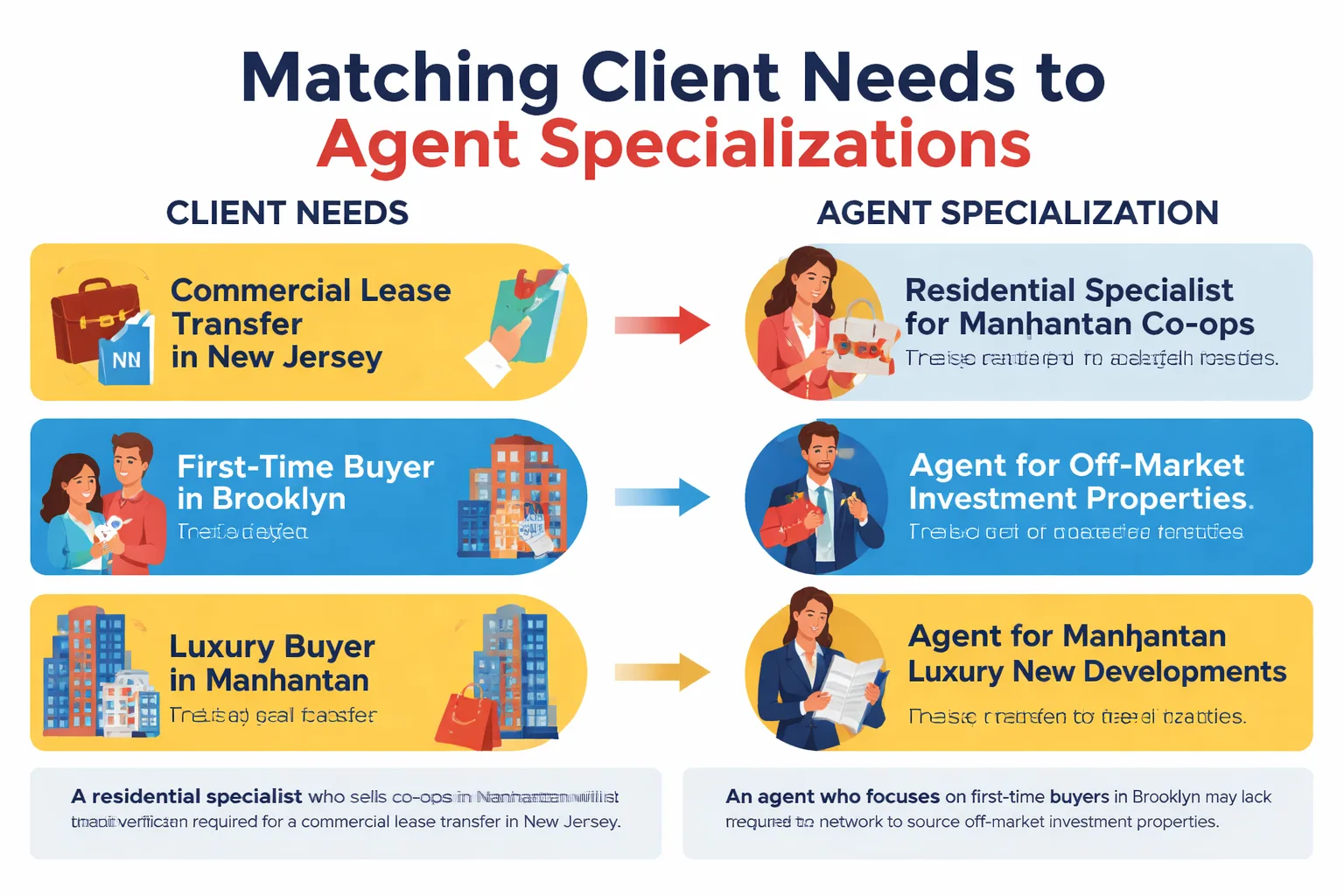
The most common mistake is treating all agents as interchangeable. A residential specialist who sells co-ops in Manhattan will not necessarily understand the financial verification required for a commercial lease transfer in New Jersey. An agent who focuses on first-time buyers in Brooklyn may lack the network to source off-market investment properties. The agent's specialty must match the client's need, or the transaction suffers.
Consider the different specializations within the NY market. Luxury buyers looking at Manhattan apartments need an agent who understands sponsor unit rules, offering plans, and the specific dynamics of new development inventory. The Manhattan luxury market has shifted significantly since the pandemic. For years, new developments were designed as glass boxes optimized for a capital flight thesis, catering to foreign cash buyers who have largely stopped showing up. That has left a glut of inventory that does not resonate with domestic buyers who prioritize livability, storage, and neighborhood integration. An agent who does not understand this shift will waste a client's time on units that are sitting for a reason. The client looking at new condo developments near me needs an agent who can distinguish between a well-designed building and a glass box that will sit on the market.
Investors need a different skill set entirely. New Jersey investment properties require an agent who can analyze cash flow, not just appreciation. Experienced investors on platforms like BiggerPockets consistently preach that cash flow is the defensive play. New investors often come in focused on appreciation potential, swayed by flashy promotional materials, without understanding that without consistent cash flow to cover taxes, maintenance, and vacancies, even a property with great appreciation potential becomes a liability if the market shifts or the owner needs to liquidate quickly. The client exploring New Jersey real estate investment opportunities needs an agent who can model those numbers, not just point to a listing.
Commercial real estate demands yet another specialization. The complexity of commercial leases in NYC is staggering. One restaurant client glossed over maintenance responsibilities in their 10-year lease, assuming the landlord would handle major repairs. The fine print shifted roof and HVAC repairs to the tenant. Within two years, they faced a $20,000 HVAC replacement bill they had not budgeted for. A commercial real estate broker in NYC needs to catch those clauses before signing, not after. The lack of standardization in NYC commercial leases means every single document needs meticulous review. Treating it as just paperwork is a surefire way to encounter significant, unexpected costs.
The client should write down their specific needs before contacting anyone. Buyer or seller. Residential or commercial. Luxury or entry-level. Investment or primary residence. Geographic focus, whether that is Manhattan, Brooklyn, Westchester, or the NJ suburbs. Budget range. Timeline. Bilingual requirements. This document becomes the filter for every agent conversation that follows.
Where to search for licensed agents?
The search starts with the New York Department of State license lookup. This is non-negotiable. Every real estate agent license NY holders possess must be verifiable through the NY DOS eAccessNY system. The lookup confirms the license is active, shows the expiration date, and reveals any disciplinary actions. Searching for a ny real estate agent license should always begin here, not on Zillow.
The difference between a licensed and unlicensed agent is the difference between a protected transaction and financial exposure. The NY DOS database also confirms the brokerage affiliation, which matters because the brokerage (not the individual agent) carries the legal responsibility for the transaction.
Beyond the license lookup, several sources are worth exploring. Brokerage websites provide agent profiles with bios, designations, and recent transactions. Coldwell Banker, Douglas Elliman, Compass, and Corcoran all maintain searchable agent directories for the NY market. These profiles often include designations like CRS (Certified Residential Specialist), ABR (Accredited Buyer Representative), or CCIM (Certified Commercial Investment Member), each indicating additional training in specific areas. The client should look for designations that match their transaction type. An ABR matters for buyers. A CCIM matters for commercial investors. A CRS matters for residential specialists. Designations are not guarantees of competence, but they do indicate the agent has invested in training beyond the minimum 77-hour pre-licensing course.
Referrals remain the highest-converting source. A personal referral from someone who recently completed a similar transaction carries more weight than any online review. The caveat is that the referrer's needs must match the client's needs. A referral for a great first-time buyer agent in Buffalo is not useful if the client is shopping for a luxury condo in Manhattan. The client should ask the referrer specific questions: Would you hire this agent again? Did the agent communicate proactively or only when you reached out? Were there any surprises during the transaction? The answers reveal more than a five-star review.
Online platforms like Zillow and Realtor.com offer agent directories with reviews and transaction history. These can be useful for initial research, but the data has limitations. The REDX analysis of 2.7 million leads found that internet portal leads convert at just 1-2% annually, which suggests that agents who rely heavily on portal lead generation may be less experienced in actual client representation. Reviews on these platforms can also be gamed, with agents incentivizing reviews through closing gifts or discounted services. One Facebook discussion even claimed a 26% conversion rate for Zillow leads, but that figure lacks any disclosed methodology, sample size, or timeframe. It cannot be reconciled with REDX's data and should not inform a hiring decision.
Open houses serve as a different kind of interview. Attending an open house lets the client observe the agent in action. How do they interact with visitors? Do they know the property details beyond what is on the listing sheet? Are they responsive to questions? Can they discuss the building's financials, the board approval process, or the neighborhood comps without looking them up? This is a low-pressure way to assess an agent's communication style and market knowledge without committing to a working relationship.
For clients seeking agents in specific NY markets, geographic focus matters. A real estate agent in Rochester NY will know different market dynamics than a real estate agent in Buffalo NY. Upstate markets operate on different timelines, with different price points and different buyer profiles. A real estate agent in Brooklyn NY understands different inventory and pricing trends than a real estate agent Yonkers NY buyers would work with. Brooklyn's submarkets alone, from Williamsburg to Park Slope to Bay Ridge, each have distinct pricing dynamics and buyer pools. Each submarket has its own rhythm, and the agent's local knowledge is the single most valuable asset they bring.
For those who also consider the NJ market, the same vetting principles apply. The NJ home buying process differs from NY in several key areas, including attorney review periods and contract structures. NY uses attorneys for contract preparation from the start. NJ uses a standard form contract with a three-day attorney review period. An agent licensed in both states offers a significant advantage for clients crossing the Hudson River, because they can explain the procedural differences without the client having to hire two separate experts.
Step 3. Questions to Ask Before Committing
The interview is where the client separates competent agents from charismatic ones. Five questions cut through the marketing language and reveal actual competence.
Question 1: How many transactions have you closed in my target area and price range in the past 12 months?
This question is about specificity. An agent who says "I sell all over New York" is not a specialist. An agent who says "I closed 14 transactions in Westchester County between $800,000 and $1.2 million last year" is a specialist. The number matters less than the focus. An agent with 15 focused transactions in the client's target market is more valuable than one with 100 scattered across five boroughs and three states. The client should also ask for the addresses or at least the street names of recent closings. A competent agent can name them. A vague agent cannot.
Question 2: Can you walk me through a recent deal that went sideways and how you handled it?
Every deal has friction. The agent who claims nothing ever goes wrong is either lying or inexperienced. The agent who can describe a specific challenge, their problem-solving process, and the outcome is the one who will handle the client's deal when complications arise. This is especially important for commercial transactions, where the complexity is higher and the failure rate during due diligence is significant.
In commercial deals, nearly 80% of transactions fall apart during due diligence due to mismatches between financial statements and bank records, unconfirmed lease assignment clauses, and missing written landlord consent. One of the biggest pitfalls for sellers trying to transfer a bubble tea shop in New Jersey is the mismatch between stated revenue and actual bank deposits. An agent who has navigated these issues successfully can articulate the process clearly. They can explain how they reconciled the financials, how they secured written landlord consent for the lease assignment, and how they kept the deal alive when the buyer's attorney flagged discrepancies. An agent who has never dealt with a deal falling apart will not have these answers.
Question 3: What is your commission structure, and how do you handle the buyer representation agreement?
The March 2024 NAR settlement changed how commissions work. Buyers now need to sign representation agreements that specify the agent's compensation. The client needs to understand what they are paying, how the commission is structured, and whether the agent's fee is negotiable. A good agent explains this clearly. A vague answer is a red flag.
Nationally, the average commission runs 5-6%, according to Coursera's real estate salary guide. But the structure can vary. Some agents charge a flat fee. Some work on a percentage basis. Some offer tiered pricing based on service levels. The client needs to understand the full picture before committing. The agent should also explain what happens if the seller offers less cooperative compensation than the buyer agreed to pay. Does the buyer cover the difference? Does the agent reduce their fee? These are questions that need answers before the first showing, not after the first offer.
Question 4: How will you communicate with me, and how often?
Communication style is not a preference. It is a deal-critical factor. The client needs to know whether the agent prefers phone, text, email, or video calls. They need to know the expected response time. They need to know whether they will work directly with the agent or be handed off to an assistant. A client who expects daily updates and gets weekly check-ins will be frustrated. A client who prefers minimal contact and gets daily calls will feel micromanaged.
For clients who need bilingual service, this is the time to confirm language capability. An agent who claims bilingual proficiency should be able to demonstrate it in the interview. For Chinese-American buyers or international investors, having an agent who can negotiate in both English and Chinese is not a luxury. It is a necessity for ensuring nothing is lost in translation during a high-stakes transaction. The client should test this by asking a question in Chinese and evaluating the response. Claims of bilingual service should be verified, not assumed.
Question 5: What is your strategy for my specific situation?
This is the question that separates order-takers from advisors. An order-taker says "I'll show you properties and write offers." An advisor says "Based on your budget and timeline, here are three neighborhoods that fit, here is why one is currently undervalued, and here is the negotiation strategy I would use based on recent comparable sales." The advisor has a plan. The order-taker has a calendar.
For investment properties, the strategy question is even more specific. The agent should be able to discuss cash-on-cash return, cap rates, and the trade-off between cash flow and appreciation. They should understand the local NJ property tax rates by town, since property taxes directly impact investment returns. A property in a town with a 3% tax rate versus a 2% tax rate can see a difference of thousands of dollars annually, which directly impacts cash flow. An agent who cannot discuss these metrics is not equipped to represent an investor. The client looking at investment real estate agency services needs an agent who thinks like an analyst, not a salesperson.
Are you looking for a real estate agent in NY who specializes in luxury, investment, or commercial properties?
Step 4. Commissions and Agreements in 2026
The real estate commission landscape changed fundamentally after the March 2024 NAR settlement. Buyers are now required to sign buyer representation agreements before touring properties. This means the client commits to working with an agent for a specified period, and the agent's compensation is defined upfront.
This is a significant shift from the previous model, where buyer's agent commissions were typically paid by the seller through the listing agreement. Now, the buyer is responsible for agreeing to their agent's compensation, which may still be paid by the seller in many transactions, but the agreement structure is different. The buyer owns the relationship with their agent in a way that did not exist before.
The key terms to understand in a buyer representation agreement include the duration of the agreement, the compensation amount and structure, the scope of representation, and the exclusivity terms. Some agreements are exclusive, meaning the client cannot work with another agent during the term. Others are non-exclusive, allowing the client to work with multiple agents. The client needs to read every clause before signing. The agreement should also specify what happens if the client finds a property independently or if the transaction does not close.
Negotiating commission is not taboo. The agent expects the client to ask. The client should understand what services are included in the fee: property search, negotiation, contract review coordination, inspection coordination, closing support, and post-closing follow-up. If the agent is only providing property search and offer submission, a lower fee may be appropriate. If the agent is providing comprehensive representation including market analysis, contractor referrals, and investment modeling, the fee reflects that level of service.
For sellers, the listing agreement specifies the commission paid to the listing agent and the cooperative compensation offered to the buyer's agent. The seller should understand the total commission, the split, and what marketing services are included. A discount broker may charge less but provide fewer marketing services, which can impact the final sale price and time on market. The seller should ask: What professional photography is included? Will the listing go on the MLS within 24 hours? What is the digital marketing strategy? Is staging included? These are not perks. They are the services that justify the commission.
The title fees and closing costs associated with a NY real estate transaction are separate from the commission. The client should understand both to budget accurately for the total transaction cost. NY closing costs include mortgage recording tax, mansion tax for properties over $1 million, and title insurance premiums that differ from NJ. These costs can add 2-4% to the purchase price. The agent should be able to estimate these costs before the offer is made, not after.
In commercial transactions, commission structures differ from residential. Commercial leases often involve a percentage of the total lease value over the term, paid by the landlord. Commercial sales may use a percentage-based commission or a flat fee, depending on the deal size and complexity. The client should clarify the structure before engaging the agent. For a 10-year lease at $50,000 annual rent, a 6% commission on the total lease value means $30,000 paid to the broker. The client should understand who pays, when, and how the amount is calculated.
Step 5. Red Flags and Final Decision
Several warning signs indicate an agent is not the right fit. Recognizing these early saves time, money, and stress.
Red flag 1: The agent pressures the client to sign a representation agreement before discussing needs. An agent who pushes paperwork before understanding the client's goals is prioritizing their own pipeline over the client's interests. A good agent wants to assess fit before committing. If the agent says "I need you to sign this before we can talk," walk away.
Red flag 2: The agent cannot provide specific comparable sales. When asked about recent transactions in the target area, the agent should be able to name addresses, sale prices, and dates. If the agent deflects to general market trends without specifics, they lack the local knowledge to price or negotiate effectively. An agent who says "prices in this area have been going up" is not providing a comparable sale. An agent who says "345 West 72nd Street, unit 12B, closed at $1.15 million last month, which is $50,000 below ask after 45 days on market" is providing a comparable sale.
Red flag 3: The agent dismisses the client's concerns. Whether it is a concern about a property condition, a contract clause, or a negotiation strategy, the agent who says "don't worry about it" is not representing the client. The agent's job is to address concerns, not dismiss them. This is especially dangerous in commercial transactions, where dismissing a lease clause can lead to significant unexpected costs.
One client overlooked a CPI-linked rent adjustment clause in their five-year commercial lease because their agent said it was standard. In year three, they faced a 15% rent hike that completely upended their budget. The agent who dismisses concerns is the agent who costs the client money. Landlords in NYC are experts at using lease-friendly language, and without a deep dive into every clause, tenants are signing away their future.
Red flag 4: The agent has no clear specialty. An agent who claims to do everything, everywhere, for everyone is not a specialist in anything. The client needs an agent whose practice aligns with their transaction type. A residential agent handling a commercial deal is a mismatch that exposes the client to unnecessary risk. Trying to navigate complex commercial waters with a residential real estate mindset simply does not work. It exposes sellers to unnecessary risk and often derails the entire transaction.
Red flag 5: The agent's references are vague or unverifiable. "I have lots of happy clients" is not a reference. "Here are three clients in your price range and market who have agreed to speak with you" is a reference. If the agent cannot or will not provide verifiable references, the client should move on.
The final decision comes down to three factors: expertise match, communication fit, and trust. The client should have clear answers to all three before signing any agreement. If the agent is an expert in the right area, communicates in a way that works for the client, and has demonstrated trustworthiness through specific examples and verifiable references, the fit is right.
A simple decision framework helps. List the top two or three candidates after the interviews. Score each on specialty match (1-5), communication fit (1-5), and trust level (1-5). The agent with the highest total score is the one to hire. If two agents score similarly, go with the one who provided the most specific, verifiable examples during the interview. Specificity is the signal of competence.
How to Become a Real Estate Agent in NY State
Many people searching for an agent also wonder about the path to becoming one. Understanding what it takes to get a real estate agent license NY state requires helps clients appreciate the baseline qualification every agent should hold. It also helps clients understand why the license alone is not sufficient to guarantee competence.
To become a real estate agent in NY state, the candidate must complete a 77-hour pre-licensing course from a state-approved provider. This is the foundational education requirement. The course covers real estate law, agency relationships, contracts, financing, and ethical obligations. It does not cover negotiation tactics, market analysis, or property-specific knowledge. After completing the coursework, the candidate must pass the NY state licensing exam, which consists of a national portion and a state-specific portion. The state portion covers NY-specific laws, including the NY DOS rules on agency disclosure, the NY fair housing laws, and the specific requirements for handling earnest money deposits.
The process for how to become a real estate agent in NY also requires affiliation with a sponsoring broker. The candidate cannot practice independently. The sponsoring broker provides supervision, mentorship, and the legal framework for the agent's transactions. New agents should choose a brokerage that offers training, since the 77-hour course covers theory, not practice. The brokerage choice matters enormously for a new agent's development. A brokerage with a formal mentorship program, regular training sessions, and a culture of collaboration will produce a more competent agent than one that simply hands the new licensee a desk and a phone.
For those asking how to become real estate agent ny licensed professionals are, the steps are: complete the 77-hour course, pass the exam, find a sponsoring broker, submit the license application with fees, and maintain continuing education requirements. The license must be renewed every two years, with 22.5 hours of continuing education required for renewal, including specific hours on fair housing, agency, and implicit bias. The continuing education requirement exists because laws change. Agents who do not stay current on legal updates put their clients at risk.
The barrier to entry is relatively low, which is why the license alone is not a sufficient qualification for hiring. The 77-hour course and a passing exam score mean the agent understands the legal framework. It does not mean they can negotiate a complex deal, price a property accurately, or navigate the specific dynamics of a local submarket. That is why the interview process matters more than the license verification. The license is the floor, not the ceiling. The client should verify the license, then conduct the interview. Both steps are required. Neither alone is sufficient.
What This Won't Fix
Hiring the right agent does not fix a fundamentally bad deal. If the property is overpriced, the inspection reveals structural issues, or the financials do not support the investment, no agent can make that transaction work. The agent's job is to identify these problems early and advise accordingly, not to manufacture a good deal from bad fundamentals.
Hiring the right agent also does not compensate for an unrealistic budget. If the client's budget does not match the market, the agent can negotiate, but they cannot create inventory that does not exist. The client needs to enter the market with realistic expectations, informed by actual comparable sales data, not aspirational thinking.
Finally, hiring the right agent does not eliminate all risk. Real estate transactions involve multiple parties, external factors like interest rate changes, and market conditions that shift between offer and closing. The right agent minimizes risk through expertise and proactive problem-solving. They do not eliminate it entirely. Clients who expect a risk-free transaction will be disappointed regardless of who they hire.
FAQ
Can I work with multiple agents in NY?
In most cases, the buyer representation agreement specifies exclusivity. If the agreement is exclusive, the client cannot work with another agent for properties covered by the agreement during the term. Non-exclusive agreements exist but are less common. The client should clarify this before signing. Working with multiple agents without clarifying the agreement terms can create commission disputes and legal complications.
How long should I commit to a buyer's agent?
Typical buyer representation agreements run 30 to 90 days. Shorter terms give the client flexibility to switch if the fit is wrong. Longer terms may provide more committed service from the agent. The client should start with a shorter term if they are unsure about the agent. The agreement can always be extended if the relationship is working well.
What is the difference between a buyer's agent and a seller's agent?
A buyer's agent represents the buyer's interests, including finding properties, negotiating price, and advocating for the buyer throughout the transaction. A seller's agent (listing agent) represents the seller's interests, including marketing the property, managing showings, and negotiating for the best sale price. A dual agent represents both parties, which creates inherent conflicts of interest. Dual agency is legal in NY with written consent from both parties, but many clients prefer separate representation.
Should I hire an agent licensed in both NY and NJ?
For clients considering properties in both states, an agent licensed in both NY and NJ offers significant advantages. The agent can provide seamless representation across state lines, understand the differences in contract structures, attorney review periods, and closing processes. The NJ home buying process differs from NY in several key areas, and an agent who understands both can save the client time and prevent costly mistakes.
How do I verify a NY real estate agent's disciplinary history?
The NY DOS eAccessNY system shows disciplinary actions on an agent's license record. The client should search the agent's name or license number and review the full record. Disciplinary actions can include fines, suspensions, or license revocations. Even a clean record does not guarantee competence, but a record with disciplinary actions is a clear warning sign.
What should I do if my agent is not performing?
First, communicate the concern directly. A good agent will respond and adjust. If the agent does not respond or the issues persist, the client should review the representation agreement for termination terms. Most agreements include a termination clause. The client can also contact the agent's broker to request reassignment to a different agent within the same brokerage. If the issue involves ethical violations, the client can file a complaint with the NY Department of State.
Finding the right real estate agent in NY comes down to matching expertise to need, verifying credentials through the NY DOS license lookup, asking specific interview questions, understanding the commission structure post-NAR settlement, and watching for red flags. The client who follows these five steps will hire an agent who represents their interests with the knowledge and communication the transaction demands. Whether buying a luxury condo near Manhattan, investing in New Jersey real estate, or seeking a Westchester County home, the right real estate agent NY professional makes the difference between a transaction that closes smoothly and one that falls apart.
About the Author
Judy Zhou, Coldwell Banker Realtor®
Judy Zhou is a top-ranked Coldwell Banker Realtor® serving New Jersey and New York, recognized in the top 7% of agents internationally with prestigious awards like the International Diamond Society and President's Elite. Licensed in both NJ and NY, she specializes in luxury homes, investment properties, and commercial real estate, offering seamless bilingual English-Chinese service.
Work with a bilingual, multi-state licensed agent who has closed transactions across NY and NJ luxury, investment, and commercial markets. Schedule your consultation today.