What Is a Luxury Real Estate Agency — and Is It Worth It?

By Judy Zhou, Coldwell Banker Realtor®
Key Takeaways
- Luxury agencies serve buyers above the 90th price percentile, with Manhattan thresholds far higher than in Bergen County, NJ, per Realtor.com research.
- Listing commissions run 2.5–3%, but luxury firms justify premiums through global buyer networks and concierge marketing instead of MLS volume.
- Properties qualify as luxury only through exclusivity and relationships, not price alone—a $1.8 million colonial in Tenafly does not automatically count.
- Skip open houses and public listings; engage luxury agencies for private, invitation-only access to high-net-worth transactions.
The idea of a dedicated luxury real estate agency traces back to the Gilded Age, when New York brokerages began quietly matching Vanderbilt-era industrialists with Fifth Avenue mansions through private, invitation-only arrangements. No public listings, no open houses, no negotiation theater. That tradition of exclusivity never disappeared. It evolved into today's specialized luxury real estate agencies operating across Manhattan luxury apartments, NJ luxury condos, and high-value commercial real estate in NJ and NYC, where the rules, relationships, and results look nothing like the standard market.
A luxury real estate agency is a specialized brokerage that combines exclusive listing networks, international marketing reach, and concierge-level client service to serve high-net-worth buyers and sellers operating above a market's 90th price percentile. Unlike standard brokerages that compete on volume and MLS visibility, luxury agencies compete on relationships, discretion, and global buyer access. Realtor.com's economic research defines luxury by price percentile rather than a fixed dollar amount, meaning the threshold shifts by market. In Manhattan, that threshold sits far higher than in Bergen County, New Jersey. The Federal Reserve's research on broker compensation notes that listing agent commissions typically range from 2.5% to 3%, though luxury agencies often justify premium structures through expanded marketing scope and international buyer networks.
What Makes an Agency 'Luxury' — The Real Definition
Price alone does not create luxury. A four-bedroom colonial in Tenafly listed at $1.8 million is expensive, but it is not automatically a luxury property. The distinction matters because mislabeling a home as luxury when it simply carries a high price tag leads to mismatched marketing, wasted advertising spend, and disappointed sellers.
Realtor.com's economic research establishes the foundational metric: luxury is defined by the 90th percentile of home prices in a given market. The top 10% of homes by price qualify. This percentile-based approach means a $900,000 condo in Jersey City might qualify as luxury in that local market, while the same price in Manhattan would not even approach the threshold. The old million-dollar benchmark was useful when it was introduced, but inflation and regional price divergence made it unreliable. A million dollars buys a studio in some Manhattan neighborhoods and a substantial estate in parts of Sussex County.
Beyond the price threshold, a luxury real estate agency is defined structurally by four elements that separate it from a standard brokerage.
First, exclusive listing networks. Luxury agencies maintain access to private, off-market, and pocket listings that never appear on public MLS feeds. These properties circulate through invitation-only networks, agent-to-agent referrals, and relationships with private wealth managers. The property exists. It is for sale. But the public does not know about it.
Second, international marketing infrastructure. A genuine luxury agency has the ability to place a listing in front of buyers in London, Dubai, Hong Kong, and Shanghai through syndicated advertising partnerships, global referral networks, and relationships with international private banks. This is not a matter of listing on a website with international traffic. It is targeted outreach to qualified buyers through channels that require relationships, not just ad spend.
Third, concierge-level service standards. Luxury clients expect a single point of contact who coordinates everything from private jet logistics for property viewings to interior design consultations before a listing goes live. The agent functions as a project manager for the entire transaction lifecycle, not just a person who unlocks doors and processes paperwork.
Fourth, specialized agent qualifications. Luxury agents typically hold additional certifications, maintain multilingual capabilities, and have verifiable track records in the upper price tiers. A licensed real estate agent in NY or NJ can technically show any property, but the qualifications that matter in luxury transactions go well beyond the real estate agent license nj requirements.
Realtor.com defines luxury as the top 10% of homes by price in a given market, not a fixed dollar threshold, which means the luxury bar shifts dramatically between Manhattan and suburban New Jersey.
What Services Does a Luxury Real Estate Agency Actually Provide?
The service stack at a luxury agency looks fundamentally different from what a standard brokerage offers. The transaction itself, negotiating price, managing inspections, coordinating closing, is the baseline. Everything layered on top is what defines the luxury service model.
Professional staging is standard practice. Before a listing goes live, a luxury agency typically engages a professional stager who designs the interior to present the property at its absolute peak. This is not rearranging furniture. It involves renting or purchasing furnishings, art, and accessories that match the target buyer demographic. A Manhattan penthouse targeting international buyers might receive a different staging treatment than a Bergen County estate targeting empty-nesters from Manhattan. The cost runs into the tens of thousands, and the agency absorbs it as part of the listing agreement.
International marketing goes beyond syndicating a listing to a few websites. Luxury agencies maintain relationships with global advertising platforms, international real estate publications, and private wealth networks that refer high-net-worth clients. A listing for a Manhattan luxury apartment might be marketed through targeted advertising in financial publications read by international investors, through private showings at industry events in London or Hong Kong, or through direct outreach to wealth managers whose clients have expressed interest in New York real estate.
Private showings replace open houses. Luxury properties rarely go through the public-open-house model that dominates the standard market. Instead, qualified buyers are vetted financially before any showing is scheduled. Viewings happen by appointment, often with the seller absent, and sometimes with additional security measures in place. For particularly high-profile properties, showings might happen through a series of private events where invited buyers tour the property in a curated experience.
Concierge referrals extend the service beyond the transaction. Luxury agencies maintain networks of trusted service providers: estate attorneys, tax advisors, interior designers, architects, contractors, property managers, and even private security firms. Clients buying a luxury condo or estate often need these services immediately, and the agency's referral network saves them the time and risk of finding providers independently.
Multilingual support is a practical necessity, not a courtesy. In the NJ and NYC markets, a significant percentage of luxury buyers are international or part of communities where English is not the primary language for complex financial transactions. Bilingual capability, particularly in Mandarin and Cantonese, directly serves the Chinese-American buyer community and international investors from Greater China who represent a meaningful share of luxury transactions in the region.
For commercial real estate transactions, the service model extends to investment property nj analysis, tenant placement strategy, and long-term portfolio planning. A luxury agency handling commercial real estate in NJ and NYC brings the same relationship-driven approach to commercial clients: discrete transactions, vetted buyer pools, and marketing that targets qualified investors rather than broadcasting publicly.
Unsure whether your property needs a luxury agency or an independent specialist?
Luxury Agency vs. Independent Luxury Agent: Key Differences
This is where the conversation gets nuanced, and where the conventional wisdom needs a correction.
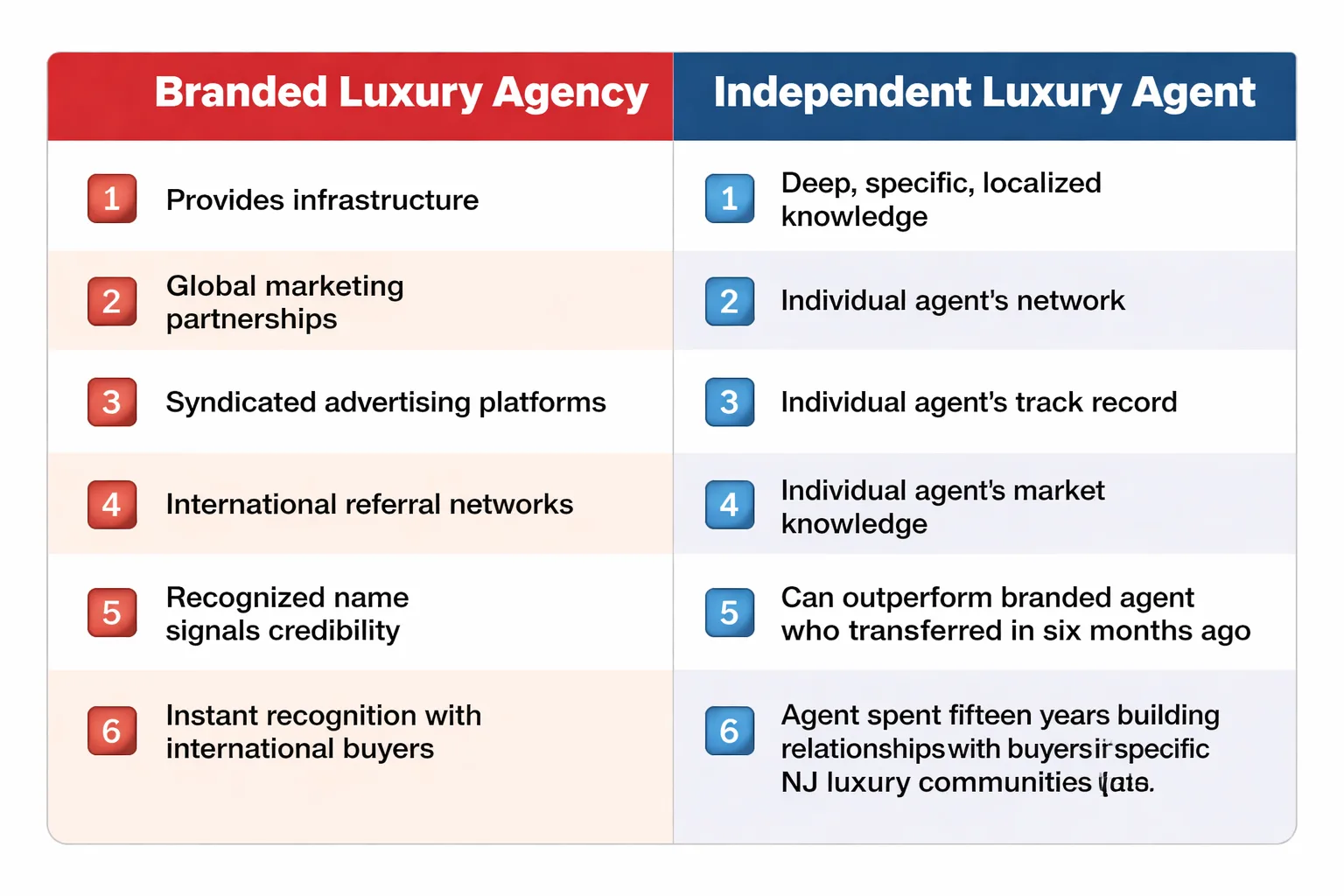
The assumption that a branded luxury agency is always the better choice for high-end transactions is wrong. The brand name on the door matters less than the individual agent's network, track record, and market knowledge. An independent agent who has spent fifteen years building relationships with buyers in specific NJ luxury communities can outperform a branded agency agent who transferred in six months ago.
The branded agency provides infrastructure. Global marketing partnerships, syndicated advertising platforms, international referral networks, and a recognized name that signals credibility to out-of-area buyers. These are real advantages. A Sotheby's or Christie's listing carries instant recognition with international buyers who may not know any individual agent in the New Jersey market.
But the independent agent provides something the brand cannot: deep, specific, localized knowledge. An agent who has closed thirty transactions in a specific town over a decade knows the inventory, the buyer pool, the zoning quirks, the school district nuances, and the pricing patterns in ways that no brand-affiliated agent new to the area can match. For NJ luxury condos and suburban estate properties, this local depth often matters more than international brand recognition.
The practical question is whether the property needs global exposure or local expertise. A $12 million Manhattan penthouse with international buyer appeal benefits from a branded agency's global marketing machine. A $3.5 million estate in Scarsdale or a luxury condo in Jersey City might sell faster and at a better price through an independent agent who knows every qualified buyer in that micro-market.
The commission structure also differs. Branded luxury agencies typically charge premium commission rates, often 5-6% total, reflecting the marketing infrastructure they deploy. Independent agents may offer more flexible structures, sometimes 3-5%, because their overhead is lower. The Federal Reserve's research on broker compensation notes that commission rates have been trending downward, and the luxury market is not immune to this pressure, particularly as agents and clients increasingly negotiate rates on a per-transaction basis.
The ideal scenario for many sellers is finding an agent who combines both: independent business structure with access to branded network resources. Some top-ranked agents maintain their own practices while holding memberships in luxury referral networks that provide international marketing reach without the overhead and commission premium of a full branded agency affiliation.
Is a Luxury Real Estate Agency Worth the Commission?
This question has no universal answer, and anyone who gives one without understanding the specific property and market is guessing.
The commission premium at a luxury agency is real. Where a standard listing might carry a 4-5% total commission split between listing and buyer agents, luxury agencies often structure deals at 5-6% or higher, particularly for properties above $5 million where the marketing investment is substantial. The question is whether that premium generates a return through a higher sale price, faster sale, or access to buyer pools that a standard listing would not reach.
For sellers, the ROI calculation depends on three factors. First, the property's appeal to international buyers. If the listing genuinely attracts interest from buyers in global financial centers, the international marketing infrastructure of a luxury agency has measurable value. Second, the local market depth of competing agents. If three independent agents in the area have comparable buyer networks, the branded agency's advantage shrinks. Third, the specific marketing plan the agency proposes. A luxury agency that simply lists the property on their website and waits is not worth the premium. One that deploys targeted international advertising, stages the property professionally, and actively shops the listing to private buyer networks is earning the fee.
For buyers, the value proposition is different. A luxury agency provides access to off-market and pre-market listings that a standard buyer never sees. In a market where the best properties sell before they are publicly listed, this access has tangible value. The agency's vetting of properties, coordination of private showings, and relationship with sellers' agents can also smooth a transaction that might otherwise stall over inspection findings or financing contingencies.
The honest assessment is that the worth depends on the gap between what the property will sell for with standard representation versus luxury representation. That gap is widest for properties with international buyer appeal, properties in the top tier of their local market where marketing quality directly affects buyer perception, and properties where discretion matters (divorce sales, estate sales, public-figure transactions). For a well-located luxury condo in a hot Jersey City development, the gap may be narrow. For a $15 million Manhattan penthouse, the gap may be significant.
The commission premium at a luxury agency is worth paying when the property's international buyer appeal, need for discretion, or top-of-market positioning makes the expanded marketing infrastructure a direct driver of final sale price rather than overhead cost.
How Does a Luxury Real Estate Agency Market Properties Differently?
The marketing engine inside a luxury agency operates on a completely different model than the standard MLS-and-Zillow approach. The differences are structural, not cosmetic.
Standard listings go live on the MLS, syndicate to consumer portals, and wait for buyer interest. Luxury listings often bypass the MLS entirely, or enter it selectively after private marketing efforts have exhausted the direct buyer network. The property is shopped first to qualified buyers through the agency's internal network, then to partner agencies through referral arrangements, and only then to the broader market if no buyer emerges.
Professional photography and videography are table stakes at every level of the market. What distinguishes luxury marketing is the production value. Cinematic video tours, drone footage, twilight photography, and virtual staging are standard. The marketing package for a luxury listing often resembles a film production more than a real estate listing, with dedicated crews, multiple shoot days, and post-production editing.
Targeted advertising replaces broadcast exposure. Instead of maximizing views, luxury marketing maximizes precision. Advertising dollars go toward reaching specific buyer profiles: international investors in particular financial centers, domestic buyers in specific income brackets, or demographic groups whose life patterns suggest imminent luxury purchases. The targeting uses financial publication advertising, private club networks, and direct outreach through wealth management relationships rather than digital ads optimized for clicks.
Print media still plays a role in luxury marketing, which surprises people who assume everything has gone digital. High-end real estate publications, private club magazines, and targeted direct mail to qualified buyer lists remain effective channels for reaching demographics that do not browse listing websites. A full-page feature in the right publication can reach buyers who are not actively searching but would act on the right opportunity.
For commercial real estate broker nyc transactions, the marketing approach adapts to the buyer pool. Commercial investment properties are marketed through institutional investor networks, private equity firm relationships, and direct outreach to qualified buyers rather than public listing. The same discretion principle applies: the best transactions happen privately, between parties who have been vetted and who trust each other's representations.
What Qualifications Should a Luxury Real Estate Agent Have?
The baseline requirement is a valid real estate license in the state where the agent practices. A ny real estate agent must hold a New York license, and an agent practicing in New Jersey must hold a New Jersey license. Agents who operate across both markets, which is common in the Manhattan-adjacent region, hold licenses in both states.
Beyond the license, the qualifications that actually matter in luxury real estate are harder to quantify but easy to verify.
Transaction history in the relevant price tier. An agent who has closed twenty transactions above $3 million has demonstrated the ability to manage the complexity of luxury deals. An agent whose transaction history is primarily in the $500,000 to $1 million range may be skilled, but the luxury market operates differently. Financing structures are more complex, inspection processes are more involved, and buyer expectations are higher.
International buyer network. For luxury properties with global appeal, the agent's personal network of international buyer contacts and referral relationships matters. This is not about the agency's brand. It is about the agent's individual relationships.
Multilingual capability. In the NJ and NYC markets, agents who speak Mandarin, Cantonese, or other languages relevant to the international buyer community have a direct advantage. Bilingual service is not a courtesy. It is a functional requirement for serving a meaningful segment of the luxury market.
Market-specific knowledge. An agent specializing in manhattan luxury apartments needs different knowledge than one specializing in Bergen County estates or Jersey City luxury condos. Zoning regulations, NJ property tax rates by town, school district quality, commuter access patterns, and development pipelines all vary by micro-market. The agent's depth in the specific market where the property sits is non-negotiable.
Professional designations provide additional signal. Membership in organizations like the Luxury Home Council, Certified Luxury Home Marketing Specialist designation, or equivalent credentials indicate commitment to the luxury market segment. These are not guarantees of quality, but they demonstrate that the agent has invested in luxury-specific training and maintains professional standards above the baseline license requirements.
How to Choose the Right Luxury Agency for NJ and NYC
The selection process for a luxury agency or agent in the New York and New Jersey markets should be systematic, not impression-based. The brand name and the office decor are not decision criteria. The following checklist is.
First, verify the agent's transaction history in the specific price tier and market. Ask for recent closed transactions in the relevant price range and location. A legitimate luxury agent can provide this. If the agent's recent closings are all in a different price tier or different market, the agent may not have the right buyer network.
Second, assess international buyer reach. For properties with global appeal, ask specifically how the agent or agency reaches international buyers. What publications do they advertise in? What referral networks do they participate in? What relationships do they maintain with wealth managers or private banks? Vague answers to these questions are a warning sign.
Third, evaluate bilingual capability if it is relevant to the target buyer pool. For properties likely to attract interest from Chinese-American buyers or international investors from Greater China, an agent who provides native-level Mandarin or Cantonese service has a meaningful advantage. The bilingual capability must be functional, not token. Ask whether the agent can conduct a full negotiation in the language, not just greetings.
Fourth, review the proposed marketing plan in detail. A luxury listing should come with a written marketing plan that specifies photography, videography, staging, advertising channels, timeline, and expected milestones. If the plan is a template that could apply to any property, the agent has not done the work.
Fifth, check title fees and closing costs transparency. The agent should be able to walk through the full transaction cost structure, including title insurance, transfer taxes, and closing costs, without ambiguity. Luxury transactions carry significant closing costs, and an agent who cannot articulate them clearly is not providing the service level the fee implies.
Sixth, evaluate the agent's commercial real estate capabilities if the transaction involves investment property. Luxury residential agents are not automatically qualified to handle commercial real estate nj transactions. The analysis, tenant evaluation, and income projection requirements are different. If the transaction involves mixed-use or income-producing property, verify the agent's commercial experience.
The NJ and NYC Luxury Market Reality
The New York and New Jersey luxury markets have specific characteristics that generic luxury real estate advice does not capture.
Manhattan luxury apartments operate in a global market. The buyer pool includes international investors, domestic high-net-worth individuals, and corporate buyers. Pricing is aggressive, inventory turns quickly at the top tier, and the marketing infrastructure needs to reach global financial centers. A luxury agency with genuine international reach adds value here.
NJ luxury condos and estates operate in a different context. The buyer pool is more regional: Manhattan commuters relocating to suburban luxury, empty-nesters downsizing within premium communities, and a smaller share of international buyers. The marketing needs are more targeted. An agent who knows the buyer pool in specific New Jersey communities provides more value than international brand recognition.
The Westchester County homes for sale market sits between these two contexts. It attracts Manhattan buyers looking for suburban luxury within commuting distance, and it requires knowledge of both the Manhattan buyer mindset and the suburban market dynamics.
For commercial real estate, the investment real estate agency model applies differently. Commercial transactions in NJ and NYC are relationship-driven, often involving repeated transactions between investors and brokers who have worked together before. The luxury agency model maps onto commercial real estate through discrete transaction handling, vetted buyer pools, and marketing that targets qualified investors rather than broadcasting publicly.
The NJ home buying process has specific legal and procedural elements that differ from New York. Attorney review periods, inspection contingencies, and disclosure requirements vary between the states. A luxury agent operating across both markets must navigate these differences fluently. For buyers considering new construction, understanding the new condo developments near me landscape requires knowing which developers deliver quality, which projects have realistic timelines, and which offering plans have terms that could affect long-term value.
What Drives the Price Premium in Luxury Brokerage?
Understanding why luxury agencies command premium commissions requires looking at the actual cost structure of a luxury listing. The overhead is not just a bigger office and nicer letterhead. It is a fundamentally different cost per transaction.
A standard listing might spend $500 to $1,500 on photography, MLS entry, and syndicated online exposure. A luxury listing easily consumes $15,000 to $50,000 in pre-marketing costs before the property ever hits the market. Professional staging for a large estate can run $10,000 to $25,000 for furniture rental, art installation, and design consultation. Cinematic video production, including drone crews and post-production editing, adds another $5,000 to $15,000. Targeted print advertising in international publications, premium placement on luxury listing platforms, and private event hosting for buyer previews can push the total marketing investment past $50,000 for a flagship property.
The agency absorbs these costs upfront. If the property does not sell, the agency loses that investment entirely. This risk profile is fundamentally different from a standard brokerage, where the marketing investment per listing is low enough that unsold properties represent minimal financial exposure. The premium commission on a luxury transaction compensates the agency for taking on this upfront capital risk.
For sellers, this means the commission conversation should include a direct discussion of the marketing budget. A luxury agency proposing a 6% commission on a $5 million listing is collecting $300,000 in total commission. The listing side might keep $150,000. If the agency is investing $40,000 in marketing, the net revenue is $110,000. That is a reasonable return for a high-touch transaction. If the agency is investing $5,000 in marketing and collecting $150,000, the seller is overpaying. The marketing budget disclosure is the single most effective tool for evaluating whether the commission premium is justified.
A luxury agency that cannot or will not disclose its per-listing marketing budget is not earning the premium commission it charges. Sellers should treat marketing budget transparency as a non-negotiable term of the listing agreement.
When Does a Luxury Real Estate Agency Waste Your Money?
Not every high-end property benefits from luxury agency representation. The market has specific scenarios where the premium commission is wasted overhead.
A property in a highly liquid market where qualified buyers are actively searching does not need international marketing infrastructure. If a luxury condo in a desirable Jersey City development has multiple buyers making offers within the first week of public listing, the expanded marketing reach of a luxury agency adds nothing. The property would sell itself through standard MLS exposure. Paying a 6% commission in this scenario means paying for infrastructure that was not used.
A property that is priced above market value to test the market does not benefit from luxury marketing. Marketing amplifies the appeal of a correctly priced property. It does not fix the problem of an overpriced property. A luxury agency that takes an overpriced listing and deploys a $30,000 marketing budget is burning the seller's money. The property will sit unsold, the marketing investment will be lost, and the eventual price reduction will make the final sale price lower than if the property had been priced correctly from the start with standard representation.
A property with fundamental condition issues that the seller refuses to address does not benefit from luxury staging or cinematic photography. Professional marketing creates a polished first impression, but buyer inspections and in-person viewings will reveal underlying problems. The marketing investment is wasted if the property cannot deliver on the promise the marketing creates.
The contrarian truth is that some properties and some sellers are better served by a competent standard brokerage that charges a fair commission for a straightforward transaction. The luxury agency model is not inherently superior. It is a specialized tool that adds value in specific scenarios and adds cost in others. The seller's job is to identify which scenario applies to their property.
The Hidden Mechanics of Off-Market Luxury Transactions
The off-market listing is the defining feature of luxury real estate that the public never sees. Understanding how these transactions work explains why luxury agencies command premium fees and why buyer representation matters.
A pocket listing is a property that a seller wants to sell without public market exposure. The reasons vary. A public figure may not want their address broadcast. A divorcing couple may want to liquidate an asset quietly. An estate sale may involve family dynamics that require discretion. A seller may simply want to test the market privately before committing to a public listing.
In these scenarios, the property never enters the MLS. The listing agent shops the property directly to qualified buyers through their personal network, through agent-to-agent referrals within the luxury agency's broader network, and through targeted outreach to specific buyers who have expressed interest in that property type or neighborhood.
The buyer's agent in an off-market transaction has a different role. Instead of searching the MLS for available properties, the buyer's agent maintains relationships with listing agents who control pocket listings. When a buyer describes what they are looking for, the agent reaches out to their network to see if a matching property is available off-market. This requires a different kind of market knowledge. The agent needs to know not just what is listed, but what is about to be listed, what is being quietly shopped, and which listing agents control which properties.
For buyers, this means that the best properties may never appear on any website. A buyer searching public listings is seeing a filtered view of the market. The off-market inventory is where the most desirable properties often sit, and access to that inventory requires working with an agent who has the right relationships.
This is the core value proposition of a luxury real estate agency for buyers. The premium buyer representation fee, if one is charged, provides access to inventory that the public never sees. For a buyer looking for a specific type of property in a specific neighborhood, this access can mean the difference between finding the right home and settling for what is publicly available.
FAQ
What price point qualifies as luxury real estate?
There is no fixed dollar threshold. Realtor.com's economic research defines luxury as the top 10% of homes by price in a given market. In Manhattan, that threshold may exceed $5 million. In parts of New Jersey, it may be closer to $1.5 million. The percentile-based definition means the luxury bar shifts by location.
Do luxury agencies charge higher commissions?
Luxury agencies typically charge 5-6% total commission, compared to 4-5% at standard brokerages. The premium reflects expanded marketing infrastructure, international advertising, and concierge services. However, commission rates are negotiable, and the Federal Reserve's research notes a broader downward trend in real estate commissions.
Can a standard real estate agent sell a luxury property?
Yes. Any licensed agent can list and sell any property. The question is whether they have the buyer network, marketing infrastructure, and transaction experience to maximize the sale price. A luxury property listed with an agent who lacks international marketing reach may sell, but potentially to a smaller buyer pool at a lower price.
How do luxury agencies find international buyers?
Through syndicated advertising partnerships with international real estate publications, referral relationships with global wealth management firms, participation in international real estate networks, and direct marketing to qualified buyer profiles in target financial centers. The specific channels vary by agency and by the property's appeal.
Is a luxury real estate agency worth it for buyers?
For buyers seeking off-market or pre-market properties, yes. Luxury agencies provide access to listings that never reach public platforms. For buyers who are comfortable searching public listings and do not need concierge-level support, the value proposition is weaker. The worth depends on whether the buyer needs access to the private market.
The decision to work with a luxury real estate agency should come down to one calculation: does the expanded marketing reach, buyer network access, and service level generate a return that exceeds the commission premium? For properties with international buyer appeal and sellers who value discretion, the answer is often yes. For well-located properties in hot local markets where qualified buyers are abundant, the gap may not justify the premium. The right luxury real estate agency, or the right independent luxury agent, earns their fee through measurable outcomes, not brand recognition.
About the Author
Judy Zhou, Coldwell Banker Realtor®
Judy Zhou is a top-ranked Coldwell Banker Realtor® serving New Jersey and New York, recognized in the top 7% of agents internationally with prestigious awards like the International Diamond Society and President's Elite. Licensed in both NJ and NY, she specializes in luxury homes, investment properties, and commercial real estate, offering seamless bilingual English-Chinese service.
Get a personalized assessment of your property's marketing strategy and commission structure from a top-ranked agent licensed in both NJ and NY.