Why Is Property Tax So High in NJ? The Real Reasons
By Judy Zhou, Keller Williams Realtor®
Key Takeaways
- New Jersey homeowners pay the highest property taxes in the nation, averaging over $9,500 annually with effective rates exceeding 2.3%, because the state funds schools and services almost entirely through local property taxes rather than broad-based state taxes.
- When home values rise in New Jersey, property tax bills increase in lockstep since local governments resist lowering rates, a pattern confirmed by the Lincoln Institute of Land Policy across 564 municipalities and nearly 600 school districts.
- Self-represented homeowners in New Jersey lose tax appeals like Faber v. Toms River because they cannot compel assessors to appear in Tax Court and fail to provide documented adjustments for comparable sales.
- New Jersey's property tax burden results from three structural choices: extreme municipal fragmentation, a school funding formula tied to local property wealth, and the absence of meaningful statewide reform.
New Jersey's property tax bill isn't an accident. It's a policy choice.
New Jersey homeowners pay the highest property taxes in the nation because the state funds schools, counties, and municipal services almost entirely through local property taxes instead of broad-based state taxes. The Lincoln Institute of Land Policy confirms that when home values rise, property tax bills rise in lockstep because local governments resist lowering rates to capture windfall revenue. The average New Jersey homeowner pays over $9,500 annually, with effective rates frequently exceeding 2.3% of assessed value. That structural choice, repeated across 564 municipalities and nearly 600 school districts, is why the question "why is property tax so high in nj" has a simple answer: the state chose this model and never meaningfully reformed it.
Homeowners who challenge their assessments often fail because they do not understand the procedural rules. In Faber v. Toms River, a self-represented taxpayer lost her appeal because she could not compel the assessor to appear in Tax Court, and her comparable sales lacked documented adjustments for location and style differences, according to Englert Law. That case is not an outlier. It is the standard outcome for property owners who treat tax appeals like a conversation rather than a litigation proceeding.
Why Is Property Tax So High in NJ?
New Jersey's property tax burden is the product of three compounding structural decisions: extreme municipal fragmentation, a school funding formula that leans on local property wealth, and the absence of a meaningful state-level offset. The state operates 564 separate municipalities, each with its own police department, public works operation, administrative staff, and elected officials. Consolidation could reduce overhead. It has not happened at any meaningful scale because residents resist losing local control.
The school funding piece is the larger driver. New Jersey's school districts consume the largest share of property tax revenue by a wide margin. The state does contribute to education funding through income tax and other revenue sources, but the local property tax remains the dominant funding mechanism for school operations. When a town has high per-pupil costs, small enrollment, or both, the tax rate climbs to cover the difference.
New Jersey's effective property tax rate of approximately 2.23% is the highest of any state, nearly double the national average of roughly 1.1%, according to data compiled by NJLux. A $500,000 home in New Jersey carries an annual tax bill around $11,150. The same home in a state with a 1.1% effective rate would cost $5,500. That $5,650 annual gap compounds over a 30-year mortgage into nearly $170,000 in additional carrying costs, before accounting for annual increases.
The third factor is political. New Jersey governors from both parties have proposed property tax relief programs, rebate checks, and circuit breakers. These programs provide marginal relief but do not address the structural dependency on property taxes. The Lincoln Institute of Land Policy notes that property tax revenue is inherently rigid because local governments set rates based on spending needs, not on homeowners' ability to pay. When home values surge during a real estate boom, assessments rise, and tax bills follow. The rate does not drop to offset the higher assessed value. The town simply collects more.
This is why the question "why is property tax so high in nj" leads back to policy, not mismanagement. The system was designed to fund local government and schools through property wealth. It works as intended. The problem is that the design itself produces outcomes that strain homeowners.
The history matters here. New Jersey's income tax was established in 1976 specifically to fund public schools and reduce the property tax burden. The state Supreme Court's Robinson v. Cahill decision required the legislature to create a more equitable school funding mechanism. The income tax was the answer. For a brief period, it provided meaningful offset. Over the decades, however, state aid formulas shifted, education costs outpaced revenue growth, and the property tax reassumed its position as the dominant school funding source. The income tax did not replace property taxes. It supplemented them, and the property tax burden continued to climb.
The state's ANCHOR program (Affordable New Jersey Communities for Homeowners and Renters) represents the most recent attempt at relief. ANCHOR sends direct rebates to homeowners and renters based on income thresholds. In 2026, eligible homeowners earning up to $150,000 receive approximately $1,500, while those earning between $150,000 and $250,000 receive approximately $1,000. These amounts offset a fraction of the average $9,500 bill. The program provides political cover without addressing the structural problem. No governor has successfully pushed the legislative changes required to consolidate municipalities, regionalize school districts, or shift the funding base away from property taxes.
Are County Taxes Part of Property Taxes in NJ?
Yes. County taxes are one of three components that make up a New Jersey property tax bill, alongside municipal taxes and school district taxes. Every property owner in the state receives a single tax bill, but the revenue splits three ways (sometimes four, with special district assessments for fire, sewer, or open space).
The breakdown typically looks like this:
- School district taxes: the largest portion, generally 50-60% of the total bill. This funds teacher salaries, school operations, transportation, and facilities. Towns with regional school districts or high per-pupil spending see this category dominate their bills. - Municipal taxes: usually 25-30% of the bill. This covers police, fire, public works, code enforcement, municipal courts, and local administrative functions. The 564-municipality structure means overhead is duplicated across small towns that could theoretically share services. - County taxes: typically 15-20% of the bill. This funds county colleges, county roads, prosecutors' offices, county jails, parks, and shared services. Bergen County's open space trust fund, for example, adds a small additional assessment.
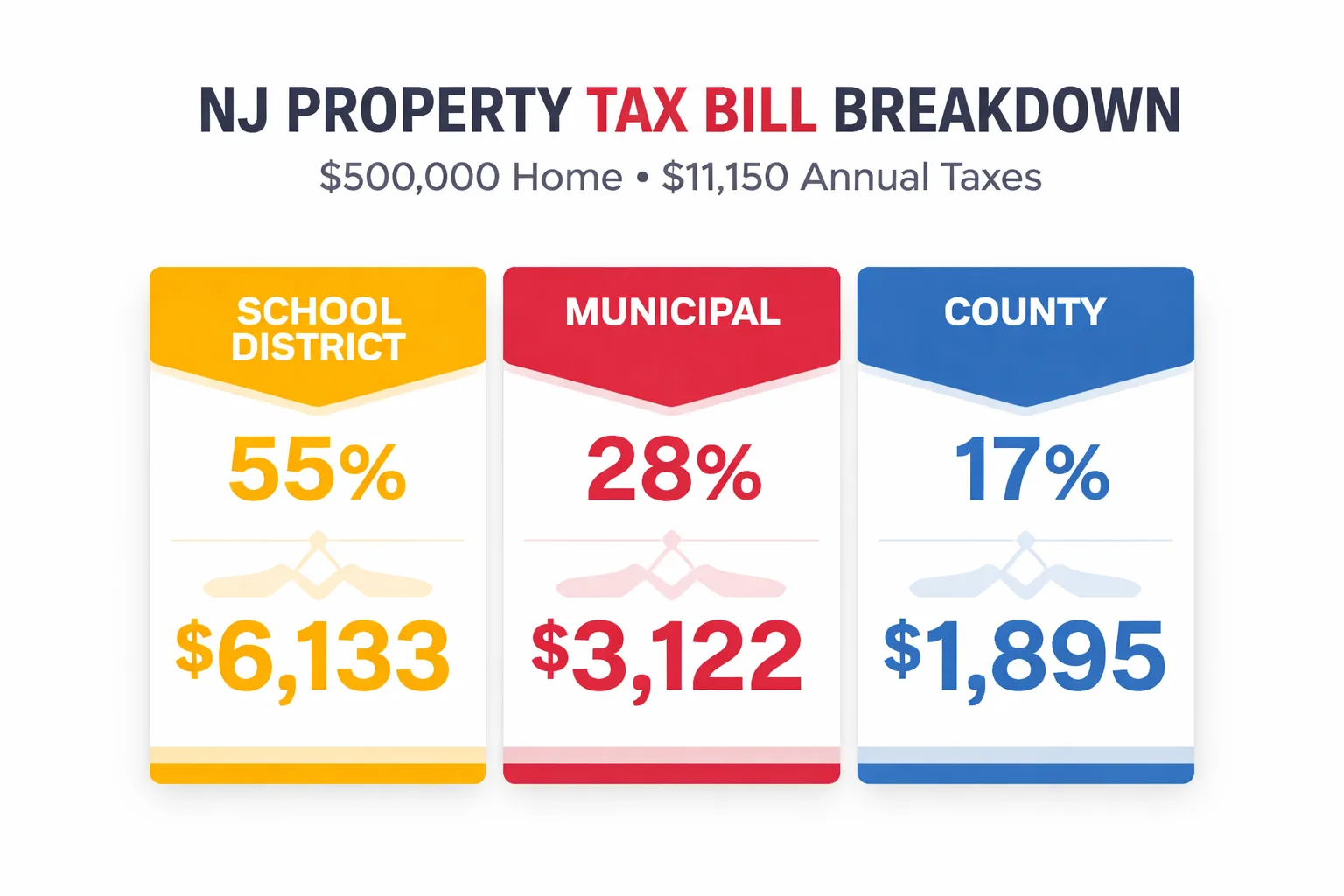
A homeowner in Tenafly, NJ, pays all three layers. The school portion funds the Tenafly school district. The municipal portion funds Tenafly's borough operations. The county portion funds Bergen County government. Each layer sets its own budget independently, and the tax assessor calculates the combined rate based on the total of all three budgets divided by the town's total assessed value.
This fragmentation matters for buyers. Two homes with identical purchase prices in different Bergen County towns can have tax bills that differ by $4,000 or more annually because school spending, municipal efficiency, and county assessments vary town by town. A nj real estate agent who understands these micro-level differences can save buyers from choosing a town based on list price alone, then discovering the carrying costs are unsustainable.
The special district assessments deserve attention because they are easy to miss. A home in a town with a separate fire district, sewer authority, or open space preservation fund will see additional line items on the tax bill. These assessments can add $300 to $1,200 annually depending on the district. Buyers reviewing listings often see only the total tax figure without understanding which components are fixed and which could change. A sewer authority assessment, for instance, may increase if the authority issues bonds for infrastructure upgrades. A fire district assessment may rise if the department expands staffing or purchases new equipment. These micro-level levies compound the overall burden and are virtually invisible until the first tax bill arrives after closing.
How NJ Compares to NY and Other States
New Jersey's property taxes are the highest in the nation, but comparing them to neighboring states requires looking at the total tax picture, not just the property tax line item. New York has lower property taxes on paper but compensates through high state income taxes, New York City's additional resident income tax, and elevated sales taxes. Connecticut's property taxes are high but generally below New Jersey's, and the state offers different relief mechanisms.
The comparison that matters most for buyers crossing the Hudson is total cost of ownership. A buyer purchasing a $1.2 million home in Manhattan faces no separate property tax bill in the traditional sense. Instead, monthly maintenance fees in a co-op or condo include the building's property tax allocation. Those maintenance charges can exceed $3,000 monthly for a unit at that price point. A buyer purchasing a $1.2 million home in Englewood Cliffs or Alpine, NJ, faces an annual property tax bill of roughly $24,000 to $28,000, which works out to $2,000 to $2,333 monthly. The New Jersey option can be cheaper on a monthly basis once New York's income tax surcharge is factored in.
For investors evaluating commercial real estate nj against New York alternatives, the calculus shifts. New Jersey's property taxes directly erode cap rates. A property quoted at a 6.5% cap rate can drop to a 4.0% net return after a 2.5% effective property tax rate and standard operating costs. The same property in a lower-tax state might retain 5.5% net. This is why investors who work with a knowledgeable ny real estate agent or NJ-licensed professional need to see tax-adjusted pro formas, not headline cap rates.
The recurring pattern in cross-state comparisons is that New Jersey trades higher property taxes for lower state income tax rates than New York, lower sales taxes than New York City, and a suburban lifestyle that Manhattan cannot replicate. Buyers who focus only on the property tax line miss the total-cost savings.
Connecticut presents a useful third comparison point. Connecticut's effective property tax rate averages around 2.0%, slightly below New Jersey's but still among the highest nationally. Connecticut funds schools through a combination of state aid and local property taxes, similar to New Jersey, but has fewer municipalities (169 versus 564) and a less fragmented governance structure. Connecticut also offers a local property tax credit against the state income tax for eligible homeowners, which provides a modest offset that New Jersey's system does not match at the state level. For buyers considering a move to the tri-state area, Connecticut's lower property taxes may seem attractive, but the state's higher income tax rates (top marginal rate of 5.0% compared to New Jersey's 10.75%) can erase the property tax savings for high earners.
Pennsylvania rounds out the regional comparison. Pennsylvania's effective property tax rate averages around 1.5%, significantly below New Jersey's. However, Pennsylvania school districts have broader taxing authority, including the ability to levy earned income taxes, which shifts some school funding away from property taxes. A buyer moving from New Jersey to Pennsylvania might see property taxes drop by 30% but face a new local earned income tax of 1-2%. The total tax burden does not disappear. It relocates.
What Drives the School Tax Portion?
School funding is the single largest driver of New Jersey property tax bills, and the mechanics are worth understanding because they explain why rates vary so dramatically between neighboring towns. New Jersey uses a formula-based school funding model that calculates a district's "adequate" budget based on enrollment, student demographics, and special education needs. The state then covers a portion of that budget through aid, and the remainder is raised through local property taxes.
Here is where the system creates wide disparities. A town with high property wealth (high assessed value per pupil) receives minimal state aid because the formula assumes the town can fund its own schools. A town with low property wealth receives more state aid but may still need a high tax rate because its total assessed value is small. The result is that two towns with similar school quality can have very different tax rates based on their property wealth, enrollment, and state aid eligibility.
Bergen County illustrates this. Alpine, with its high property values and small student population, maintains strong schools with a relatively lower tax rate because the tax base is enormous relative to enrollment. Teaneck, with a larger student population and more moderate property values, needs a higher rate to fund comparable school services. The 2026 New Jersey housing market outlook reflects these differences, with buyers increasingly weighing school district quality against tax burden when choosing between towns.
For buyers evaluating investment property nj, the school tax component affects cash flow directly. A multi-family property in a high-tax town generates less net operating income than the same property in a lower-tax town, even if gross rents are identical. Investors who skip this analysis end up with cap rate projections that look strong on paper and collapse at tax time.
The special education funding dynamic deserves specific attention. New Jersey mandates that school districts provide appropriate educational services for all students, including those with significant special education needs. The cost of out-of-district placements, specialized staffing, and transportation for special education students can run well into six figures per student annually. When a small district has even a handful of students requiring these services, the budget impact is disproportionate. The state provides categorical aid for special education, but it does not cover the full cost. The shortfall falls on local property taxpayers. This is why two towns with identical home values and similar enrollment can have tax rates that differ by 0.3 to 0.5 percentage points. One town may have higher special education costs that the state aid formula does not fully offset.
Regional school districts add another layer of complexity. In towns that send students to a regional high school (such as the Northern Valley Regional High School district in Bergen County), the tax bill includes a separate line item for the regional district's apportionment. The regional district sets its own budget, and each sending town pays a share based on a formula that typically weights enrollment and property valuation. A town's share can shift year to year as enrollment changes, which means the regional school portion of the tax bill can increase even if the municipal and county portions stay flat. Buyers who see a stable tax bill for three years may be surprised in year four when the regional apportionment recalculates.
Can You Appeal Your Property Tax Assessment?
Yes, but the process is harder than most homeowners expect, and procedural mistakes end more appeals than weak evidence does. New Jersey allows property owners to file tax appeals by January 15 of each year (or April 1 for most municipalities, depending on the filing method). The appeal challenges the assessed value of the property, not the tax rate itself. If the assessment is reduced, the tax bill drops proportionally.
The catch is that the burden of proof falls entirely on the property owner. In county tax board hearings, the assessor is required by regulation to appear and defend the assessment. In Tax Court, the assessor is not required to appear unless the property owner issues a proper trial subpoena. Self-represented taxpayers who do not understand this distinction routinely lose.
The Faber v. Toms River case is instructive. The homeowner challenged her assessment by claiming the property record card overstated her home's square footage and lot size. She presented three comparable sales. The court rejected all three because they lacked documented adjustments for location and style differences. Her own testimony, without expert corroboration, was insufficient. The appeal was dismissed.
Property owners who challenge assessments in New Jersey Tax Court without expert testimony or properly adjusted comparable sales data face dismissal rates that make self-representation a poor gamble, as documented in the Englert Law analysis of Faber v. Toms River.
A successful appeal requires three elements: a certified appraisal or well-documented comparable sales with adjustments, an understanding of the filing deadline and jurisdiction, and (for Tax Court filings) proper subpoena procedures. Homeowners who hire a property tax attorney or work with a Realtor who understands the appeals process have materially better outcomes.
The distinction between county tax board and Tax Court matters for strategy. County tax board hearings are less formal, less expensive, and faster. They are appropriate for smaller assessment disputes where the potential savings are modest. Tax Court is more formal, requires stricter evidence presentation, and typically involves higher legal costs. However, Tax Court decisions carry precedential weight and can be more favorable for complex cases involving unique properties or significant assessment gaps. The filing fee for county tax board appeals is modest (typically $25 to $150 depending on the disputed amount), while Tax Court filing fees start higher and attorney fees can run $3,000 to $8,000 for a fully litigated matter. The economics dictate the forum: small disputes belong at the county board, large disputes belong in Tax Court.
Another procedural trap involves the "chapter 91" request. New Jersey law allows municipalities to request income and expense information from income-producing properties. If an investor owns a rental property and fails to respond to a chapter 91 request within 45 days, the property is deemed to have no income, and the assessor can value it using cost or market approaches that may produce a higher assessment. Investors who ignore chapter 91 requests lose the right to challenge their assessment using the income approach, which is often the most favorable valuation method for rental properties. This single procedural oversight has cost investors tens of thousands in inflated assessments.
Which NJ Towns Have Lower Tax Rates?
Property tax rates vary widely across New Jersey, and the differences between towns can be dramatic. Bergen County, where Keller Williams Town Life Realty is based, contains some of the state's most desirable towns with tax rates that range from moderate to high. The towns with the lowest effective rates tend to share common characteristics: large commercial tax bases, small school enrollments relative to property wealth, or significant ratables from commercial real estate.
Towns worth examining for buyers sensitive to property taxes:
- Alpine: low rate driven by enormous property values and small enrollment. The tax base is so large relative to municipal and school costs that the rate stays depressed. - Englewood Cliffs: corporate headquarters (including LG Electronics' North American HQ) provide commercial ratables that offset residential tax burden. - Rockleigh: minimal residential development and a small population keep municipal costs low. - Tenafly: moderate rate relative to school quality. The town offers strong schools with a tax rate that, while not the lowest in Bergen County, provides value relative to educational outcomes.
Essex County presents a different picture. Newark's tax rate is among the highest in the state because the city's large student population, aging infrastructure, and concentrated poverty require high municipal spending relative to the tax base. Millburn and Livingston, also in Essex County, have lower rates because their property wealth supports school and municipal budgets more efficiently.
Buyers comparing nj luxury condos to single-family homes should note that condo owners pay property taxes on their individual units, but the tax rate calculation differs because the condo association handles some maintenance costs that a single-family homeowner bears directly. The total carrying cost comparison requires looking at taxes plus HOA fees, not taxes alone.
A comparison of Fort Lee versus Short Hills illustrates how two luxury-adjacent markets handle taxes differently. Fort Lee's condo-heavy inventory and commercial base along Route 4 creates a different tax profile than Short Hills' large-lot single-family homes with premium school district costs.
The commercial ratable effect is the most underappreciated factor in town-level tax comparisons. A town with a large mall, office park, or corporate campus generates significant tax revenue from non-residential properties. This revenue offsets the residential share of the total tax levy. Englewood Cliffs is the classic example. The town's corporate office base produces millions in annual property tax revenue from a small number of commercial parcels. Residential homeowners benefit because the total levy is spread across a broader base. When a major corporate tenant leaves or a commercial property's assessment is reduced on appeal, the residential share increases. This happened in several Bergen County towns after the 2020-2021 office market contraction. Buyers should ask what percentage of the town's total assessed value comes from commercial properties. A town with 25% or more commercial ratables has a meaningful buffer. A town with less than 5% commercial ratables has almost no buffer, and residential taxpayers bear the full weight of every budget increase.
Are you factoring property taxes into your home buying budget?
What This Means When Buying a Home in NJ
The practical takeaway for buyers is that list price is the wrong starting point for affordability calculations in New Jersey. The true cost of ownership is list price plus 30 years of property taxes, and those taxes vary by thousands of dollars between towns that are ten minutes apart.
A buyer looking at a $750,000 home in Closter (see the Closter September 2026 market data) needs to know the specific tax rate, not just the listed tax figure from the MLS. MLS tax data can be outdated, especially if a town has undergone a recent reassessment. The effective rate, calculated as annual tax divided by current market value, gives a more accurate picture.
Here is a concrete example. A $750,000 home with a listed tax of $13,500 implies an effective rate of 1.8%. If the town recently reassessed and the new effective rate is 2.2%, the actual tax bill on a $750,000 purchase could be $16,500. That $3,000 annual difference, over a 30-year mortgage, adds $90,000 to the carrying cost. It also affects mortgage qualification, because lenders factor property taxes into the monthly debt-to-income ratio.
Buyers should request three pieces of information before making an offer:
1. The current tax bill from the municipality, not the MLS listing. MLS data can lag by a year or more. 2. The most recent reassessment date. Towns that reassessed recently have assessments closer to market value. Towns that have not reassessed in years may have assessments far below market value, which means a sale could trigger a reassessment at the new purchase price. 3. The town's tax appeal history. Some towns routinely lose appeals, which signals that assessments may be challengeable. Others have tight assessments that leave little room for reduction.
Understanding title fees and closing costs is also essential, because New Jersey's closing costs include tax-related adjustments that surprise buyers who are not prepared. The seller credits the buyer for prepaid taxes at closing, and the amounts can be significant depending on the tax cycle and payment schedule.
The reassessment trigger is a critical and often misunderstood mechanism. In New Jersey, a sale does not automatically trigger a reassessment. The assessor's office typically conducts town-wide reassessments on a cyclical basis, often every 5 to 10 years. However, a sale at a price significantly above the current assessed value can draw the assessor's attention. If the assessor determines that the property's assessment no longer reflects market value, they can issue an added assessment notice. The new buyer then receives a supplemental tax bill for the difference. This is particularly common in towns that have not conducted a town-wide reassessment in many years, where assessed values have drifted far below market values. A buyer purchasing a home assessed at $400,000 for $650,000 in a town that has not reassessed since 2015 should anticipate a potential added assessment that could raise the tax bill by 40% or more within the first year of ownership.
Mortgage lenders calculate the debt-to-income ratio using the projected monthly tax payment, but they typically use the current tax bill, not the post-reassessment estimate. This means a buyer can qualify for a mortgage based on a $13,500 annual tax bill, close on the property, and then receive a supplemental bill for $19,000 six months later. The lender is not responsible for the shortfall. The buyer's monthly housing payment increases, and in extreme cases, the buyer can face payment shock that threatens affordability. This scenario plays out most frequently in towns with long reassessment cycles and rapidly appreciating home values, conditions that describe much of Bergen County from 2020 through 2026.
How Do Investors Account for NJ Property Taxes?
Investors face a different version of the property tax problem. Residential buyers can absorb a high tax bill if they love the home and plan to stay long-term. Investors cannot. Property taxes flow directly through to net operating income, and every dollar of tax reduces the cap rate by a corresponding amount.
The mistake investors make is relying on the seller's pro forma, which often uses the current tax bill. If the property has been held by the same owner for 15 years and the town has not reassessed, the current tax bill may reflect an assessment far below market value. A sale at a significantly higher price can trigger a reassessment, and the new tax bill can jump by 40% or more. The investor's projected cap rate evaporates.
This is particularly dangerous for commercial real estate nj transactions where the buyer is acquiring an income-producing property with a quoted cap rate based on current expenses. A property quoted at a 6.5% cap rate with a $20,000 annual tax bill might reassess to $32,000 after the sale. The cap rate drops to 5.7% on the same net operating income. If the investor financed the acquisition based on the 6.5% projection, the debt service coverage ratio falls below the lender's minimum, and the investor faces a cash flow crisis.
Investors who purchase commercial or investment property in New Jersey without modeling post-reassessment tax exposure routinely see cap rates compress by 0.5 to 1.5 percentage points within the first tax cycle, eroding returns that looked strong on the seller's pro forma.
The solution is to model the worst-case tax scenario before closing. Assume the property reassesses at the purchase price and calculate the new tax bill using the town's effective rate. If the deal still cash flows at the worst-case tax level, proceed. If it does not, renegotiate the price or walk away.
A specific example illustrates the stakes. An investor purchases a 12-unit multi-family property in Hackensack for $3.2 million. The seller's pro forma shows gross annual rent of $360,000, operating expenses of $120,000 (including a $42,000 tax bill), and net operating income of $240,000. The quoted cap rate is 7.5%. The investor finances 70% of the purchase at 6.5% interest, producing annual debt service of approximately $176,000. Cash flow after debt service is $64,000 annually. The deal looks solid.
But the property was assessed at $1.9 million, and the town has not reassessed since 2018. After the sale at $3.2 million, the assessor initiates an added assessment. The new assessed value is $3.2 million. At Hackensack's effective tax rate of approximately 2.4%, the new annual tax bill is $76,800. That is $34,800 more than the pro forma assumed. Net operating income drops to $205,200. The cap rate falls to 6.4%. Cash flow after debt service drops to $29,200. The investor's cash-on-cash return falls from 6.7% to 3.0%. The deal went from solid to marginal because of one line item that the seller's pro forma did not project forward.
This is why working with an agent who understands commercial property tax mechanics is not a luxury. It is a necessity. The New Jersey real estate investment landscape rewards investors who model tax exposure correctly and punishes those who do not.
The Hidden Cost of Ignoring Tax Differences
Here is the contrarian take that most buyers and investors get wrong. The conventional wisdom in New Jersey real estate is to shop for the lowest-priced home in the best school district. That strategy ignores the tax component so completely that it can cost more than buying a higher-priced home in a lower-tax town.
Consider two scenarios. A buyer purchases a $650,000 home in a high-tax Bergen County town with a 2.4% effective rate. The annual tax bill is $15,600. Over 30 years at a 3% annual tax increase, the total tax paid exceeds $750,000. The buyer has paid more in taxes than the home cost.
A second buyer purchases a $700,000 home in a nearby town with a 1.7% effective rate. The annual tax bill is $11,900. Over 30 years at the same 3% increase, the total tax paid is approximately $572,000. The second buyer paid $50,000 more for the home but saved nearly $180,000 in taxes over the holding period. The higher-priced home was cheaper to own.
This math is not hypothetical. It plays out across Bergen, Essex, Morris, and Hudson counties every year. Buyers who work with an agent who understands effective tax rates, reassessment triggers, and long-term cost projections make better decisions. Buyers who work with an agent who only compares list prices do not.
The same logic applies to New York investment properties and cross-border buyers. An international buyer evaluating manhattan luxury apartments against New Jersey alternatives needs to see a 10-year total cost of ownership comparison, not a price-per-square-foot spreadsheet. The property tax differential is the single largest variable in that comparison.
The compounding effect of annual tax increases deserves closer examination. New Jersey property taxes do not stay flat. Municipal budgets, school contracts, and county obligations increase year over year. A 3% annual increase is a reasonable baseline assumption, though some years see larger jumps when new teacher contracts are negotiated or capital projects are approved. Over 30 years, a 3% annual increase causes the tax bill to nearly triple. A $12,000 tax bill in year one becomes approximately $35,000 in year 30. The total cumulative tax paid over the mortgage term exceeds $575,000 on that initial $12,000 bill. When buyers calculate affordability, they typically use the year-one tax figure. The year-30 figure is the one that determines whether they can actually stay in the home through retirement.
This compounding effect is why the town selection decision is arguably more important than the home selection decision. A buyer can renovate a kitchen, add a bathroom, or finish a basement. A buyer cannot change the town's tax rate, school district boundaries, or municipal structure. The tax environment is fixed for the duration of ownership. Choosing a town with a 1.7% effective rate over a town with a 2.4% effective rate saves the buyer approximately $150,000 to $200,000 over a typical ownership period. That savings can fund college tuition, retirement contributions, or the down payment on a next home. It is the single largest financial variable in the New Jersey home buying decision, and it is the one most buyers spend the least time analyzing.
What This Actually Means
New Jersey's property taxes are high because the state chose to fund local government and schools through property wealth rather than through broad-based state taxes. That choice is embedded in the political structure, the municipal fragmentation, and the school funding formula. It is not changing. Buyers and investors who wait for reform will wait indefinitely.
The actionable response is to treat property taxes as a primary variable in every real estate decision, not an afterthought. Calculate the effective rate for the specific town. Model the post-reassessment tax exposure for investment properties. Compare total cost of ownership across towns, not just list prices. File tax appeals when assessments are demonstrably too high, but do so with proper evidence and procedural compliance.
For buyers working with a real estate agent in nj, the question to ask is not "what is the tax rate in this town?" but "what will my tax bill look like in year one, year five, and year ten, and what happens if the town reassesses after my purchase?" Agents who can answer that question with specific numbers add value that compounds over the life of the ownership. Agents who cannot are selling houses, not advising buyers.
The data is clear. New Jersey's property tax system is the most expensive in the nation by design. The buyers who succeed are the ones who understand the design and plan around it.
FAQ
What is the average property tax bill in New Jersey?
The average New Jersey property tax bill exceeds $9,500 annually, based on effective rates that frequently surpass 2.2% of assessed value. Bills vary significantly by town, with some Bergen County municipalities posting lower rates due to commercial ratables, while Essex and Hudson County towns with high municipal spending can exceed $15,000 annually on a median-priced home.
How are New Jersey property taxes calculated?
New Jersey property taxes are calculated by multiplying the assessed value of the property by the general tax rate, which combines municipal, school district, and county levies. The general tax rate is determined annually by dividing the total municipal, school, and county budgets by the total assessed value of all properties in the taxing district.
When is the deadline to file a property tax appeal in New Jersey?
The deadline to file a property tax appeal in New Jersey is typically April 1 of the tax year for most municipalities filed with the county tax board, or January 15 for filings directly to the Tax Court. Property owners should verify the specific deadline for their jurisdiction, as filing deadlines are strictly enforced and late appeals are dismissed.
Do New Jersey property taxes go up every year?
New Jersey property taxes can increase annually based on municipal, school, and county budget changes. Even if tax rates remain stable, tax bills can rise when property assessments increase due to reassessments or market appreciation. The Lincoln Institute of Land Policy notes that local governments typically do not lower tax rates when assessments rise, resulting in higher bills.
Are property taxes higher in NJ or NY?
New Jersey has higher property taxes than New York on average, with effective rates around 2.23% compared to New York's approximately 1.7%. However, New York compensates with higher state income taxes, New York City resident income tax, and elevated sales taxes. Total cost of ownership comparisons often favor New Jersey suburbs over Manhattan for buyers who factor in all tax categories.
Can a Realtor help reduce my property taxes?
A Realtor cannot directly reduce property taxes, but an experienced agent can identify whether a property's assessment appears challengeable, provide comparable sales data to support an appeal, and connect homeowners with property tax attorneys who handle the formal appeal process. Agents who understand the tax landscape also help buyers choose towns where the tax burden aligns with their long-term budget.
About the Author
Judy Zhou, Keller Williams Realtor®
Judy Zhou is a Realtor® with Keller Williams Town Life Realty in Tenafly, NJ, serving New Jersey and New York with $35M+ in sales volume. Licensed in both NJ and NY, she specializes in luxury homes, investment properties, and commercial real estate, offering seamless bilingual English-Chinese service. Before joining Keller Williams, she earned Coldwell Banker's International President's Elite (2024) and International Diamond Society (2025) awards.
Get a town-by-town tax comparison before you make an offer in New Jersey or New York.