How to Buy NJ Luxury Homes for Sale in 6 Clear Steps
How to Buy NJ Luxury Homes for Sale in 6 Clear Steps
By Judy Zhou, Keller Williams Realtor®
Key Takeaways
- Luxury homes in the New York-Newark-Jersey City metro enter the priciest 10% of listings at $2.62 million, per Realtor.com's September 2026 report.
- Off-market residential sales volume rose at least 30% year-over-year in Brooklyn, Manhattan, and Queens during 2025.
- A single missed comp in NJ luxury deals can cost buyers $40,000 or more in overpayment.
- Skip generic steps like "get pre-approved then make an offer" because luxury NJ transactions require jumbo financing, attorney review, and off-market access.
By Judy Zhou, Realtor®, Keller Williams Town Life Realty (Tenafly, NJ)
Buying a luxury home in New Jersey is nothing like buying a regular one.
The threshold for new luxury homes in nj typically starts around $1 million, but the real entry point in the New York-Newark-Jersey City metro area is $2.62 million for the priciest 10% of listings, according to Realtor.com's September 2026 Luxury Housing Report. Off-market residential sales volume jumped at least 30% year-over-year in Brooklyn, Manhattan, and Queens in 2025, per The Real Deal's private sales data report. And in a market where a single missed comp can cost a buyer $40,000 or more in overpayment, the agent you choose matters more than the listing you find.
The standard advice, "get pre-approved, find an agent, make an offer," is dangerous at this price tier. Luxury transactions involve jumbo financing, attorney review periods, off-market inventory, and tax structures that can make or break a deal. This guide breaks the process into six concrete steps, grounded in 2026 market data and real transaction experience.
Why New Luxury Homes in NJ Are Worth the Process
New Jersey's luxury market in 2026 is defined by Manhattan spillover. Buyers priced out of Manhattan luxury apartments, or those seeking more square footage per dollar, are landing in Bergen and Essex counties. The towns that consistently command premium prices are Tenafly, Short Hills, Demarest, and Englewood Cliffs. Each offers a different value proposition.
Tenafly sits roughly 10 miles from the George Washington Bridge. It has top-rated public schools, large lot sizes, and a mix of new construction and renovated estates. Short Hills (part of Millburn Township) is the gold standard for commute-to-Manhattan luxury, with Midtown Direct train service reaching Penn Station in about 30 minutes. Demarest and Englewood Cliffs offer quieter, more private settings with larger lots and lower density.
The demand driver is straightforward. Manhattan buyers get more space, better schools, and lower per-square-foot costs. A $2.62 million Manhattan apartment might buy 1,200 square feet. The same budget in Tenafly can secure 5,000+ square feet on an acre of land. That math is pulling buyers across the Hudson at a rate that keeps luxury homes nj for sale inventory tight.
But the process of acquiring one of these properties is where most buyers stumble. The mistakes are expensive, and they are preventable.
For a broader view of where the market is heading, the 2026 New Jersey Housing Market Outlook breaks down price trends and inventory projections across the state.
How do I define my budget honestly?
Most luxury buyers start with a number they heard at a dinner party. That number is almost always wrong.
The purchase price is the floor, not the ceiling of what you will spend. New Jersey property taxes are among the highest in the nation, and they scale with home value. A $2 million home in Bergen County can carry $30,000 to $40,000 in annual property taxes. In Essex County, that same home might see $45,000 to $55,000. Those numbers reshape what "affordable" means.
Here is how to build a real budget.
Start with your liquid capital. Lenders offering jumbo loans typically require 20% down minimum, and many want 25% to 30% on loans above $1.5 million. On a $2 million purchase, that is $400,000 to $600,000 in cash just for the down payment. Then add closing costs, which run 2% to 5% of the purchase price in New Jersey. Then add carrying costs: property taxes, insurance, maintenance, and (for new construction) any builder upgrade costs that fall outside the base contract.
A realistic framework looks like this:
| Budget Component | Estimated Amount (on $2M Purchase) |
| Down Payment (20-30%) | $400,000 to $600,000 |
| Closing Costs (2-5%) | $40,000 to $100,000 |
| Annual Property Tax (Bergen) | $30,000 to $40,000 |
| Annual Property Tax (Essex) | $45,000 to $55,000 |
| Inspection + Appraisal | $2,000 to $5,000 |
| Move-in + Immediate Repairs | $10,000 to $50,000 |
That table is why buyers who start with "I have $500,000 cash" end up shopping at $1.5 million, not $2 million. The math does not lie.
For a detailed breakdown of closing costs, including title fees specific to New Jersey, the Title Fees Closing Costs guide walks through each line item.
Step 2: Choose the Right Town for Your Life
This is where buyers waste the most time. They tour properties in five different towns before realizing none of them fit their commute, school requirements, or lifestyle. The fix is to narrow the town list before booking a single showing.
Three filters matter most for luxury buyers in New Jersey.
Commute. If you work in Midtown Manhattan, your target commute is under 45 minutes. Short Hills and Millburn give you direct train access. Tenafly and Englewood Cliffs require a bus or car to the George Washington Bridge, then subway. That is 40 to 60 minutes depending on traffic. If you work from home two or three days a week, the commute matters less, and towns further out (Saddle River, Alpine) become viable.
Schools. New Jersey's top public school districts are concentrated in the luxury towns. Millburn, Tenafly, and Demarest consistently rank in the state's top 20. But school quality also drives price. A comparable home in a top-district town can cost 15% to 25% more than the same home in a neighboring town with lower-ranked schools. If you do not have school-aged children, that premium is wasted money.
Lot size and privacy. Luxury buyers in New Jersey consistently prioritize lot size over interior square footage. A 4,000-square-foot home on two acres will hold value better than a 6,000-square-foot home on a quarter acre. Waterfront properties, particularly along the Hudson or in towns like Edgewater and Weehawken, carry a separate premium.
For buyers comparing specific Bergen County towns, the Closter vs Tenafly comparison breaks down price tiers, school ratings, and commute differences side by side.
Looking for new luxury homes in NJ? Get matched with a specialist who knows the towns, the taxes, and the off-market inventory.
How Does Jumbo Financing Work for Luxury Purchases?
The conforming loan limit in most of New Jersey for 2026 is well below typical luxury purchase prices. That means most luxury homes for sale nj buyers need a jumbo loan, which operates under different rules than conventional mortgages.
Jumbo loans exceed the conforming loan limits set by Fannie Mae and Freddie Mac. For 2026, the baseline conforming limit is $806,500 in most markets, with high-cost area limits reaching up to $1,209,750. Anything above those thresholds is a jumbo loan, and lenders apply stricter qualification standards.
Here is what that means in practice.
Lenders typically require a credit score of 700 or above, though 740+ gets you the best rates. Debt-to-income ratios are capped tighter, often at 43% maximum. Cash reserves matter more: many lenders want 12 months of PITI (principal, interest, taxes, insurance) in liquid assets after closing. On a $2 million home with $35,000 in annual taxes, that means holding roughly $150,000 to $200,000 in reserves even after the down payment.
Pre-approval for a jumbo loan is not a 15-minute online form. It requires two years of tax returns, full asset verification, and often a conversation with an underwriter. Buyers should start this process 30 to 60 days before they intend to tour properties seriously. A seller of a $3 million home will not entertain an offer without a verified pre-approval letter from a reputable lender.
For international and Chinese-American buyers, bilingual services matter. Loan documentation, contract review, and negotiation all carry nuances that get lost in translation. Working with an agent and lender who operate fluently in both English and Chinese removes friction that can delay or derail a transaction.
Step 3: Assemble a Team That Knows Luxury
The biggest mistake luxury buyers make is using the wrong agent. A friend's referral to a "nice agent" who helped them buy a $600,000 colonial is not the person you want handling a $2.5 million transaction.
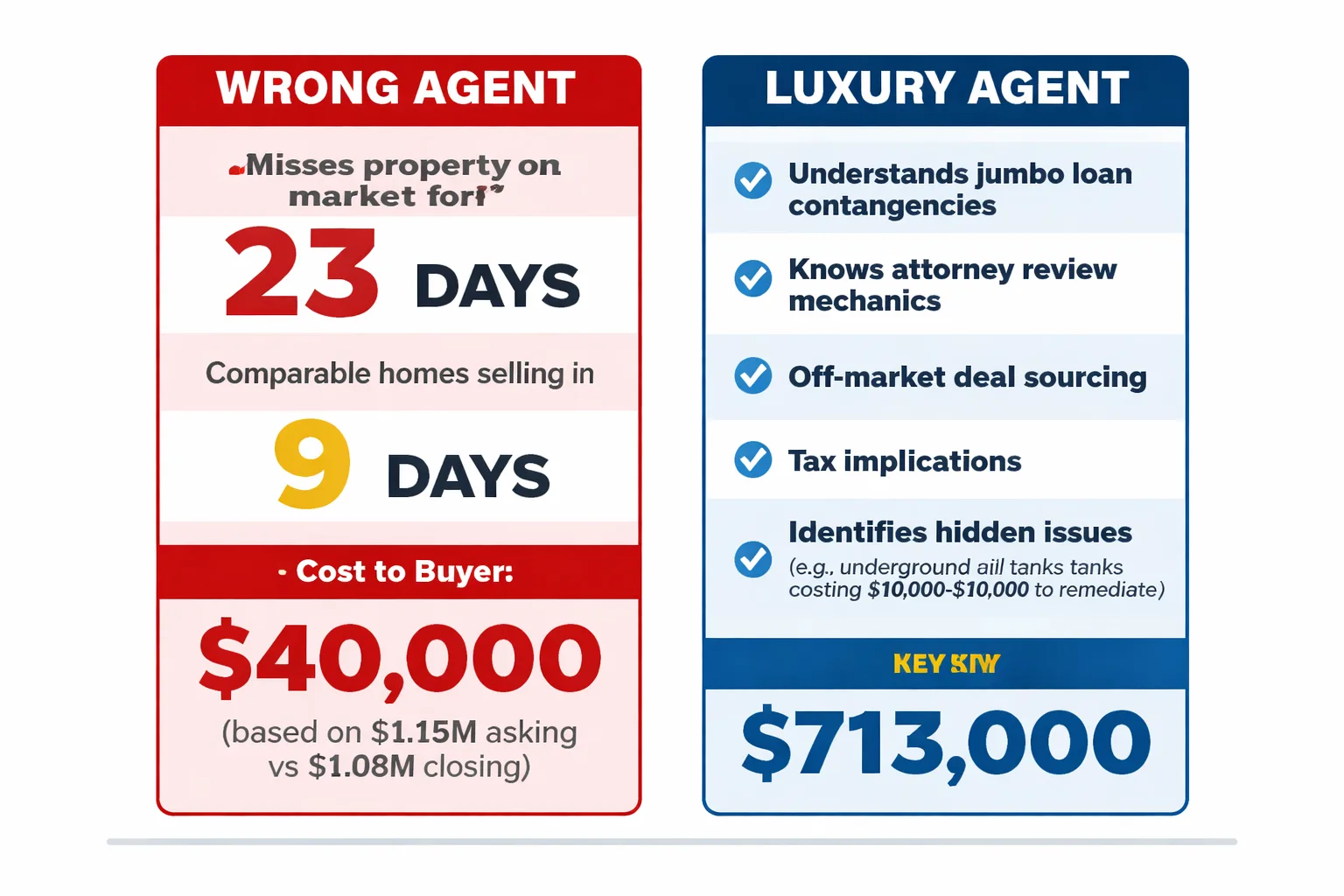
Luxury transactions require specific competencies. The agent needs to understand jumbo loan contingencies, attorney review mechanics, off-market deal sourcing, and the tax implications of purchasing in different counties. They need to know whether a property has hidden issues, like underground oil tanks, that are common in older New Jersey homes and can cost $10,000 to $30,000 to remediate.
The data backs this up. A buyer in Bergen County was recently advised to offer full asking price on a $1.15 million home. The agent missed that the property had been on the market for 23 days, while comparable homes in that area were selling in an average of 9 days. Similar properties were closing at $1.08 million. That advice cost the buyer at least $40,000.
At the $2 million-plus level, the stakes are higher. A missed comp, a poorly timed offer, or a failure to negotiate inspection findings can cost $50,000 to $100,000.
Your team should include:
1. A specialized luxury real estate agent with documented transaction history at your price point 2. A jumbo loan lender (not a general mortgage broker) 3. A New Jersey real estate attorney (mandatory in NJ, unlike some states) 4. A home inspector experienced with high-end and new construction properties 5. A title company familiar with luxury transactions
The NJ Home Buying Process guide walks through the full timeline from offer to closing, including the attorney review period that is unique to New Jersey.
Step 4: Get Pre-Approved Before You Tour
Touring luxury homes without a pre-approval is wasted time. Listing agents for luxury homes for sale in nj routinely ask for proof of funds or pre-approval before allowing showings. If you cannot produce it, you will not get past the front door.
The pre-approval process for jumbo loans is more intensive than conventional mortgages. Expect to provide:
- Two years of personal and business tax returns (if self-employed) - Full asset statements (bank, investment, retirement accounts) - Profit and loss statements for the current year (if self-employed) - Explanation of any large deposits or credit inquiries. Verification of identity and residency status
The lender will also pull a tri-merge credit report and may request a property-specific appraisal before issuing final approval. On new construction, the appraisal must account for builder upgrades and lot premiums, which can complicate the valuation.
Start the pre-approval process early. It takes 2 to 3 weeks for most buyers, longer for self-employed individuals or those with complex asset structures. Once you have the letter, it is valid for 60 to 90 days, which aligns with a typical luxury search timeline.
For buyers also considering new construction, the New Condo Developments Near Me resource covers what to look for in developer agreements, warranty terms, and upgrade pricing.
Step 5: Tour Properties Like an Investor
Most luxury buyers tour homes emotionally. They walk in, see the marble kitchen and the wine room, and start imagining dinner parties. That is exactly how you overpay.
Touring like an investor means looking at data before you look at finishes.
Before any showing, your agent should provide a comparative market analysis (CMA) that includes:
- Recent sales within the last 6 months in that specific town and price tier. Current active listings (your competition) - Days on market for the subject property and for recent comps. Price per square foot for sold properties, adjusted for lot size and condition. Any price reductions on the subject property
Days on market is a critical signal. A luxury home that has been listed for 90+ days in a town where similar properties sell in 30 to 45 days is either overpriced or has a specific issue (location, layout, lot shape). That is leverage in negotiation. A home that just hit the market and already has multiple showings is not where you start with a low offer.
Price per square foot is useful but imperfect. A 5,000-square-foot home on two acres is not directly comparable to a 5,000-square-foot home on a quarter acre. Your agent should adjust for lot value, which in luxury markets can represent 25% to 40% of total property value.
When touring new construction specifically, look beyond the finishes. Check the builder's warranty terms, which in New Jersey typically cover structural defects for 10 years but may limit coverage on other systems. Ask about the builder's reputation, previous projects, and whether any of their developments have had litigation over construction defects. The New York Real Estate Developers guide covers how to evaluate developer track records, which applies equally to NJ builders serving the Manhattan commuter market.
Step 6: Negotiate, Enter Attorney Review, and Close
New Jersey is one of the few states where a real estate attorney is required for residential transactions. After you make an offer and the seller accepts, the contract enters a three-day attorney review period. During this window, either party can cancel the transaction for any reason, and attorneys on both sides negotiate contract terms.
This is where luxury transactions get complex.
The attorney review period is your chance to renegotiate based on inspection findings. In New Jersey, the home inspection typically happens during or immediately after attorney review. If the inspection reveals issues (roof, foundation, HVAC, underground oil tank, mold, water intrusion), your attorney can request repairs, price credits, or contract amendments.
For new construction, the inspection is different. You are not just checking the home's condition. You are verifying that the builder delivered what was specified in the contract: the agreed-upon upgrades, the lot, the finishes, the systems. A punch list inspection, conducted 30 to 60 days before closing, identifies incomplete or deficient items. The builder must address them before closing or provide a credit.
Closing costs in New Jersey luxury transactions typically include:
| Cost Item | Typical Range |
| Attorney fees | $1,500 to $3,500 |
| Title insurance | $3,000 to $8,000+ |
| Transfer tax (state) | $4.00 per $500 of value |
| Mansion tax (over $1M) | 1% of purchase price |
| Recording fees | $100 to $300 |
| Survey (if required) | $500 to $2,000 |
The mansion tax is a New Jersey-specific cost that catches many buyers off guard. On a $2 million purchase, that is an additional $20,000. Budget for it.
The closing timeline for luxury transactions in New Jersey typically runs 30 to 60 days from contract execution, assuming financing is in place. Cash deals can close faster, sometimes in 14 to 21 days, but title work and attorney review still require time.
Which NJ County Has the Highest Property Taxes?
Essex County has the highest average property taxes in New Jersey, with an average effective rate that consistently ranks above Bergen County. According to the New Jersey Office of the Attorney General, property tax administration varies significantly by county, and Essex County municipalities like Millburn, Maplewood, and South Orange carry some of the state's highest effective rates.
For luxury buyers, this matters directly. A $2 million home in Essex County may carry $45,000 to $55,000 in annual property taxes. The same home in Bergen County (Tenafly, Demarest, Englewood Cliffs) may carry $30,000 to $40,000. Over a 10-year holding period, that difference compounds to $150,000 or more.
To calculate your estimated annual tax bill, multiply the assessed value of the property by the municipal tax rate. In New Jersey, assessed values are supposed to mirror market value, but revaluations happen infrequently. Ask your agent for the current assessed value and the most recent tax bill before making an offer.
Senior exemptions (65+) may apply. New Jersey offers a property tax deduction of up to $250 per year for qualifying senior residents, and some municipalities offer additional senior freeze programs that cap year-over-year increases. These are modest savings relative to the total bill, but they are worth claiming.
How Do You Spot Fake Luxury in New Jersey?
The term "luxury" is unregulated in real estate marketing. Any developer or seller can slap the word on a listing, and many do. Distinguishing genuine luxury nj homes for sale from marketing-driven imitations requires looking past the surface.
Real luxury is found in the systems and construction quality, not the staging. Subtle indicators of true high-end construction include separate drains for every sink and shower (a sign of premium plumbing engineering), solid core doors, commercial-grade HVAC zoning, and structured wiring for smart home systems that runs through dedicated conduits rather than retrofitting. These are the features that prevent costly repairs and maintain property value over a 10 to 20 year holding period.
Flashy amenities marketed in brochures, like infinity pools or brand-name appliances, are often used to justify a price premium that does not hold up in resale. A $15,000 Sub-Zero refrigerator can be installed in any kitchen. It does not make the home luxury. What matters is whether the envelope, foundation, and mechanical systems match the price tag.
When touring new construction, ask the builder for a specification sheet that details the insulation values, framing dimensions, plumbing brands, and electrical panel capacity. If they cannot or will not provide it, that is a signal. A builder confident in their construction quality will document it.
What Due Diligence Protects Luxury Investors in NJ?
Luxury real estate is not just a home. It is an investment asset. And like any investment, it carries risks that standard buyer due diligence does not always catch. The threat of fraud in high-value real estate is real. A leader of a New Jersey real estate investment firm recently admitted to a role in a $658 million Ponzi scheme that defrauded investors through fraudulent property deals, according to the U.S. Attorney's Office, District of New Jersey.
That case is an extreme example, but it highlights a pattern. High-net-worth buyers, particularly those investing from abroad or entering the market for the first time, often skip the verification steps that protect their capital. They trust the brand, the presentation, or the referral without checking the underlying documentation.
For luxury homes in nj for sale, standard due diligence means verifying the chain of title, checking for liens or encumbrances, confirming the property's zoning and any variance history, and reviewing the survey for boundary disputes. For new construction, it means reviewing the builder's corporate history, litigation record, and warranty claims history. A builder with multiple recent lawsuits over construction defects is a risk, regardless of how polished the model home looks.
For investors evaluating commercial or mixed-use opportunities alongside residential luxury, the Investment Real Estate Agency resource covers commercial-specific due diligence, and the What Is Commercial Real Estate guide breaks down asset classes and investment structures.
What Are the Hidden Risks in NJ Luxury Real Estate?
Beyond the standard transaction risks, New Jersey luxury buyers face specific exposures that can derail an investment. Political and regulatory risk is one that catches international investors off guard.
The One Journal Square project in Jersey City is a case study. Despite its luxury positioning and high-profile backing, the project stalled due to mayoral opposition to tax abatements and controversies surrounding the EB-5 visa program. Investors who committed capital based on projected returns and immigration timelines found themselves in limbo. Local politics and regulatory changes can completely derail even the most promising-looking investments.
Underground oil tanks are another New Jersey-specific issue. Many older homes in Bergen and Essex counties have abandoned or active underground storage tanks. Remediation can cost $10,000 to $30,000, and contamination can trigger environmental liability. A specialized environmental inspection is a wise investment before closing on any luxury property built before 1990.
Water intrusion and foundation issues are also common in older luxury estates. A standard home inspection may not catch subtle signs of water penetration behind finished basement walls. Hire an inspector who uses thermal imaging and moisture meters, not just a visual walkthrough.
What This Won't Fix
This six-step process assumes you are buying a luxury home as a primary residence or a long-term hold. It does not solve for three scenarios.
First, if you are buying for short-term appreciation, the process changes. New Jersey luxury markets are illiquid. Homes sit longer, and price movements are slower than in Manhattan condos. A flip strategy on a $2 million home in Bergen County is a different calculus than what this guide covers.
Second, if you are an international investor relying on EB-5 or similar programs, regulatory risk can override every other factor. The One Journal Square project in Jersey City stalled due to mayoral opposition to tax abatements and EB-5 controversies, leaving investors with uncertain returns and immigration outcomes. No amount of market analysis compensates for political risk at that level.
Third, if you are buying commercial real estate or mixed-use property, the due diligence framework is entirely different. Residential luxury and commercial investment require different specialists, different financing, and different tax analysis. Do not use this guide for commercial acquisitions.
For investors evaluating commercial opportunities, the Investment Real Estate Agency resource covers commercial-specific due diligence, and the What Is Commercial Real Estate guide breaks down asset classes and investment structures.
The Bottom Line
Buying new luxury homes in nj is a process that rewards preparation and punishes shortcuts. The buyers who succeed are the ones who define their budget honestly, choose a town that fits their life, assemble a team with luxury-specific experience, get pre-approved before touring, evaluate properties with data, and navigate attorney review with a competent attorney.
The buyers who fail are the ones who skip steps, trust the wrong agent, and fall in love with finishes before checking the comps. At $2 million-plus, every mistake costs real money.
The New Jersey luxury market in 2026 is competitive, but it is navigable. The data is available. The process is knowable. The question is whether you will follow it.
FAQ
What is the average price of luxury homes in NJ?
The entry point for luxury homes in the New York-Newark-Jersey City metro area is approximately $2.62 million for the priciest 10% of listings, per Realtor.com's September 2026 Luxury Housing Report. In New Jersey specifically, luxury homes in top towns like Tenafly, Short Hills, and Demarest typically start around $1.5 million, with premium estates reaching $5 million to $10 million.
How long does it take to close on a luxury home in New Jersey?
Closing typically takes 30 to 60 days from contract execution if financing is in place. The three-day attorney review period, home inspection, appraisal, and title work all fit within this window. Cash transactions can close in 14 to 21 days, though attorney review and title searches still require time.
Do I need a real estate attorney in New Jersey?
Yes. New Jersey is one of the few states that requires an attorney for residential real estate transactions. The attorney review period is a mandatory three-day window after contract execution where either party can cancel or renegotiate. For luxury transactions, the attorney also negotiates inspection findings, contract contingencies, and closing terms.
What is the mansion tax in New Jersey?
New Jersey charges a 1% mansion tax on residential properties sold for $1 million or more. On a $2 million purchase, that is $20,000. This is in addition to the standard state transfer fee of $4.00 per $500 of property value. Buyers should budget for this as part of closing costs.
Are new construction luxury homes in NJ a good investment?
New construction can offer advantages: modern systems, energy efficiency, builder warranties, and customization options. However, the investment value depends on the builder's reputation, location, lot quality, and whether the purchase price aligns with comparable resale values. Some new builds carry a premium that does not fully translate to resale value in the first five years.
How do I find off-market luxury homes in New Jersey?
Off-market inventory is significant in the luxury market. Working with an agent who has relationships with other luxury agents, access to private networks, and knowledge of pre-market listings is the primary way to access these properties. Off-market residential sales volume jumped at least 30% year-over-year in Brooklyn, Manhattan, and Queens in 2025, per The Real Deal, and similar trends are reaching New Jersey.
What should I look for in a luxury home inspection?
Beyond the standard roof, foundation, and HVAC checks, luxury inspections should include thermal imaging for moisture detection, separate evaluations for smart home systems and commercial-grade appliances, environmental testing for radon and mold, and an underground oil tank sweep for properties built before 1990. For new construction, a punch list inspection 30 to 60 days before closing verifies that the builder delivered all contracted upgrades and finishes.
About the Author
Judy Zhou, Keller Williams Realtor®
Judy Zhou is a Realtor® with Keller Williams Town Life Realty in Tenafly, NJ, serving New Jersey and New York with $35M+ in sales volume. Licensed in both NJ and NY, she specializes in luxury homes, investment properties, and commercial real estate, offering seamless bilingual English-Chinese service. Before joining Keller Williams, she earned Coldwell Banker's International President's Elite (2024) and International Diamond Society (2025) awards.
Stop browsing listings and start working with an agent who has closed $35M+ in NJ and NY real estate. Schedule a consultation to define your budget, shortlist your towns, and access off-market luxury inventory before it hits the MLS.