What Is Commercial Real Estate? The 2026 Investor's Guide

By Judy Zhou, Coldwell Banker Realtor®
Key Takeaways
- Commercial real estate generated 9.72% average annual returns for listed equity REITs over 26 years, beating private real estate's 7.79%.
- New Jersey commercial vacancy rates stayed significantly below the national average across all seven metro areas and four property classes.
- Target office buildings, retail centers, and multifamily complexes of five or more units in New York and New Jersey markets to capture longer leases and stronger inflation hedges.
- Calculate net operating income and focus on high-barrier assets to benefit from the post-pandemic flight to quality reshaping commercial values in 2026.
Residential real estate is not the safe, reliable wealth-builder most investors think it is. Commercial property is. While first-time investors pour money into single-family rentals chasing modest yields, seasoned players in markets like Manhattan and northern New Jersey have long understood that office buildings, retail centers, and multifamily complexes above a certain unit threshold deliver superior income stability, stronger appreciation fundamentals, and tax structures that residential assets can't touch. If you've been sleeping on commercial property as investment, 2026 is the year to wake up.
Commercial property as investment generates higher yields, longer lease terms, and stronger inflation hedges than residential real estate. Data from a 26-year CEM Benchmarking study shows listed equity REITs returned an average of 9.72% annually, outperforming private real estate's 7.79%. Rutgers research found New Jersey commercial vacancy rates were significantly lower than the national average across all seven metropolitan areas and all four property classes. The NYC Comptroller's office confirms a post-pandemic flight to quality that is reshaping which commercial assets hold value. The 2026 landscape rewards investors who understand asset classes, can calculate net operating income, and know how to execute deals in high-barrier markets like NJ and NY.
What Is Commercial Real Estate, Exactly?
Commercial real estate (CRE) is any income-producing property used exclusively for business purposes. That includes office buildings, retail centers, industrial warehouses, multifamily apartment complexes (typically five or more units), hotels, and mixed-use developments combining residential and commercial space. The line between residential and commercial isn't just about the building. It's about how the asset is financed, leased, valued, and managed.
The legal distinction matters enormously. Residential properties fall under consumer protection laws that cap security deposits, regulate eviction procedures, and mandate certain habitability standards. Commercial leases are business-to-business contracts with far fewer statutory guardrails. A commercial tenant can agree to maintain the roof, replace the HVAC system, and pay property taxes through a triple-net lease structure. That shift in responsibility changes the entire financial profile of the asset.
Financially, commercial properties are valued based on their income-producing capacity, not comparable sales. A residential appraiser looks at what similar homes sold for in the neighborhood. A commercial appraiser calculates the property's net operating income (NOI) and applies a capitalization rate to determine value. This means a well-managed commercial asset can be force-appreciated by increasing revenue or cutting expenses. A residential property's value is largely at the mercy of market comps.
Operationally, commercial real estate demands a different mindset. Lease negotiations take weeks or months, not days. Tenant improvements can cost hundreds of thousands of dollars. Due diligence involves environmental assessments, zoning verification, and lease abstract analysis. Investors who approach commercial deals with a residential mindset routinely underestimate the complexity and get burned on hidden liabilities buried in lease documents.
The tax structures available to commercial investors are also distinct. Cost segregation studies can accelerate depreciation on commercial buildings, generating substantial paper losses that shelter other income. 1031 exchanges allow investors to defer capital gains taxes by reinvesting proceeds into like-kind commercial properties. These benefits exist for residential investors too, but the scale and flexibility of commercial tax strategies are fundamentally different.
For investors considering investment on commercial property, the definition extends beyond just "a building where business happens." It encompasses an entire ecosystem of financing mechanisms, lease structures, and valuation methods that residential real estate doesn't touch.
Is Commercial Property a Good Investment in 2026?
Yes, commercial property remains a strong investment in 2026, particularly in the NJ and NY markets, but the answer depends heavily on asset class and location. Industrial and multifamily properties continue to outperform office and retail, and northern New Jersey's proximity to Manhattan creates persistent demand that insulates commercial assets from national downturns.
The Rutgers Policy Lab report found that all seven New Jersey metropolitan areas had lower vacancy rates for multifamily commercial properties compared to the national average as of early 2022. Most NJ metro areas showed lower-than-average vacancies across all four commercial property classes: multifamily, industrial, office, and retail. Property tax assessors interviewed by Rutgers researchers expressed optimistic views about current and future demand for New Jersey commercial property, particularly for industrial and multifamily assets. That optimism has held through 2026.
The NYC Comptroller's office confirmed that NYC office market vacancy rates approximately doubled post-pandemic, with Class B and C buildings facing particular challenges. But this isn't a uniform decline. It's a flight to quality. Class A buildings in prime Manhattan locations are absorbing tenants fleeing older, less amenitized spaces. Investors who buy Class B or C office buildings without a repositioning plan are taking on real risk. Those who target Class A or invest in industrial and multifamily are positioned for stable returns.
Cap rates in 2026 vary widely by asset class and submarket. Industrial properties in northern New Jersey trade at cap rates between 5% and 7%, reflecting strong demand from e-commerce and logistics tenants. Multifamily assets in Hudson County and along the Gold Coast trade at 4% to 6%, with premium properties in Jersey City and Hoboken sometimes dipping below 4%. Manhattan office cap rates range from 6% to 9% depending on building class and location, with distressed Class C assets trading at even higher spreads.
The Deloitte 2026 Commercial Real Estate Outlook highlights that sustainability mandates and ESG requirements are increasingly driving tenant preferences. Buildings with green certifications command rent premiums and lower vacancy rates. Investors who ignore this trend in 2026 are buying assets that will underperform.
For those asking is commercial property a good investment, the data points to a qualified yes. The qualification matters: asset selection, market knowledge, and professional guidance separate winners from losers. The NAR's July 2025 Commercial Real Estate Market Insights confirmed that commercial transaction volumes are recovering from the 2023-2024 slowdown, with industrial and multifamily leading the rebound.
How Commercial Property Returns Are Calculated
Understanding commercial real estate metrics is non-negotiable. These numbers determine whether a deal makes money or destroys it. Four metrics matter most: net operating income, capitalization rate, cash-on-cash return, and gross rent multiplier.
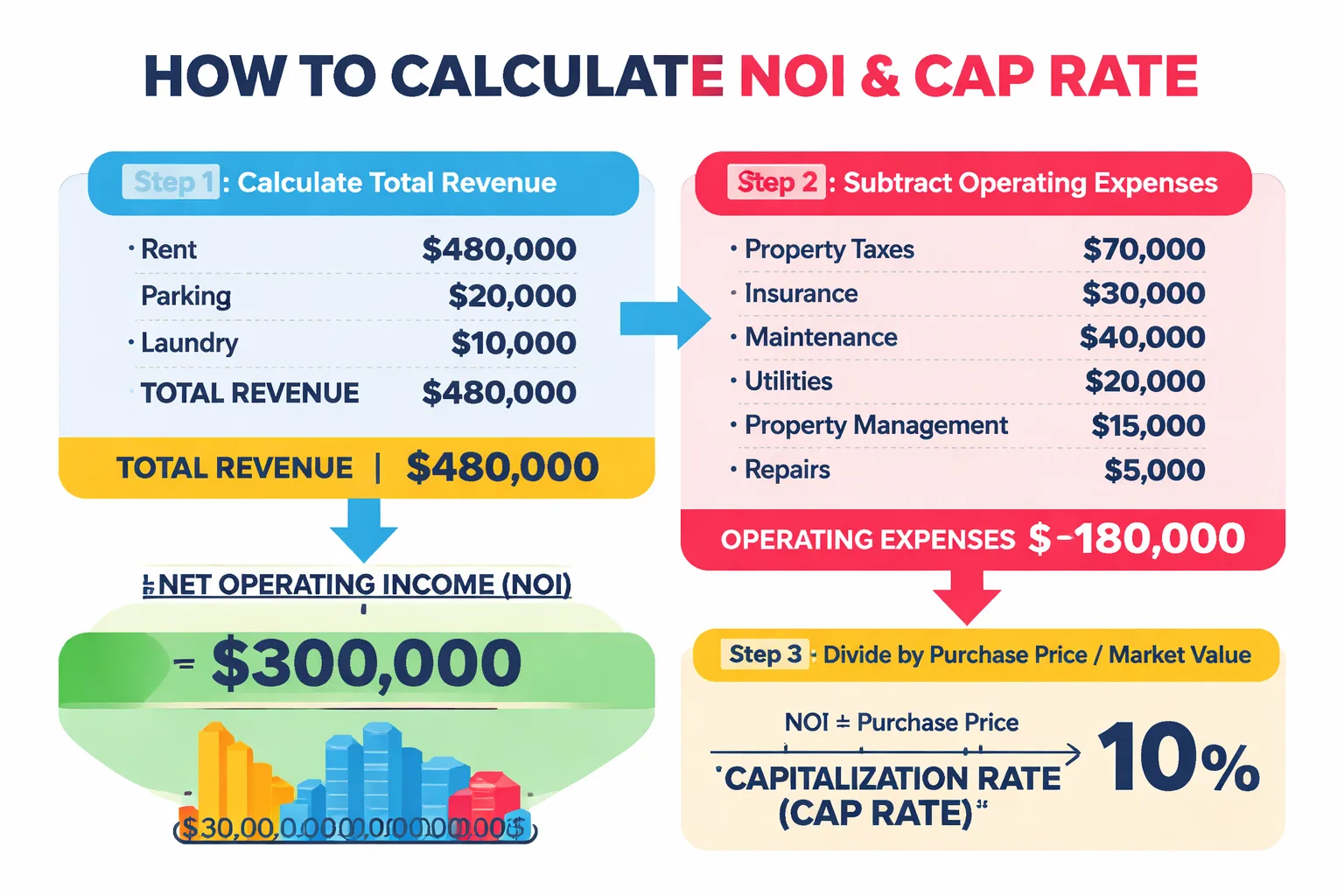
Net Operating Income (NOI) is the foundational number. It's the property's total revenue minus all operating expenses, excluding debt service and depreciation. Revenue includes rent, parking fees, laundry income, and any other revenue the property generates. Operating expenses include property taxes, insurance, maintenance, utilities (for common areas), property management fees, and repairs. A 20-unit apartment building in Jersey City generating $480,000 in annual rent with $180,000 in operating expenses has an NOI of $300,000. That number drives every other calculation.
Capitalization Rate (Cap Rate) is the property's unlevered yield. Divide NOI by the purchase price or current market value. A property with $300,000 in NOI purchased for $5,000,000 has a 6% cap rate. Cap rates compress when markets heat up (prices rise faster than rents) and expand when risk increases or markets cool. The cap rate is also a quick risk gauge: a 4% cap rate signals a lower-risk, premium asset in a prime location. A 9% cap rate signals higher risk, likely in a secondary market or with a building needing significant work.
Cash-on-Cash Return measures the actual yield on invested capital after debt service. If an investor puts $1,500,000 down on a $5,000,000 property (with a $3,500,000 loan at 6% interest), and the property generates $300,000 in NOI with $252,000 in annual debt service, the cash flow is $48,000. The cash-on-cash return is $48,000 divided by $1,500,000, or 3.2%. That's tight. Investors typically want 8% or higher on commercial deals, which means either negotiating a lower purchase price, increasing rents, or finding cheaper financing.
Gross Rent Multiplier (GRM) is a quick screening tool. Divide the purchase price by gross annual rent. A property listed at $5,000,000 generating $480,000 in annual rent has a GRM of 10.4. Lower GRMs indicate better value, but GRM ignores expenses, so it should never be the sole metric. It's useful for comparing similar properties in the same submarket during initial screening.
Here's a practical example. An investor finds a 15-unit multifamily building in Fort Lee, NJ listed at $4,200,000. Current rent roll shows $540,000 in gross annual rent. Operating expenses run approximately 38% of gross income, or $205,200. NOI is $334,800. The cap rate is $334,800 divided by $4,200,000, or 7.97%. With a 30% down payment ($1,260,000) and a 6.5% commercial mortgage, annual debt service is approximately $243,000. Annual cash flow is $91,800. Cash-on-cash return is 7.3%. That's a viable deal, though investors should model rent increases and expense inflation to stress-test the assumptions.
When evaluating commercial real estate investment property loans, lenders typically look at the Debt Service Coverage Ratio (DSCR). DSCR is NOI divided by annual debt service. Most commercial lenders require a minimum DSCR of 1.25, meaning the property's NOI must exceed debt service by at least 25%. A property with $334,800 in NOI and $243,000 in debt service has a DSCR of 1.38, which clears the threshold comfortably.
Who Should (and Shouldn't) Invest in Commercial Property?
Commercial real estate is not for everyone. The capital requirements, complexity, and risk profile demand a specific type of investor. Understanding whether the profile fits is the first honest step.
Investors who should consider commercial property:
Accredited investors with $500,000 or more in deployable capital are well-positioned. Commercial down payments typically range from 25% to 35%, and a quality asset in NJ or NY starts around $2,000,000. That means $500,000 to $700,000 in cash, plus reserves for tenant improvements, leasing commissions, and unexpected repairs.
Investors seeking passive income with inflation protection benefit from commercial leases that include rent escalations tied to CPI or fixed annual increases. A 10-year commercial lease with 3% annual escalations provides predictable, growing income that residential month-to-month tenancies can't match.
Those with a long-term horizon of 7 to 10 years or more can weather market cycles. Commercial real estate values fluctuate with interest rates and economic conditions. Investors who need liquidity within 3 years should stay in public markets, not lock capital into illiquid buildings.
Investors who already own a business and need a location can benefit from owner-occupied commercial real estate. SBA 504 loans allow business owners to purchase property with as little as 10% down, making the entry barrier far lower than for investor-owned deals.
Investors who should think twice:
First-time investors with under $100,000 in capital are better served by New Jersey real estate investment strategies focused on residential or mixed-use properties, or by REITs that offer commercial exposure without the capital intensity.
Investors who want hands-off passive income without active management should look at REITs or syndications, not direct ownership. Commercial buildings require active management, tenant relationships, and periodic capital improvements. The data backs this up: the CEM Benchmarking 2026 Study found that listed equity REITs returned an average of 9.72% annually over a 26-year period, outperforming private real estate's 7.79% net return. For purely passive investors, the public markets actually delivered better results.
Investors with low risk tolerance who can't stomach vacancy periods or unexpected capital expenditures should avoid direct commercial ownership. A commercial tenant vacating a 10,000-square-foot retail space can mean 6 to 12 months of zero income while the space is re-tenanted. The financial impact is far more severe than a single residential unit going vacant.
Those without access to professional commercial brokerage expertise should not attempt direct investment. The complexity of commercial leases, zoning regulations, environmental assessments, and financing structures creates too many traps for unguided investors. Working with an investment real estate agency that understands the NJ and NY commercial landscape is not optional. It's a prerequisite.
The contrarian view here: many investors assume commercial real estate is inherently riskier than residential. The data suggests otherwise when deals are structured properly. Longer lease terms, triple-net structures that pass expenses to tenants, and institutional-grade due diligence actually reduce certain risks that residential landlords face routinely. The risk in commercial real estate comes from ignorance, not the asset class itself.
What Are the Main Types of Commercial Property?
Commercial real estate encompasses several distinct asset classes, each with different risk-return profiles, tenant dynamics, and financing structures. Understanding these categories is essential for any investor evaluating commercial property as investment.
Office buildings range from single-tenant professional buildings to downtown Class A skyscrapers. The office sector faces structural headwinds in 2026 as remote and hybrid work arrangements persist. However, Class A buildings with modern amenities, green certifications, and prime locations continue to perform well. The flight to quality documented by the NYC Comptroller means tenants are consolidating into fewer, higher-quality spaces. Investors considering office assets must differentiate between trophy buildings in Manhattan's Financial District and aging Class C properties in secondary locations.
Retail properties include neighborhood strip centers, regional malls, single-tenant net-leased buildings, and mixed-use ground-floor retail. The retail sector has bifurcated. Grocery-anchored strip centers in dense NJ suburbs remain resilient because they serve daily needs. Regional malls continue to struggle. Single-tenant net-leased properties (pharmacies, fast food, dollar stores) offer predictable income with minimal management, making them popular entry points for first-time commercial investors.
Industrial properties encompass warehouses, distribution centers, light manufacturing, and flex space. This is the strongest-performing commercial sector in 2026. Northern New Jersey's proximity to the Port of Newark, major highways, and the Manhattan consumer market makes it one of the most sought-after industrial markets in the country. E-commerce demand continues to drive absorption, and cap rates remain compressed. Investors seeking industrial exposure in NJ face intense competition but strong fundamentals.
Multifamily commercial properties are apartment buildings with five or more units. These bridge the residential and commercial worlds. They offer the income stability of commercial leases (typically 12-month leases with renewal options) while serving the essential human need for housing. The Rutgers data showing NJ multifamily vacancy rates below the national average underscores the strength of this asset class. Hudson County's 8% corporate ownership rate for residential properties (the highest in NJ) signals strong institutional interest in the region's multifamily market.
Hospitality properties include hotels, motels, and resorts. These are the most cyclical commercial assets, with revenue directly tied to economic conditions and travel patterns. Hotel investments require specialized management and carry higher operational risk. They're typically reserved for experienced investors with hospitality expertise.
Special purpose properties include self-storage facilities, medical offices, data centers, and educational facilities. Self-storage has emerged as a favorite among commercial investors for its low management intensity and recession-resistant demand. Medical offices benefit from the aging population trend and offer stable, long-term tenancies. Data centers are the newest commercial frontier, driven by AI infrastructure demand, though they require massive capital and specialized expertise.
Ready to evaluate your first commercial property deal in NJ or NY?
How Do Commercial Leases Actually Work?
Commercial leases are fundamentally different from residential leases. They're negotiable business contracts that can run from 1 to 25 years, with structures that dramatically affect the property's income and the owner's expenses. Three primary lease types dominate the commercial market.
Gross leases (also called full-service leases) require the landlord to pay all operating expenses: property taxes, insurance, maintenance, and utilities. The tenant pays a single monthly rent amount. This structure is common in office buildings and gives tenants predictable costs. For landlords, gross leases concentrate expense risk. If property taxes spike or a major repair is needed, the landlord absorbs the cost. Gross leases typically command higher base rents to compensate for this risk.
Net leases shift some or all operating expenses to the tenant. A single-net lease has the tenant pay property taxes in addition to rent. A double-net lease adds insurance. A triple-net lease (NNN) requires the tenant to pay property taxes, insurance, and all maintenance costs. Triple-net leases are the gold standard for commercial investors because they provide predictable income with minimal expense variability. Single-tenant retail properties (pharmacies, banks, fast food) typically use NNN leases with 10 to 15-year terms and annual rent escalations of 1.5% to 3%.
Modified gross leases split expenses between landlord and tenant in negotiated combinations. The landlord might pay structural maintenance (roof, foundation) while the tenant pays interior maintenance, utilities, and janitorial. These are common in multi-tenant office and retail buildings.
The lease type directly impacts valuation. A building with NNN leases is worth more than an identical building with gross leases because the income is more predictable and the expense risk is lower. Investors must always abstract leases during due diligence to understand exactly who pays what, when rent escalations occur, and what termination or renewal options exist.
This is where inexperienced investors get hurt. A client once overlooked a CPI-linked rent adjustment clause in a five-year commercial lease. In year three, a 15% rent hike kicked in that completely upended the tenant's budget. The tenant couldn't absorb the increase and defaulted. The landlord faced vacancy and legal costs because neither party had properly modeled the CPI adjustment. Every clause in a commercial lease has financial consequences. Treating the lease as "just paperwork" is the most expensive mistake a commercial investor can make.
What Drives Commercial Property Values in NJ and NY?
Several factors drive commercial property values in the New Jersey and New York markets. Understanding these drivers is essential for identifying opportunities and avoiding overpriced assets.
Location and accessibility remain paramount. Commercial properties near major transportation hubs, highways, and population centers command premium values. In northern New Jersey, properties along the Hudson River waterfront (Jersey City, Hoboken, Weehawken) benefit from Manhattan proximity and ferry/light rail access. In New York, properties near subway lines and in established commercial corridors maintain stronger demand.
Tenant credit quality directly impacts value. A commercial building leased to a national credit tenant (a publicly traded company with strong financials) is worth more than the same building leased to a local business. Tenant creditworthiness affects the cap rate investors are willing to accept. Investment-grade tenants can compress cap rates by 50 to 100 basis points compared to non-credit tenants.
Lease term remaining matters. A building with 12 years remaining on a 15-year NNN lease is more valuable than the same building with 2 years remaining. Long lease terms provide income certainty that investors and lenders reward with higher valuations and better financing terms.
Interest rates exert perhaps the strongest influence on commercial property values in 2026. When interest rates rise, cap rates tend to expand (property values decline) because investors demand higher yields to offset higher borrowing costs. When rates fall, cap rates compress and values rise. The relationship isn't perfectly correlated, but the directional impact is significant. The PwC/ULI Emerging Trends in Real Estate 2026 report emphasizes that interest rate uncertainty remains the dominant factor influencing commercial transaction volume and pricing.
Zoning and development potential can significantly affect value. A property zoned for higher-density use may be worth more than its current income suggests because of redevelopment potential. Investors should always verify current zoning and check for pending rezoning or development plans that could affect the property. Working with a commercial broker who knows local zoning regulations is invaluable.
Market-specific factors in NJ include the state's notoriously high property taxes. NJ property tax rates by town vary significantly, and the difference between a 2% and 4% effective tax rate can make or break a commercial deal's cash flow. Investors must model property taxes carefully and account for potential reassessments after acquisition.
How to Get Started with Commercial Real Estate Investment in NJ or NY
Getting started in commercial real estate requires a systematic approach. Skipping steps in this process is how investors lose money. Here is the phased approach that experienced commercial investors follow.
Phase 1: Define investment criteria. Before looking at any property, an investor needs to define their target return, risk tolerance, capital available, and preferred asset class. Are they seeking a 7% cap rate on a stabilized multifamily building in Hudson County? A 9% cap rate on a value-add office building in Bergen County? A single-tenant NNN retail property with a national credit tenant? The criteria should be specific enough to filter out deals that don't fit.
Phase 2: Assemble the professional team. Commercial real estate is a team sport. The minimum team includes a commercial real estate broker, a real estate attorney, a commercial lender or mortgage broker, an accountant familiar with real estate taxation, and a property manager (if not self-managing). The broker is the quarterback. They identify opportunities, run comps, negotiate terms, and coordinate the transaction. In the NJ and NY markets, working with a broker who understands both states and serves international and bilingual clients can be the difference between a smooth transaction and a stalled deal.
Phase 3: Secure financing pre-approval. Commercial lenders include banks, credit unions, life insurance companies, debt funds, and CMBS lenders. Each has different underwriting criteria, loan terms, and risk appetites. Getting pre-approved (or at least pre-qualified) before making offers signals seriousness to sellers and their brokers. Commercial real estate investment property loans typically require 25% to 35% down, a DSCR of 1.25 or higher, and a personal guarantee from the borrower (especially for loans under $5 million).
Phase 4: Conduct rigorous due diligence. This is where deals are made or broken. The due diligence period (typically 30 to 60 days in commercial contracts) is the investor's window to verify every assumption. The checklist includes:
1. Financial audit: Verify every line of the rent roll against actual leases. Confirm that reported income matches bank deposits. The mismatch between financial statements and bank records is one of the most common reasons commercial deals fall apart during due diligence. 2. Physical inspection: Commission a Property Condition Assessment (PCA) that evaluates the building's structural, mechanical, electrical, and plumbing systems. Identify deferred maintenance and estimate remaining useful life of major systems. 3. Environmental assessment: A Phase I Environmental Site Assessment is standard. If it identifies potential contamination, a Phase II assessment with soil and groundwater testing is required. 4. Title and survey: Verify ownership, check for liens and encumbrances, and confirm the property boundaries match the survey. 5. Zoning verification: Confirm the property's current use is legal and permitted. Check for any zoning changes pending that could affect future use. 6. Lease abstracts: Have an attorney abstract every lease to identify rent escalations, termination options, tenant improvement obligations, and assignment clauses.
Phase 5: Close and transition. After due diligence, the investor secures final loan approval, obtains title insurance, and closes. The transition period involves tenant introductions, transferring security deposits, switching utility accounts, and implementing the property management plan.
For international and Chinese-American investors, the NJ and NY commercial markets present unique opportunities and challenges. Bilingual expertise matters. Lease documents, financial statements, and regulatory requirements are complex enough in English. Investors who need documents reviewed and explained in Chinese benefit from working with a broker who can bridge both languages and cultures. Understanding the nuances of cross-border investment, including FIRPTA considerations for foreign sellers and financing options available to non-U.S. citizens, requires specialized knowledge.
The Manhattan market deserves specific attention. New York investment properties in the commercial space range from small mixed-use buildings in the outer boroughs to trophy office towers in Midtown. The post-pandemic reshuffling has created opportunities for savvy investors. Manhattan luxury apartments and new development condos have seen a shift in buyer demographics. Foreign cash buyers who drove the pre-pandemic market have largely stopped showing up. Domestic high-net-worth buyers now dominate, and they prioritize livability, storage, and neighborhood integration over the glass-box aesthetic that defined the last development cycle.
This mismatch between what developers built and what buyers want has created opportunities. New condo developments near me that were designed for the pre-pandemic foreign buyer market are sitting with unsold inventory, and concessions are climbing. Investors who understand this dynamic can negotiate favorable terms on bulk purchases or distressed developer sales.
For those exploring new York real estate developers and their projects, understanding the developer's financial position and motivation is key. Developers facing loan maturities or carrying costs on unsold inventory are more motivated to deal. A commercial broker with relationships in the developer community can access off-market opportunities and negotiate from a position of strength.
What Are the Common Exit Strategies for Commercial Property?
Every commercial investment should begin with the end in mind. Exit strategy determines the holding period, improvement plan, and financing structure. Four primary exit strategies dominate commercial real estate.
Sell to another investor. The most straightforward exit. The investor improves the property's NOI through rent increases, expense reductions, or occupancy improvements, then sells at a lower cap rate (higher value) to another investor seeking stabilized income. The key is demonstrating consistent, growing income over a 3 to 5 year holding period.
Refinance and hold. If the property has appreciated and NOI has increased, the investor can refinance at a higher valuation, pull out tax-free equity, and retain ownership. This strategy allows the investor to recycle capital into new deals while keeping the cash-flowing asset. It's particularly effective when interest rates decline after the initial acquisition.
1031 exchange. This tax-deferral strategy allows an investor to sell a commercial property and reinvest the proceeds into one or more like-kind commercial properties within specific timelines (45 days to identify, 180 days to close). The capital gains tax is deferred, not eliminated, but the deferral can supercharge portfolio growth by allowing the full sale proceeds to be reinvested. Investors considering investment property commercial transactions should always model the 1031 option before selling.
Redevelop or repurpose. For properties with higher and better use potential, the investor can redevelop the site into a different property type. An old industrial site in a gentrifying NJ suburb might be redeveloped into mixed-use residential and retail. A struggling Class C office building might be converted to residential. These projects carry significant risk and require entitlements, construction expertise, and substantial capital, but the returns can be exceptional.
What Risks Should Commercial Investors Watch For?
Commercial real estate carries risks that residential investors may not encounter. Understanding these risks is essential for protecting capital.
Tenant concentration risk. A single-tenant commercial building has all its income tied to one tenant. If that tenant defaults or leaves, the property produces zero income until re-tenanted. Multi-tenant buildings mitigate this risk through diversification, but even multi-tenant properties can suffer if multiple leases expire simultaneously.
Interest rate risk. Commercial mortgages often have shorter terms (5, 7, or 10 years) than residential 30-year fixed mortgages. When the loan matures, the investor must refinance at prevailing rates. If rates have risen significantly, the new debt service may exceed the property's cash flow, forcing a sale at an unfavorable time or a capital call.
Economic cycle risk. Commercial property performance is tied to economic activity. Office demand correlates with employment. Retail demand correlates with consumer spending. Industrial demand correlates with trade and logistics volumes. A recession can increase vacancies and reduce rents across all sectors simultaneously.
Environmental liability risk. Commercial properties can carry environmental contamination from prior uses (gas stations, dry cleaners, industrial manufacturing). The cost of remediation can exceed the property's value. Phase I and Phase II environmental assessments during due diligence are the primary defense against this risk.
Regulatory and zoning risk. Changes in zoning laws, building codes, or rent regulations can affect property values and income. New York City's Local Law 97, which imposes carbon emission limits on buildings, is a current example. Property owners who fail to comply face fines that can erode NOI. Investors must stay informed about regulatory changes in their markets.
Liquidity risk. Commercial real estate is illiquid. Selling a commercial property can take 6 to 18 months. Investors who need to access capital quickly may be forced to sell at a discount. This is why commercial investments require a long-term horizon and adequate reserves.
The JP Morgan 2026 Commercial Real Estate Trends report notes that while risks are real, the commercial sector's fundamentals remain sound in markets with strong employment growth and limited new supply. Northern New Jersey and Manhattan both qualify, making them attractive markets for investors who understand the risks and structure their deals accordingly.
How Does the NJ/NY Market Compare Nationally?
The New Jersey and New York commercial markets behave differently than the national average. Understanding these differences is what allows local investors to outperform.
New Jersey's commercial vacancy rates were significantly lower than the national average across all seven metropolitan areas studied by Rutgers, encompassing multifamily, industrial, office, and retail. This is not a marginal difference. It reflects the state's geographic advantage as a distribution hub, its dense population supporting retail and multifamily demand, and its limited land availability constraining new supply.
The corporate ownership rate of one-to-four-unit residential properties in New Jersey was 4% statewide in 2022, with Hudson County recording the highest rate at 8%. This signals strong investor demand for the region's residential properties, which often serves as a gateway to larger commercial investments. Investors who start with residential properties in NJ frequently graduate to multifamily commercial buildings as they build capital and experience.
Manhattan's commercial market operates on a different scale. The borough's office inventory exceeds 400 million square feet, making it the largest office market in the country. The post-pandemic adjustment has been painful for Class B and C buildings, but Class A properties are recovering. The flight to quality means investors who can afford trophy assets are buying into a market with limited new supply and persistent demand from financial services, technology, and professional services tenants.
For investors considering commercial property investment in dubai or other international markets as a comparison, the NJ/NY market offers deeper liquidity, stronger legal protections, and more transparent transaction processes. International investors often find the U.S. commercial market more accessible and predictable than emerging markets, despite the higher entry costs.
The NAR commercial market data confirms that the Northeast region, including NJ and NY, maintains stronger commercial price appreciation than the national average, driven by constrained supply and persistent demand from a diverse economic base.
What Does the 2026 Outlook Hold for Commercial Property?
The 2026 outlook for commercial real estate is mixed but fundamentally positive for well-selected assets in strong markets. Several trends will shape the year ahead.
Interest rate stabilization is the most significant factor. After years of volatility, rates appear to be finding a floor. This stability allows investors to underwrite deals with greater confidence and unlocks transaction volume that was frozen during periods of rate uncertainty. Properties that were held off the market are beginning to trade.
The industrial sector continues to be the standout performer. E-commerce penetration, last-mile delivery demand, and the reshoring of manufacturing are driving industrial absorption in northern New Jersey. Cap rates have compressed, but rent growth justifies current pricing for well-located assets.
Multifamily remains resilient. Housing shortages in both NJ and NY support rent growth and occupancy. The challenge for investors is finding deals at cap rates that make sense given current financing costs. Value-add strategies, where investors increase rents through unit renovations and amenity improvements, continue to generate attractive returns.
Office remains the wildcard. The bifurcation between Class A and Class B/C will intensify. Investors with the capital and expertise to reposition older office buildings (either through renovation or conversion to residential) will find opportunities. Those buying Class C office on cap rate alone, without a repositioning plan, are likely to underperform.
ESG and sustainability requirements are no longer optional. Buildings that fail to meet energy efficiency standards face regulatory penalties and tenant flight. The Deloitte 2026 outlook emphasizes that ESG compliance is now a baseline requirement, not a differentiator. Investors must factor compliance costs into their underwriting.
For commercial property as investment in 2026, the conclusion is clear. The opportunities are real, particularly in the NJ and NY markets, but they require knowledge, capital, and professional guidance. Investors who do their homework, assemble the right team, and approach deals with discipline will find that commercial real estate delivers the income stability, appreciation potential, and tax advantages that residential properties simply can't match.
The data is unambiguous. New Jersey's commercial vacancy rates sit below national averages. Manhattan's flight to quality rewards well-located assets. Industrial and multifamily fundamentals remain strong. The investors who succeed in 2026 will be those who understand the metrics, respect the complexity, and work with professionals who know the NJ and NY markets inside and out.
FAQ
What is commercial real estate?
Commercial real estate includes income-producing properties used for business purposes such as office buildings, retail centers, industrial warehouses, multifamily complexes with five or more units, hotels, and mixed-use developments. It differs from residential real estate in financing, leasing, valuation, and management practices, with legal distinctions that affect consumer protections and investment structures.
Why is commercial real estate considered a stronger investment than residential property?
Commercial property delivers higher yields, longer lease terms, and better inflation hedges compared to single-family rentals. Data from a 26-year CEM Benchmarking study shows listed equity REITs averaging 9.72% annual returns, outperforming private real estate at 7.79%, while New Jersey commercial vacancy rates remain below national averages across multiple markets.
What market trends affect commercial real estate in 2026?
A post-pandemic flight to quality is reshaping asset values in markets like New York and New Jersey, favoring high-barrier locations with strong fundamentals. Investors who understand asset classes, net operating income calculations, and deal execution in these areas are positioned to benefit from superior income stability and appreciation.
Which property classes show the strongest performance in commercial real estate?
Office buildings, retail centers, and multifamily complexes above a certain unit threshold demonstrate superior income stability and tax advantages over residential assets. Rutgers research highlights lower vacancy rates in New Jersey across all seven metropolitan areas and four property classes, supporting long-term investor advantages.
About the Author
Judy Zhou, Coldwell Banker Realtor®
Judy Zhou is a top-ranked Coldwell Banker Realtor® serving New Jersey and New York, recognized in the top 7% of agents internationally with prestigious awards like the International Diamond Society and President's Elite. Licensed in both NJ and NY, she specializes in luxury homes, investment properties, and commercial real estate, offering seamless bilingual English-Chinese service.
Get expert guidance from a bilingual commercial real estate broker who knows the NJ and NY markets — schedule your free investment consultation today.