Commercial Property as an Investment: What the Numbers Say in 2026

By Judy Zhou, Coldwell Banker Realtor®
Key Takeaways
- Manhattan's office availability rate reached 13.0% in Q2 2026, the lowest since before the pandemic and a sign of prime asset recovery.
- Class B and C NYC properties lag trophy towers, so investors must differentiate by building class and location rather than relying on headline numbers.
- Teams using sector-specific underwriting achieve materially better risk-adjusted returns than those applying blanket strategies across NY and NJ deals.
- Investors who skip analysis of cap rate compression, sector divergence, and tenant credit risk in 2026 are gambling, not investing.
Commercial property as an investment is not the safe, steady wealth-builder most brokers want you to believe it is. At least not right now, and not everywhere. The conventional wisdom that NYC office towers and NJ mixed-use corridors are recession-proof has been shredded by rising vacancy rates, remote-work stubbornness, and a rate environment that has punished leveraged buyers since 2022. In 2026, the investors winning in this space are the ones who stopped listening to the consensus and started reading the actual numbers.
The Manhattan office market posted a 13.0% availability rate in Q2 2026, the lowest since before the pandemic shift, according to Colliers International's Manhattan Office Market report. That signals recovery in prime NYC office assets. But recovery is uneven. The NYC Comptroller's office highlights that office market performance varies dramatically by building class and location, with Class B and C properties lagging far behind trophy towers. For anyone evaluating commercial property investment right now, the headline numbers obscure a market that is splitting between winners and distressed assets at a pace rarely seen. Investors who deploy capital without understanding cap rate compression, sector divergence, and tenant credit risk in 2026 are gambling, not investing. The data tells a more nuanced story than the bullish broker pitch, and the gap between asset classes has never been wider. Teams that adopt sector-specific underwriting see materially better risk-adjusted returns than those using blanket strategies, a pattern visible across both NJ and NY transaction data this year.
What Makes Commercial Property Different from Residential Investment?
Commercial real estate operates on a completely different mechanical framework than residential rentals. The lease structures, tenant profiles, valuation methods, and financing mechanisms all diverge in ways that catch residential investors off guard when they cross over.
The core difference is lease duration and income predictability. Residential leases typically run 12 months. Commercial leases run 3, 5, 10, or even 20 years. A single commercial tenant signing a 10-year triple-net lease provides income visibility that residential landlords never achieve. But that sword cuts both ways. When a commercial tenant goes dark, the vacancy can last 12 to 24 months. A residential unit might turn over in 30 days.
Then there is the valuation mechanism. Residential properties are valued based on comparables. What did the house next door sell for? Commercial properties are valued on income. The capitalization rate, applied to net operating income, determines value. This means a commercial investor can force appreciation by increasing NOI. Cut expenses by 10 percent or raise rents by 5 percent, and the property's value jumps because the cap rate stays constant while the income base grows. Residential investors have no comparable lever.
Tenant profiles shift dramatically too. Commercial tenants are businesses with credit profiles, financial statements, and operational risk. A residential landlord screens for employment and credit score. A commercial landlord analyzes balance sheets, P&L statements, industry trends, and covenant strength. The due diligence burden is heavier, but the upside is that a creditworthy national tenant on a 10-year lease provides bond-like income predictability.
Financing works differently as well. Residential loans offer 30-year fixed rates with conforming loan standards. Commercial loans typically run 5, 7, or 10 years with amortization schedules of 20 to 25 years, often with balloon payments or rate resets. The commercial loan investment property market in 2026 is pricing deals at spreads of 250 to 350 basis points over SOFR, depending on asset class and sponsor strength. That financing structure means refinancing risk is real and constant.
For investors considering New Jersey real estate investment strategies, the shift from residential to commercial requires a fundamental rewiring of how you underwrite risk. The same property taxes that blindside first-time homebuyers in Bergen County, where reassessments can jump tax bills by 50 percent or more after closing, also affect commercial holdings. But commercial leases often pass those tax increases through to tenants via triple-net structures. Residential landlords eat those increases.
How to Evaluate a Commercial Property Deal in NJ or NY
Evaluating a commercial deal requires running four core metrics before you ever look at the building. These numbers tell you whether the deal works or fails, and in 2026's rate environment, the margin for error is thin.
Step 1: Calculate Net Operating Income (NOI)
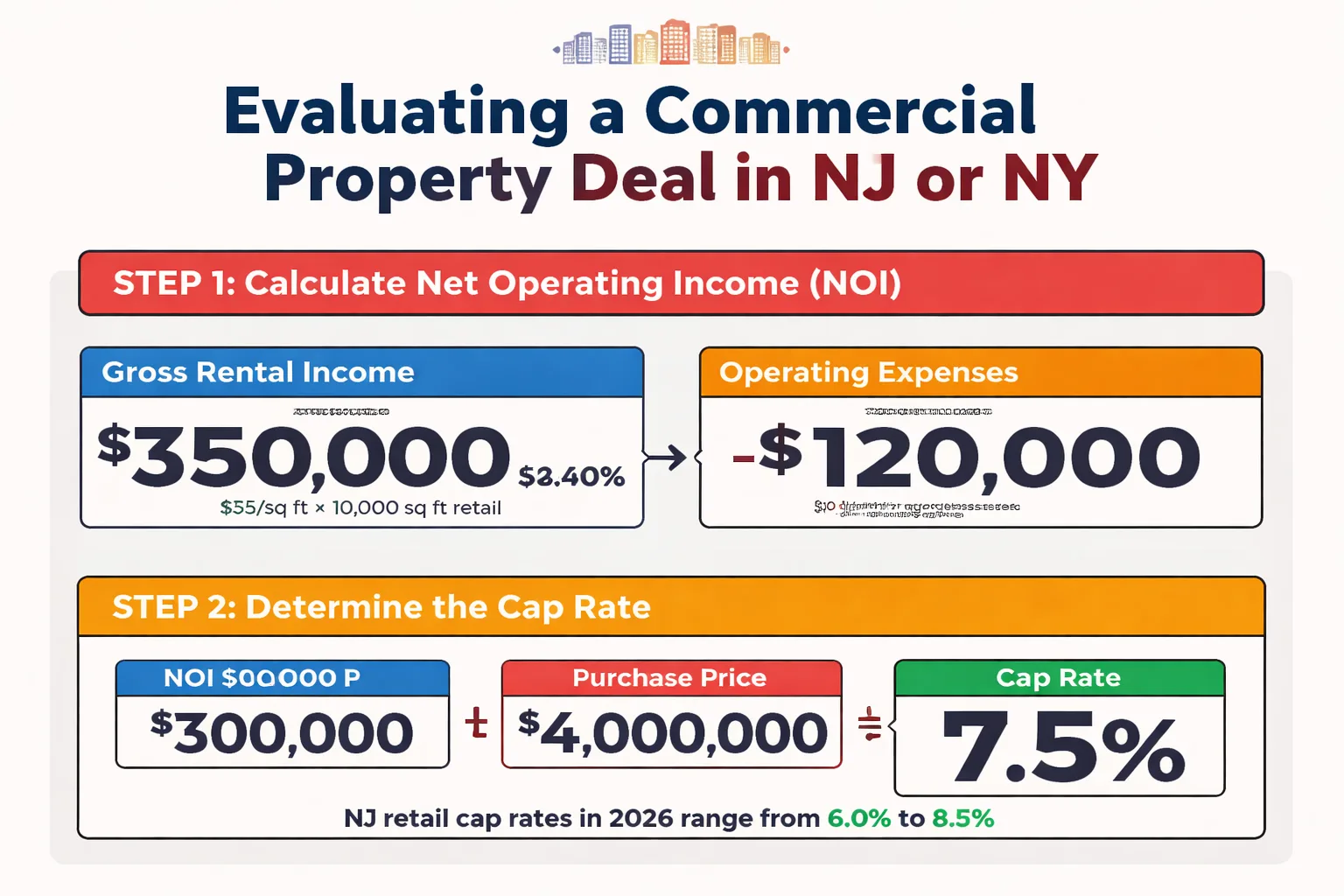
NOI is gross rental income minus operating expenses, excluding debt service and depreciation. For a 10,000-square-foot retail space in NJ renting at $35 per square foot on a triple-net lease, gross income is $350,000. If the tenant pays all operating expenses (taxes, insurance, maintenance), NOI approaches gross income minus a small management fee and reserves. If the lease is gross, subtract 30 to 40 percent for operating expenses. The NOI is the foundation for every subsequent calculation.
Step 2: Determine the Cap Rate
The capitalization rate is NOI divided by purchase price. If NOI is $300,000 and the purchase price is $4,000,000, the cap rate is 7.5 percent. In 2026, NJ retail cap rates range from 6.0 to 8.5 percent depending on location and tenant quality. Manhattan office cap rates sit between 6.5 and 9.0 percent, with trophy assets compressing toward the lower end and Class B/C properties stretching wider. Industrial properties in NJ, particularly logistics facilities near Port Newark, trade at 5.5 to 7.0 percent due to sustained demand from e-commerce and last-mile distribution.
The cap rate tells you the unlevered yield. It does not account for financing, which is where most deals live or die.
Step 3: Run Cash-on-Cash Return
Cash-on-cash return measures the actual cash flow relative to cash invested. If you put $1,200,000 down on a $4,000,000 property (30 percent down) and the property generates $180,000 in cash flow after debt service, your cash-on-cash return is 15 percent. In 2026, with commercial mortgage rates between 6.5 and 8.0 percent, many deals that looked attractive at 4 percent rates now produce single-digit cash-on-cash returns. Investors need to stress-test at current rates plus a 100-basis-point cushion.
Step 4: Check Debt Service Coverage Ratio (DSCR)
DSCR is NOI divided by annual debt service. Lenders typically require a minimum 1.25x DSCR for commercial loans. If NOI is $300,000 and annual debt service is $220,000, DSCR is 1.36x. That passes. But if rates rise and debt service jumps to $260,000, DSCR drops to 1.15x, and the deal no longer qualifies for financing. In 2026, DSCR is the metric that kills more deals than any other. Properties with marginal NOI get squeezed out when debt service eats the spread.
2026 NJ/NY Market Benchmarks by Asset Class
These are the ranges investors should use as underwriting benchmarks, not guarantees. Every deal is property-specific.
NJ Industrial (logistics/warehouse near Port Newark): Cap rates 5.5-7.0%. Rents $18-28/sq ft NNN. Vacancy under 5% in prime corridors. Strong demand from e-commerce and third-party logistics.
NJ Retail (mixed-use corridors, Route 17, Route 4): Cap rates 6.0-8.5%. Rents $25-50/sq ft NNN. Vacancy varies wildly by location. Experiential retail and food service outperform traditional soft goods.
NJ Multifamily (Bergen County, Hudson County): Cap rates 4.5-6.0%. Rents $2,200-4,500/unit/month. Strong demand from NYC spillover. Property tax volatility is the primary risk.
Manhattan Office (Class A trophy): Cap rates 6.5-7.5%. Rents $65-120/sq ft. Availability tightening at 13.0% per Colliers Q2 2026 data.
Manhattan Office (Class B/C): Cap rates 8.0-10.0+%. Rents $40-65/sq ft. Distressed sales common. Conversion to residential is viable but capital-intensive.
NYC Retail (ground-floor Manhattan): Cap rates 5.5-8.0%. Rents $100-500+/sq ft depending on corridor. Foot traffic recovery is uneven. The old model of high traffic equals high rent is broken, as seen when Beijing shopping centers saw vacancy rates decrease 0.7% year-over-year in Q4 2024, yet ground-floor rents fell 0.9% quarter-over-quarter. That pattern is repeating in Manhattan retail corridors.
Is Commercial Property a Good Investment Right Now?
This is the question every investor is asking in 2026, and the honest answer is: it depends entirely on the asset class, the location, and the sponsor's ability to underwrite properly.
For industrial properties in NJ, the answer is a qualified yes. Demand from e-commerce logistics, last-mile delivery, and third-party logistics operators remains strong. Port Newark-adjacent properties continue to see rent growth and low vacancy. The thesis is straightforward: goods need to move, and NJ is the corridor.
For Manhattan Class A office, the answer is a cautious yes for well-capitalized investors. The 13.0% availability rate in Q2 2026 represents meaningful recovery from pandemic highs. Trophy buildings with green certifications, modern amenities, and transit proximity are absorbing tenants fleeing obsolete Class B/C stock. The flight-to-quality trade is real and quantifiable.
For Class B/C office in both NJ and NYC, the answer is no, unless you have a conversion thesis. These buildings face structural headwinds from remote work, aging infrastructure, and tenant flight to better buildings. The IGIS Asset Management case at 1551 Broadway near Times Square is instructive. Investors heavily backed the office building, then the pandemic hit, remote work exploded, vacancy rates skyrocketed, and they ended up dumping junior bonds for less than 30 percent of principal. That is what happens when structural shifts meet leverage.
For NJ retail, the answer is selective. Mixed-use corridors with strong demographics and experiential tenants can work. Dead malls and power centers anchored by struggling department stores do not. The investor who buys a well-located strip center with a national credit tenant on a 10-year lease and local service tenants filling the remaining space can generate stable 7-8 percent cap rate returns. The investor who buys based on foot traffic alone, without analyzing tenant credit and lease duration, will underperform.
For multifamily in NJ, the answer is yes but expensive. Cap rates are compressed (4.5-6.0%), prices are high, and property tax risk is real. But demand from NYC spillover is relentless, and rent growth in Hudson and Bergen Counties continues to outpace inflation. The play is buy-and-hold for cash flow, not flip for appreciation.
The contrarian take: the worst time to follow the consensus on commercial real estate is when the consensus is loudest. Right now, the consensus says avoid office and buy industrial. That consensus has compressed industrial cap rates to the point where returns are thin. The smart money is looking at distressed Class B office with conversion potential, where cap rates above 10 percent provide margin for the capital expenditures needed to repurpose the building.
Are you evaluating a commercial property deal in NJ or NY and need expert underwriting guidance?
Comparison Table: Commercial vs. Residential Investment Returns
The side-by-side comparison below reflects 2026 NJ/NY market conditions. These are ranges, not point estimates, and every deal varies based on location, condition, and execution.
| Metric | Commercial Property (NJ/NY) | Residential Investment (NJ/NY) |
| Typical Cap Rate | 5.5-10.0% (varies by sector) | 4.0-6.0% (single/multifamily) |
| Cash-on-Cash Return | 6-15% (leveraged, sector-dependent) | 5-10% (leveraged) |
| Lease Duration | 3-20 years | 12 months |
| Vacancy Risk | High impact (single tenant = 100% vacancy) | Low impact (one unit of many) |
| Tenant Quality | Business credit, financials, covenants | Personal credit, employment verification |
| Financing | 5-10 year terms, 20-25 year amortization, rate resets | 30-year fixed, conforming loans available |
| Minimum Capital | $500K-$5M+ (direct ownership) | $50K-$500K (down payment) |
| Management Burden | Professional management required, tenant relationships are B2B | Self-management possible, tenant relationships are B2C |
| Liquidity | Low (6-18 month sale process) | Moderate (30-90 day sale process) |
| Tax Treatment | Depreciation, 1031 exchanges, cost segregation, interest deduction | Depreciation, 1031 exchanges, mortgage interest deduction |
| Appreciation Mechanism | Income-driven (NOI / cap rate) | Comp-driven (market comparables) |
| Barriers to Entry | High (capital, expertise, relationships) | Moderate (capital, basic knowledge) |
The table reveals why commercial property investment is not for everyone. The capital requirements are steeper. The vacancy risk concentrates in fewer tenants. The financing is shorter-term and exposes investors to refinancing risk. But the returns, when deals are properly underwritten, can exceed residential by 200 to 400 basis points on a leveraged basis.
How Do Cap Rates Differ Across NJ and NY Asset Classes?
Cap rates are not uniform. They vary by property type, submarket, tenant quality, and lease structure. Understanding these differences is essential for anyone evaluating investment in commercial property in 2026.
In NJ, industrial properties near Port Newark and the Turnpike corridors trade at the tightest cap rates (5.5-7.0%) because demand from logistics operators is relentless. These deals offer lower yields but stronger rent growth and lower vacancy risk. Investors accept lower cap rates for the safety of the income stream.
NJ retail cap rates range wider (6.0-8.5%) because the risk profile varies dramatically by location and tenant mix. A strip center anchored by a national grocery chain on Route 17 in Paramus trades at 6.0 percent. A similar center with local tenants and weaker demographics in a secondary corridor trades at 8.5 percent. The 250-basis-point spread reflects tenant credit risk, lease duration, and trade area demographics.
NJ multifamily cap rates (4.5-6.0%) are the tightest in the market. Hudson County properties near the Hudson-Bergen Light Rail and ferry terminals trade at 4.5-5.0 percent. Investors are paying up for rent growth and demand stability. The risk is property tax reassessment, which can erode NOI quickly if the municipality catches up to market values.
In Manhattan, office cap rates split by building class. Trophy Class A buildings in Plaza District and Hudson Yards trade at 6.5-7.5 percent. Class B/C buildings in Midtown South and the Financial District trade at 8.0-10.0+ percent, with some distressed sales clearing at even wider spreads. The NYC Comptroller's office has flagged this divergence as a structural shift, not a cyclical one.
Manhattan retail cap rates (5.5-8.0%) depend heavily on corridor. SoHo and Fifth Avenue prime frontage trades at 5.5-6.0 percent. Secondary corridors trade at 7.0-8.0 percent. The key variable is whether foot traffic translates to tenant sales. Increasingly, it does not, which is why underwriting must include tenant sales-per-square-foot data, not just foot traffic counts.
What Are the Main Ways to Invest in Commercial Property?
Direct ownership is the most common path for investors with sufficient capital and expertise. You buy the property, sign the lease, manage the asset, and collect the income. The upside is full control and the ability to force appreciation through NOI growth. The downside is concentration risk, capital intensity, and operational burden. Minimum capital for direct ownership in NJ/NY typically starts at $500,000 for smaller retail or mixed-use properties and scales to $5 million and above for institutional-grade assets.
Real Estate Investment Trusts (REITs) offer a passive alternative. Publicly traded REITs provide exposure to commercial real estate without the capital and management burden of direct ownership. The trade-off is that REIT returns are diluted by management fees, and share prices correlate with equity markets, not just underlying property performance. In 2026, office REITs have been volatile, reflecting the uncertainty around return-to-office trends, while industrial REITs have delivered steadier performance.
Syndications and private equity funds pool capital from multiple investors to acquire larger properties. These structures allow investors to participate in deals that would be inaccessible individually. The general partner structures the deal, raises capital, and manages the asset. Limited partners contribute capital and receive passive income. The trade-off is limited control and reliance on the GP's execution. For investors who want exposure to new York investment properties without operational involvement, syndications can be an entry point.
Crowdfunding platforms have democratized access to commercial deals with minimum investments as low as $25,000. The quality of these platforms varies enormously, and due diligence on the sponsor is critical. Some platforms have delivered solid returns on industrial and multifamily deals. Others have exposed investors to losses on office and retail bets gone wrong.
1031 exchanges remain a powerful tool for investors looking to defer capital gains by reinvesting proceeds from a sold property into a like-kind commercial property. The IRS requires strict adherence to timelines (45 days to identify, 180 days to close), and the rules are unforgiving. But for investors with appreciated residential or commercial holdings, a 1031 exchange into a commercial property can unlock better yields while deferring tax liability.
Where Are the Best NJ/NY Opportunities in 2026?
Geographic specificity matters. General market data does not help an investor who needs to know where to deploy capital in the NJ/NY corridor.
Hudson County, NJ (Jersey City, Hoboken, Weehawken): Multifamily demand remains strong due to proximity to Manhattan and transit infrastructure. Cap rates are compressed (4.5-5.5%), but rent growth justifies the pricing for buy-and-hold investors. The PATH train and ferry access make these markets perennial NYC spillover destinations.
Bergen County, NJ (Edgewater, Fort Lee, Englewood): Mixed-use properties along transit corridors offer stable returns. The demographic profile is affluent, and demand for retail and service tenants is consistent. Property tax risk is the primary concern, as reassessments can significantly impact NOI. Investors should model tax increases of 20-30 percent over a 5-year hold period.
Port Newark / Elizabeth, NJ: Industrial logistics properties are the strongest commercial thesis in the region. E-commerce demand, last-mile delivery requirements, and port-adjacent location drive rent growth and low vacancy. Cap rates are tight (5.5-7.0%), but the income stability compensates. Build-to-suit opportunities and value-add industrial conversions offer upside.
Manhattan Class A Office (Hudson Yards, Plaza District, One Vanderbilt corridor): Trophy assets are recovering. The 13.0% availability rate in Q2 2026 reflects tenant migration to quality. Investors with institutional capital can access these deals, but the entry point is steep. For smaller investors, REIT exposure to Manhattan Class A office is the practical path.
Manhattan Retail (SoHo, West Village, Williamsburg bridgehead): Selective opportunities exist for investors who underwrite tenant sales, not just foot traffic. Ground-floor retail in residential neighborhoods with strong demographics and limited new supply can generate stable returns. The key is avoiding corridors where new construction has flooded supply.
Staten Island, NY: Often overlooked, Staten Island offers retail and industrial opportunities at cap rates 50-100 basis points wider than comparable NJ properties. The Verrazzano Bridge and proximity to Newark Liberty International Airport make it a logistics play for investors priced out of NJ industrial.
For investors exploring New Condo Developments Near Me as a residential strategy, the commercial alternatives in the same submarkets often offer better risk-adjusted returns, particularly in mixed-use configurations where residential and commercial income streams diversify the risk profile.
What This Won't Fix
A commercial property investment will not solve a cash flow problem. If an investor needs liquidity or regular income distributions, direct commercial ownership is the wrong vehicle. Commercial properties are illiquid, capital-intensive, and subject to long vacancy periods that can wipe out a year's cash flow in a single quarter.
This strategy also will not protect against poor tenant selection. A 10-year lease with a tenant who goes bankrupt in year two provides no income security. The lease duration is only as valuable as the tenant's ability to pay. Investors who skip tenant credit analysis because the lease is long are setting themselves up for exactly the kind of loss that destroyed returns in the 1551 Broadway case.
Finally, buying commercial property will not automatically generate passive income. Direct ownership requires active management, tenant relationships, lease negotiations, and capital expenditure planning. Investors who treat commercial real estate as a set-it-and-forget-it asset class consistently underperform those who engage professional management or partner with experienced operators.
Making the Right Choice for Your Portfolio
The decision to invest in commercial property comes down to four factors: capital availability, risk tolerance, time horizon, and expertise.
Capital: Direct ownership requires $500K minimum for smaller deals and $2M+ for institutional-grade assets. REITs and crowdfunding lower the barrier to $1,000-$25,000. Syndications typically require $50K-$250K minimum commitments.
Risk tolerance: Commercial real estate concentrates risk in fewer tenants and longer lease commitments. An investor who cannot stomach 12-24 month vacancies should stick to residential or REITs. An investor who can underwrite tenant credit and manage leasing risk can earn 200-400 basis points more than residential yields.
Time horizon: Commercial deals require 5-10 year hold periods to realize value through lease-up, NOI growth, and market cycles. Investors with shorter horizons should look at REITs or residential flips.
Expertise: Commercial underwriting is a different skill set. Cap rate analysis, DSCR modeling, tenant credit assessment, and lease structure negotiation require specialized knowledge. Investors who lack this expertise should either partner with an experienced operator or build the knowledge before deploying capital.
A bilingual broker with experience in both NJ and NY commercial markets can surface off-market deals that never reach listing platforms. The commercial market in the NJ/NY corridor runs on relationships. Many of the best deals trade between parties who know each other, not through competitive listing processes. For international and Chinese-American investors, working with a broker who understands both the local market dynamics and the cultural and linguistic nuances of cross-border investment can be the difference between accessing opportunities and missing them entirely.
For those also considering residential strategies in the same markets, Westchester County Homes For Sale offer a comparison point for investors weighing residential versus commercial deployment in the NYC metro area.
The investors winning in 2026 are not the ones following the consensus. They are the ones reading the data, underwriting conservatively, and deploying capital where the numbers actually work. Industrial in NJ. Class A office in Manhattan. Selective retail with credit tenants. Distressed Class B office with conversion thesis. Everything else is a bet on hope, and hope is not an investment strategy.
FAQ: Commercial Property Investment in NJ and NY
What is the minimum capital needed to invest in commercial property in NJ or NY?
Direct ownership typically requires $500,000 minimum for smaller retail or mixed-use properties. Institutional-grade assets start at $2-5 million. REITs offer entry at $1,000, crowdfunding platforms at $25,000, and syndications at $50,000-$250,000. The capital requirement scales with deal size and structure.
Can foreign nationals get commercial real estate investment property loans in NJ or NY?
Yes, but with stricter requirements. Foreign nationals typically need 35-40% down payments, proof of income or assets, and may face higher interest rates (50-100 basis points above domestic borrowers). Some lenders specialize in foreign national borrowers. A bilingual broker with experience in cross-border transactions can connect investors with appropriate lenders and navigate documentation requirements.
How does a 1031 exchange work for commercial property?
A 1031 exchange allows investors to defer capital gains taxes by reinvesting proceeds from a sold property into a like-kind commercial property. The IRS requires identification of replacement property within 45 days and closing within 180 days. The rules are strict and unforgiving. Work with a qualified intermediary and a commercial real estate attorney to ensure compliance. The tax deferral can be significant, especially for investors with highly appreciated properties.
How do I find a qualified commercial real estate broker in NJ?
Look for a broker with direct experience in the asset class you are targeting, a track record of closed transactions in your target submarket, and references from previous investor clients. Verify their license through the NJ Real Estate Commission. For investors targeting both NJ and NY markets, a broker licensed in both states who understands the regulatory and market differences can streamline the process. Real Estate Agents in New York and NJ-based brokers with commercial specialization are the starting point.
What is the difference between a commercial loan and a residential investment property loan?
Commercial loans typically have 5-10 year terms with 20-25 year amortization schedules, variable or fixed rates tied to SOFR, and require 25-35% down payments. Residential investment property loans offer 30-year fixed rates, conforming loan standards, and 15-25% down payments. Commercial loans are underwritten based on the property's income (DSCR), while residential loans are underwritten based on the borrower's personal income and credit.
Is commercial property investment better than residential in 2026?
Neither is universally better. Commercial offers higher yields (200-400 basis points) and income-driven appreciation, but requires more capital, expertise, and risk tolerance. Residential offers liquidity, simpler financing, and broader tenant pools. The right choice depends on the investor's capital, timeline, and risk profile. Many successful investors hold both asset classes to diversify risk across income streams.
About the Author
Judy Zhou, Coldwell Banker Realtor®
Judy Zhou is a top-ranked Coldwell Banker Realtor® serving New Jersey and New York, recognized in the top 7% of agents internationally with prestigious awards like the International Diamond Society and President's Elite. Licensed in both NJ and NY, she specializes in luxury homes, investment properties, and commercial real estate, offering seamless bilingual English-Chinese service.
Get a data-driven commercial property analysis from a bilingual broker licensed in both NJ and NY, with access to off-market deals and cross-border financing connections.