What Is a Real Estate Agent Salary in NJ? The 2026 Reality

By Judy Zhou, Coldwell Banker Realtor®
Key Takeaways
- NJ full-time agents earn $45,000 to $350,000+ in gross commission income in 2026, with top earnings concentrated in Manhattan-adjacent luxury markets.
- The U.S. Bureau of Labor Statistics reports a national median of $56,320 for real estate agents and $72,280 for brokers as of May 2024.
- Agents adapting commission models after the NAR settlement are out-earning those reliant on old referrals, per Federal Reserve May 2025 data.
- Treat real estate as a commission-only independent contractor role in NJ rather than a fixed salary, since expenses and transaction volume determine net income.
The average real estate agent salary in NJ is not a useful number, and anyone leading with it is either uninformed or selling you something. Statewide averages blend Manhattan-adjacent luxury brokers closing million-dollar deals in Jersey City with part-time agents who complete three transactions a year in rural Warren County. Then present the blended result as a meaningful benchmark. In 2026, understanding what New Jersey agents actually earn requires abandoning the average entirely and looking at the variables that create a $40,000 ceiling for some and a $400,000 floor for others.
The U.S. Bureau of Labor Statistics reports a median annual wage of $56,320 for real estate sales agents as of May 2024, but that number covers the entire country and tells you nothing about New Jersey specifically. The median for real estate brokers sits higher at $72,280, reflecting the additional licensing and experience required. In New Jersey, the practical range for full-time agents in 2026 spans roughly $45,000 to $350,000+ in gross commission income, with the top tier concentrated in Manhattan-adjacent luxury markets and specialized commercial niches. The Federal Reserve's May 2025 research on broker compensation trends confirms that commission structures are shifting post-NAR settlement, meaning agents who adapt their business models are pulling ahead while those relying on old referral networks are losing ground.
What Does a Real Estate Agent in NJ Actually Earn?
The short answer is that there is no salary. Real estate agents in New Jersey are independent contractors compensated almost entirely on commission. When someone asks about a "real estate agent salary nj," they are asking the wrong question. The right question is: what does a full-time NJ agent earn in gross commission income, and what do they keep after expenses?
The distinction matters enormously. A W-2 employee earning $75,000 has taxes withheld, receives benefits, and can budget with reasonable certainty. A 1099 agent earning $75,000 in gross commission pays self-employment taxes, covers their own health insurance, funds their own retirement, absorbs every marketing cost, and may go 60 or 90 days between paychecks. The same top-line number produces a dramatically different financial reality.
Here is where the data gets frustrating. The Bureau of Labor Statistics lumps all sales agents together nationally, reporting that median annual wage of $56,320. But that figure includes part-time agents, agents in their first year who close one or two transactions, and agents in markets where median home prices are $180,000. New Jersey's median home price sits far higher than the national median, which means per-transaction commissions are larger. But higher home prices also mean higher barriers to entry, more competition for listings, and longer time to close.
The National Association of REALTORS does not publish state-level income data in a clean, downloadable format. What industry observers know from membership data and local board reports is that the real estate agent in nj salary distribution is bimodal. There is a large cluster of agents earning $30,000 to $60,000 in gross commission (many working part-time or in their first three years) and a smaller cluster earning $150,000 to $400,000+ (experienced agents with established referral networks, often specializing in luxury or commercial transactions). The middle is thinner than most people expect.
Agents who understand the bimodal distribution and deliberately build toward the upper cluster are the ones who turn real estate into a career rather than a side gig. The path to that upper cluster is not mysterious. It involves specialization, geographic focus, and a willingness to invest in marketing and professional development during the lean early years.
How NJ Agent Earnings Break Down: Commission vs. Split
Commission is the engine. Understanding how it flows from transaction to agent paycheck is essential for anyone evaluating this career path or working with an agent.
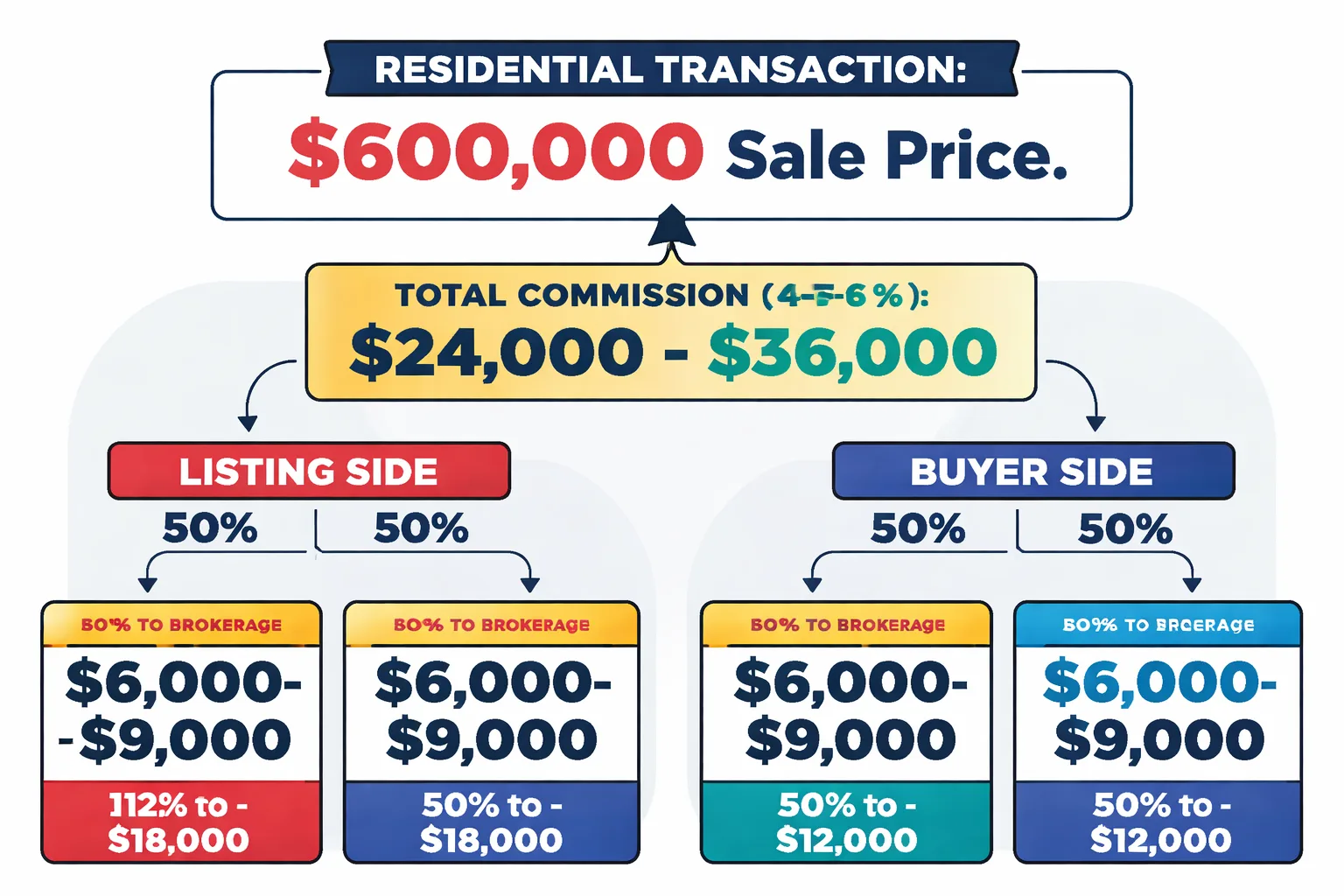
In New Jersey, total commission on a residential transaction typically ranges from 4% to 6% of the sale price, split between the listing side and the buyer side. After the August 2024 NAR settlement, the structure shifted. Commissions are no longer automatically offered through the MLS, and buyer agents must negotiate their compensation directly with buyers. The Federal Reserve's May 2025 analysis of broker compensation trends documented how this settlement is reshaping agent earnings across markets, with buyer-side commissions under downward pressure in some segments.
Here is how a $600,000 transaction breaks down for a NJ agent under a traditional model (pre-settlement structure, still common in many transactions):
- Total commission at 5%: $30,000. Split between listing and buyer brokerage: $15,000 each side. Brokerage split (assuming 70/30, common for mid-experience agents): agent receives $10,500. After franchise fee and transaction coordination fee (~$500): ~$10,000 net to agent. After self-employment tax (~15.3%), marketing costs, and overhead: ~$7,500 take-home equivalent
Now the same math on a $1.2M transaction:
- Total commission at 5%: $60,000. Per side: $30,000. Agent at 70/30 split: $21,000. After fees and taxes: roughly $15,000 take-home equivalent
The math explains why luxury agents earn disproportionately. One $1.2M closing produces the same income as two $600K closings, but with half the transaction coordination, half the client management, and half the time investment. An agent closing four $1.2M transactions per year can out-earn an agent closing twelve $400K transactions, despite doing one-third the volume. This is why specialization in luxury and high-value segments is the single most reliable income multiplier in NJ real estate.
But the split percentage is not fixed. New agents typically start at 50/50 or 60/40 splits, reflecting the brokerage's training and lead-generation investment. Experienced agents with proven production negotiate 80/20 or even 90/10 splits. Some agents move to 100% commission brokerages where they pay a monthly desk fee ($500 to $1,500) but keep every dollar of commission. The right model depends entirely on whether the agent generates their own leads or relies on brokerage-provided opportunities.
The real estate agent nj salary conversation also has to account for the expense side of the ledger, which most salary articles ignore entirely.
Annual business expenses for a full-time NJ agent typically include:
- MLS access and local board dues: $1,200 to $2,000. Errors and Omissions (E&O) insurance: $300 to $800. Continuing education and license renewal: $200 to $500. Marketing (digital ads, print, signage, photography): $5,000 to $25,000. Transportation (gas, wear, mileage not fully reimbursed): $3,000 to $8,000. Phone, software, CRM, transaction management tools: $1,500 to $3,500. Health insurance (individual market): $6,000 to $14,400
A conservative expense total for a producing agent runs $18,000 to $30,000 annually before they see a dollar of profit. This is why gross commission income is a misleading proxy for take-home pay. An agent earning $80,000 in gross commission with $25,000 in expenses and 15.3% self-employment tax nets roughly $46,000. That is a solid income, but it is not the number most people picture when they hear "$80,000."
What Factors Drive Higher Earnings for NJ Agents?
Five variables separate the upper cluster from the lower cluster. None of them require genius. All of them require intentionality.
Specialization. Generalist agents compete on volume and price. Specialist agents compete on expertise and referrals. The data from luxury markets is clear: Colibri Real Estate notes that commissions in luxury real estate yield much larger payouts per transaction than standard markets, though the percentage may be similar. An agent specializing in nj luxury condos near Manhattan can close fewer transactions and out-earn a generalist doing high volume in suburban single-family. The same principle applies to commercial real estate nj, where a single lease or sale transaction can produce six-figure commissions.
Geographic focus. New Jersey's geography creates dramatically different earning environments. Bergen County agents operating in towns like Closter and Tenafly serve a market where median home prices exceed $800,000 and buyer pools include Manhattan commuters seeking suburban space. Essex County agents working in Montclair and surrounding towns benefit from a similar dynamic: strong demand, limited inventory, and price points that generate meaningful commissions per transaction. Agents in Salem or Cumberland County work with median home prices below $250,000, meaning they need three to four times the transaction volume to match Bergen County income.
The NJ property tax rates by town also influence agent strategy. Towns with higher tax rates can suppress buyer demand and extend days on market, while towns with competitive tax profiles see faster turnover. Agents who understand these dynamics can guide clients effectively and build referral networks in markets where transactions happen quickly and repeatedly.
Bilingual capabilities. In the NJ and NY markets, bilingual English-Chinese service is not a nice-to-have. It is a revenue multiplier. Chinese international buyers and Chinese-American families represent a significant and growing segment of the luxury and investment property market in Manhattan-adjacent New Jersey. Agents who serve this community build referral networks that compound over time. A single satisfied family can produce three to five referral transactions over a decade. The bilingual agent who captures that network has a structural advantage that no marketing budget can replicate.
Volume and consistency. The agents who earn $300,000+ are not the ones who close the single biggest deal. They are the ones who close 15 to 30 transactions annually with a mix of price points, maintaining a pipeline that produces income every month rather than in bursts. This requires systems: a CRM, a lead-nurturing process, a referral strategy, and a marketing engine that runs whether the agent is actively prospecting or not.
Brokerage alignment. The right brokerage provides training, mentorship, lead flow, brand recognition, and a commission structure that scales with production. The wrong brokerage takes a large split and provides nothing but a desk. Agents should evaluate brokerages the way an investor evaluates a partnership: what does each side bring, and does the split reflect the value contributed? The NAR Code of Ethics sets professional standards, but individual brokerages vary enormously in what they offer beyond the brand name.
The recurring pattern is that top earners do not outwork everyone else. They out-position everyone else. A generalist working 70 hours a week will lose to a specialist working 45 hours a week with a defined niche, a geographic focus, and a referral engine.
Curious what top NJ agents actually earn in your market?
NJ vs. NY Agent Salary: Is There a Meaningful Difference?
The short answer is yes, but not in the direction most people assume.
New York State agent demographics reveal a telling shift. NYSAR member demographics research shows that broker-licensed agents in New York rose from 11% in 2021 to 20% in 2023. That jump reflects agents investing in higher credentials to capture larger commissions and differentiate in a crowded market. The New York State single-family median price moved from $579,000 at the start of 2024 to $589,000 by year-end, according to the same data set.
New York's advantage is transaction size. Manhattan luxury apartments and manhattan luxury apartments generate commissions that dwarf typical NJ residential transactions. A LinkedIn analysis by Surabhi Sahu found that a Manhattan seller paid $78,000 in commissions on a $1.3M apartment, while a Brooklyn seller paid $28,000 on a similar-priced property. That $50,000 gap within the same market illustrates how commission norms vary by borough and luxury tier.
But New York's disadvantage is competition and cost. Manhattan has one of the highest agent-to-listing ratios in the country. More agents compete for fewer listings, which means the median agent earns less than the median NJ agent despite higher per-transaction commissions. The RealTrends New York market data shows that the top agents in New York dominate an outsized share of transaction volume, leaving the long tail of agents fighting for scraps.
New Jersey's advantage is the Manhattan-adjacency without Manhattan competition. NJ agents serving the commuter belt from Fort Lee to Jersey City to Hoboken capture Manhattan-adjacent price points ($700K to $2M+) with less agent density than Manhattan itself. The nj home buying process tends to be more structured and less frenzied than NYC bidding wars, which means agents can manage more transactions simultaneously.
Here is where dual licensing becomes the strategic play. Agents licensed in both NJ and NY can serve clients across the Hudson River without referring business out. A buyer selling a Manhattan apartment and purchasing a home in Englewood Cliffs represents two commission opportunities for the same client relationship. Dual-licensed agents capture both sides of the move, and the referral relationship stays in-house.
The Ariel Property Advisors H1 2026 Manhattan report confirms that Manhattan remained the primary driver of NYC investment sales in the first half of 2026. For agents with commercial focus, the investment property nj market and Manhattan commercial sales represent complementary rather than competing opportunities. The Ariel H1 2026 all-assets report tracks multifamily and commercial volume that directly impacts agent earnings in both markets.
The agents who earn the most are not choosing NJ or NY. They are choosing both, and structuring their business to serve clients who move between the two markets.
How Does the NAR Settlement Change Agent Income?
The August 2024 NAR settlement did not eliminate commissions. It eliminated the automatic offering of buyer-side compensation through the MLS. In practice, this means buyer agents must now negotiate their fee directly with the buyer, often through a written agreement, before showing properties.
The Federal Reserve's May 2025 research on broker compensation trends documented the early effects. The data shows downward pressure on buyer-side commission rates in some markets, as buyers who are already stretching to afford a home push back on additional out-of-pocket costs. However, the same research notes that listing-side commissions have remained relatively stable.
For NJ agents, the settlement creates two distinct challenges. Buyer agents must justify their value explicitly rather than having it baked into the listing. Listing agents face pressure from sellers who question why they should offer any buyer-side compensation at all. The agents who navigate this shift successfully are the ones who can articulate their value in concrete terms: market knowledge, negotiation skill, access to off-market inventory, and transaction management that protects the client's interests.
The settlement also accelerates the bifurcation between top earners and struggling agents. Agents with strong referral networks and established reputations are largely unaffected. Their clients already understand the value they provide and are willing to pay for it. Agents who relied on MLS-driven lead flow and automatic compensation are the ones feeling the squeeze. The NAR settlement did not destroy agent income. It exposed which agents had built real value and which had been coasting on a system that compensated them regardless of performance.
When Should a New Agent Specialize?
Not on day one. The counterintuitive truth is that new agents who specialize too early starve. Specialization requires a referral network, and a referral network requires closed transactions and satisfied clients. A new agent with zero closed transactions cannot credibly claim to be a luxury specialist or a commercial expert, no matter how much coursework they have completed.
The right sequence is: spend the first 18 to 24 months as a generalist, closing transactions across price points and property types. Use this period to learn the mechanics of NJ real estate: contracts, inspection contingencies, attorney review, appraisal processes, and closing coordination. Build a base of 15 to 25 satisfied clients. Then, once the referral engine is primed, begin narrowing focus toward the niche that produced the best income and the most satisfaction.
For agents entering the market in 2026, the most lucrative niches in NJ are:
- Manhattan-adjacent luxury residential (Jersey City, Hoboken, Fort Lee, Edgewater): high price points, international buyer interest, and strong demand from NYC relocators - Commercial real estate (industrial, retail, office in Bergen, Hudson, Essex counties): fewer practitioners, larger transaction sizes, and less competition per deal - Investment properties (multifamily, mixed-use): recurring client relationships as investors build portfolios over time, and new york investment properties cross-market opportunities for dual-licensed agents - Bilingual luxury service: serving Chinese international and Chinese-American buyers in the premium segment, where language and cultural fluency create a moat that competitors cannot easily cross
The agents who follow this progression and specialize deliberately are the ones who move from the $45,000 cluster to the $200,000+ cluster. There is no shortcut. There is no course that replaces closed transactions. There is no certification that substitutes for a referral network built through demonstrated competence.
What Does the Career Path Look Like?
Real estate careers in NJ follow a recognizable progression, though the timeline varies based on market conditions, agent effort, and brokerage support.
Year 1: Survival. Gross commission income typically ranges from $15,000 to $45,000. Most first-year agents close 2 to 6 transactions, often relying on personal networks and brokerage-provided leads. Expenses exceed income for many. The first year is about learning, not earning. Agents who enter real estate expecting immediate six-figure income are the ones who leave within 12 months.
Years 2 to 3: Traction. Gross commission rises to $45,000 to $90,000 as the agent builds a pipeline, develops referral sources, and gains confidence in negotiation and transaction management. This is where the split between future top earners and permanent mid-tier agents becomes visible. Agents who invest in marketing, CRM systems, and professional development during this phase pull ahead. Agents who coast on their first-year momentum plateau.
Years 4 to 7: Acceleration. Gross commission ranges from $90,000 to $250,000+ for agents who have specialized, built a referral engine, and developed a recognizable personal brand within their niche. This is the phase where team formation becomes relevant. An agent closing 30+ transactions annually starts hiring assistants and buyer agents to handle volume, transitioning from individual producer to business owner.
Year 8+: Maturity and leverage. Top agents earn $250,000 to $500,000+ in gross commission, often through teams rather than individual production. The agent's role shifts from closing transactions to managing relationships, overseeing a team, and focusing on the highest-value deals personally while delegating the rest. At this stage, the real estate agent salary nj question becomes almost irrelevant because the agent is running a business, not collecting a paycheck.
Team vs. Solo: Which Model Pays More?
The answer depends on what the agent optimizes for.
Solo agents keep 100% of their commission (after brokerage split) and have complete control over their business. They also handle every task themselves: lead generation, client communication, contract preparation, inspection coordination, closing scheduling, and post-closing follow-up. A solo agent can handle roughly 15 to 25 transactions annually before hitting a ceiling where service quality starts to degrade.
Team leaders earn more per transaction on paper but carry overhead. A team with two buyer agents, a listing coordinator, and a transaction manager might close 60 to 120 transactions annually. The team leader's personal gross commission can exceed $400,000, but after paying team commissions and overhead, net income might be $200,000 to $300,000. The team model produces higher total income but requires management skills that many agents do not possess.
The decision between solo and team is really a decision about what kind of business the agent wants to build. Solo agents who specialize in luxury or commercial can earn $200,000+ without ever forming a team, because their per-transaction commission is high enough that volume is not the primary driver. Agents in the residential mid-market ($400K to $700K price points) almost inevitably need a team to scale beyond $150,000 in gross commission, because the per-transaction commission is too small to produce significant income without high volume.
The team question is not about income ceiling. It is about income efficiency. A solo luxury agent earning $250,000 on 8 transactions works fewer hours and carries less overhead than a team leader earning $300,000 on 80 transactions. Both are successful. They have simply chosen different business models.
What This Means for 2026 and Beyond
The real estate agent salary nj landscape in 2026 is shaped by three forces that will intensify over the next several years.
First, commission compression on the buyer side. The NAR settlement's effects are still working through the market. Buyer-side commission rates are under pressure, and agents who cannot articulate their value in writing and in conversation will lose deals to discount brokerages and direct-to-consumer platforms. The agents who thrive will be the ones who can show clients, in concrete terms, what they save by having professional representation: negotiation gains, inspection contingencies that protect deposits, and access to inventory that is not on Zillow.
Second, technology displacement of low-value tasks. Transaction coordination, document preparation, and lead capture are increasingly automated. Agents who spend their days on paperwork will find that work disappearing. Agents who spend their days on relationships, negotiation, and market intelligence will find their work more valuable than ever. The title fees and closing costs landscape is already digitizing, and agents who understand the full transaction stack will out-serve those who only know how to unlock doors.
Third, the bifurcation between luxury/specialized agents and commodity agents will widen. The middle is disappearing. Agents earning $60,000 to $90,000 in gross commission are the most vulnerable, because they are too expensive for the volume they produce and not specialized enough to command premium referrals. The path forward is to move up (specialize, build a brand, earn $200,000+) or move down (embrace volume, build a team, systematize). Standing still is the most dangerous strategy.
For anyone evaluating a real estate career in New Jersey, the question is not what is the average salary. The question is: which cluster are you building toward, and what is your plan to get there? The data shows the path. Specialization, geographic focus, bilingual capability, and deliberate career progression are the variables that matter. Everything else is noise.
The agents who earn $400,000+ in NJ real estate are not lucky. They are intentional. They chose a niche, served it relentlessly, and built a referral network that compounds over time. The average salary article will never tell you that, because averages cannot capture intentionality.
FAQ
Is a real estate agent salary in NJ actually a salary?
No. Real estate agents in New Jersey are independent contractors paid on commission. There is no base salary, no guaranteed income, and no employer-provided benefits. Agents earn a percentage of each transaction's commission, split with their brokerage. The term "salary" is a misnomer that obscures the entrepreneurial nature of the role.
How much does a new real estate agent make in NJ?
First-year agents in New Jersey typically earn $15,000 to $45,000 in gross commission, closing 2 to 6 transactions. Most rely on personal networks and brokerage-provided leads. After expenses ($18,000 to $30,000 annually), many first-year agents net very little. The first year is about building a foundation, not generating significant income.
Do NJ real estate agents make more than NY agents?
It depends on the segment. Manhattan luxury agents earn higher per-transaction commissions, but face more competition. NJ agents in Manhattan-adjacent markets (Jersey City, Hoboken, Fort Lee) capture high price points with less agent density. Dual-licensed agents who serve clients moving between NJ and NY earn the most overall, because they capture both sides of cross-Hudson relocations.
What is the highest-paying real estate niche in NJ?
Commercial real estate and Manhattan-adjacent luxury residential are the highest-paying niches. A single commercial lease or sale can produce six-figure commissions. Luxury residential transactions in the $1.5M to $3M range generate $30,000 to $60,000 in commission per side. Agents who combine bilingual English-Chinese service with luxury focus have a structural advantage in the international buyer segment.
How long does it take to earn $100,000 as a NJ agent?
Typically 3 to 5 years for a full-time agent who builds deliberately. Year 1 is survival. Years 2 to 3 build traction. By year 4, agents with a referral pipeline and a defined niche can reach $100,000 in gross commission. Reaching $100,000 in net income (after expenses and taxes) usually takes 5 to 7 years and requires either specialization in high-value segments or team formation to scale volume.
What expenses do NJ real estate agents pay?
Annual business expenses include MLS and board dues ($1,200 to $2,000), E&O insurance ($300 to $800), continuing education ($200 to $500), marketing ($5,000 to $25,000), transportation ($3,000 to $8,000), software and CRM ($1,500 to $3,500), and individual health insurance ($6,000 to $14,400). Total annual overhead runs $18,000 to $30,000 for a producing agent.
About the Author
Judy Zhou, Coldwell Banker Realtor®
Judy Zhou is a top-ranked Coldwell Banker Realtor® serving New Jersey and New York, recognized in the top 7% of agents internationally with prestigious awards like the International Diamond Society and President's Elite. Licensed in both NJ and NY, she specializes in luxury homes, investment properties, and commercial real estate, offering seamless bilingual English-Chinese service.
Get a personalized income strategy session with a top-ranked Coldwell Banker Realtor licensed in both NJ and NY.