Is Short Hills, NJ Actually Worth the Price Tag in 2026?
By Judy Zhou, Coldwell Banker Realtor®
Key Takeaways
- Short Hills median home value hit $2,418,306 in August 2026 with 8.0% year-over-year appreciation per Zillow ZHVI.
- Median sold price reached $2,499,500 while median listings climbed to $3,695,000, up 36.85% year-over-year.
- Short Hills trades at 3.1 times Essex County's $800,000 median sold price with homes at $562 per square foot.
- The market's 52 active listings and 42-day median days on market reward informed buyers who move quickly.
Short Hills became Short Hills in the 1870s, when real estate developer Stewart Hartshorn purchased 1,500 acres of Essex County hillside with a single vision: a planned community for prosperous New Yorkers who wanted countryside without sacrificing the city. He built the train station first, then sold the land around it. Nearly 150 years later, the logic hasn't changed. But the price tag has multiplied beyond anything Hartshorn could have imagined. In 2026, buyers working with a real estate agent in NJ are paying for a 19th-century master plan that still, remarkably, delivers on its original promise.
Short Hills median home values hover near $2.5 million as of August 2026, with Zillow's ZHVI reporting an average home value of $2,418,306 and 8.0% year-over-year appreciation. Realtor.com data shows a median sold price of $2,499,500, down 3.87% year-over-year, while the median listing price sits at $3,695,000 (up 36.85% YoY). The price-per-square-foot stands at $562. Essex County's broader median sold price is $800,000, meaning Short Hills trades at roughly 3.1x the county median. With 52 active listings and a median 42 days on market, this is a market that rewards informed buyers and punishes casual ones.
Is Short Hills, NJ a Wealthy Area?
Short Hills is not just affluent. It is one of the wealthiest census-designated places in the United States, and the data makes that unmistakable. The community sits within Millburn Township, Essex County, and its wealth profile has been consistent for decades.
The median home value of $2,418,306 (per Zillow's ZHVI methodology) places Short Hills in the top tier of New Jersey communities by housing value. For context, Essex County's median sold price is $800,000, according to Realtor.com. That means Short Hills homes trade at roughly 3.1 times the county median. This is not a modest premium. It is a stratification.
The community's wealth is reinforced by its tax base, school district performance, and the self-selecting nature of who buys here. Short Hills does not have a "starter home" market. Entry points begin where most NJ towns peak. The 52 active listings as of August 2026 range well into the eight-figure range, and the median listing price of $3,695,000 (up 36.85% year-over-year) signals that sellers are testing the upper bounds of what this market will bear.
The comparison to neighboring Millburn is worth noting. Millburn and Short Hills share the same township government, school district, and train line. The primary difference is housing stock and price point. Millburn proper offers slightly more modest homes (though still expensive by any national standard), while Short Hills commands a premium for larger lots, architectural significance, and the cachet of the Short Hills ZIP code itself. Buyers who want the school district without the Short Hills price tag often look to Millburn proper first.
The practical implication for buyers: Short Hills is a wealth-preserved market. Prices do not swing wildly because the buyer pool is narrow, financially strong, and buying for the long term. This is not a speculative market. It is a wealth-storage market.
Is It Expensive to Live in Short Hills, NJ?
Yes. And the expense extends well beyond the purchase price.
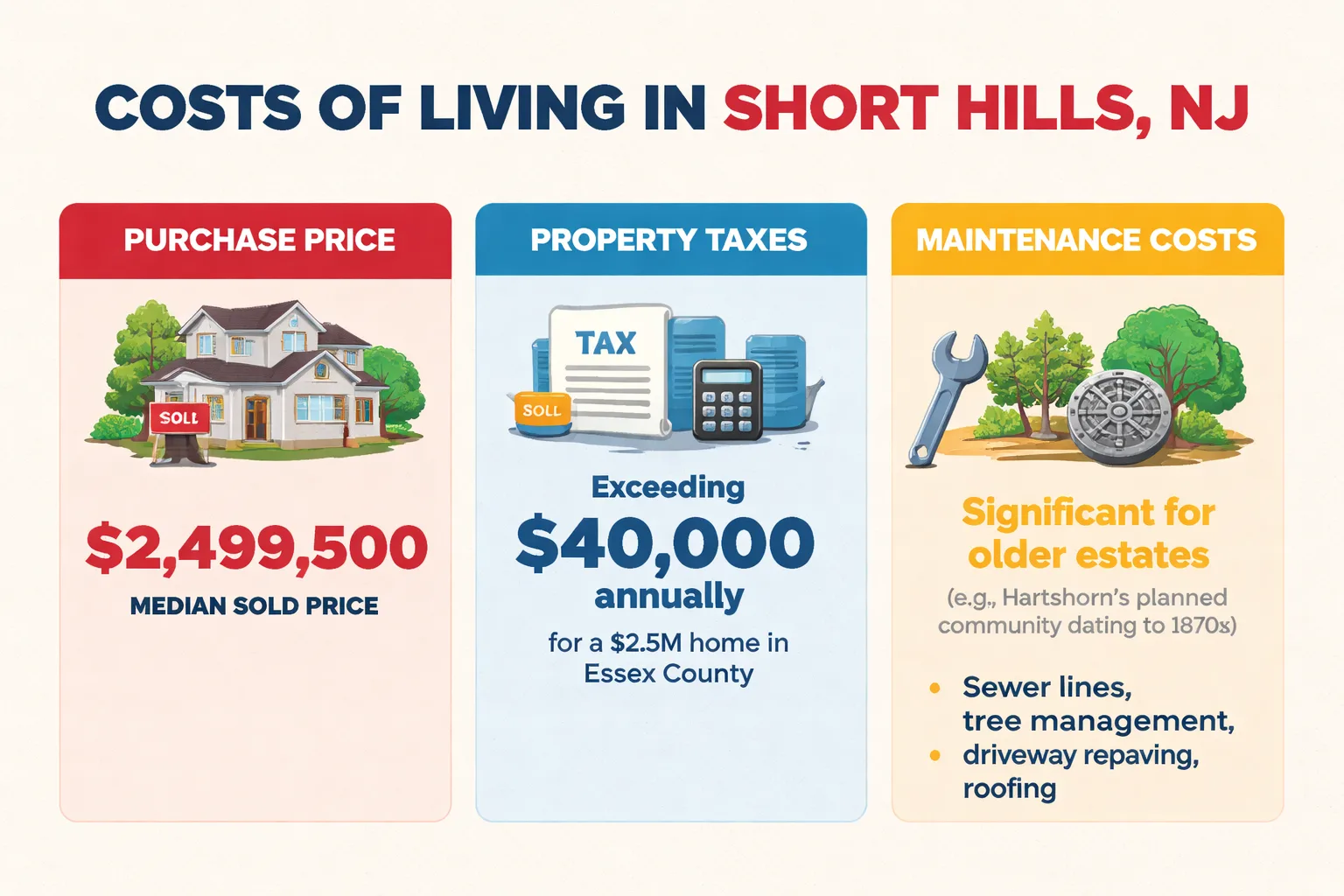
The median sold price of $2,499,500 is the headline number, but the carrying costs are what catch buyers off guard. New Jersey property taxes are among the highest in the nation, and Essex County carries some of the steepest rates in the state. Buyers should review NJ property tax rates by town to understand the specific millage rates that apply to Short Hills properties. A $2.5 million home in Short Hills can carry annual property taxes exceeding $40,000 depending on the specific lot and assessed value.
Then there are the less obvious costs. Many Short Hills homes are older estates that require significant maintenance. Hartshorn's planned community dates to the 1870s, and while the homes have been renovated, the infrastructure (sewer lines, mature tree management, driveway repaving, roofing on large footprints) carries costs that buyers from newer construction markets do not always anticipate. A 5,000-square-foot home costs more to heat, cool, and maintain than a 2,500-square-foot home. This is not a revelation, but buyers who are relocating from Manhattan apartments or nj luxury condos often underestimate the delta.
For buyers considering the broader cost-of-living picture, Short Hills does offer some offsets. The commute to Manhattan is direct (more on this below), which reduces or eliminates the need for a second vehicle. The school district is top-ranked, which means families avoid private school tuition that can run $40,000-$60,000 per child annually in the New York metro area. For families with three children, that is a $120,000-$180,000 annual savings. The math changes when you factor that in.
The day-to-day cost of living in Short Hills (groceries, dining, services) is comparable to other affluent Essex County suburbs. Dining options in nearby Millburn and Summit are excellent but not inexpensive. Retail is limited within Short Hills itself; most residents drive to Short Hills Mall (a high-end shopping center) or to neighboring towns for daily necessities.
The honest assessment: Short Hills is expensive to buy into and expensive to maintain. The value proposition is not affordability. It is quality of life, school district access, and commute efficiency. Buyers who frame the decision as "is this worth the cost?" are asking the wrong question. The right question is: "does the combination of schools, commute, and community justify the premium over a less expensive NJ suburb?" For many families, the answer is yes. For others, a town like Summit or Westfield offers 80% of the value at 60% of the cost.
Is Short Hills, NJ a Good Place to Live?
This is where the data gets qualitative, and where Short Hills genuinely earns its premium.
The Millburn Township School District, which serves Short Hills, is consistently ranked among the top public school districts in New Jersey. This is the single most important driver of Short Hills home values. Families move here for the schools. The district's academic performance, college placement records, and extracurricular offerings are competitive with top private schools in the New York metro area. For families who would otherwise pay $40,000-$60,000 annually per child for private school, the math on a Short Hills home becomes more defensible.
The commute is the second pillar. Short Hills has its own NJ Transit station on the Morris & Essex Line, with direct service to Hoboken and one-seat rides to Penn Station during off-peak hours. The commute to Midtown Manhattan is approximately 45-50 minutes by train. For a community with this level of housing stock and school quality, that commute time is competitive. Buyers evaluating Short Hills against Westchester County alternatives like Scarsdale or other Westchester County homes for sale will find similar commute times but different tax structures and school district profiles.
Walkability is where Short Hills falls short. This is a car-dependent community. The train station is walkable from some streets, but daily errands, dining, and retail require driving. Buyers coming from Manhattan or from more walkable NJ towns like Montclair or Maplewood may find this adjustment difficult. Short Hills is not a "stroll to dinner" town. It is a "drive to everything" town. For some buyers, this is a feature (privacy, quiet, large lots). For others, it is a drawback.
Dining and retail in Short Hills proper are limited. The Short Hills Mall (operated as a high-end shopping center) offers luxury retail, but daily dining options are sparse within the CDP itself. Nearby Millburn and Summit expand the options. Residents who want a vibrant restaurant scene tend to drive to Summit, Maplewood, or Montclair.
What residents consistently cite as the area's biggest draws: the schools, the commute, the architectural quality of the housing stock, and the community's understated wealth. Short Hills is not flashy. The wealth is old-money and professional. The community is quiet, and that quietness is the point.
What residents cite as drawbacks: property taxes, limited walkability, the maintenance burden on older homes, and the fact that the nearest "downtown" experience requires a drive. Some residents also note that the community can feel insular, particularly for newcomers who are not part of established social networks.
The overall quality-of-life assessment is strong, but it is not universal. Short Hills is an excellent place to live for families who prioritize schools, space, and commute access to Manhattan. It is a poor fit for buyers who want walkability, a vibrant restaurant scene, or a low-maintenance lifestyle.
Are House Prices Dropping in NJ. And What Does That Mean for Short Hills?
The New Jersey housing market in 2026 is sending mixed signals, and Short Hills is a case study in why aggregate data can mislead.
Statewide, New Jersey has seen price appreciation slow compared to the 2020-2023 surge, but prices have not collapsed. The Rutgers Edward J. Bloustein School reported a 9.1% increase in Essex County single-family home prices in its analysis of prior market cycles, and NJ REALTORS® data via 10K Research tracks ongoing monthly trends. The broader pattern is a market that has cooled from its peak but remains well above pre-pandemic levels.
Short Hills, specifically, shows a fascinating divergence in the data. Realtor.com reports a median sold price of $2,499,500 as of August 2026, down 3.87% year-over-year. But Zillow's ZHVI shows an average home value of $2,418,306, up 8.0% year-over-year. How can both be true?
They measure different things. Realtor.com tracks median sold price (the middle point of actual closed transactions in a given period). Zillow's ZHVI estimates the typical home value across all homes, including those not on the market. In a thin market like Short Hills (52 active listings), the median sold price can swing based on which homes happened to close that month. A cluster of lower-priced sales can drag the median down even while individual home values appreciate.
The median listing price of $3,695,000 (up 36.85% YoY) adds another layer. Sellers are listing aggressively, but buyers are not paying those prices. The gap between median listing price ($3,695,000) and median sold price ($2,499,500) is $1,195,500. That is a 47.8% gap. In plain terms: sellers are asking for nearly double what buyers are paying. This is a market where pricing strategy is everything.
The Short Hills data tells a story of a market where sellers are optimistic, buyers are disciplined, and the gap between asking and closing prices is wider than most national averages would suggest.
For buyers, this means opportunity. Homes that sit on the market for 42+ days (the current median DOM) give buyers leverage. Sellers who listed at $3.695 million and haven't received offers are more receptive to negotiation than they were 60 days in. A knowledgeable real estate agent in NJ can identify these stale listings and negotiate effectively.
For sellers, this means pricing discipline is non-negotiable. Listing at the top of the range to "test the market" is a strategy that worked in 2021. In 2026, it guarantees 42+ days of silence and a price reduction that signals desperation. The data shows that correctly priced homes sell. Overpriced homes sit.
For the next 6 months, the expectation should be continued price stability with downward pressure on overpriced listings. Interest rate dynamics, inventory levels (52 active listings is moderate for Short Hills), and the broader economic environment will determine whether the market tilts toward buyers or sellers. As of August 2026, it leans slightly toward buyers, but only for well-priced homes. Poorly priced homes will continue to sit.
What Does a Real Estate Agent in NJ Actually Do for Short Hills Buyers?
The role of a real estate agent in NJ goes well beyond unlocking doors and forwarding listings. In a micro-market like Short Hills, the agent's value is hyperlocal expertise, pricing intelligence, and access to inventory that never reaches the open market.
Short Hills is a thin market. With 52 active listings in August 2026, the inventory is small enough that every listing, every sale, and every price reduction is visible to an agent who tracks the ZIP code daily. A knowledgeable agent knows which homes have been sitting, which sellers are motivated, and which listings have had price reductions that signal flexibility. This is not information available on Zillow. It is information that comes from monitoring the market in real time and maintaining relationships with listing agents.
Off-market access is another critical function. In luxury markets like Short Hills, many sellers do not want their homes on the MLS. They do not want public photos, open houses, or signage. They sell quietly, through agent-to-agent networks. A buyer working with an agent who is plugged into the Short Hills broker community gets access to these properties. A buyer working with an agent who is not local does not.
Pricing strategy is where a local agent earns their fee. The gap between median listing price ($3,695,000) and median sold price ($2,499,500) is $1,195,500. An agent who understands this gap can prevent a buyer from overpaying and can prevent a seller from underpricing. The NJ home buying process involves multiple stages where agent expertise directly affects the outcome: offer strategy, attorney review, inspection negotiation, and appraisal management.
For buyers considering Short Hills alongside other NJ markets, the agent's role extends to comparative analysis. How does Short Hills compare to Summit? To Westfield? To Westchester County alternatives? An agent who works across NJ and NY can provide side-by-side analysis of property taxes, school districts, and commute times. This is particularly valuable for international and Chinese-American buyers who may not have firsthand experience with NJ town comparisons.
For investment property buyers, the agent's role shifts to cash flow analysis, rental market assessment, and long-term appreciation modeling. Short Hills is not a rental market in the traditional sense, but buyers who are purchasing for long-term wealth preservation need to understand the total cost of ownership, not just the purchase price. An agent who understands New Jersey real estate investment can frame the decision in investment terms.
The NJ Real Estate Commission, under the New Jersey Division of Consumer Affairs, regulates all real estate licensees in the state. Every licensed agent must complete pre-licensing education, pass the state exam, and maintain continuing education requirements. The Commission's role is consumer protection, and buyers should verify any agent's license status through the Division of Consumer Affairs website before entering into a representation agreement.
How Do You Become a Real Estate Agent in NJ?
Becoming a licensed real estate agent in New Jersey requires completing 150 hours of pre-licensing education at a state-approved school, passing the NJ Real Estate Commission's licensing exam, and affiliating with a sponsoring brokerage. The process is structured and non-negotiable.
The 150-hour course covers real estate principles, practices, law, contracts, and agency relationships. It is divided into three 50-hour modules. After completing the coursework, candidates must pass the state exam, which includes both national and state-specific sections. The exam tests knowledge of real estate law, agency disclosure, contract requirements, fair housing regulations, and NJ-specific statutes.
Once licensed, new agents must complete continuing education requirements to maintain their license. The NJ real estate agent license renewal cycle includes 12 hours of continuing education, with specific topics required for first-time renewals. The licensing framework ensures that agents maintain current knowledge of legal and regulatory changes.
For those researching how to become a real estate agent in NJ, the process is the same whether the goal is residential sales in Short Hills or commercial real estate in Newark. The license is general. Specialization comes through experience, mentorship, and market-specific training after licensure.
The question of how much a real estate agent makes in NJ varies widely. Commission structures, market segment, and transaction volume all affect earnings. In luxury markets like Short Hills, where median sale prices exceed $2.4 million, the per-transaction commission is substantial. But transaction volume is lower than in entry-level markets. The real estate agent commission in NJ is negotiable by law, and buyers and sellers should discuss commission structure openly with their agent before signing any representation agreement.
How to Become a NJ Real Estate Agent. Licensing, Costs, and Timeline
The path to becoming a real estate agent in NJ is well-defined, but the details matter. Here is the step-by-step breakdown.
First, complete the 75-hour pre-licensing course required for a salesperson license. (Note: New Jersey requires 150 hours total, split into three 50-hour segments: General, Agency/Ethics, and NJ-specific law. Some providers package these differently.) The coursework can be completed online or in person at state-approved real estate schools. Costs typically range from $400 to $800 depending on the provider.
Second, pass the state licensing exam. The exam is administered by PSI Services and costs approximately $45 per attempt. The exam includes 110 questions covering both national real estate principles and NJ-specific law. A score of 70% or higher is required on both sections.
Third, affiliate with a sponsoring broker. In New Jersey, a newly licensed agent cannot practice independently. They must hang their license with a brokerage (such as Coldwell Banker, Weichert, Douglas Elliman, or a local independent). The brokerage provides supervision, mentorship, and often leads for new agents. For agents targeting luxury markets like Short Hills, the choice of brokerage matters because it affects brand recognition, marketing resources, and access to luxury clientele.
Fourth, obtain errors and omissions (E&O) insurance and pay the license application fee. The NJ Real Estate Commission requires proof of E&O coverage before issuing a license. The application fee is approximately $160.
Fifth, complete continuing education. The first renewal requires 12 hours of CE, including mandatory topics like fair housing, agency law, and ethics. Subsequent renewals require the same 12 hours but with different mandatory topics.
The total timeline from starting coursework to receiving a license is typically 2-4 months, depending on course scheduling and exam availability. The total cost (coursework, exam, application, E&O insurance, association dues) ranges from $800 to $1,500.
For agents who want to specialize in Short Hills or similar luxury markets, the licensing process is just the beginning. Market expertise, broker network development, and client relationship building take years. The most successful agents in Short Hills are not the ones who just got licensed. They are the ones who have spent years tracking this specific micro-market.
What Are the NJ Real Estate Agent License Requirements in 2026?
The specific requirements for obtaining and maintaining a real estate agent license in NJ are governed by the New Jersey Real Estate Commission (REC). Understanding these requirements matters not just for aspiring agents but also for buyers and sellers who want to verify that their agent is properly credentialed.
The REC operates under the New Jersey Division of Consumer Affairs within the Department of Consumer Affairs. Its mandate is consumer protection, and it enforces standards for licensing, conduct, and continuing education. Every agent practicing in Short Hills, or anywhere else in Essex County, must hold an active license issued by the REC.
To obtain the initial salesperson license, candidates must be at least 18 years old, have a high school diploma or equivalent, and complete the 150-hour pre-licensing education requirement. The coursework must be completed at a school approved by the REC. The three 50-hour modules cover general real estate principles, agency relationships and ethics, and NJ-specific real estate law. Candidates must pass the state exam with a 70% minimum on both the national and state portions.
The real estate agent license nj renewal cycle operates on a biennial basis. Licenses expire on June 30 of even-numbered years. To renew, agents must complete 12 hours of continuing education (CE) during each two-year cycle. The CE curriculum includes two mandatory hours each of fair housing, agency law, ethics, and legal updates. The remaining four hours are elective. First-year licensees have specific additional requirements, including mandatory topics on agency relationships and disclosure rules.
Errors and omissions insurance is required for all active licensees. The REC sets minimum coverage requirements, and agents must maintain continuous coverage. If an agent's E&O insurance lapses, their license is automatically suspended until coverage is reinstated.
For buyers and sellers in Short Hills, the practical takeaway is this: you can verify any agent's license status and disciplinary history through the New Jersey Division of Consumer Affairs online license verification system. You can check whether the license is active, when it expires, and whether any disciplinary actions have been taken. This is a step that takes 60 seconds and can prevent significant problems.
How Much Does a Real Estate Agent Make in NJ?
The earnings potential for a real estate agent in NJ varies dramatically based on market segment, transaction volume, and commission structure. The question "how much does a real estate agent make in nj" has no single answer, but the data provides useful ranges.
In the entry-level and mid-market segments, NJ agents typically earn between $40,000 and $80,000 annually, assuming a moderate transaction volume of 4-8 deals per year. The median home price in Essex County is $800,000, per Realtor.com. At a 2.5% commission (the typical buyer or seller side), an agent closing 6 transactions at the county median earns approximately $120,000 in gross commission income before brokerage splits and expenses.
In luxury markets like Short Hills, the per-transaction economics change significantly. The median sold price of $2,499,500 means a single transaction at 2.5% generates approximately $62,487 in gross commission. An agent closing four Short Hills transactions per year earns roughly $250,000 in gross commission income. However, luxury transaction volume is lower. The market has 52 active listings and a 42-day median DOM, which means the total transaction volume is limited. Agents who close 8-10 Short Hills transactions annually are among the top performers in this micro-market.
The brokerage split affects take-home pay. At major brokerages like Coldwell Banker, Weichert, and Douglas Elliman, new agents typically start on a 50/50 or 60/40 split (agent/brokerage). Experienced agents with high volume can negotiate splits of 70/30 or higher. Some brokerages offer capped-split models where the agent keeps 100% of commissions after paying a set cap amount per year. The structure matters because a $62,487 commission on a 50/50 split yields $31,243 to the agent, while a 70/30 split yields $43,740.
The real estate agent fees in NJ are negotiable by law. There is no fixed commission rate. The total commission on a transaction is typically 5-6% of the sale price, split between the buyer's agent and the seller's agent. In Short Hills, where sale prices exceed $2.4 million, a 5% total commission generates $124,975, split between two agents. This is why luxury market representation is highly competitive.
For buyers and sellers, the practical implication is that commission is negotiable and should be discussed openly. The agent's experience, market knowledge, and track record should justify their fee. In Short Hills, where the gap between listing and sold prices exceeds $1.1 million, an agent who negotiates effectively can save or earn far more than their commission cost.
Finding the Right Agent for Short Hills. Town-Specific Considerations
Not every licensed agent is equipped to handle a Short Hills transaction. The market's price point, architectural complexity, and buyer profile demand specific expertise.
For buyers and sellers in Short Hills, the ideal agent has three qualities: deep knowledge of the Short Hills ZIP code, experience with luxury transactions in the $2-5 million range, and a network that includes the listing agents who dominate this market. The Weichert Realtors Short Hills office and Douglas Elliman's NJ presence are among the brokerages with established Short Hills footprints. Agents like Josh Sarnell (Douglas Elliman) describe an approach combining "20 years of sales experience with cinematic marketing and innovative technology" to "generate meaningful demand," per his published marketing philosophy. Whether that approach translates to better outcomes for Short Hills buyers and sellers is a question worth asking directly.
For buyers evaluating agents, the questions to ask are specific: How many Short Hills transactions have you closed in the past 12 months? Can you provide a comparative market analysis for this specific neighborhood? What is your strategy for negotiating the gap between listing price and sold price? Do you have access to off-market inventory in this ZIP code?
For commercial real estate buyers, the agent selection criteria shift. A commercial real estate broker NYC or NJ-based commercial agent needs to understand investment property analysis, tenant placement, and lease structuring. Short Hills is primarily residential, but investors who are building portfolios across NJ and NY need an agent who can operate across both markets and both property types.
The practical advice: interview at least two agents before committing. Ask for recent transaction data. Verify the license through the NJ Division of Consumer Affairs. And choose the agent who demonstrates specific knowledge of Short Hills, not the one who simply says "I can sell anywhere."
How Do Short Hills Agent Fees Compare Across NJ Markets?
The question of real estate agent commission in NJ has different answers depending on the market segment and geographic location. Short Hills commands a different fee structure than entry-level markets in Newark or Edison, and understanding these differences helps buyers and sellers evaluate whether their agent's commission is justified.
In Short Hills, the median sold price of $2,499,500 means that a standard 5% total commission generates approximately $124,975 in total commission, split between the buyer's and seller's agents. The per-transaction commission is substantial, which is why experienced agents compete aggressively for Short Hills listings. However, because transaction volume is lower (52 active listings, 42-day median DOM), agents must maintain a pipeline of qualified buyers to sustain consistent income.
In more affordable NJ markets, the dynamics shift. An agent working as a newark nj real estate agent faces a different market. Newark's median home prices are significantly lower than Short Hills, which means per-transaction commissions are smaller. But Newark's transaction volume is higher, and inventory turns faster. An agent in Newark may close 15-20 transactions per year at lower per-deal commissions but higher total volume.
The same applies to an edison nj real estate agent. Edison's market is mid-range, with higher transaction volume than Short Hills but lower per-transaction commissions. The real estate agent princeton nj market occupies a middle ground: Princeton's home values are higher than the NJ median but below Short Hills, and the market benefits from the university-driven economy and stable demand.
For buyers and sellers, the key insight is that commission rates are not uniform across NJ. While the total commission percentage (typically 5-6%) may be similar in different markets, the dollar amounts vary dramatically. A 5% commission on a $2.5 million Short Hills home ($125,000) is very different from a 5% commission on a $500,000 Newark home ($25,000). The agent's work, expertise, and market knowledge should justify the fee in the context of the specific market.
In Short Hills, the agent's value is not in volume. It is in precision. An agent who prices a Short Hills home correctly, markets it to the right buyer pool, and negotiates the gap between the $3,695,000 median listing price and the $2,499,500 median sold price is earning their fee through outcome, not through transaction count. The title fees and closing costs on a Short Hills transaction are also substantial, and an experienced agent helps navigate these costs effectively.
What This Means for Buyers and Sellers in 2026
Short Hills in 2026 is a market that rewards discipline. The data shows a widening gap between asking and sold prices. The schools and commute remain best-in-class. The property taxes and maintenance costs are real. The market is not crashing, but it is not surging either. It is a market where the right agent, the right pricing strategy, and the right patience level produce outcomes. Overpaying is easy. Getting a fair deal requires expertise.
For buyers, the opportunity is in the 42-day median days on market. Stale listings create leverage. For sellers, the risk is in the $3,695,000 median listing price. Overpricing guarantees stagnation. For both sides, the agent's role is to bridge the $1,195,500 gap between asking and closing with data, not aspiration.
Short Hills is worth the price tag if the buyer values what Short Hills delivers: top-ranked schools, a sub-50-minute commute to Manhattan, architectural quality, and a community that has preserved its character for 150 years. It is not worth the price tag if the buyer is looking for walkability, a vibrant restaurant scene, or a low-maintenance lifestyle. The data answers the question. The decision is personal.
For buyers and sellers who need to move forward, the next step is finding an agent who understands this specific market. The right real estate agent in NJ for Short Hills is not the agent with the most listings or the flashiest marketing. It is the agent who can interpret the data, negotiate the gap, and deliver an outcome grounded in market reality. That agent is worth their weight in gold in a market where the wrong pricing decision costs hundreds of thousands of dollars.
Considering a move to Short Hills? Get a personalized market analysis for your situation.
FAQ
What is the median home price in Short Hills, NJ in 2026?
The median sold price in Short Hills as of August 2026 is $2,499,500, according to Realtor.com. The average home value per Zillow's ZHVI is $2,418,306. The median listing price is $3,695,000. The price-per-square-foot is $562.
How long do homes stay on the market in Short Hills?
The median days on market is 42 days as of August 2026, per Realtor.com. This is moderate for a luxury market. Well-priced homes sell faster. Overpriced homes sit significantly longer.
What are the property taxes in Short Hills, NJ?
Short Hills property taxes are based on Essex County millage rates and vary by assessed value. Buyers should review NJ property tax rates by town for specific figures. A $2.5 million home can carry annual taxes exceeding $40,000.
Is Short Hills a good investment for 2026?
Short Hills is a wealth preservation market, not a speculative one. The 8.0% year-over-year appreciation in Zillow's ZHVI suggests stable long-term value growth. The market is thin (52 active listings), which limits liquidity but supports price stability. Investors should frame Short Hills as long-term holding, not short-term flipping.
How do I find a qualified real estate agent in NJ for Short Hills?
Look for an agent with documented Short Hills transaction history, luxury market experience, and local broker network access. Verify the license through the NJ Division of Consumer Affairs. Interview at least two agents and ask for recent closed transaction data in the Short Hills ZIP code specifically.
What is the gap between listing and sold prices in Short Hills?
The median listing price is $3,695,000 and the median sold price is $2,499,500, creating a gap of $1,195,500 (47.8%). This gap indicates that sellers are listing aggressively while buyers are negotiating firmly. A skilled agent bridges this gap with data-driven pricing strategy.
About the Author
Judy Zhou, Coldwell Banker Realtor®
Judy Zhou is a top-ranked Coldwell Banker Realtor® serving New Jersey and New York, recognized in the top 7% of agents internationally with prestigious awards like the International Diamond Society and President's Elite. Licensed in both NJ and NY, she specializes in luxury homes, investment properties, and commercial real estate, offering seamless bilingual English-Chinese service.
Work with an agent who knows the Short Hills market block by block. Schedule a consultation to discuss your buying or selling strategy today.