How to Become a Real Estate Agent in NY: 5 Honest Steps
By Judy Zhou, Coldwell Banker Realtor®
Key Takeaways
- New York requires 77 hours of pre-licensing education, a 70% exam score, a sponsoring broker, and a $55 fee, with the full process taking 2-4 months.
- 75% of newly licensed agents in New York leave the industry within their first two years.
- The median new real estate agent in NY takes 6-12 months to close their first transaction after getting licensed.
- Most licensing guides stop at "pass the test and find a broker," leaving agents unprepared for New York's competitive market.
Getting your real estate license in New York is the easy part. And that's exactly why most new agents fail. The state's 77-hour pre-licensing requirement, the exam, the background check: none of it is the real barrier to a sustainable career selling New York investment properties or landing clients eyeing Manhattan luxury apartments. The barrier is everything that comes after. Most licensing guides stop at "pass the test and find a broker," leaving new agents completely unprepared for the brutal realities of one of the world's most competitive real estate markets.
Becoming a real estate agent new york ny requires 77 hours of pre-licensing education, a passing exam score of 70% or higher, a sponsoring broker, and a $55 license fee paid to the New York Department of State. The full process typically takes 2-4 months from enrollment to activation. But here's what no licensing school will tell you: the median new agent in NY takes 6-12 months to close their first transaction, and roughly 75% of newly licensed agents leave the industry within their first two years. The license gets you in the door. It says nothing about whether you'll survive.
The New York State Office of the Professions maintains licensing records by profession, with overall registration counts reported at the start of each fiscal year. But raw license counts don't tell the survival story. The gap between "licensed" and "earning a living" is where careers go to die.
What It Actually Takes to Get Licensed in New York
New York's licensing requirements look straightforward on paper. They are. That's part of the problem.
The state mandates 77 hours of pre-licensing education from an approved provider, a 70% minimum passing score on the state exam, and a sponsoring broker before your license activates. The NY Department of State oversees real estate licensing (not the Office of the Professions under NYSED, despite common confusion). The exam costs $15 per attempt, the license application fee is $55, and fingerprinting runs approximately $90 through the state's vendor.
Compare that to New Jersey's requirements: 75 hours of pre-licensing, a 70% exam pass threshold, and a similar sponsoring broker model. The hour difference is negligible. The market difference is enormous. A real estate agent ny faces a transaction environment where the national median days on market sits at 55 days as of March 2026, but Manhattan's luxury segment operates on entirely different timelines. A $4 million co-op can sit for 180 days. A competitively priced studio in Brooklyn might go under contract in 9 days.
The licensing process is identical whether you plan to sell studio apartments in the Bronx or commercial real estate in Manhattan. The career trajectory is not. Agents who specialize early, whether in investment property nj transactions or Manhattan luxury apartments, build referral networks that compound. Generalists compete on commission splits and hope.
Here's the honest framing: the 77-hour course teaches you about fiduciary duty, fair housing law, and contract basics. It teaches you nothing about how to price a pre-war co-op, how to navigate a board package, or how to qualify a buyer who claims they're "pre-approved" but has a conditional letter from an online lender. That knowledge comes from a brokerage willing to train you, a mentor willing to answer questions, and clients willing to trust a new agent. Getting all three is the actual work.
The difference between a textbook contract clause and a real-world negotiation is the difference between reading about swimming and jumping in the ocean. The course covers the general principles of a purchase offer. It does not teach you what to do when a buyer wants to renegotiate after a home inspection reveals a cracked foundation, or when a co-op board rejects your buyer's application because their debt-to-income ratio is 33% instead of the unwritten 25% threshold the board prefers. These are the moments where careers are made or broken. The license just gets you permission to be in the room when those conversations happen.
Step-by-Step: From Enrollment to First Commission
The five steps below cover the mechanical path from zero to licensed. Each includes realistic time estimates and cost ranges based on current NY Department of State fee schedules.
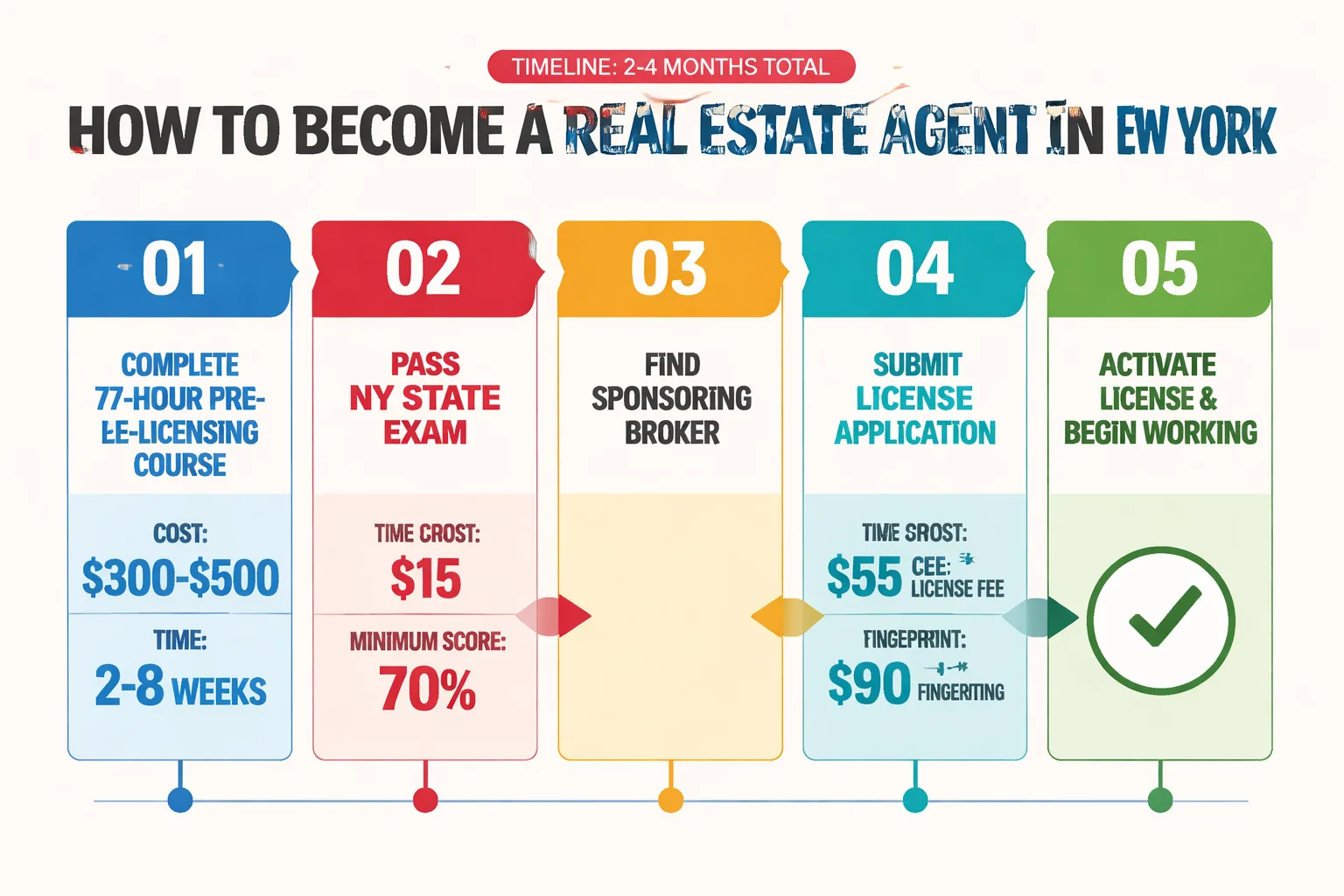
Step 1: Complete the 77-Hour Pre-Licensing Course
Cost: $300-$500. Time: 2-8 weeks depending on format (in-person, online, or hybrid).
New York requires 77 hours of instruction from a DOS-approved provider. The curriculum covers agency law, contracts, fair housing, real estate math, and NY-specific regulations. Online courses are self-paced. In-person programs run on fixed schedules. The content is the same. The accountability is not.
Most candidates underestimate the real estate math component. Prorations, commission calculations, and property tax adjustments trip up test-takers who coasted through the legal sections. Spend extra time on math if numbers aren't intuitive. The exam doesn't care about your strengths.
Step 2: Pass the NY State Real Estate Exam
Cost: $15 per attempt. Time: Scheduled within 1-2 weeks of course completion.
The exam has 75 multiple-choice questions. You need 70% to pass. That means answering at least 53 correctly. The exam covers both national real estate concepts and NY-specific law. You'll face questions about NY's disclosure requirements, co-op transactions, and state-specific contract provisions.
If you fail, you can retake immediately. Each attempt costs another $15. There's no limit on retakes, but the psychological toll of failing twice is real. Study like you can only afford one attempt.
For those wondering how to become a real estate agent in ny state efficiently: the exam is the single biggest bottleneck. Course completion is guaranteed if you show up. The exam is not. Resources like exam prep videos can help identify common pitfalls, but nothing replaces drilling practice questions until the patterns become automatic.
Step 3: Find a Sponsoring Broker
Cost: $0 (you're interviewing them, not paying them). Time: 2-6 weeks of active searching.
Your license is inactive until a sponsoring broker activates it. This is the most consequential decision in the entire process. The wrong brokerage stalls your career for years. The right one accelerates it.
Look for three things: a formal training program (not "shadow me and you'll learn"), a reasonable commission split for new agents (50/50 is standard starting, anything below 40% to you is exploitative for a new agent with no book of business), and a managing broker who actually answers their phone. The brand name matters less than the local office culture. A Coldwell Banker office with a hands-on manager beats a boutique firm with a celebrity name and zero infrastructure.
Step 4: Submit Your License Application
Cost: $55 application fee + ~$90 fingerprinting. Time: 2-4 weeks for processing.
Once you have a sponsoring broker, you submit your license application through the NY Department of State eAccess system. The application includes your course completion certificate, exam pass confirmation, sponsoring broker information, and fingerprinting results. The background check disqualifies applicants with certain felonies, particularly those involving fraud or theft. Most clean applications process within 2-3 weeks.
Step 5: Activate Your License and Start Prospecting
Cost: $0. Time: Immediate upon approval.
Your sponsoring broker activates your license through the DOS portal. You're officially a real estate agent ny. Now the real work begins.
The first 90 days determine whether you'll make it. New agents who wait for leads from their brokerage fail. New agents who build their sphere of influence, attend open houses, knock on doors in their farm area, and call everyone they know survive. The license is permission to work. It's not work itself.
For agents considering cross-border practice, New York and New Jersey have separate licensing requirements. A ny real estate agent license doesn't authorize you to practice in NJ. Agents who want to work both markets need dual licensure. The NJ home buying process differs from NY's attorney-driven transaction model in ways that matter at the closing table.
How Hard Is the NY Real Estate Exam. And How Do You Pass It?
The NY real estate exam is moderately difficult. The exam consists of 75 multiple-choice questions covering national real estate concepts and NY-specific law, with a 70% passing score required. Most candidates who complete the full 77-hour course pass on their first or second attempt. Those who skip practice exams or rush through the course fail at higher rates.
The exam is not designed to trick you. It's designed to verify that you absorbed the course material. The questions that trip people up fall into three categories:
NY-specific law questions. These cover disclosure obligations, co-op vs. condo differences, and state-specific contract requirements. If your course was national-focused, you'll need to supplement with NY-specific study materials. The Department of State publishes a content outline that maps exactly what's tested. Study that outline.
Math questions. Commission calculations, prorations, tax adjustments, and interest computations. These aren't complex equations. They're word problems that require reading carefully and knowing which formula applies. Practice with a calculator until the setup becomes automatic.
Scenario-based ethics questions. These present a situation and ask what the agent should do. The answer is almost always: disclose everything to your client, get it in writing, and don't represent both sides without informed consent. Fair housing violations are the most heavily tested ethics topic.
Study strategy that works: complete 500+ practice questions before exam day. If you're consistently scoring 75%+ on practice exams, you'll pass the real thing. If you're scoring below 70%, go back and re-study your weak areas. Don't schedule the exam until your practice scores are stable.
For those asking how do i become a real estate agent in ny and worrying about the exam: it's the most straightforward part of the process. The exam has a right answer. Real estate practice rarely does.
What Real Estate Agents in NY Actually Earn
This is where most articles lie. They cite average agent income figures that blend part-time hobbyists with full-time professionals and call it a "typical" salary.
There is no typical salary for a real estate agent in ny. Income ranges from $0 (first-year agents who close nothing) to seven figures (top producers in Manhattan luxury or commercial real estate). The median is meaningless because the distribution is bimodal: a large cluster of low earners and a smaller cluster of high earners with very little in between.
Here's what's real:
First-year agents in NY typically earn $15,000-$40,000, and many earn less. The first 6-12 months are essentially unpaid training. You're learning the market, building a client base, and waiting for transactions to close. If you need immediate income, real estate is not the right move.
Agents with 2-5 years of experience who've survived the initial culling earn $50,000-$120,000. The survivors have figured out their niche, built referral pipelines, and developed enough competence to handle transactions without constant hand-holding.
Experienced agents (5+ years) with established books of business earn $100,000-$500,000+. The top tier, particularly those specializing in Manhattan luxury apartments or commercial real estate transactions, can earn well above that. Specialization drives income more than any other variable. An agent who closes five $2 million transactions at 2.5% commission earns $250,000 in gross commission income. An agent who closes twenty $200,000 transactions at the same rate earns $100,000. Same work. Different ceiling.
Commission in NY is negotiable. The traditional 6% listing commission (split between buyer's and seller's agents) is eroding. Discount brokerages and flat-fee models have put downward pressure on rates. Luxury transactions often command lower percentage rates (2-3% total) because the dollar amounts are large. Entry-level transactions in emerging Brooklyn or Bronx neighborhoods may see full 5-6% rates because the work-to-revenue ratio is higher.
For agents interested in commercial real estate, the economics shift. Commercial leases and sales involve larger dollar amounts but longer sales cycles. A single commercial lease transaction can generate a commission equal to 3-5 residential sales. The trade-off is that commercial deals take 6-18 months to close, and the client acquisition cost is significantly higher. Agents who understand both investment real estate and local market dynamics have a structural advantage.
The Redfin housing market data shows the national median days on market at 55 days as of March 2026. But that's a residential metric. Commercial timelines are longer. Luxury timelines are longer. The agent who understands how transaction velocity varies by segment can choose a specialization that matches their financial runway.
Thinking about getting licensed in NY or NJ? Get guidance from an agent who's built a career in both markets.
Choosing the Right Brokerage to Launch Your NY Career
The brokerage decision is not reversible in practice. You can technically switch brokers anytime. But the relationships, training, and market positioning you develop in your first year follow you. Choose deliberately.
What to Look For
Formal training programs. Not a binder. Not "follow me around." A structured curriculum that covers contract preparation, negotiation, market analysis, and transaction management. Ask to see the training schedule before you sign. If they can't produce one, walk.
Mentorship that's built into the compensation structure. Some brokerages pair new agents with experienced agents and split commissions during the mentorship period. This means the mentor has a financial incentive to actually teach you. Models where mentorship is "voluntary" produce mentors who are too busy closing their own deals to help.
Market positioning that matches your goals. A brokerage that dominates Westchester residential sales may be useless if you want to sell Manhattan luxury apartments. A commercial real estate firm with strong NYC presence won't help you build a residential practice in Queens. Know what you want to sell before you choose where to hang your license. For context on how market focus shapes career options, Westchester County's residential market operates differently from Manhattan's co-op-dominated landscape.
Technology and lead generation infrastructure. Every brokerage claims they provide leads. Ask what percentage of their new agents' transactions come from brokerage-provided leads versus self-generated. If the answer is "mostly self-generated," the leads aren't real. If the answer is "we provide 60%+ of leads," ask about the conversion rate and the average lead quality. Some brokerages hand out internet leads that convert at 0.5%. That's not a lead source. That's noise.
Commission Splits and Fees
New agent commission splits typically start at 50/50 (you keep 50% of the gross commission). Some brokerages offer 60/40 or 70/30 to new agents as a recruiting incentive. Read the fine print. Some offer high splits but charge monthly desk fees, technology fees, and franchise fees that eat the difference. A 70/30 split with $500/month in fees can net less than a 50/50 split with no fees at $15,000 in annual production.
The split should improve as your production grows. Ask about the escalation schedule. If the split never improves regardless of how much you produce, you're subsidizing the brokerage's overhead indefinitely.
Coldwell Banker and the Value of Brand Infrastructure
Coldwell Banker's infrastructure matters for new agents in ways that aren't immediately visible. The brand has global reach, which matters for agents serving international and Chinese-American buyers looking at new condo developments or cross-border investment properties. The training infrastructure is formalized. The technology stack (CRM, marketing tools, lead platforms) is enterprise-grade.
But the brand is the floor, not the ceiling. What determines success is the specific office and the specific managing broker. A Coldwell Banker office with a manager who reviews your contracts, coaches your negotiations, and connects you with experienced agents is worth more than any brand name. A Coldwell Banker office where the manager is too busy producing their own business to support new agents is just an expensive desk rental.
Interview multiple offices within the same brand. The differences between offices of the same franchise can be larger than the differences between brands.
How Does NY Compare to Other States for New Agents?
New York's licensing requirements are similar to New Jersey's (75 hours vs. 77 hours, same 70% pass threshold). The career environments are different animals.
NY's market is denser, more transaction-heavy, and dominated by co-ops in Manhattan (which require board approval and financial scrutiny that doesn't exist in most markets). The attorney-driven transaction model in NY means agents work alongside real estate attorneys on every deal. In NJ, attorneys are involved during a 3-day attorney review period but transactions are more agent-led.
For agents considering dual licensure, the NJ property tax landscape is a different conversation than NY's. Property tax rates, closing costs, and title fee structures vary significantly between the two states. Agents who understand both markets can serve clients relocating across the Hudson, but the learning curve is real.
A career as a real estate agent new york ny is fundamentally different from a career in any other US market. The attorney review process in New Jersey gives buyers a 3-day window to back out of a contract for any reason, which creates a different negotiation dynamic. New York has no such statutory review period. Once a contract is signed in NY, it's binding (with contingencies). This means NY agents must be more careful before the contract is executed, because the safety net is smaller. The due diligence happens before the offer, not after.
Where New Agents Actually Work: NY Market Breakdown
The question of how to become real estate agent ny often comes with a geographic assumption: Manhattan. That's wrong. Manhattan is the most visible market but not where most new agents start.
Brooklyn is the largest residential market by transaction volume in NYC. A real estate agent brooklyn ny serves a market where brownstones, condos, and new developments create diverse transaction types. Competition is fierce, but the volume supports new agents who hustle.
Queens offers similar volume with slightly lower price points. A real estate agent in queens ny can build a career serving immigrant communities, first-time buyers, and investors looking at multi-family properties.
The Bronx has seen significant price appreciation. A real estate agent bronx ny works in a market where entry-level prices are still accessible but rising, creating opportunities for agents who understand investment fundamentals.
Westchester and other suburban markets north of the city offer a different pace. A real estate agent westchester ny handles single-family homes, luxury estates, and commuter-town relocations. The transaction model is more traditional (no co-op boards, standard single-family contracts).
Upstate markets (Rochester, Buffalo, Syracuse, Albany, Binghamton) operate on entirely different economics. A real estate agent in rochester ny or real estate agent buffalo ny works with lower price points but higher volume potential. The albany ny real estate agent market benefits from government employment stability. These markets are less glamorous but can be more sustainable for agents who want steady volume without Manhattan's cutthroat competition.
The New York State Office of the Professions tracks license statistics by profession, with registration counts reported at the start of each fiscal year. These figures show the scale of licensed professionals across the state, though they don't break down survival rates or earnings by region.
How to Become a Real Estate Agent NY: The Full Checklist
For those searching how to become a real estate agent ny or how to become real estate agent in ny, the process is identical regardless of how you phrase the question. Here is the complete checklist in sequence:
1. Verify eligibility: Be at least 18 years old, have a high school diploma or GED, and have no disqualifying criminal convictions (fraud, theft, or forgery felonies are the most common barriers). 2. Enroll in a DOS-approved 77-hour pre-licensing course. Choose online, in-person, or hybrid based on your schedule and learning style. 3. Complete the course and obtain your certificate of completion. The school reports your completion electronically to the Department of State. 4. Schedule and pass the NY state real estate salesperson exam. Score 70% or higher (53 of 75 questions correct). 5. Find a sponsoring broker. Your license is inactive without one. Interview at least three offices before committing. 6. Submit your license application through the DOS eAccess system with your sponsoring broker's information, exam pass confirmation, and fingerprinting results. 7. Pay the $55 license fee and approximately $90 for fingerprinting/background check. 8. Wait 2-4 weeks for processing. Your sponsoring broker activates your license upon approval. 9. Join the local MLS (Multiple Listing Service) through your brokerage. Budget $20-$50/month for MLS access. 10. Complete any brokerage-specific onboarding and new agent training programs.
The total cost from enrollment to activation ranges from $400-$700. The total time ranges from 2-4 months. Once activated, the clock starts on your first commission. Every day after activation that you're not prospecting is a day you're falling behind agents who are.
How to Become Real Estate Agent NY: Specialization Paths
The question of how to become real estate agent ny has a different answer depending on what you want to sell. The license is the same. The career is not.
Residential sales is the default path for most new agents. You'll work with buyers and sellers of single-family homes, condos, and co-ops. The transaction volume is high, the learning curve is steep, and the competition is intense. In Manhattan, residential agents must master co-op board packages, which are financial disclosures that can run 100+ pages and require years of tax returns, reference letters, and asset verification. A buyer rejected by a co-op board has no recourse. The agent who didn't prepare the package properly loses the deal and the client.
Luxury real estate is where the income ceiling is highest, but the barrier to entry is steep. Luxury clients expect market knowledge, discretion, and network access that new agents simply don't have. Most successful luxury agents spent years building a referral base before landing their first $5 million listing. New agents who try to jump straight into luxury without the network or the market knowledge get eaten alive.
Commercial real estate involves leasing and selling office, retail, industrial, and multifamily properties. The commissions are larger, but the sales cycles are longer and the client acquisition is harder. Commercial clients are business owners and investors who expect sophisticated financial analysis, market research, and deal structuring. A residential agent who tries to cross into commercial without retraining will be exposed quickly. For agents interested in this path, understanding New York real estate developers and their projects is essential context.
Investment properties require understanding cap rates, cash-on-cash returns, 1031 exchanges, and financing structures that residential agents rarely encounter. An agent who can analyze a multi-family property's pro forma and identify value-add opportunities serves a client base that buys repeatedly. Investors who have a good experience with an agent become repeat clients. That's the most valuable relationship in real estate.
What This Won't Fix: The Honest Boundary
This guide covers the mechanical path to licensure. It does not fix three problems that kill more careers than exam failure ever will.
Financial runway. If you don't have 6-12 months of living expenses saved, the gap between licensing and first commission will force you out. No amount of hustle compensates for an empty bank account when your first deal falls through at closing. The agents who survive are the ones who planned for the gap.
Personality fit. Real estate requires sustained rejection tolerance, comfort with financial uncertainty, and genuine interest in helping people make the largest financial decision of their lives. If you're entering because you watched a reality show about flipping houses, the daily reality of lease negotiations, inspection disputes, and buyer financing rejections will be a brutal awakening.
Market timing. Entering real estate during a transaction slowdown means fewer deals available for new agents to cut their teeth on. Experienced agents with established books of business absorb the available volume first. New agents get the leftovers. That's not a commentary on your talent. It's market physics.
FAQ
How long does it take to become a real estate agent in NY?
The full process typically takes 2-4 months: 2-8 weeks for the 77-hour pre-licensing course, 1-2 weeks to schedule and take the exam, and 2-4 weeks for application processing once you have a sponsoring broker. Agents who study full-time can complete everything in 6-8 weeks. Agents with day jobs should plan for 3-4 months.
How much does it cost to get a NY real estate license?
Total upfront costs range from $400-$700: $300-$500 for the pre-licensing course, $15 for the exam, $55 for the license application, and approximately $90 for fingerprinting. Additional costs include exam prep materials ($50-$150), association dues if your brokerage requires NAR/local board membership ($200-$500/year), and MLS access fees ($20-$50/month).
Can I practice real estate in NJ with a NY license?
No. New York and New Jersey have separate licensing requirements. You must complete NJ's 75-hour pre-licensing course, pass the NJ state exam, and obtain a NJ sponsoring broker to practice in New Jersey. Agents who want to work both markets need dual licensure. The processes are similar but separate.
Do I need a college degree to become a real estate agent in NY?
No. New York requires a high school diploma or equivalent (GED). There are no college degree requirements. The 77-hour pre-licensing course is the only educational prerequisite. However, strong writing, math, and communication skills significantly impact career success.
How do I verify a real estate agent's license in NY?
Use the real estate agent lookup ny tool on the NY Department of State website. The eAccess system allows public searches by name, license number, or brokerage. This verifies active status, license type, expiration date, and any disciplinary actions. Always verify an agent's license before working with them.
What's the difference between a salesperson and broker license in NY?
A salesperson license (what this guide covers) allows you to work under a sponsoring broker. A broker license requires 2+ years of experience as a licensed salesperson, 152 additional hours of education, and a broker's exam. Brokers can operate independently, hire agents, and own a brokerage. Most new agents start as salespersons and pursue broker licensure after gaining experience.
The path to becoming a real estate agent new york ny is documented, finite, and accessible to anyone with a high school diploma and a few hundred dollars. The path to a sustainable career is none of those things. Get the license. Then get to work on the part that actually matters: building the competence, client base, and market knowledge that turn a license into a livelihood.
About the Author
Judy Zhou, Coldwell Banker Realtor®
Judy Zhou is a top-ranked Coldwell Banker Realtor® serving New Jersey and New York, recognized in the top 7% of agents internationally with prestigious awards like the International Diamond Society and President's Elite. Licensed in both NJ and NY, she specializes in luxury homes, investment properties, and commercial real estate, offering seamless bilingual English-Chinese service.
Skip the generic licensing advice. Talk to someone who actually sells real estate in NY and NJ and can tell you what the first year really looks like.