What Is Zillow Real Estate — and How Agents Actually Use It

By Judy Zhou, Keller Williams Realtor®
Key Takeaways
- Zillow, launched in 2006 by former Microsoft executives Rich Barton and Lloyd Frink, now draws over 200 million monthly visits as the dominant U.S. home-search starting point.
- Zillow's automated Zestimates carry a median error rate of 2.4% nationally, widening sharply in non-disclosure states and luxury markets.
- Zillow is not an MLS and shows filtered, delayed data, so agents in fast-moving markets like Bergen County or Manhattan must cross-check against live MLS feeds before pricing.
- Buyers who treat Zillow as the definitive source routinely over-rely on Zestimates and neighborhood comparisons without understanding sourcing gaps, creating false confidence before contacting agents.
In 2006, two former Microsoft executives named Rich Barton and Lloyd Frink launched a website with a single audacious goal: make real estate data free and public for the first time in American history. Before Zillow, home prices were closely guarded information, accessible only through agents and brokers. Nearly two decades later, that founding provocation has reshaped how NJ real estate agents pitch listings, how commercial real estate brokers in NYC value assets, and how everyday buyers evaluate everything from NJ luxury condos to New York investment properties. Often before speaking to a single professional.
Zillow real estate is a public-facing digital marketplace that aggregates property listings, ownership records, and automated valuations (Zestimates) from MLS feeds, public tax records, and user-submitted data. It is not an MLS, not a brokerage in the traditional sense, and its value estimates carry a median error rate of 2.4% nationally, which widens significantly in non-disclosure states and luxury markets. The platform processes over 200 million monthly visits, making it the dominant consumer starting point for home searches in the United States. But what users see on Zillow is a filtered, delayed, and algorithmically interpreted version of what a licensed agent sees on the MLS. That gap matters enormously in markets like Bergen County, NJ, or Manhattan, where inventory moves fast and price discovery depends on data Zillow does not surface.
The platform's influence is undeniable. It has trained an entire generation of buyers to start their search online, to check Zestimates before making offers, and to compare neighborhoods using tools that did not exist 20 years ago. But the same convenience that makes Zillow useful also creates false confidence. Buyers who treat Zillow as the definitive source of truth, without understanding how its data is sourced, how its estimates are calculated, and where its coverage breaks down, routinely make decisions that cost them tens of thousands of dollars.
This article breaks down what Zillow actually is, how its core features work, how licensed agents use it strategically, and where it falls critically short for buyers and investors in the NJ and NY markets.
What Is Zillow Real Estate?
Zillow real estate is, at its core, a consumer-facing property database. It aggregates listings from Multiple Listing Services (MLS) across the country through syndication agreements, layers in public records data (tax assessments, sale histories, ownership transfers), and presents everything in a searchable interface that anyone with an internet connection can access for free. The platform also generates its own automated valuation model, the Zestimate, which uses statistical modeling to estimate property values based on comparable sales and market trends.
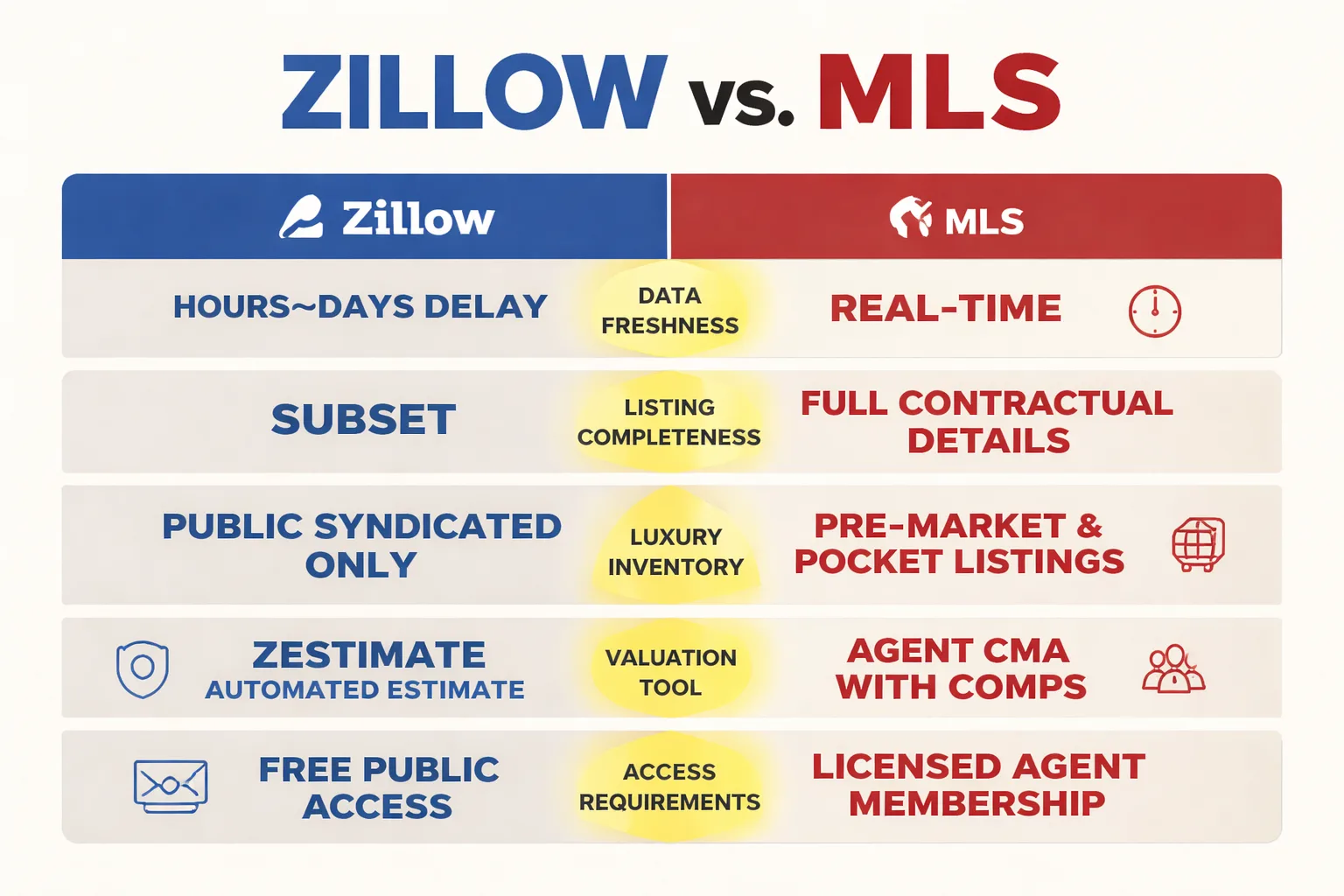
The critical distinction is that Zillow is not an MLS. An MLS is a private, member-only database maintained by local real estate boards, where licensed agents post listings with full contractual details, showing instructions, compensation terms, and real-time status updates. Zillow receives a subset of that data through syndication feeds, often with delays ranging from hours to days. A property that shows as "active" on Zillow may have already gone under contract on the MLS. A listing that appears on Zillow may be missing critical details about easements, HOA restrictions, or pending legal issues that are visible only to MLS members.
Zillow also allows homeowners and agents to post listings directly through its platform through programs like "Make Me Move" (discontinued) and its For Sale by Owner (FSBO) portal. These listings bypass the MLS entirely, which means they may not appear in agent searches and may lack the data integrity that MLS listings provide. For buyers working with an agent, these FSBO listings create friction because the buyer's agent must negotiate compensation directly with the seller, often without the protections and standardized terms that MLS transactions provide.
The platform's data sourcing has another significant limitation. In non-disclosure states (states where sale prices are not publicly recorded), Zillow relies on tax assessments and limited deed records to estimate values. This produces Zestimates that can diverge wildly from actual market values. Even in disclosure states like New Jersey and New York, luxury properties, off-market transactions, and new construction often lack the comparable sale data needed for accurate automated valuations.
For buyers evaluating NJ luxury condos or Manhattan luxury apartments, the gap between Zillow's data and ground truth can be enormous. A luxury condo that sold privately through a pocket listing will never appear in Zillow's comparable sales algorithm. A new development with pre-construction pricing will not have closed sales to anchor a Zestimate. The result is a platform that works reasonably well for standard residential properties in established neighborhoods but degrades quickly at the edges of the market where most luxury and investment transactions actually occur.
The platform also operates Zillow Offers, an iBuyer program that purchased homes directly from sellers for resale. Zillow shut down this program in late 2021 after losing hundreds of millions of dollars, a failure that illustrates the limits of algorithmic valuation even when backed by institutional capital. If Zillow's own algorithms could not accurately price homes at scale for its own balance sheet, individual buyers and sellers should approach the Zestimate with even more caution.
How Zillow's Zestimate Algorithm Actually Works
The Zestimate is the feature that made Zillow famous. It is also the feature that causes the most damage when buyers and sellers treat it as gospel. Understanding how the algorithm works reveals exactly why it breaks down in specific markets.
Zillow's automated valuation model uses a combination of statistical techniques, including machine learning models trained on public records, MLS data feeds, and user-submitted information. The model considers comparable sales (recent transactions of similar properties nearby), tax assessment data, historical price trends, and property characteristics (square footage, bedroom count, lot size, location). It then generates an estimated market value that updates regularly as new data flows in.
The problem is that the model's accuracy depends entirely on the quality and recency of its input data. In a cookie-cutter subdivision where homes are similar, sale prices are public, and transactions happen frequently, the Zestimate can be reasonably accurate. Zillow reports a median error rate of 2.4% for on-market homes nationally, meaning half of its estimates are within 2.4% of the actual sale price. That sounds impressive until you do the math: on a $1.5M home in Bergen County, a 2.4% error is $36,000. On a $5M commercial property, it is $120,000.
And that is the best-case scenario. For off-market homes, the median error rate jumps to 7.49%. In luxury markets where comparable sales are sparse and transactions are often private, the error rate can exceed 10-15%. On a $2.62M Manhattan luxury apartment entry point (the threshold for the priciest 10% of listings per Realtor.com research), a 10% Zestimate error means a $260,000 swing in either direction. No buyer should be making offer decisions with that level of uncertainty.
The Zestimate also struggles with properties that have unique characteristics. A home with a finished basement, a recently renovated kitchen, or a new roof will not have those improvements reflected in public records unless a permit was filed and the tax assessment was updated. A property with an underground oil tank (a common issue in older NJ homes) will not have that liability factored into its Zestimate at all. These are exactly the kinds of issues that a competent NJ real estate agent identifies during a walkthrough and that can dramatically affect a property's true market value.
The algorithm also cannot account for market micro-trends. In a neighborhood where inventory suddenly spikes and buyer demand softens, comparable sales from three months ago may no longer reflect current conditions. The 2026 New Jersey housing market outlook projects an average home value around $555,000 with decelerated growth, creating negotiation windows that Zillow's backward-looking algorithm will not capture until weeks after the trend begins.
Here is where buyers get into trouble. They see a Zestimate of $1.1M, assume the property is worth roughly that amount, and base their offer on it. The agent they are working with has access to MLS data showing that comparable properties in the same neighborhood are actually closing at $1.08M. The buyer overpays by $40,000 or more because they anchored to a number generated by an algorithm that lacked the most recent data. This is not a hypothetical scenario. It happens regularly in competitive markets like Bergen County, where properties can sit on the market longer than the local average without Zillow's algorithm adjusting downward quickly enough.
The Zestimate breaks down in three specific scenarios that NJ and NY buyers encounter frequently. First, properties with significant unpermitted improvements: a homeowner who finished a basement or added a bathroom without pulling permits will have a Zestimate that undervalues the property by the cost of those improvements, sometimes $50,000-$100,000. Second, properties affected by external factors not in public records: a home near a new high-traffic development, or one with a recently discovered environmental issue, will have a Zestimate that does not reflect the impact. Third, properties in transitional neighborhoods where sale prices are rising rapidly: the Zestimate's reliance on historical comparables means it lags behind actual market momentum, sometimes by 5-8% in neighborhoods experiencing rapid appreciation.
How Licensed Agents Use Zillow Strategically
Licensed agents do not ignore Zillow. That would be malpractice in a market where the platform dominates consumer attention. But they use it very differently than consumers do, and understanding that difference reveals the platform's actual role in a real estate transaction.
Agents use Zillow primarily for exposure. When a listing goes live on the MLS, it syndicates to Zillow automatically (assuming the broker has enabled syndication). This gives the listing visibility to the millions of consumers who start their search on Zillow rather than on an agent's website or the MLS portal. For listings that need broad consumer reach, this syndication is valuable. A seller listing a $800,000 home in a standard residential neighborhood benefits from Zillow's traffic because the target buyer is likely browsing Zillow on a Sunday afternoon.
But agents do not rely on Zillow for accuracy. They rely on the MLS. The MLS provides real-time status updates (active, under contract, closed), full showing instructions, compensation details, private remarks visible only to agents, and historical data that is more complete and more current than what Zillow displays. An agent checking Zillow for market data is like a doctor checking WebMD for a diagnosis. It is a starting point, not a clinical tool.
Agents also use Zillow's Premier Agent program, which allows agents to pay for placement on listings in specific ZIP codes. When a consumer clicks on a listing and contacts an agent through Zillow, that lead is routed to the Premier Agent who has purchased that ZIP code. This is a lead generation tool, not a valuation tool. The quality of these leads varies enormously, and experienced agents typically treat them as a supplement to their referral and sphere-of-influence business, not as a primary source of clients.
For commercial real estate in NJ, Zillow's utility is even more limited. Commercial transactions rely on income approach valuations, cap rate analysis, environmental assessments, and lease audits that Zillow's residential-focused platform does not support. A commercial real estate broker in NYC would never use Zillow to value a multi-family investment property or a retail strip center. The data required for those valuations lives in specialized commercial platforms (CoStar, Crexi, LoopNet) and in the broker's own underwriting models.
The gap between Zillow and MLS data is most pronounced in luxury and pre-market inventory. Many luxury listings in NJ and NY are pre-market or pocket listings that never appear on Zillow. A property that a seller wants to test quietly before a public launch will be shared among a small network of agents through the MLS's private channels but will not syndicate to consumer platforms. Buyers who rely solely on Zillow will never see these properties. They will only see what has been publicly listed and syndicated, which in luxury markets often represents a fraction of the actual available inventory.
This is where the agent's value becomes irreplaceable. An agent with deep local networks knows about properties before they hit Zillow. They know which neighborhoods have quiet inventory building up. They know which sellers are motivated but have not yet listed publicly. Zillow cannot replicate this because its data model depends on listings being publicly posted. The platform is a mirror of what is already public. It is not a window into what is about to become available.
When Does Zillow Mislead Buyers and Investors?
Zillow misleads buyers and investors when they treat it as a substitute for professional representation rather than a supplement to it. The specific failure modes are predictable and well-documented.
The first failure mode is price anchoring. Buyers see a Zestimate, internalize it as the property's value, and negotiate relative to that number rather than relative to actual comparable sales. In markets where Zestimates are accurate, this works out fine. In markets where they are not, it leads to overpayment. The data shows this is most likely to happen with luxury properties, unique homes, properties in non-disclosure states, and properties in neighborhoods with sparse recent sales.
The second failure mode is stale listings. Zillow's syndication feed does not always update in real time. A property that went under contract on the MLS three days ago may still show as active on Zillow. Buyers waste time pursuing properties that are no longer available, and in fast-moving markets, this delay can mean missing properties that are actually available. For investment properties in NJ, where timing and due diligence windows are tight, stale listing data can derail an entire transaction timeline.
The third failure mode is missing context. Zillow shows price history, tax records, and basic property characteristics. It does not show pending litigation, code violations, unrecorded liens, shared easements, or the presence of underground oil tanks. These are exactly the issues that derail NJ real estate transactions during the attorney review period. New Jersey's unique 3-day attorney review window is designed to catch these problems, but only if the buyer's agent has identified potential red flags before the offer is made. Zillow provides none of this context.
The fourth failure mode is false inventory confidence. Buyers browsing Zillow believe they are seeing all available properties in a given area. They are not. They are seeing all publicly syndicated listings. Off-market properties, pocket listings, pre-market inventory, and FSBO listings that have not been submitted to Zillow are invisible to the platform. In luxury markets near Manhattan, the most desirable properties are often the ones that never appear on Zillow at all.
The fifth failure mode is investment analysis shortcuts. Investors who use Zillow to evaluate rental properties, cap rates, or cash flow projections are working with incomplete data. Zillow's rental estimates are algorithmic guesses based on limited rental comparables. They do not account for actual lease terms, tenant quality, maintenance history, or the specific operating costs that determine whether an investment property generates positive cash flow. A proper investment analysis requires the kind of underwriting that a commercial real estate professional performs, not a consumer platform's automated estimate.
Consider a concrete example from the Bergen County market. A buyer found a property listed at $1.15M on Zillow with a Zestimate of $1.12M. The buyer felt confident offering full asking price because the Zestimate suggested the listing was fairly priced. What Zillow did not show was that the property had been on the market for 23 days, while comparable homes in that neighborhood were selling in an average of 9 days. It also did not show that three similar properties nearby had recently closed at $1.08M. The buyer's agent, had the buyer been working with one, would have pulled the MLS comparables and advised an offer of $1.08M-$1.09M. Instead, the buyer overpaid by at least $40,000 because they trusted a Zestimate that was lagging behind actual market conditions.
Why Zillow Cannot Replace Local Agent Expertise
The contrarian take that needs stating plainly: Zillow has not democratized real estate. It has democratized real estate data. Those are fundamentally different things, and confusing them costs buyers money.
Data without interpretation is noise. A buyer who sees 50 listings on Zillow in a target neighborhood has data. A buyer who knows which 3 of those 50 are overpriced, which 5 have hidden issues that will emerge during inspection, and which 2 are likely to accept a below-asking offer has expertise. Zillow provides the first. A local agent provides the second.
In the NJ and NY markets, local expertise operates on multiple levels that Zillow cannot replicate. The first is hyper-local market knowledge. An agent who works Bergen County daily knows that a property listed for 23 days in a neighborhood where the average DOM is 9 days is a signal that something is wrong or that the price is too high. Zillow's algorithm does not flag this. It just shows the listing as active.
The second is school district nuance. Chinese-American buyers and international investors often prioritize school districts above almost every other factor. The difference between two adjacent neighborhoods in Bergen County can be a difference of 200 points on a school ranking, and that difference drives property values by 10-20%. Zillow shows school ratings but does not explain the nuances of district boundaries, special programs, or enrollment policies that affect property values.
The third is transaction navigation. New Jersey's attorney review period, dual agency risks, earnest money protections, and the new buyer agency agreement requirements under the Real Estate Consumer Protection Enhancement Act create a legal landscape that Zillow does not address at all. An agent who understands these legal mechanics protects buyers from losing deposits, inheriting undisclosed debts, or being locked into unfavorable contract terms. Zillow's platform has no mechanism for this.
The fourth is bilingual and cultural competence. For Chinese-American buyers and international investors, the ability to negotiate in Mandarin, understand cross-border fund transfer logistics, and navigate cultural expectations around real estate transactions is not a nice-to-have. It is a requirement for a smooth transaction. Zillow is an English-language platform with no cultural context. A bilingual agent who can explain Bergen County school district nuances in Mandarin, coordinate with international banks, and bridge cultural gaps in negotiation strategy provides value that no platform can replicate.
The fifth is professional network access. Real estate transactions require inspectors, attorneys, lenders, contractors, and title companies. An experienced agent has a vetted network of these professionals and can coordinate them efficiently. Zillow offers directory listings but does not vet quality or coordinate the transaction workflow. In commercial transactions, this network extends to environmental consultants, zoning attorneys, and property managers whose expertise determines whether an investment succeeds or fails.
How Does Zillow Compare to the MLS for NJ and NY Agents?
The comparison between Zillow and the MLS is not a matter of preference. It is a matter of data architecture. The two systems serve different audiences, operate on different data pipelines, and produce different outputs. Understanding the structural differences explains why agents treat them as complementary tools rather than interchangeable ones.
Zillow's data pipeline begins with MLS syndication. When a listing agent posts a property to the MLS, the MLS sends a data feed to Zillow (and other consumer portals like Realtor.com and Redfin) through a syndication agreement. This feed includes the property's public-facing information: address, price, photos, bedroom count, bathroom count, square footage, and a description. It does not include agent remarks, showing instructions, compensation details, or contingency information. The feed also operates on a delay. Depending on the MLS and the syndication configuration, this delay can range from 15 minutes to 24 hours or more.
The MLS, by contrast, is real-time. When a listing's status changes from active to under contract, that change is reflected immediately on the MLS. Agents who are monitoring the MLS see the change instantly. Buyers who are monitoring Zillow may not see it for hours or days. In a market where properties receive multiple offers within 48 hours of listing, this delay is not a minor inconvenience. It is a structural disadvantage.
The data completeness gap is equally significant. The MLS includes fields that Zillow does not display: special assessment information, HOA dues and rules, flood zone status, zoning classification, parking details, and agent-to-agent remarks about property condition or seller motivation. These fields exist on the MLS because they matter to buyers' decision-making. Zillow omits them because its consumer interface is designed for browsing, not for transaction-level due diligence.
For a NJ real estate agent working with buyers in Bergen County, the MLS is the primary tool for identifying properties, analyzing comparables, and managing the transaction workflow. Zillow is a secondary tool for client communication. Agents may use Zillow to show clients what a neighborhood looks like or to give them a broad sense of pricing, but when it comes to making offers, negotiating terms, and conducting due diligence, the MLS is the source of truth.
For a NY real estate agent working with buyers in Manhattan, the gap is even wider. Manhattan's co-op market operates on rules that Zillow's platform does not fully capture. Co-op board requirements, flip taxes, financing restrictions, and proprietary lease terms are critical transaction details that live in the MLS and in agent networks, not on Zillow. A buyer who relies on Zillow to evaluate Manhattan co-ops is missing the most important information needed to make an informed decision.
Are you seeing the full inventory picture, or just what Zillow shows you?
What Should Buyers Do With Zillow Data?
Buyers should use Zillow as a discovery tool, not a decision tool. The platform is excellent for initial neighborhood research, for browsing available inventory, and for getting a rough sense of price ranges in a target area. It is terrible for making offer decisions, for evaluating investment returns, or for navigating the legal complexities of a real estate transaction.
The practical workflow is straightforward. Browse Zillow to identify target neighborhoods and properties. Note the listings that look interesting. Then hand that list to a licensed agent who can pull the actual MLS data, verify current status, identify comparable sales that Zillow's algorithm may have missed, and flag potential issues before an offer is made. The agent's MLS access provides real-time data, complete listing details, and historical context that Zillow cannot match.
For investors evaluating commercial real estate in NJ or New York investment properties, the workflow should include professional underwriting from day one. Zillow's rental estimates and value projections are not investment-grade data. A proper analysis includes tax and holding cost projections, rent roll verification, expense audits, cap rate calculations based on actual market comparables, and an assessment of regulatory risks that could affect the investment's trajectory.
The NJ real estate commission phone number and licensing verification tools exist for a reason. Buyers should verify that any agent they work with is properly licensed and in good standing before relying on their advice. This is especially important for international buyers and investors who may not have local references to check. The New Jersey Real Estate Commission maintains a public license search that allows anyone to verify an agent's license status, disciplinary history, and brokerage affiliation.
For buyers considering a career in real estate themselves, understanding the gap between Zillow's consumer data and MLS-level professional data is a foundational lesson. The 75-hour NJ real estate license course required for licensure covers exactly these distinctions, and the licensing exam tests candidates on their understanding of MLS rules, agency relationships, and valuation methods that Zillow's platform abstracts away from consumers.
What Role Does Zillow Play in Commercial Real Estate?
Zillow plays almost no role in commercial real estate transactions. The platform was built for residential consumers, and its data architecture, valuation models, and listing formats reflect that orientation. Commercial real estate requires a fundamentally different analytical framework that Zillow does not support.
Commercial valuation relies on the income approach. A property's value is determined by its net operating income (NOI) and the market cap rate, not by comparable residential sales. Zillow's Zestimate does not calculate NOI. It does not analyze rent rolls, lease terms, tenant credit quality, or expense ratios. It does not assess environmental risk, zoning compliance, or the impact of pending regulatory changes on a property's income potential.
For a commercial real estate broker in NYC evaluating a multi-family property in Jersey City or a retail space in Manhattan, the tools of choice are CoStar, Crexi, and LoopNet. These platforms provide commercial-specific data: tenant lease profiles, CAM charges, vacancy rates, cap rate comparables, and submarket trend analysis. They also provide the kind of financial modeling tools that commercial investors need to underwrite deals.
The New York State commercial real estate market has specific dynamics that require local expertise beyond what any platform provides. Changes in tax abatement policies, rent stabilization laws, and EB-5 program regulations can dramatically alter an investment's trajectory. The One Journal Square project in Jersey City illustrates how political opposition and EB-5 controversies can stall a major development. No algorithmic platform captures these risks. Only a broker with deep local knowledge and active deal experience can identify them before capital is committed.
Investors who try to use Zillow for commercial property research are working with data that is incomplete, misclassified, or simply absent. A mixed-use property in Hoboken may appear on Zillow as a residential listing with no indication of its commercial income potential. A multi-family building may be listed with residential rental estimates that do not reflect actual lease terms or rent stabilization constraints. The platform's residential focus makes it a poor proxy for commercial market analysis.
How Do Top NJ and NY Agents Leverage Zillow's Reach?
Top real estate agents in New Jersey and top real estate brokers in the USA understand that Zillow's reach is a marketing asset, not an analytical tool. They use the platform to build visibility, capture leads, and supplement their MLS-based workflow, but they never confuse Zillow's consumer data with professional-grade market intelligence.
The Premier Agent program is the primary mechanism through which agents leverage Zillow's traffic. Agents purchase ZIP code-level placement, which gives them prominent positioning on listings in their target markets. When a consumer browsing Zillow clicks to contact an agent about a specific listing, the lead routes to the Premier Agent who owns that ZIP code. This lead generation model can be effective for agents building a client base, particularly in markets with high consumer search volume.
However, the quality of Zillow leads is notoriously variable. Many leads are from consumers in the earliest stages of research who are months away from a transaction. Some are from renters who clicked on a listing without intent to buy. Experienced agents typically convert a small percentage of Zillow leads into closed transactions, which means the cost per acquired client through the Premier Agent program can be high relative to referral-based business.
For agents serving the Chinese-American community and international investors, Zillow's reach has limited cultural relevance. Chinese buyers often rely on WeChat groups, word-of-mouth referrals, and Chinese-language platforms for their real estate research. An agent who serves this community effectively builds presence through community engagement and bilingual marketing, not through Zillow's English-language Premier Agent program.
The most effective agents use Zillow as one channel in a multi-channel marketing strategy. They maintain active profiles on the platform, respond promptly to inquiries, and use Zillow's listing syndication to maximize exposure for their sellers. But they invest more heavily in their MLS membership, their professional network, and their direct client relationships, because those are the assets that actually drive transaction success.
What Are the Legal Risks of Relying on Zillow in NJ?
New Jersey's real estate transaction framework includes several legal protections and obligations that Zillow's platform does not address. Buyers who rely on Zillow without understanding these legal structures expose themselves to risks that can cost them their earnest money, their deposit, or their entire investment.
The 3-day attorney review period is unique to New Jersey. After a contract is signed, both parties have three business days to have their attorneys review and cancel the contract for any reason. This window is designed to catch legal issues before the transaction becomes binding. But the effectiveness of this window depends on the buyer's agent identifying potential red flags before the offer is made. Zillow does not flag shared easements, unreleased liens, title defects, or zoning violations. These are issues that a competent agent identifies through MLS remarks, public records searches, and local knowledge.
New Jersey's strict tenant protection laws also create risks that Zillow does not surface. An investor who buys a property with existing tenants may find that the state's anti-eviction laws make it difficult to vacant the property for renovation or resale. Section 121's 2/5 year tax exemption rule creates tax implications for owners who rent out a property before selling. These are the kinds of regulatory details that determine whether an investment succeeds or fails, and they are invisible on Zillow.
The Real Estate Consumer Protection Enhancement Act, effective August 1, 2024, added new requirements for buyer agency agreements and potential direct commission payments. This regulatory change makes it more critical than ever for buyers to have an agent who can clearly define responsibilities, negotiate terms, and navigate the legal framework. Zillow's platform has no mechanism for facilitating these legal protections.
For older homes, which are common throughout New Jersey, the risks multiply. Underground oil tanks, aging septic systems, lead paint, asbestos, and structural issues are all common in properties built before 1980. Zillow may show a property's year built, but it does not flag the specific maintenance and environmental issues associated with older homes. An agent who specializes in older NJ properties proactively identifies these risks and builds inspection contingencies into the offer.
The title fees and closing costs associated with NJ real estate transactions are another area where Zillow's estimates are unreliable. Zillow provides a closing cost calculator that uses generalized assumptions, but actual closing costs vary significantly based on the specific title company, municipality, and transaction structure. An agent provides accurate closing cost estimates based on the actual transaction details, not algorithmic approximations.
FAQ
Is Zillow the same as the MLS?
No. Zillow is a public-facing platform that aggregates a subset of MLS data through syndication agreements. The MLS is a private, member-only database with real-time listing status, full contractual details, and agent-only remarks. Zillow's data is delayed and incomplete compared to the MLS.
How accurate is the Zestimate for NJ and NY properties?
Zillow reports a median error rate of 2.4% for on-market homes nationally, but this increases to 7.49% for off-market homes. In luxury markets and neighborhoods with sparse comparable sales, the error rate can exceed 10%. On a $1.5M Bergen County home, even the best-case 2.4% error equals $36,000.
Can buyers find off-market or pre-market luxury properties on Zillow?
No. Zillow only displays publicly syndicated listings. Pocket listings, pre-market inventory, and private sales that have not been submitted to the MLS or Zillow's platform are invisible to Zillow users. These properties often represent the most desirable inventory in luxury markets near Manhattan.
Should investors use Zillow for investment property analysis?
No. Zillow's rental estimates and value projections are algorithmic approximations based on limited data. Proper investment analysis requires income approach valuations, cap rate calculations, expense audits, and regulatory risk assessments that Zillow does not provide. Investors should work with a commercial real estate professional for investment-grade underwriting.
Does Zillow work for commercial real estate in NJ?
Zillow's platform is designed for residential properties. Commercial transactions require specialized platforms (CoStar, Crexi, LoopNet) and professional underwriting that Zillow does not support. A commercial real estate broker in NYC would not use Zillow for property valuation or investment analysis.
What should buyers do instead of relying on Zillow?
Use Zillow for initial neighborhood research and property discovery, then work with a licensed local agent who has MLS access. The agent provides real-time data, comparable sales analysis, legal guidance through NJ's attorney review period, and access to off-market inventory that Zillow does not surface.
Can international buyers rely on Zillow for NJ and NY property research?
Zillow can be a starting point for international buyers exploring NJ and NY markets, but it lacks the bilingual support, cultural context, and cross-border transaction guidance that international investors need. A bilingual agent who understands cross-border fund transfers, school district nuances, and local market dynamics provides value that Zillow's English-language platform cannot replicate.
About the Author
Judy Zhou, Keller Williams Realtor®
Judy Zhou is a Realtor® with Keller Williams Town Life Realty in Tenafly, NJ, serving New Jersey and New York with $35M+ in sales volume. Licensed in both NJ and NY, she specializes in luxury homes, investment properties, and commercial real estate, offering seamless bilingual English-Chinese service. Before joining Keller Williams, she earned Coldwell Banker's International President's Elite (2024) and International Diamond Society (2025) awards.
Get MLS-level market data, off-market luxury listings, and bilingual representation for your next NJ or NY real estate transaction.