Best NJ Towns for Commercial Real Estate Investment in 2026
By Judy Zhou, Coldwell Banker Realtor®
Key Takeaways
- New Jersey office vacancy fell to 25.0% in Q2 2026, its lowest level since 2022 per JLL research.
- Northern and Central New Jersey posted 1.29 million square feet of year-to-date net absorption through mid-2026.
- Jersey City ranks #2 nationally for CRE investment and development in the ULI/PwC Emerging Trends report.
- Cap rates span 4% in premium Hudson County submarkets to 9% in Trenton, creating a wide range of entry points for NJ commercial investors.
The conference room at a Montclair commercial real estate agency in NJ is standing-room-only on a Tuesday morning in early 2025. Around the table: a Brooklyn developer, a family office from Short Hills, two commercial real estate brokers who usually work Manhattan luxury apartments, and a hedge fund analyst who flew in from Chicago. They are all looking at the same submarket map of New Jersey, circling the same three towns. Nobody in that room is there by accident. They have all done the math, talked to the same NJ real estate agents, and arrived at an identical conclusion. Quietly, separately, and about six months too late.
New Jersey's commercial real estate market is outperforming expectations in 2026, with office vacancy falling to 25.0% in Q2 2026, its lowest level since 2022, according to JLL research. Year-to-date net absorption has hit 1.29 million square feet across Northern and Central New Jersey. The ULI/PwC 'Emerging Trends in Real Estate' report ranks Jersey City #2 nationally for CRE investment and development. Cap rates range from 4% in premium Hudson County submarkets to 9% in capital-city Trenton. For investors working with a commercial real estate agency in NJ, the opportunity set has rarely been this wide or this fragmented.
The data tells a story that contradicts the national narrative about commercial real estate collapse. While Sun Belt office markets hemorrhage tenants and West Coast retail struggles with post-pandemic foot traffic, New Jersey's proximity to Manhattan, its port-and-airport logistics infrastructure, and its transit-connected suburban corridors are creating a bifurcated market. Premium assets trade at compressed cap rates. Value-add properties in incentive-rich cities deliver cash flow that coastal investors didn't think was possible within commuting distance of NYC. The Class A sublease pipeline sits at 5.2 million square feet (mid-2026, JLL), which means opportunistic buyers have real inventory to negotiate on.
Here's what nobody at that Montclair meeting said out loud: the best returns in 2026 aren't in the towns getting the most press. They're in the markets where cap rates still hit 7-9% and where NJEDA tax abatements can transform a marginal deal into a standout one.
Why NJ Commercial Real Estate Still Attracts Investors in 2026
New Jersey's commercial market benefits from a geographic accident that no other state can replicate. The state sits directly across the Hudson from Manhattan, with PATH trains, NJ Transit rail, ferry networks, and an interstate highway system that moves goods and people with an efficiency that Sun Belt markets simply cannot match. For any investor who has priced Manhattan luxury apartments or New York investment properties, the cap rate spread between NYC and NJ is the first thing that catches attention. A retail corridor in Hoboken might trade at a 4-5.5% cap rate. Three miles west in Newark's Ironbound district, that same asset class can deliver 6-8%.
The state's logistics infrastructure is the second pillar. Port Newark and Newark Liberty International Airport anchor a warehouse and distribution network that serves the entire Northeast corridor. Elizabeth and Edison sit at the intersection of I-95, the NJ Turnpike, and rail lines that connect to every major consumer market from Boston to Washington, D.C. Industrial vacancy rates in these submarkets hover near zero. That fundamentals picture is why a New Jersey real estate investment strategy increasingly centers on last-mile logistics and mixed-use transit-oriented development rather than traditional suburban office.
The third factor is incentives. NJEDA property tax abatements of 5-30 years are available in qualifying redevelopment zones across Newark, Trenton, Jersey City, and New Brunswick. For a developer underwriting a ground-up project or a major renovation, these abatements can be the difference between a deal that pencils and one that doesn't. The Rutgers Policy Lab's 2022 analysis of vacant commercial property in New Jersey documented the scale of underutilized properties across the state, and the policy response since then has been aggressive: cities are actively incentivizing redevelopment to return these properties to productive use.
For investors evaluating NJ against other markets, the combination of Manhattan proximity, port infrastructure, and tax incentives creates a risk-adjusted return profile that few states can match. The trade-off is regulatory complexity. Rent control ordinances in Jersey City and Newark, environmental due diligence requirements under NJ DEP/ISRA rules for industrial properties, and a zoning landscape that varies town by town all demand local expertise. That's where working with a commercial real estate agency in NJ becomes not just helpful but essential to avoiding costly mistakes.
How We Ranked These Towns
The methodology behind this ranking is built on five quantifiable factors that matter to investors, not to tourists or residential homebuyers. Every metric below was evaluated for each of the ten towns profiled.
Cap rates are the starting point. A town with 7-9% cap rates signals strong cash flow but may carry higher risk or longer appreciation timelines. A town trading at 4-5.5% signals premium pricing, strong tenant demand, and appreciation potential but tighter cash flow. Neither is inherently better. The right choice depends on the investor's goal.
Vacancy trends indicate market health. The JLL New Jersey Office Market Report for Q2 2026 shows regional office vacancy at 25.0%, the lowest since 2022, with 1.29 million square feet of positive net absorption year-to-date. Towns with submarket vacancy below the regional average scored higher. Industrial markets with near-zero vacancy, like Edison and Elizabeth, scored highest on this metric.
Zoning flexibility matters because it determines what an investor can actually do with a property after acquisition. Towns with active redevelopment zones, mixed-use overlays, and streamlined approval processes for qualifying projects scored higher than towns with rigid, single-use zoning.
Transit proximity is weighted heavily for office, retail, and mixed-use properties. Direct PATH access to Manhattan (Jersey City, Hoboken) or NJ Transit rail service to NYC Penn Station (Newark, New Brunswick, Rahway) drives commercial tenant demand and supports higher asking rents. For industrial properties, highway and port access replaced transit as the key metric.
Transaction volume signals liquidity. Towns with active CRE broker networks, recent sales comps, and institutional investor presence scored higher because liquidity means easier exits and more reliable pricing data.
What are key metrics by town?
| Town | Avg. Cap Rate | Price/Sq. Ft. (Key Sector) | Vacancy Trend | Investor Demand Score |
| Jersey City | 5%–7% | $35–$55 (office/retail) | Declining | Very High |
| Newark | 6%–8% | $22–$40 (retail/office) | Stable | High |
| New Brunswick | 5.5%–6.5% | $28–$48 (office/lab) | Declining | High |
| Rahway | 6%–7.5% | $18–$30 (commercial) | Improving | Medium-High |
| Hoboken | 4%–5.5% | $50–$90 (retail) | Low | Very High |
| Elizabeth | 5.5%–7% | $16–$26 (industrial) | Near-zero (industrial) | High |
| Edison/Piscataway | 5.5%–6.5% | $15–$24 (industrial/flex) | Near-zero | High |
| Trenton | 7%–9% | $14–$24 (retail/office) | Elevated | Medium |
| Cherry Hill/Marlton | 5.5%–7% | $22–$42 (retail/medical) | Stable | Medium-High |
| Asbury Park | 5%–6.5% | $28–$50 (retail/hospitality) | Improving | High |
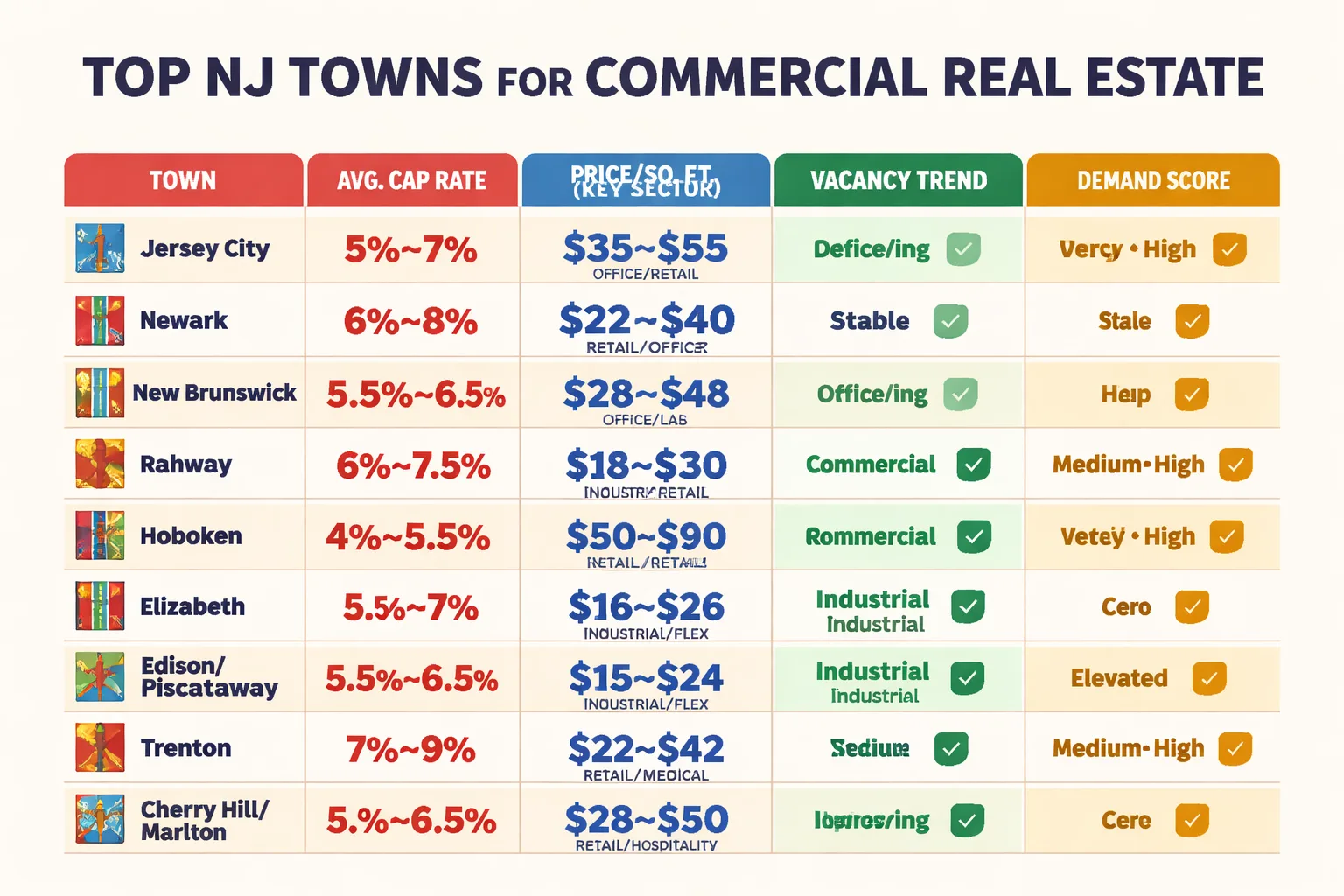
The table tells a story that most investors miss on first pass. The highest cap rates (Trenton, Newark) are not in the towns with the highest demand scores. The lowest cap rates (Hoboken) are in the town with the most compressed returns. The sweet spot for 2026 sits in the middle: Rahway, New Brunswick, and Asbury Park offer cap rates above 5.5% alongside improving vacancy trends and genuine appreciation catalysts.
How to Choose the Right Market for Your Goals
Matching an investment strategy to the right NJ submarket is where most investors either make or lose money. The framework below maps the four primary commercial property types to the towns where each performs best.
Retail investors should focus on Hoboken, Jersey City, and Asbury Park. Hoboken's Washington Street corridor commands $50-$90/sq. ft. NNN rents, supported by a dense, high-income residential base. Jersey City's waterfront mixed-use inventory benefits from Manhattan spillover demand and PATH access. Asbury Park's booming arts and hospitality scene drives year-round foot traffic that supports boutique retail and F&B concepts. The trade-off across all three: compressed cap rates mean cash-flow-first strategies are difficult. These markets reward appreciation plays and long-term hold strategies.
Office investors face a bifurcated market. Class A space near transit hubs (Jersey City waterfront, Hoboken) maintains strong occupancy. Class B and C office along the Route 1 corridor (Edison, Piscataway) faces headwinds from remote work adoption. The Northern New Jersey Office Market Report for Q3 2024 documented the challenges in this segment, and while conditions have improved by 2026, the recovery is uneven. New Brunswick's Helix innovation district is the standout: life sciences and biotech tenants are driving demand for lab-adjacent office space at $28-$48/sq. ft. NNN, well above traditional office pricing.
Industrial and logistics investors should look at Elizabeth and Edison. Elizabeth's proximity to Port Newark and Newark Liberty Airport makes it a premier last-mile logistics location, with industrial rents from $16-$26/sq. ft. NNN and near-zero vacancy. Edison's Route 1 corridor, anchored by Rutgers University and a massive logistics sector, maintains similar fundamentals. The caveat: land costs have risen sharply in both markets, compressing margins on ground-up development. Acquiring existing facilities with below-market leases may offer better returns than new construction.
Mixed-use and value-add investors have the widest opportunity set. Newark's Ironbound district offers 6-8% cap rates alongside NJEDA abatements and a diversified tenant base. Rahway's revitalized downtown arts district is forecast to deliver 6-8% appreciation in 2026, well above the state average, with entry pricing from the low $400Ks. Trenton offers the highest cap rates in the state (7-9%) but requires patient capital and active property management. For investors seeking investment property in NJ with both cash flow and appreciation upside, Rahway and New Brunswick are the markets where both metrics point in the right direction simultaneously.
This is also where the role of a commercial real estate agency in NJ becomes critical. Each town has its own zoning idiosyncrasies, rent control ordinances, environmental review requirements, and tenant base characteristics. A broker who understands the difference between a Jersey City PILOT agreement and a Newark NJEDA abatement, who knows which Elizabeth industrial parcels require ISRA compliance before closing, and who has relationships with the developers driving Asbury Park's revitalization can save investors months of due diligence and thousands in unanticipated costs. The NJ property tax rates by town vary enormously, and property tax expense is one of the largest line items in any commercial pro forma.
Which of these NJ commercial markets matches your investment strategy?
Is Jersey City best for institutional investors?
Best for: Institutional investors, commercial real estate agencies in NJ, and developers seeking high-appreciation, transit-connected assets with strong NYC spillover demand.
The #2 ranked commercial real estate market in the ULI/PwC 'Emerging Trends in Real Estate' report, Jersey City offers unmatched proximity to Manhattan with a booming mixed-use and industrial investment landscape. The city's waterfront office and residential towers, its growing inventory of industrial and flex space in the inland sections, and its direct PATH and ferry access to Midtown and Downtown Manhattan create a market that performs like a sixth borough of New York. City-level property tax abatements of 5-30 years for qualifying redevelopment projects add a layer of incentive that few markets can match.
Key features: - Ranked #2 nationally for CRE investment and development by ULI/PwC for 2026. Waterfront mixed-use, office, multifamily, and industrial inventory. Direct PATH train and ferry access to Midtown and Downtown Manhattan. City-level property tax abatements of 5. 30 years for qualifying redevelopment projects
Pricing: Commercial cap rates typically range from 5%–7%; office and retail asking rents average $35–$55/sq. ft. NNN; industrial space from $18–$28/sq. ft.
Jersey City is the market that most out-of-state investors know about, and for good reason. The ULI/PwC ranking isn't a marketing pitch. It reflects real capital flows, real tenant demand, and real infrastructure investment. The challenge for investors in 2026 is that premium pricing has compressed cap rates to the 5-7% range, making pure cash-flow strategies harder to underwrite. Rent control ordinances require careful review before acquisition, particularly for multifamily-adjacent commercial properties. The opportunity here is for investors who can execute on mixed-use development or repositioning plays where the abatement structure amplifies returns. For luxury waterfront real estate exposure with Manhattan-grade tenant demand, Jersey City remains the benchmark.
Is Newark best for cash-flow investors?
Best for: Cash-flow-focused investors and commercial real estate agencies in NJ seeking high-yield urban assets with long-term appreciation upside.
New Jersey's largest city delivers some of the state's highest commercial cap rates (6%–8% in the Ironbound district) alongside major redevelopment incentives and a diversified tenant base. The presence of Newark Liberty International Airport, major healthcare systems, and universities creates a floor of demand that most mid-sized cities can't replicate. NJEDA property tax abatements of 5-30 years for qualifying redevelopment projects make ground-up and renovation projects financially viable in ways that raw market pricing wouldn't support.
Key features: - 6%–8% cap rates in the Ironbound district. Among the highest in the state. NJEDA property tax abatements of 5. 30 years for qualifying redevelopment. Major logistics, healthcare, and education anchor tenants. Newark Liberty International Airport proximity drives industrial and logistics demand
Pricing: Cap rates of 6%–8% in core districts; retail/office asking rents from $22–$40/sq. ft.; industrial from $14–$22/sq. ft. NNN.
Newark is the contrarian pick in this ranking, and that's exactly why it deserves the #2 spot. The cap rates here are genuine. The Ironbound district's 6-8% range reflects real tenant demand from a diversified base, not distressed assets being unloaded. The airport proximity drives industrial and logistics demand that keeps warehouse occupancy high. The challenge is regulatory: rent control and tenant protection laws add complexity to underwriting, and some submarkets require environmental due diligence under NJ DEP/ISRA rules. Investors who do the homework, or who work with a commercial real estate agency in NJ that knows the city's regulatory landscape, can acquire assets here at cap rates that simply don't exist in Hudson County. For cash-flow investors willing to navigate complexity, Newark's Ironbound district offers the best yield-to-risk ratio in Northern New Jersey in 2026.
Is New Brunswick best for life sciences investors?
Best for: Life sciences real estate investors, commercial real estate agencies in NJ, and mixed-use developers targeting innovation-economy tenants.
Home to Rutgers University and the emerging Helix biotech/life sciences innovation district, New Brunswick is a rising star for commercial and mixed-use real estate investment in Central NJ. The Helix district is attracting biotech and life sciences firms that need specialized lab and office space, and the surrounding property values are rising in response. The tenant base is diversified across students, medical professionals from Robert Wood Johnson Medical Center, and corporate occupiers, which creates demand resilience that single-industry markets can't match. NJ Transit rail provides direct service to NYC Penn Station, connecting the market to Manhattan's capital and talent pools.
Key features: - Helix innovation district attracting biotech and life sciences firms, boosting surrounding property values. Diversified tenant base: students, medical professionals, and corporate occupiers. NJ Transit rail hub with direct service to NYC Penn Station. Strong rental demand driven by Rutgers University and Robert Wood Johnson Medical Center
Pricing: Office/lab space from $28–$48/sq. ft. NNN; retail from $20–$35/sq. ft.; multifamily cap rates averaging 5.5%–6.5%.
New Brunswick is the market that most investors underestimate. The Helix innovation district is not a concept or a plan. It is under construction, with biotech firms committing to space and driving demand for lab-adjacent office at pricing that exceeds traditional office by 40-60%. The challenge is that lab and life sciences buildout costs are significantly higher than standard office tenant improvements, and competition for prime parcels near the Helix district is intensifying. Investors who acquire properties within the innovation district's orbit now, before the next phase of development is complete, are positioning for appreciation that will likely outpace the state average. The Helix district is the single most consequential commercial real estate development in Central New Jersey, and its spillover effects are just beginning.
Is Rahway best for value-add investors?
Best for: Value-add investors and commercial real estate agencies in NJ seeking multi-family and mixed-use opportunities with strong appreciation upside at accessible price points.
An affordable Union County entry point with a revitalized downtown arts district, Rahway is forecast to deliver 6%–8% appreciation in 2026. Well above the NJ state average. The town's NJ Transit rail access to NYC is a key driver of commercial tenant demand, and the revitalized downtown is attracting new retail and F&B tenants that are creating the kind of street-level vibrancy that drives mixed-use property values. Entry-level investment properties from the low $400Ks make this one of the most accessible markets on this list for investors who don't have institutional capital but want institutional-grade appreciation potential.
Key features: - 6%–8% price appreciation forecast for 2026, significantly exceeding the NJ state average. Revitalized downtown with arts district attracting new retail and F&B tenants. Excellent NJ Transit rail access to NYC. A key driver of commercial tenant demand. Affordable entry pricing compared to Jersey City and Hoboken
Pricing: Commercial asking rents from $18–$30/sq. ft. NNN; multi-family cap rates of 6%–7.5%; entry-level investment properties from the low $400Ks.
Rahway is the market where the math works for investors who need both cash flow and appreciation. The 6-8% appreciation forecast for 2026 is not speculative. It reflects a revitalization process that is already underway, with new businesses opening and property values rising in response. The cap rates of 6-7.5% on multi-family properties are competitive with Newark's Ironbound district but at lower entry pricing and with a less complex regulatory environment. The limitation is scale: the commercial inventory is smaller than in the top-tier markets, which limits options for large-format or institutional deals. For investors doing their first or second commercial deal, or for those building a portfolio of mixed-use properties in a rising market, Rahway offers the best entry point in Northern New Jersey.
5. Hoboken — Best for premium retail investors
Best for: Retail and mixed-use investors and commercial real estate agencies in NJ targeting affluent, transit-rich submarkets with stable, long-term tenancy.
A premium Hudson County market directly across from Midtown Manhattan, Hoboken commands top-tier rents for retail, office, and mixed-use commercial assets with best-in-class appreciation. Washington Street's retail corridor is among the most sought-after in Northern New Jersey, with rents from $50-$90/sq. ft. NNN. The dense, high-income residential base supports robust retail and F&B commercial demand, and the town has been identified as a top market for maximum appreciation in 2026. Direct PATH train, NJ Transit rail, and ferry access to Manhattan makes this the most transit-connected market in the state.
Key features: - Direct PATH train, NJ Transit rail, and ferry access to Manhattan. Washington Street retail corridor among the most sought-after in Northern NJ. Strong appreciation trajectory. Identified as a top market for maximum appreciation in 2026. Dense, high-income residential base supports robust retail and F&B commercial demand
Pricing: Retail rents from $50–$90/sq. ft. NNN on Washington Street; office from $40–$60/sq. ft.; commercial properties typically trade at 4%–5.5% cap rates.
Hoboken is the market where investors pay for certainty. The 4-5.5% cap rates are the lowest in this ranking, reflecting premium pricing driven by Manhattan-grade demand and severely limited supply. Very little land is available for new development, which constrains inventory and supports existing asset values. For cash-flow-first investors, these cap rates make underwriting difficult. For appreciation investors and those seeking stable, long-term tenancy in an affluent submarket, Hoboken delivers a risk profile that resembles Manhattan luxury retail more than NJ suburban commercial. The Prodigy Real Estate analysis of Hudson County rental trends frames the broader narrative of renters transitioning to homeownership, which supports retail and service-sector demand as the residential base grows. Investors who want waterfront luxury real estate exposure with commercial income should have Hoboken on their short list.
6. Elizabeth. Best for industrial and logistics investors
Best for: Industrial, logistics, and retail commercial real estate investors and agencies in NJ seeking high-occupancy assets near major transportation infrastructure.
A logistics and industrial powerhouse adjacent to Newark Airport and the Port of Newark, Elizabeth offers a compelling mix of commercial and industrial investment opportunities with strong occupancy fundamentals. Direct access to Newark Liberty Airport and Port Newark makes this a premier last-mile logistics location. The mix of residential, retail, and industrial commercial real estate opportunities gives investors options across asset classes. Proximity to NYC and major interstate highways (I-95, NJ Turnpike) ensures that industrial tenants have the connectivity they need to serve the entire Northeast corridor.
Key features: - Direct access to Newark Liberty Airport and Port Newark. Premier last-mile logistics location. Mix of residential, retail, and industrial commercial real estate opportunities. Proximity to NYC and major interstate highways (I-95, NJ Turnpike) - Diverse and growing population base supports retail and service-sector commercial demand
Pricing: Industrial/warehouse rents from $16–$26/sq. ft. NNN; retail from $20–$38/sq. ft.; commercial cap rates averaging 5.5%–7%.
Elizabeth is the industrial play in this ranking, and the fundamentals are as strong as any market in the country. Port Newark and the airport create a logistics ecosystem that drives near-zero industrial vacancy and consistent tenant demand. The 5.5-7% cap rate range on commercial properties reflects the market's strength: pricing has risen, but cap rates haven't compressed to the degree seen in Hudson County retail. The challenge is environmental. NJ DEP compliance, particularly under ISRA (Industrial Site Recovery Act) rules, can slow industrial property closings and add costs to due diligence. Retail corridors in Elizabeth also face competition from e-commerce, requiring active asset management and careful tenant mix curation. For investors who understand industrial real estate and are willing to navigate environmental review, Elizabeth offers some of the most defensible commercial assets in the state.
7. Edison / Piscataway. Best for suburban office and flex investors
Best for: Office, industrial, and flex-space investors and commercial real estate agencies in NJ targeting stable, corporate-anchored suburban markets with consistent cash flow.
A Middlesex County commercial hub anchored by Rutgers University and a massive logistics sector, Edison and Piscataway maintain near-zero vacancy rates and are a 'sweet spot' for 2026 CRE investment. The proximity to Rutgers University and a large logistics sector keeps vacancy rates near zero. The major corporate and pharmaceutical tenant base along the Route 1 corridor provides diversified demand that supports both office and flex-space pricing. The area is well-connected via NJ Turnpike, Garden State Parkway, and NJ Transit rail, giving tenants the access they need without the premium pricing of Hudson County.
Key features: - Proximity to Rutgers University and a large logistics sector keeps vacancy rates near zero. Strong economy and diverse housing and commercial real estate options. Major corporate and pharmaceutical tenant base along the Route 1 corridor. Well-connected via NJ Turnpike, Garden State Parkway, and NJ Transit rail
Pricing: Industrial/flex rents from $15–$24/sq. ft. NNN; office from $22–$36/sq. ft.; retail from $24–$40/sq. ft.; cap rates averaging 5.5%–6.5%.
Edison and Piscataway represent the suburban stability play. The near-zero vacancy rates in industrial and flex space are the headline metric. Corporate and pharmaceutical tenants along the Route 1 corridor provide long-term lease stability that supports the 5.5-6.5% cap rate range. The challenge is the Route 1 office market, which faces headwinds from remote work trends. Office assets in this corridor require careful tenant retention strategies and may need repositioning to attract tenants who want amenity-rich, modern space rather than traditional suburban office. Land costs have risen sharply, compressing margins on ground-up development. For investors acquiring existing flex or industrial space with below-market leases, the value-add path is clear: renew or release at market rates and capture the spread.
8. Trenton. Best for maximum cash flow
Best for: Cash-flow-focused investors and commercial real estate agencies in NJ seeking high-yield, value-add commercial and mixed-use assets in an incentive-rich urban market.
New Jersey's capital city offers some of the state's highest commercial cap rates and is actively supported by NJEDA redevelopment incentives, making it a top pick for cash-flow-maximizing investors in 2026. Among the highest commercial cap rates in NJ (7%–9%) make this ideal for maximum cash flow strategies. NJEDA property tax abatements of 5-30 years for qualifying redevelopment projects can transform a marginal deal into a strong performer. The state capital status provides stable government and institutional anchor tenants that create a floor of demand. Philadelphia commuter access via SEPTA and NJ Transit adds tenant demand from a second metro area.
Key features: - Among the highest commercial cap rates in NJ. Ideal for maximum cash flow strategies. NJEDA property tax abatements of 5. 30 years for qualifying redevelopment projects. State capital status provides stable government and institutional anchor tenants. Philadelphia commuter access via SEPTA and NJ Transit adds tenant demand
Pricing: Commercial cap rates of 7%–9%; retail/office rents from $14–$24/sq. ft. NNN; industrial from $10–$18/sq. ft. — among the most affordable in the state.
Trenton is the highest-risk, highest-reward market in this ranking. The 7-9% cap rates are the best in New Jersey, and the $14-$24/sq. ft. asking rents are among the most affordable in the state. NJEDA abatements can make redevelopment projects viable that wouldn't pencil anywhere else. The trade-off is patience. Appreciation timelines in Trenton are longer than in northern NJ. Some districts carry elevated vacancy risk and require active property management. This is not a market for passive investors. It is a market for investors who want maximum cash flow, who have the operational capacity to manage urban assets, and who are willing to hold for a longer appreciation cycle. For investors whose primary metric is yield, Trenton's cap rates are unmatched in New Jersey.
9. Cherry Hill / Marlton (South Jersey) — Best for suburban retail and medical office

Best for: Retail, medical office, and suburban commercial investors and real estate agencies in NJ targeting stable, income-producing South Jersey assets with Philadelphia MSA exposure.
South Jersey's premier commercial corridor, anchored by Cherry Hill and Marlton, offers suburban retail, office, and medical real estate with strong Philadelphia MSA fundamentals and growing investor interest in 2026. Strong suburban retail and medical office demand is driven by affluent South Jersey demographics. Marlton offers a rare combination of suburban lifestyle, competitive pricing, and Philadelphia commuter access. Local CRE agencies including Vantage Commercial and Wolf Commercial Real Estate (WCRE) are active in this corridor, with WCRE completing multiple office and retail transactions through Q1 2026.
Key features: - Vantage Commercial and Wolf Commercial Real Estate (WCRE) are active local CRE agencies serving this corridor. Strong suburban retail and medical office demand driven by affluent South Jersey demographics. Marlton offers rare combination of suburban lifestyle, competitive pricing, and Philadelphia commuter access. WCRE completed multiple office and retail transactions in the corridor through Q1 2026
Pricing: Retail rents from $22–$42/sq. ft. NNN; medical office from $24–$38/sq. ft.; commercial cap rates averaging 5.5%–7%; entry-level commercial assets from the mid-$500Ks.
Cherry Hill and Marlton are the South Jersey answer to the northern NJ markets that dominate this ranking. The Philadelphia MSA exposure creates a different tenant base and demand driver than the NYC-oriented markets, and for investors seeking geographic diversification within NJ, this corridor is the logical choice. Medical office is the standout asset class here, with demand from affluent South Jersey demographics supporting $24-$38/sq. ft. rents and stable occupancy. The suburban office market faces the same remote-work headwinds as Edison's Route 1 corridor, and retail assets require careful tenant mix curation to compete with e-commerce pressure. Entry-level commercial assets from the mid-$500Ks make this an accessible market for investors building a portfolio. For investors who already hold assets in northern NJ and want to diversify without leaving the state, Cherry Hill and Marlton offer the most compelling fundamentals in South Jersey.
10. Asbury Park — Best for boutique retail and hospitality
Best for: Boutique retail, hospitality, and mixed-use investors and commercial real estate agencies in NJ seeking high-growth, lifestyle-driven coastal market exposure.
A revitalized Jersey Shore city with a booming arts, entertainment, and hospitality scene, Asbury Park is one of NJ's fastest-appreciating commercial markets and a standout performer for mixed-use and boutique retail investment in 2026. Property values are appreciating at rates significantly outpacing many traditional NJ investment markets. Substantial infrastructure improvements and new commercial developments are underway. The burgeoning arts, entertainment, and hospitality scene drives year-round foot traffic. The compact market footprint means strategic acquisitions benefit from neighborhood-wide spillover appreciation.
Key features: - Property values appreciating at rates significantly outpacing many traditional NJ investment markets in 2026. Substantial infrastructure improvements and new commercial developments underway. Burgeoning arts, entertainment, and hospitality scene drives year-round foot traffic. Compact market footprint means strategic acquisitions benefit from neighborhood-wide spillover appreciation
Pricing: Retail/hospitality rents from $28–$50/sq. ft. NNN; mixed-use commercial cap rates of 5%–6.5%; boutique commercial properties typically trading from the high $600Ks.
Asbury Park is the wild card in this ranking, and it earned its spot. The appreciation rates here are not incremental. They are outpacing many of the traditional NJ investment markets that investors default to. The arts and entertainment scene has moved beyond a seasonal draw to become a year-round economic engine that supports retail, hospitality, and mixed-use demand. The challenge is scale and seasonality. The market is compact, which limits options for large-format or institutional deals. Seasonal tourism patterns can create cash flow variability for hospitality-dependent assets. For investors who understand lifestyle-driven markets and want exposure to a coastal economy that is still in its growth phase, Asbury Park offers appreciation potential that few markets in the state can match. The key is acquiring properties that benefit from the spillover effect of ongoing revitalization, rather than betting on a single block or corridor.
Making the Right Choice
The ten towns profiled above represent the full spectrum of commercial real estate investment opportunities in New Jersey for 2026. The right choice depends on three factors that only the investor can answer.
First, what is the primary goal? Cash-flow investors should focus on Newark's Ironbound district (6-8% cap rates), Trenton (7-9%), and Rahway (6-7.5%). Appreciation investors should look at Jersey City, Hoboken, Asbury Park, and New Brunswick's Helix district orbit. Investors who need both should focus on Rahway and New Brunswick, where cap rates and appreciation forecasts both point in the right direction.
Second, what is the risk tolerance? Premium markets like Jersey City and Hoboken offer lower cap rates but greater certainty and liquidity. Value-add markets like Trenton and Newark offer higher cap rates but require active management, regulatory navigation, and longer hold periods. The NAR's commercial real estate market research provides broader context on national trends that can help investors calibrate their risk assessment against NJ-specific opportunities.
Third, what is the operational capacity? Industrial assets in Elizabeth and Edison require different management capabilities than retail assets in Hoboken or hospitality assets in Asbury Park. Matching the asset type to the investor's operational strengths is as important as matching the town to the investment goal.
For investors who are new to NJ commercial real estate, or who are expanding from residential to commercial, working with a commercial real estate agency in NJ is the single most effective way to accelerate the learning curve and avoid costly mistakes. The regulatory landscape, the tax structure, and the market-specific dynamics described above are not things that can be fully understood from a desk in another state. Local expertise matters. The NJ home buying process is already complex for residential buyers. Commercial transactions add layers of complexity around zoning, environmental review, lease analysis, and incentive structuring that demand specialized knowledge.
For investors considering new condo developments near transit-oriented commercial corridors, the mixed-use markets profiled above (Jersey City, New Brunswick, Rahway, Asbury Park) offer opportunities to combine residential and commercial exposure in a single investment. And for those who want to understand the broader New York real estate developer landscape that drives demand in NJ's transit-connected markets, the cross-border dynamics between NYC and NJ commercial real estate are worth studying in depth.
The NJ commercial real estate market in 2026 is not a monolith. It is a collection of distinct submarkets, each with its own cap rate profile, tenant base, regulatory environment, and appreciation trajectory. The investors who succeed are the ones who match their strategy to the right town, understand the local dynamics, and work with professionals who know the difference between a deal that looks good on paper and one that actually performs.
FAQ: NJ Commercial Real Estate Investment
Is commercial property a good investment in NJ in 2026?
Yes, for investors who match their strategy to the right submarket. New Jersey's office vacancy fell to 25.0% in Q2 2026 (its lowest since 2022), year-to-date net absorption hit 1.29 million square feet, and cap rates range from 4% in premium Hudson County markets to 9% in Trenton. The ULI/PwC report ranks Jersey City #2 nationally for CRE investment. The state's proximity to Manhattan, port infrastructure, and NJEDA tax incentives create a risk-adjusted return profile that few states match. Success depends on town selection, property type alignment, and local market expertise.
What is the cheapest place to buy commercial property in New Jersey?
Trenton offers the most affordable commercial real estate in the state, with retail and office asking rents from $14-$24/sq. ft. NNN and industrial space from $10-$18/sq. ft. Cap rates of 7-9% are the highest in NJ. Entry-level commercial assets are significantly cheaper than in Hudson County or the Route 1 corridor. The trade-off is longer appreciation timelines and the need for active property management. Newark's industrial submarkets ($14-$22/sq. ft.) and Rahway (entry-level from the low $400Ks) are the next most accessible markets for investors seeking lower entry points.
How do I find a commercial real estate agency in NJ?
Look for a commercial real estate agency in NJ with specific experience in your target submarket and property type. The right broker understands local zoning, NJEDA incentive structures, rent control ordinances, and environmental review requirements. They should have recent transaction comps in the town you're targeting and relationships with the developers, tenants, and lenders active in that market. Verify their track record through closed deals, not just listings. For investors crossing state lines, a broker licensed in both NJ and NY who understands the cross-border dynamics between Manhattan and NJ transit-connected markets can provide additional value.
What are the best NJ towns for commercial real estate investment in 2026?
The top markets are Jersey City (#2 nationally per ULI/PwC), Newark (6-8% cap rates in the Ironbound), New Brunswick (Helix biotech district), Rahway (6-8% appreciation forecast), Hoboken (premium retail), Elizabeth (industrial and logistics), Edison/Piscataway (near-zero vacancy), Trenton (7-9% cap rates), Cherry Hill/Marlton (South Jersey retail and medical office), and Asbury Park (boutique retail and hospitality). Each serves a different investor profile, from institutional to first-time commercial buyers.
What cap rates can I expect for NJ commercial real estate in 2026?
Cap rates vary widely by submarket and asset type. Premium Hudson County markets (Hoboken, Jersey City waterfront) trade at 4-5.5%. Newark's Ironbound district delivers 6-8%. Trenton offers the highest cap rates at 7-9%. Suburban markets like Edison and Cherry Hill average 5.5-7%. Industrial assets in Elizabeth and Edison command tighter cap rates due to near-zero vacancy. The spread between the highest and lowest cap rates in NJ is approximately 500 basis points, which gives investors meaningful flexibility to match yield to risk tolerance.
Should I invest in NJ commercial real estate or NYC commercial real estate?
The answer depends on the investment goal. NYC offers higher absolute rents and greater liquidity but lower cap rates and higher entry costs. NJ offers higher cap rates, lower entry pricing, and access to the same tenant pool through transit connectivity. Many investors hold both: NYC assets for appreciation and prestige, NJ assets for cash flow and yield. A broker licensed in both states can help identify cross-market opportunities and execute transactions on both sides of the Hudson.
About the Author
Judy Zhou, Coldwell Banker Realtor®
Judy Zhou is a top-ranked Coldwell Banker Realtor® serving New Jersey and New York, recognized in the top 7% of agents internationally with prestigious awards like the International Diamond Society and President's Elite. Licensed in both NJ and NY, she specializes in luxury homes, investment properties, and commercial real estate, offering seamless bilingual English-Chinese service.
Get a personalized CRE investment analysis for your target NJ submarket from a broker licensed in both New Jersey and New York.