How NJ Property Taxes Actually Work — and What's Rising in 2026

By Judy Zhou, Keller Williams Realtor®
Key Takeaways
- New Jersey's median property tax of $9,541 is 3.2 times the U.S. average of $2,969, the highest rate in the nation.
- Effective tax rates across the state's 564 municipalities range from 1.5% to over 4%, so a $1M property can face $15,000 to $40,000+ in annual taxes.
- Property tax is calculated by multiplying assessed value by the local tax rate and dividing by 100, after applying the equalization ratio.
- The 1947 constitution locked in local control, giving each of New Jersey's 564 towns independent power to set its own levy.
New Jersey's property tax system was essentially locked into its modern form in 1947, when the state constitution enshrined local control over taxation. Handing each of the state's 564 municipalities the power to set its own levy. That decision, made when New Jersey's population was barely four million, now governs tax bills for nearly nine million residents, thousands of commercial real estate investors, and a luxury condo market that didn't exist yet. Nearly eight decades later, that hyper-local structure is precisely why learning how to calculate nj property tax requires understanding your specific town. Not just the state average.
New Jersey holds the nation's highest median property tax at $9,541, nearly 3.2 times the U.S. average of $2,969, according to WalletHub's 2025 Property Tax by State analysis. The Lincoln Institute of Land Policy's 2023 comparative data confirms NJ residents pay the highest property tax rates in the country, a ranking sustained for over a decade. The core formula is simple: assessed value multiplied by the local tax rate, divided by 100. But the inputs vary wildly across 564 municipalities. For investors and homeowners, the effective tax rate ranges from roughly 1.5% in some towns to over 4% in others, meaning a $1M property can carry anywhere from $15,000 to $40,000+ in annual taxes. Understanding these mechanics is the single most important step before buying in NJ.
How to Calculate NJ Property Tax
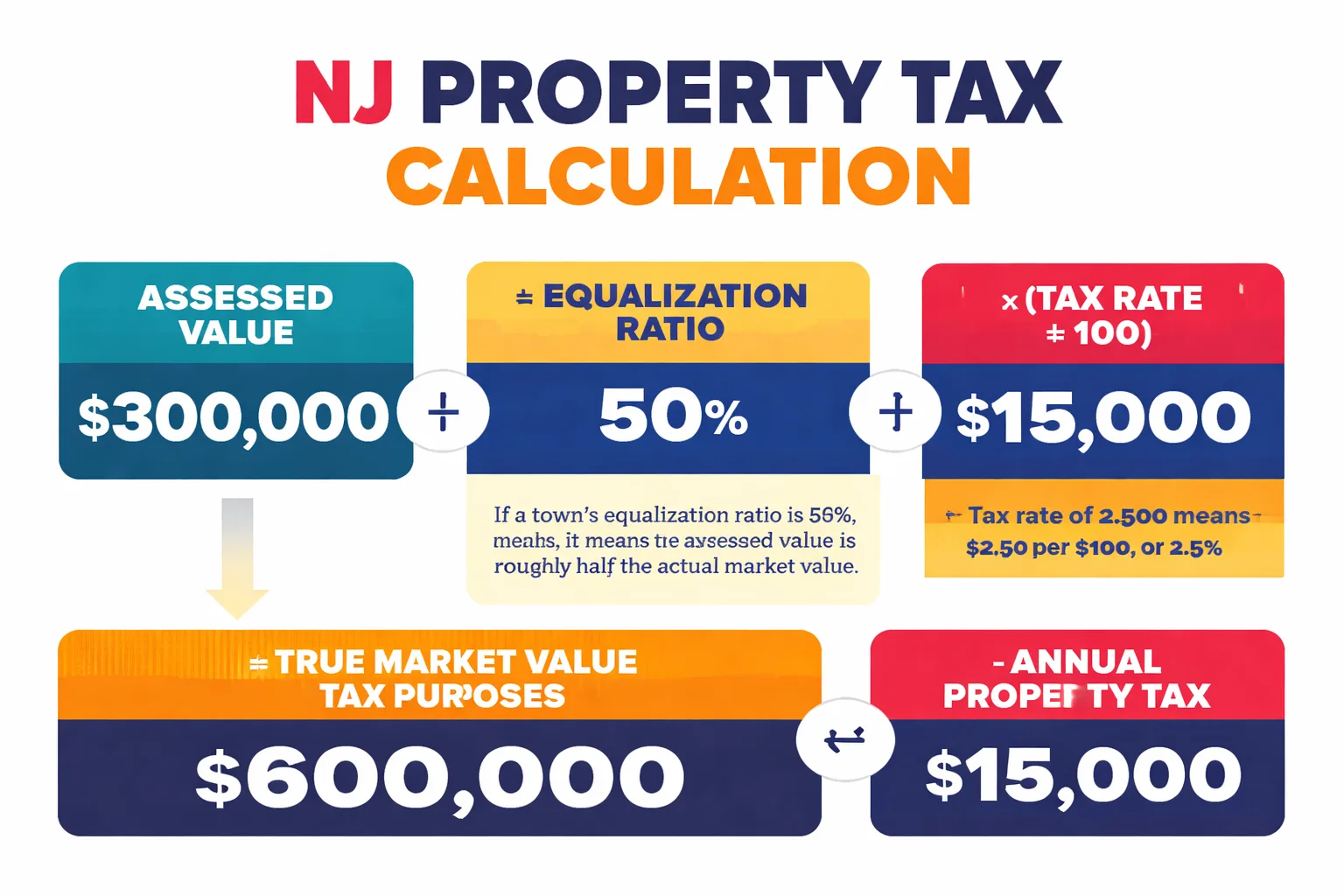
The formula itself is straightforward. The complexity lives inside the inputs. New Jersey property tax is calculated by taking a property's assessed value, applying the equalization ratio to derive true market value for tax purposes, and multiplying by the municipal tax rate. Here is the exact formula:
Annual Property Tax = (Assessed Value ÷ Equalization Ratio) × (Tax Rate ÷ 100)
The tax rate is expressed as a dollar amount per $100 of assessed value. A rate of 2.500 means $2.50 per $100, or 2.5%.
The equalization ratio is where most people get tripped up. It exists because New Jersey municipalities do not reassess every year. Over time, assessed values drift away from actual market values. The county tax board calculates an equalization ratio to bring everyone back to true market value for tax distribution purposes. If a town's equalization ratio is 50%, it means the average assessed value is roughly half the actual market value.
Here is a plain-English example using a Bergen County home. Consider a home in Tenafly, NJ, assessed at $700,000. Tenafly's equalization ratio is approximately 85%. The municipal tax rate is roughly 2.400.
Step 1: Calculate equalized value. $700,000 ÷ 0.85 = $823,529.
Step 2: Apply the tax rate. $823,529 × (2.400 ÷ 100) = $19,765.
Annual property tax on this home: approximately $19,765, or about $1,647 per month.
That monthly figure is what matters for buyers. An FHA pre-approval might be based on the seller's lower tax bill from years ago, but after closing, a reassessment can easily cause the tax bill to jump by 50% or more. This means an extra $250+ per month, accumulating to over $15,000 in additional, unexpected expenses within just five years. It shatters budget expectations and makes reselling harder down the line. For a deeper look at Bergen County town comparisons, the Closter vs Tenafly breakdown illustrates how tax rates vary even between neighboring municipalities.
For commercial real estate investors, the calculation is the same but the stakes are higher. A property's effective tax rate of 2.5% to 3.5% can drop the actual net return by 1.5 to 2.5 percentage points compared to the headline cap rate. An industrial asset quoted at a 6.5% cap rate might yield closer to 4% after property taxes and operating costs. That is the difference between a solid investment and a marginal one.
Let's run a second example to show how different the outcome can be just one town over. Consider a similar-sized home in a Salem County municipality with an assessed value of $200,000. The equalization ratio is 100% (meaning the town recently completed a revaluation and assessments match market values). The municipal tax rate is 3.800.
Step 1: Calculate equalized value. $200,000 ÷ 1.00 = $200,000.
Step 2: Apply the tax rate. $200,000 × (3.800 ÷ 100) = $7,600.
Annual property tax: $7,600. That is less than the Tenafly bill in absolute dollars. But the effective rate is 3.8% versus Tenafly's 2.4%. If the Salem County home were valued at $823,529 (the same equalized value as the Tenafly example), the annual tax would be $31,294. The rate matters more than the total bill when comparing properties across towns.
A third example: a commercial property in Jersey City. A multi-family building assessed at $2,500,000. Jersey City's equalization ratio is roughly 35%. The tax rate is 1.800.
Step 1: Calculate equalized value. $2,500,000 ÷ 0.35 = $7,142,857.
Step 2: Apply the tax rate. $7,142,857 × (1.800 ÷ 100) = $128,571.
Annual property tax on this commercial building: $128,571, or roughly $10,714 per month. For an investor underwriting this deal at a 5% cap rate, the property needs to generate $357,143 in net operating income (before taxes) to justify the $7.14M value. After property taxes of $128,571, the investor keeps $228,571. That is an effective yield of 3.2% on the purchase price, not 5%. The gap between the headline cap rate and the after-tax yield is where deals live or die.
Are Property Taxes Going Up in NJ in 2026?
Yes. Property taxes in New Jersey are rising in 2026, driven by municipal budget increases, school funding shortfalls, and the expiration of pandemic-era federal aid that propped up local budgets through 2025. Multiple municipalities across Bergen, Essex, and Monmouth counties have approved budget increases for the 2026 fiscal year that translate directly into higher tax levies.
The structural pressure is undeniable. New Jersey's school funding formula (the School Funding Reform Act) has been underfunded for years. When the state does not fully fund its share, local school districts raise property taxes to cover the gap. In 2026, several districts are seeing their state aid reduced under the S2 funding law, which phases out adjustment aid for districts that were historically overfunded. Those districts must either cut services or raise local taxes. Most choose the latter.
The counties seeing the sharpest increases in 2026 tend to be those with school districts losing S2 adjustment aid and those that delayed revaluations during the pandemic. When a town delays reassessment, the tax burden shifts unevenly across properties. Some owners pay more than their fair share while others pay less. When the revaluation finally hits, the correction can be dramatic.
For the broader housing market context, the 2026 New Jersey Housing Market Outlook tracks how these tax pressures interact with buyer demand and inventory trends across the state.
Here is what buyers and investors should expect in specific segments:
Luxury condos and NJ luxury condos: New luxury condo developments near Manhattan often carry abatements that phase out over 10 to 20 years. When those abatements expire, the tax bill can double or triple. Buyers who purchased during the abatement period face a shock. The same dynamic that made Manhattan's 421-a tax abatement program so valuable (and its expiration so disruptive) applies to NJ abatements. The roughly 10 existing Manhattan buildings that still offer these abatements are incredibly valuable for exactly this reason. In NJ, buyers should verify abatement status before closing, not after.
Commercial real estate NJ: Commercial properties are assessed based on income approach, not just comparable sales. When cap rates compress and values rise, assessed values follow. A commercial property purchased at a 5% cap rate will have a higher assessed value than the same income stream valued at a 7% cap rate. Higher assessed values mean higher taxes. Investors who underwrite deals without modeling the tax impact of their own purchase price are setting themselves up for a revaluation surprise.
Investment property NJ: Multi-family investors face a double squeeze. Rising property taxes increase operating expenses, which reduces net operating income, which reduces the property's appraised value for refinancing. If the tax increase is large enough, it can trigger a loan covenant violation on commercial debt. This is why comprehensive tax and holding cost analysis belongs at the beginning of the transaction, not the end.
The 2026 environment adds another layer: insurance costs. Property insurance premiums in NJ have risen sharply over the past two years, particularly in coastal areas and older multi-family buildings. When insurance and taxes both escalate, the combined carrying cost increase can overwhelm rent growth. A multi-family property that was cash-flow positive in 2024 may be marginal in 2026 if both tax and insurance costs have risen 15-20% each. Investors need to model these as paired line items, not separate concerns.
Why Is NJ Property Tax So High?
Three structural reasons, none of which are fixable without constitutional reform.
1. School funding reliance. New Jersey funds its public schools primarily through local property taxes. According to the Lincoln Institute of Land Policy, NJ's property tax reliance is among the highest in the nation. The state income tax and sales tax are constitutionally dedicated to property tax relief (the Homestead Rebate program and similar mechanisms), but those programs have been repeatedly scaled back. When state aid falls short, the gap lands on local property owners.
The numbers tell the story. School taxes account for roughly 50-55% of the average NJ property tax bill. County taxes add another 15-20%. Municipal taxes (police, fire, public works, administration) account for 25-30%. Library and open space taxes make up the remainder. When a school district's state aid is cut by $2M, that gap is spread across the town's ratable base. In a town with $500M in total ratables, a $2M shortfall adds 0.4% to the tax rate. For a homeowner with a $500K assessed value, that is an extra $2,000 per year. One school funding decision can move a tax bill by thousands of dollars.
2. Home rule. New Jersey has 564 municipalities, over 600 school districts, and 21 counties. Each municipality sets its own tax rate, maintains its own services, and employs its own administrative staff. This fragmentation is expensive. The same state constitution that enshrined local control in 1947 makes consolidation nearly impossible without voter approval in every affected town. Voters almost never approve consolidation because it means losing local control over schools and services.
The administrative duplication is staggering. A town of 8,000 residents maintains a full municipal apparatus: clerk, tax assessor, tax collector, construction office, police department, public works, and a separate school district administration. The neighboring town of 10,000 residents does the same. Two towns, two sets of administrators, two police departments, two school superintendents. In a consolidated model, those costs would be shared. In NJ, they are duplicated. The overhead is baked into every tax bill.
3. No meaningful county consolidation. In states like Maryland and Virginia, county governments handle many services that NJ municipalities handle separately. Police, fire, and school administration at the county level creates economies of scale. New Jersey's structure prevents this. The result is duplicated administrative overhead across hundreds of small jurisdictions, all funded by property taxes.
The WalletHub data puts the scale in perspective. NJ's median homeowner tax of $9,541 dwarfs the national average of $2,969. The Yahoo Finance coverage of WalletHub's report notes NJ ranked 51st (last place) for property tax affordability. This is not a recent problem. It is a structural feature of how the state funds government.
For buyers comparing NJ to neighboring markets, the contrast is stark. Manhattan luxury apartments carry high monthly carrying costs (common charges, maintenance, taxes at $3+ per square foot in luxury buildings), but the property tax component is often lower than NJ suburbs on a percentage basis. The tradeoff is that Manhattan co-op maintenance includes underlying building debt service and operating costs that NJ property taxes do not. Neither market is cheap. But the cost structure is different, and buyers need to understand which model fits their financial situation.
What Town in NJ Has the Highest Property Tax?
The answer depends on whether you measure by tax rate or by total tax bill. A $2M home in a low-rate town can pay more in total taxes than a $500K home in a high-rate town.
Highest effective tax rates (percentage of home value): Tavistock Borough in Camden County consistently ranks at or near the top, with effective rates exceeding 4%. Several Salem County municipalities also exceed 4%. These are small towns with limited ratables (commercial and industrial properties that share the tax burden). When a town has almost no commercial base, residential owners absorb the entire levy.
Highest total tax bills: Affluent suburbs with high property values and moderate-to-high rates produce the largest bills. Millburn (Essex County), Tenafly (Bergen County), and Alpine (Bergen County) all see total annual tax bills well above $20,000 for typical homes. A $1.5M home in Tenafly at a 2.4% effective rate generates $36,000 in annual taxes.
The comparison table below shows approximate effective tax rates by select NJ counties. These are blended averages. Individual towns within each county vary significantly.
| County | Approx. Average Effective Rate | Median Home Value | Est. Annual Tax on Median Home |
| Bergen | 2.3% | $650,000 | $14,950 |
| Essex | 2.8% | $450,000 | $12,600 |
| Hudson | 2.1% | $550,000 | $11,550 |
| Morris | 2.2% | $575,000 | $12,650 |
| Somerset | 2.4% | $525,000 | $12,600 |
| Union | 2.7% | $475,000 | $12,825 |
| Monmouth | 2.3% | $580,000 | $13,340 |
| Camden | 3.1% | $320,000 | $9,920 |
| Salem | 3.4% | $240,000 | $8,160 |
For a full breakdown by municipality, the NJ Property Tax Rates by Town resource provides town-level data across all 21 counties.
The key takeaway for investors: high-rate towns are not always bad investments. A town with a 3% rate but strong rent growth and appreciating values can outperform a town with a 1.8% rate and stagnant demand. The tax rate is one input in the total return equation. It should never be the only input.
The role of commercial ratables deserves special attention here. Jersey City and Hoboken have relatively moderate residential tax rates because their massive commercial and luxury condo bases absorb a significant portion of the levy. A town like Tenafly, with limited commercial property, pushes nearly the entire burden onto residential homeowners. This is why two towns with similar school quality and home values can have tax bills that differ by $5,000 to $10,000 per year on equivalent properties. The ratable base is the hidden variable that most buyers never examine.
Are you modeling the true property tax cost before you buy?
How Does the Appeals Process Work?
New Jersey homeowners can appeal their property tax assessment annually, with filings due by January 15 or April 1 depending on the municipality, through the County Tax Board or New Jersey Tax Court. The appeal argues that the assessed value exceeds the true market value of the property.
To win an appeal, the property owner must prove the assessment is incorrect. The most common evidence is recent comparable sales. If similar homes in the same neighborhood sold for less than the assessed value, that is grounds for reduction. An appraisal from a licensed NJ appraiser strengthens the case significantly.
The appeals process is underused. Many homeowners assume their assessment is fixed or that appealing is too complex. In reality, the process is straightforward for properties that are genuinely over-assessed. The savings compound annually. A successful appeal that reduces assessed value by $100,000 in a town with a 2.5% rate saves $2,500 every year until the next revaluation.
For commercial property owners, appeals are even more critical. Commercial assessments use the income approach, which means the assessor estimates value based on rental income and cap rates. If market cap rates have expanded (meaning values have dropped for the same income stream), the assessed value may be too high. Commercial investors should review assessments annually and appeal when market conditions support a reduction.
The contrarian view here: many tax professionals recommend appealing every year, regardless of whether you think you will win. The logic is that assessors track appeal history. Properties with a history of appeals may receive more careful (and sometimes more favorable) treatment in future revaluations. There is no penalty for losing an appeal (beyond the filing fee and professional costs), so the downside is limited.
The mechanics of filing matter. For residential properties, the filing fee at the County Tax Board level is nominal (typically $25 to $150 depending on the claimed reduction). The process is administrative, not judicial. You present your evidence (comparable sales, appraisal, photos of property defects) to the county tax board, which renders a decision. If you disagree with the board's decision, you can appeal to the New Jersey Tax Court within 45 days. Tax Court cases are more formal and typically require legal representation, but they handle high-value commercial appeals regularly.
For commercial properties, the threshold for Tax Court filing is higher. The claimed under-assessment must exceed $1,000,000 of the true market value. Below that threshold, the County Tax Board is the venue. Commercial appeals often involve detailed income and expense analyses, rent roll reviews, and cap rate testimony from appraisers. The cost of a commercial appeal (appraiser, attorney, filing fees) can run $5,000 to $15,000, but the annual savings from a successful reduction can be $20,000 to $100,000+. The ROI is substantial for properties that are genuinely over-assessed.
Deductions, Exemptions, and Credits
New Jersey offers several programs that reduce property tax bills for eligible residents:
Homestead Benefit Program: Provides a credit against property taxes for homeowners who meet income requirements. The program has been modified multiple times, and eligibility thresholds change. Homeowners should check current-year eligibility through the NJ Division of Taxation.
Senior Freeze (Property Tax Reimbursement): Eligible senior citizens and disabled residents can have their property tax frozen at the level when they first qualified. If taxes increase in subsequent years, the state reimburses the difference. This program is critical for long-term residents in high-tax towns who would otherwise be priced out by rising assessments.
Veteran's Deduction: Eligible veterans receive a $6,000 deduction from their property's assessed value. Surviving spouses of disabled veterans may qualify for a full exemption.
Disabled Veteran's Exemption: Fully disabled veterans (or surviving spouses) qualify for a full property tax exemption on their primary residence. This is the most significant exemption available in NJ.
These programs reduce the final tax bill but do not change the underlying assessment or rate. Buyers should verify whether the current owner's tax bill includes any exemptions that will not transfer. A senior's frozen tax bill tells you nothing about what your tax bill will be as a new, non-senior owner.
Factoring Taxes Into Purchase Decisions
The most expensive mistake buyers make is treating property taxes as a fixed cost rather than a variable one. The seller's tax bill is historical data, not a forecast.
When a property sells, especially at a price significantly above its assessed value, the municipality may trigger a reassessment. This is called an Added Assessment or Omitted Assessment. The new owner's tax bill can reflect the new purchase price, not the old assessed value. For a home purchased at $1.2M with an assessed value of $800,000, the tax bill could increase by 50% or more after the reassessment hits.
This is why working with an agent who understands the local tax landscape matters. A knowledgeable NJ real estate agent will pull the current assessment, calculate the effective tax rate based on the likely post-sale assessed value, and model the true monthly carrying cost. This number should drive the purchase decision, not the seller's historical tax bill.
For investors, the analysis goes further. Commercial real estate investors in high-tax areas like Monmouth County can get burned by relying on a residential agent who focuses on asking price and curb appeal. Critical operational costs and tax assessments get overlooked during due diligence. A comprehensive tax and holding cost analysis belongs at the beginning of the transaction, not after closing. The Investment Real Estate Agency resource covers how investment-focused representation differs from residential transactions.
The same principle applies to buyers considering new condo developments near Manhattan. The advertised monthly costs often reflect abated tax rates that will expire. Buyers should model the post-abatement tax bill from day one.
For first-time homebuyers navigating the NJ market, the NJ Home Buying Process guide walks through how taxes factor into the full transaction timeline, from offer to closing.
NJ vs NY Property Taxes
New Jersey and New York both impose high property taxes, but the structures differ in ways that affect investors and homeowners.
New York City operates on a classified property tax system with four classes: Class 1 (1-3 family homes), Class 2 (apartments including co-ops and condos), Class 3 (utility), and Class 4 (commercial). Each class has its own rate and assessment rules. NYC intentionally keeps Class 1 rates low to protect homeowners, which shifts the burden to Class 2 and Class 4. Co-op and condo owners in Manhattan pay effective rates that are often lower than NJ suburbs on a percentage basis, but the total carrying cost (maintenance + taxes) can exceed NJ costs.
New Jersey has no classified system. Every property type is taxed at the same municipal rate. This means commercial properties and residential properties share the same levy. In towns with a strong commercial base (like Jersey City or Hoboken), residential owners benefit because commercial properties absorb a large share of the tax burden. In towns with little commercial base, residential owners carry everything.
For buyers deciding between NJ suburbs and NYC, the comparison should include:
- Property tax rate and effective rate. Monthly maintenance or common charges (for condos and co-ops) - Income tax implications (NYC residents pay NYC income tax in addition to state tax) - Commute cost and time. School district quality (if applicable)
A $1.5M condo in Manhattan might carry $2,000/month in taxes and $3,000/month in common charges. A $1.5M home in Tenafly might carry $3,000/month in taxes and $500/month in utilities and upkeep. The total monthly cost is similar, but the composition is different. NYC buyers pay more in maintenance and income tax. NJ buyers pay more in property tax. Neither is objectively cheaper. The right choice depends on lifestyle, tax situation, and investment goals.
For buyers working across both markets, having an agent licensed in both NJ and NY provides continuity. Understanding both tax structures allows for apples-to-apples comparisons that most single-market agents cannot provide. The Westchester County Homes For Sale page covers the NY side of this cross-market analysis.
What Role Do Revaluations Play?
A revaluation (or reassessment) is the process by which a municipality updates all property assessments to reflect current market values. In NJ, there is no mandatory statewide revaluation cycle. Each municipality decides when to revalue. Some towns do it every 5 years. Others go 20 or 30 years without one.
When a revaluation occurs, every property in the town is reassessed. Some assessments go up. Some go down. The tax rate typically adjusts downward to compensate (since the total ratable base has increased), but individual tax bills shift based on how each property's new assessment compares to the town average.
Here is the critical mechanic: if your property's assessment increases more than the town average during a revaluation, your tax bill goes up even if the tax rate drops. If your assessment increases less than the town average, your tax bill goes down. The revaluation redistributes the tax burden across all properties based on updated values.
For buyers, this creates a timing risk. If you buy a property in a town that has not revalued in 15 years, and a revaluation is scheduled for the year after your purchase, your tax bill could change dramatically. The purchase price itself becomes evidence of market value. If you paid $1.2M for a property assessed at $700,000, the assessor will use your purchase price as a data point. Your new assessment could land at $1.1M or higher, triggering a tax increase of $4,000 to $8,000 per year depending on the town's rate.
Towns are required to notify property owners of new assessments after a revaluation. Owners have the right to appeal the new assessment. But the appeal window is short (typically 45 days from the mailing of the assessment notice). Buyers who close shortly before a revaluation should be prepared to file an appeal immediately.
How Does the Millage Rate Work?
The nj property tax rate is expressed in dollars per $100 of assessed value. This is sometimes called the millage rate, though NJ uses a dollar-per-$100 convention rather than the mills-per-$1,000 convention used in some other states. One mill equals $1 per $1,000 of assessed value. A tax rate of 2.500 in NJ is equivalent to 25 mills.
The municipal tax rate is calculated by dividing the total tax levy (the total amount the town needs to raise from property taxes) by the total ratable base (the sum of all assessed values in the town), then multiplying by 100.
Example: A town has a total ratable base of $2 billion. The tax levy (school, county, municipal, library, open space combined) is $50 million. The tax rate is ($50,000,000 ÷ $2,000,000,000) × 100 = 2.500.
If the town's ratable base grows (new construction, commercial development), the tax rate can drop even if the levy increases. This is why towns with strong commercial development tend to have lower residential tax rates. The commercial properties expand the ratable base, spreading the levy across more value. Conversely, if a major commercial property leaves town (a factory closes, an office park goes dark), the ratable base shrinks and the tax rate rises to maintain the same levy.
What This Means for 2026 Buyers and Investors
Property taxes in New Jersey are not going down. The structural drivers (school funding, home rule, lack of consolidation) are locked in. The 2026 pressures (S2 school funding changes, expiring abatements, post-pandemic budget gaps) are pushing rates higher in specific municipalities.
For buyers: never accept the seller's tax bill as your future cost. Pull the current assessment. Calculate the effective rate. Model the post-purchase tax bill. Factor in the possibility of reassessment. If the numbers work after all of that, proceed. If they do not, walk away.
For investors: underwrite every deal with property taxes as a line item, not an afterthought. Review assessments annually. Appeal when market data supports a reduction. In high-tax towns, verify that the cap rate accounts for the effective tax rate, not just the headline rate. A 6.5% cap rate with a 3% effective tax rate is a 3.5% net yield before debt service. That is a very different investment than the headline suggests.
The Title Fees and Closing Costs breakdown covers additional transaction costs that compound with property taxes to determine true acquisition cost.
For those exploring commercial real estate as a 2026 investment, property tax modeling is not optional. It is the difference between a profitable acquisition and a cash-flow trap.
The buyers who succeed in NJ real estate are not the ones who find the lowest tax rate. They are the ones who understand how to calculate nj property tax accurately, model the true carrying cost, and make purchase decisions based on real numbers rather than advertised ones.
FAQ
Can I appeal my NJ property tax assessment after buying a property?
Yes. New Jersey allows property owners to appeal assessments annually. The filing deadline is typically January 15 for most municipalities (April 1 for others). You will need evidence that your assessment exceeds market value, typically through comparable sales or a professional appraisal. A successful appeal reduces your assessed value, which lowers your tax bill for every year until the next revaluation.
How often do NJ municipalities reassess property values?
There is no fixed schedule. New Jersey law does not require annual reassessments. Some towns reassess every 5 to 10 years. Others go decades without a revaluation. When a town does reassess, tax bills can shift dramatically. If you buy a property well above its assessed value, you may face a significant tax increase when the next reassessment occurs or when an added assessment is triggered by the sale.
Does the seller's tax bill transfer to the new buyer?
No. The seller's tax bill reflects the seller's assessed value, which may be outdated. When you purchase a property at a higher price, the municipality may issue an added assessment that reflects the new market value. Your tax bill could be substantially higher than what the seller was paying. Always calculate your projected tax bill based on the purchase price and current municipal rate, not the seller's historical payments.
Are property taxes higher in NJ or NY?
New Jersey has the highest median property tax in the nation at $9,541, compared to the U.S. average of $2,969. New York City uses a classified system that keeps residential rates lower, but total carrying costs (including maintenance and NYC income tax) can match or exceed NJ costs. The comparison depends on property type, location, and the buyer's overall tax situation. NJ generally has higher property taxes. NYC generally has higher income taxes and maintenance costs.
What is the Homestead Benefit Program in NJ?
The Homestead Benefit Program provides a property tax credit to eligible homeowners based on income. The program has been modified multiple times, and income thresholds change annually. Homeowners must apply through the NJ Division of Taxation. The credit is applied directly to the property tax bill. Eligibility and benefit amounts vary by year, so checking current-year requirements is essential.
How do property taxes affect commercial real estate investment returns in NJ?
Property taxes are one of the largest operating expenses for commercial properties in NJ. With effective rates of 2.5% to 3.5% in many areas, taxes can reduce net operating income by 1.5 to 2.5 percentage points compared to headline cap rates. Commercial assessments use the income approach, so rising values from compressed cap rates trigger higher assessments and higher taxes. Investors must model property taxes based on the post-purchase assessed value, not the seller's historical tax bill.
About the Author
Judy Zhou, Keller Williams Realtor®
Judy Zhou is a Realtor® with Keller Williams Town Life Realty in Tenafly, NJ, serving New Jersey and New York with $35M+ in sales volume. Licensed in both NJ and NY, she specializes in luxury homes, investment properties, and commercial real estate, offering seamless bilingual English-Chinese service. Before joining Keller Williams, she earned Coldwell Banker's International President's Elite (2024) and International Diamond Society (2025) awards.
Get a property tax analysis for your next NJ or NY real estate purchase before you close.