What Is a Luxury Real Estate Broker — and Do You Actually Need One?

By Judy Zhou, Coldwell Banker Realtor®
Key Takeaways
- The term "luxury broker" carries no standardized licensing or regulatory definition in New York or New Jersey, so any licensed agent can claim the title.
- The national luxury market entry point stabilized near $1.2M with a 0.6% year-over-year decline, while the ultraluxury segment climbed for five consecutive months through early 2026.
- Sotheby's International Realty captured 34% share of voice by reach in the first half of 2026, delivering buyer visibility that individual agents cannot match.
- Verify an agent's actual sales volume in your price tier before signing, since a famous logo or website does not replace segment-specific expertise.
Most people hiring a luxury real estate broker are actually just hiring an expensive generalist with a nicer website. The term 'luxury broker' carries no standardized licensing requirement, no mandatory credential, and no regulatory definition in New York or New Jersey. Which means virtually any licensed agent can claim it. That doesn't mean genuine luxury specialists don't exist; they absolutely do, and the best ones earn every dollar of their commission. But knowing the difference between a true luxury real estate broker and a rebranded suburban agent is the first skill you need before you spend millions.
The national luxury market entry point (top 10% of listings) stabilized near $1.2M with a 0.6% year-over-year decline, while the ultraluxury segment (top 1%) climbed for five consecutive months through early 2026, according to Realtor.com's economic research. That divergence matters. It tells you the market for premium homes is bifurcating, and the agent you choose needs to understand which segment you are buying or selling into. A generalist who lists a few $900K homes a year does not suddenly become qualified because your property crosses a threshold.
The brands that dominate this space are measurable. Sotheby's International Realty captured 34% share of voice by reach in the first half of 2026, making it the most profiled luxury real estate brokerage in press coverage, per Horizon Sotheby's International Realty's reporting. That kind of brand visibility translates into buyer reach that individual agents simply cannot replicate. But press share is not sales performance, and a famous logo on your listing agreement is not a substitute for the specific skills this article covers.
What Exactly Is a Luxury Real Estate Broker?
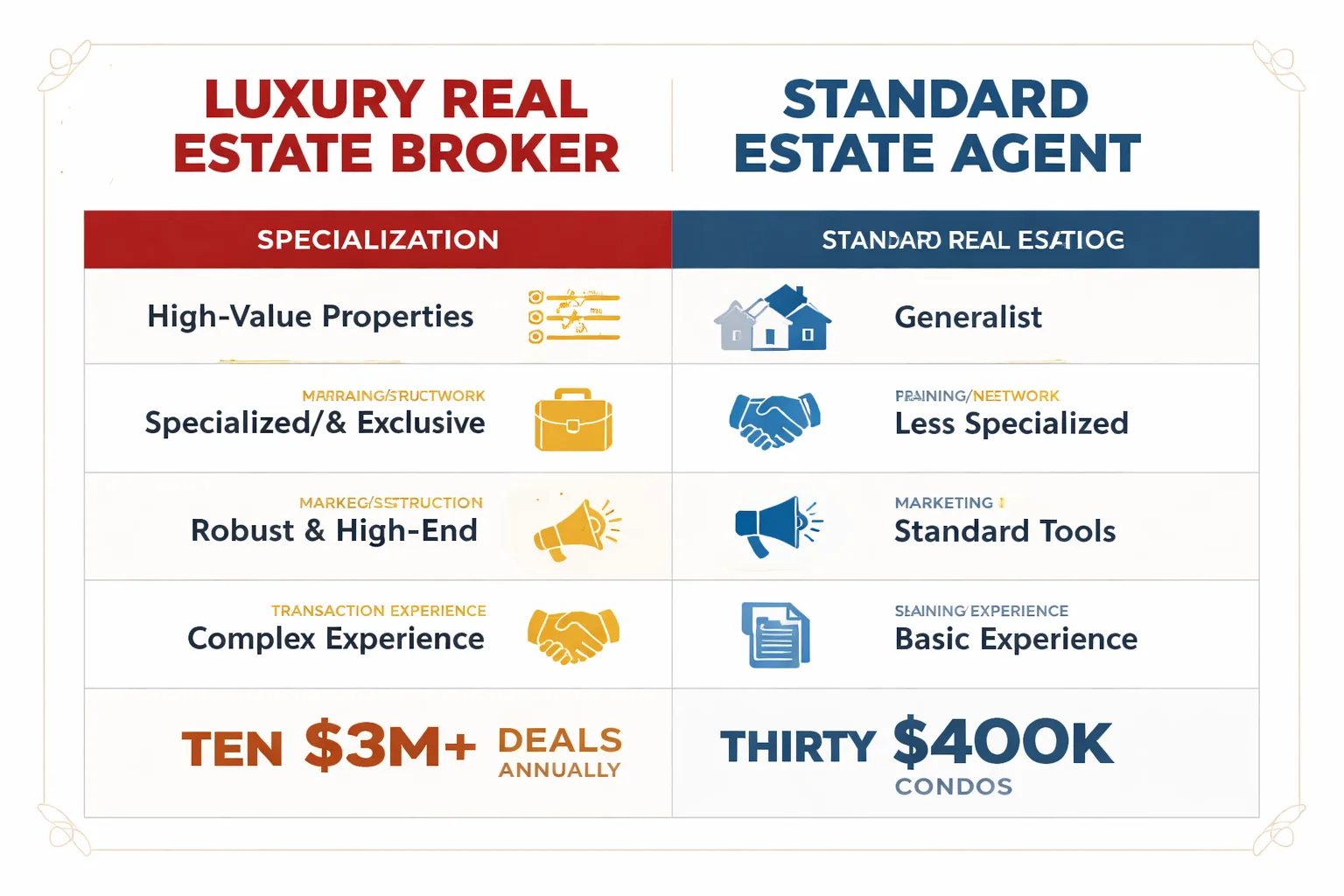
A luxury real estate broker is a licensed real estate professional who specializes in the marketing, negotiation, and sale of high-value residential or commercial properties that sit in the top tier of their local market by price, amenities, or prestige. The distinction from a standard agent is not a separate license. It is a combination of specialized training, proprietary network access, marketing infrastructure, and experience with transaction structures that generalists rarely encounter.
The credentialing gap is real. Designations like Coldwell Banker Global Luxury certification, the Certified Luxury Home Marketing Specialist (CLHMS) designation, and membership in invitation-only networks like Forbes Global Properties require documented sales volume in premium price tiers. A general agent who sells thirty $400K condos is not operating in the same universe as someone closing ten $3M+ transactions annually. The volume is different, the buyer pool is different, and the problems that arise during escrow are different.
Then there is network access. True luxury real estate agents operate within referral networks that span continents. A seller in Bergen County might have a buyer pool that includes international investors, relocating executives, or families moving capital from overseas. The right broker activates those networks through brokerage affiliations, private client events, and relationships with wealth managers and attorneys who refer high-net-worth clients. A standard agent relies on the MLS and a Zillow feed. The difference in buyer exposure can be worth hundreds of thousands of dollars on a single transaction.
Transaction complexity is the third separator. Luxury deals involve attorneys reviewing co-op board financials, negotiating private financing arrangements, managing 1031 exchanges for investment properties, coordinating staggered closings across multiple jurisdictions, and navigating privacy requirements that preclude public MLS listings entirely. The broker who has done this fifty times spots problems the generalist does not even know exist.
Consider the mechanics of a single high-end transaction. A $4M estate in Alpine, NJ hits the market. Within the first week, the listing broker has already pitched the property to qualified buyers through three private channels: the brokerage's internal luxury network, a Forbes Global Properties referral list, and direct outreach to wealth managers whose clients have expressed interest in Bergen County estates. None of these buyers will see the property on Zillow. The broker is simultaneously coordinating with an attorney to prepare a tailored purchase contract that includes a confidentiality clause, an extended due diligence period for environmental inspection (common on large-lot properties), and a structured deposit schedule that protects both parties. A generalist listing the same property would put it on the MLS, host a weekend open house, and hope for the best. The difference in outcome is not theoretical. It is mechanical.
The marketing infrastructure gap is equally concrete. A genuine luxury broker commits $15,000 to $50,000 in upfront marketing costs on a single listing: cinematic video production ($5,000-$15,000), professional architectural photography ($2,000-$5,000), drone footage ($1,000-$3,000), virtual staging ($1,500-$4,000), a dedicated property website with custom domain ($2,000-$5,000), and targeted digital advertising in international publications ($5,000-$20,000). A standard agent spends $500 on photos and calls it a day. The marketing investment is not vanity. It is the mechanism by which a property reaches the narrow buyer pool capable of affording it.
What Qualifies a Property as Luxury in 2026?
Price is the starting point, but it is not the whole picture. According to Realtor.com's luxury market data, the national entry point for luxury (top 10% of listings) sits near $1.2 million, with the ultraluxury tier (top 1%) significantly higher. But that national number is almost meaningless in the NJ/NY corridor, where local thresholds diverge sharply.
In Manhattan, luxury begins higher. A two-bedroom condo in a full-service building near Central Park can list at $2.5M without raising eyebrows, and manhattan luxury apartments in new developments routinely cross $3,000 per square foot. The threshold for what constitutes luxury in Manhattan is less about a fixed price and more about building quality, location prestige, and amenity level. A $1.5M co-op on the Upper East Side might be a solid purchase, but it is not luxury in the way a $4M condo at a new Billionaires' Row development is.
In Bergen County, New Jersey, the calculus shifts. A five-bedroom estate on an acre in Alpine or Englewood Cliffs priced at $2.5M to $5M is firmly in luxury territory. Waterfront properties along the Hudson or in towns like Closter and Tenafly command premiums driven by Manhattan skyline views, commute proximity, and lot size. The entry point is lower than Manhattan, but the property characteristics (land, privacy, architectural distinction) define the luxury classification as much as the price tag.
Then there is the investment angle. Commercial properties and mixed-use buildings in prime NJ/NY corridors can qualify as luxury real estate when they involve premium retail frontage, Class A office space, or development sites in high-demand areas. A commercial real estate broker NYC transaction involving a $5M retail condo in SoHo operates under the same luxury dynamics as a residential estate sale: limited buyer pool, complex negotiation, extended marketing timeline, and the need for discretion.
The ultraluxury segment deserves separate attention. While the broader luxury market saw a slight year-over-year price decline, the top 1% has been climbing for five straight months. This tells you the very top of the market is decoupling from the rest. Buyers at the ultraluxury level are less rate-sensitive and more motivated by scarcity, privacy, and trophy value. The broker handling a $15M Hamptons estate or a $20M Manhattan penthouse is operating in a different demand environment than the one selling a $1.5M Jersey City condo, even if both fall under the luxury umbrella.
The geographic diversity of luxury markets also matters. Luxury real estate in the Hamptons operates on a seasonal cycle that peaks in the second quarter, with oceanfront compounds and estate properties trading at premiums driven by scarcity rather than comparable sales. A broker who understands the Hamptons market knows that inventory turnover is concentrated in a six-month window and that pricing strategy must account for the cost of carrying a property through the off-season. Similarly, luxury properties in markets like Naples, Florida or Beverly Hills, California operate under entirely different demand drivers. The NJ/NY buyer who is also considering a Naples golf course estate or a Beverly Hills trophy home needs a broker who understands how these markets interact, how tax residency implications affect the purchase, and how to coordinate transactions across state lines.
Property characteristics beyond price also define luxury. A $1.8M property is not automatically luxury if it is a standard colonial on a quarter-acre lot in a generic subdivision. But a $1.8M property with 300 feet of waterfront, a deep-water dock, and privacy from neighboring lots qualifies on merit. The luxury designation is about scarcity, uniqueness, and the inability to easily replicate the property. A broker who understands this distinction will market the property based on its irreplaceable attributes rather than just its square footage.
Key Services Only a Luxury Broker Provides
This is where the rubber meets the road. The services a genuine luxury broker provides are not just upgraded versions of what a standard agent does. They are fundamentally different capabilities that justify the commission premium.
Off-market access. The most desirable luxury properties never hit Zillow. They are shared quietly within brokerage networks, shown to pre-qualified buyers only, and sold without public marketing. This serves sellers who value privacy and buyers who want first crack at inventory before competition arrives. A broker plugged into these private channels can show you properties you literally cannot find online. In the luxury tier, the best deals often happen before the public ever knows the property is for sale.
The mechanics of off-market dealing are worth understanding. A broker hears through their network that a family in Saddle River is quietly considering a sale but does not want to list publicly because of a pending divorce or a corporate relocation. The broker contacts three pre-qualified buyers in their database who have expressed interest in Saddle River estates. Within two weeks, a showing is arranged, an offer is made, and the property changes hands without a single public record of it ever being available. The seller gets their privacy. The buyer gets a property they never would have found. The broker earns a commission that a generalist never had a chance at.
International buyer networks. The NJ/NY luxury market is global. Buyers from China, Europe, the Middle East, and Latin America compete with domestic purchasers for premium properties. A broker with international reach, multilingual capability, and relationships with foreign wealth advisors can tap buyer pools that a local agent cannot access. Bilingual English-Chinese service is not a courtesy in this market. It is a competitive advantage that can be the difference between a property sitting for six months and closing in six weeks with a qualified international buyer.
The international dimension is not abstract. Chinese buyers alone represent a significant portion of foreign investment in NJ/NY real estate, and they often require a broker who can navigate cultural expectations around negotiation, property inspection, and financing. A broker who can communicate fluently in Mandarin, understand the tax implications for foreign buyers, and coordinate with attorneys who specialize in cross-border transactions provides value that no amount of local market knowledge can replace.
White-glove marketing. A luxury listing deserves cinematic video, professional architectural photography, drone footage, virtual staging, and sometimes a dedicated property website. The marketing budget for a $4M listing should look nothing like the budget for a $600K listing. Top brokers invest in presentation because the buyer pool for luxury properties is small and discerning. Every touchpoint, from the listing photos to the brochure left on the kitchen counter, signals value. Sloppy marketing on a premium property actively destroys asking price.
Discretion. High-profile sellers (CEOs, celebrities, foreign nationals) cannot afford a yard sign and a public open house. Luxury brokers manage confidentiality agreements, schedule private showings with vetted buyers only, and sometimes use LLC structures to shield the seller's identity from public records. This level of operational security is a specialized skill. A generalist who posts your $5M estate on social media without permission has just compromised your privacy and potentially your negotiating position.
Complex transaction management. Luxury transactions involve private banking relationships, attorney review periods that stretch weeks, co-op board packages that resemble mortgage applications in their complexity, and sometimes creative financing structures like seller financing or bridge loans. The broker who has navigated these structures repeatedly can keep a deal alive when a standard agent would watch it collapse. Deals fall apart at the eleventh hour because the agent misunderstood a lease assignment clause or failed to flag a co-op board's financial requirements. The right broker prevents that.
Consider a co-op transaction in Manhattan. The board package alone can run 100+ pages: three years of tax returns, personal reference letters, business reference letters, bank statements, investment portfolio summaries, and a detailed net worth statement. The board then interviews the buyer in person, and the rejection rate at certain buildings can exceed 30%. A luxury broker who has successfully navigated these boards knows which financial profiles get approved, which get rejected, and how to prepare a buyer for the interview. A generalist who has never closed a co-op deal is gambling with your time and money.
How to Choose the Right Luxury Broker
Start with credentials. Look for designations that require documented luxury sales volume: Coldwell Banker Global Luxury certification, CLHMS, or membership in networks like Forbes Global Properties or Christie's International Real Estate. International awards like the President's Elite or International Diamond Society (which recognize the top tier of agents by production) signal that the broker consistently closes high-value transactions. These are not participation trophies. They require real, verifiable sales volume.
Ask the right questions. How many properties in your price range did you close last year? What is your average days-on-market for luxury listings? Do you have access to off-market inventory? What international networks do you belong to? Can you provide bilingual services if needed? How do you handle confidentiality for high-profile clients? A broker who answers with specifics has the track record. One who deflects with vague assurances does not.
Watch for red flags. An agent who primarily sells $500K homes but claims luxury expertise because they once sold a $1.2M house is not a luxury specialist. A broker who has no international network but insists they can find foreign buyers is overpromising. An agent who pressures you to list below market for a quick sale may be prioritizing their commission timeline over your equity. And anyone who cannot explain their marketing strategy in concrete terms (specific photographers, video budget, targeted advertising channels) is going to phone it in.
Local expertise near Manhattan is non-negotiable for NJ/NY luxury transactions. The broker needs to understand commute patterns, school district reputations, zoning regulations, property tax trajectories, and the specific dynamics of towns from Alpine to Scarsdale. A NJ real estate agent who lives and works in the Manhattan-adjacent market knows things that an out-of-area luxury agent simply cannot. They know which towns are reassessing property taxes (a critical factor for first-time homebuyers and luxury buyers alike). They know which new condo developments are delivering quality and which are cutting corners. They know the co-op boards that reject buyers for opaque reasons and the condos where financing is straightforward.
The same applies to commercial and investment properties. A broker evaluating investment property in NJ needs to understand cap rates, tenant credit quality, lease structures, and the structural shifts reshaping retail and office space. The old playbook of high foot traffic equals high rent is increasingly unreliable. Simply driving foot traffic no longer guarantees rental income, and investment recommendations need to account for major structural shifts like remote work and e-commerce. The broker who brings this analytical depth to commercial transactions is providing value that goes far beyond finding a property.
Here is a practical checklist for evaluating a luxury broker candidate. Verify their claimed designations by checking the issuing organization's directory (CLHMS, Forbes Global Properties, Coldwell Banker Global Luxury all maintain searchable member databases). Request a net sheet from their last three luxury transactions showing sale price, days on market, and final sale-to-list-price ratio. Ask for a sample marketing package from a previous listing, including the property website, video, and print collateral. Request references from two past clients who purchased or sold in your price range. Confirm their bilingual capabilities by conducting a portion of the interview in the target language. And ask them to describe a deal that almost fell apart and how they saved it. The answer to that last question tells you more about their value than any credential on their business card.
When Do You Actually Need One?
Here is the contrarian take: not every premium-priced transaction requires a luxury specialist. A $1.3M condo in a well-managed Jersey City building with standard financing and no confidentiality concerns might be perfectly well-served by a strong local agent who knows the building and the neighborhood. The transaction is straightforward, the buyer pool is broad, and the marketing requirements are conventional.
But cross certain thresholds and the calculus changes. You need a luxury real estate broker when any of the following apply: the property value exceeds $2M in NJ or $3M in Manhattan, privacy is a concern, the property is unusual or hard to comp, you need international buyer exposure, the transaction involves complex financing or entity structures, or you are buying or selling commercial real estate above $2M where cap rates and tenant mix require sophisticated analysis.
The cost of hiring the wrong broker at this level is not a slightly lower sale price. It is a property that sits on the market for twelve months, a deal that collapses seventy-two hours before closing because no one reviewed the lease assignment clause, or a purchase where you overpay because no one warned you about an upcoming property tax reassessment that will add $250+ per month to your carrying costs. Those mistakes cost tens or hundreds of thousands of dollars. The right broker's commission is cheap insurance against that outcome.
Consider the specific scenario of a commercial property transaction. A buyer is acquiring a $3M retail property in a prime NJ corridor. The broker they hired through a personal referral has residential experience but no commercial background. Seventy-two hours before closing, the title company discovers that the lease assignment clause requires landlord approval, which was never obtained. The landlord now demands a $50,000 transfer fee and a 15% rent increase as a condition of approval. The deal either collapses (costing the buyer due diligence expenses and lost opportunity) or proceeds on unfavorable terms (costing the buyer tens of thousands annually in inflated rent). A broker with commercial real estate expertise would have flagged the assignment clause during the initial contract review, negotiated the landlord consent as a contingency, and structured the deal to avoid this last-minute crisis entirely.
Or consider the residential buyer who purchases a $2.5M estate in Bergen County without understanding that the town is undergoing a property tax reassessment. The seller's tax bill of $28,000 per year was based on an assessment from a decade ago. After the reassessment, the tax bill jumps to $42,000. That is an extra $14,000 per year, or $1,167 per month, that the buyer did not budget for. Over a ten-year holding period, that is $140,000 in unexpected costs. A luxury broker who knows the local tax landscape would have flagged the reassessment during the property tour, helped the buyer negotiate a price reduction to account for the upcoming increase, or directed them to a property in a town with stable tax assessments.
Buying or selling a property above $2M in NJ or NY? Are you working with the right specialist?
The Brand Question. Does the Logo Matter?
Luxury real estate brokerages invest heavily in brand equity because that equity translates into buyer trust and international reach. Sotheby's International Realty, Christie's International Real Estate, Compass, and Coldwell Banker Global Luxury all maintain marketing infrastructure, referral networks, and brand recognition that independent boutiques struggle to match. The data backs this up: Sotheby's International Realty led press share of voice at 34% in H1 2026, a position built on decades of brand investment.
But the logo is the floor, not the ceiling. A top agent at a less famous brokerage with deep local relationships and a track record of closed deals will outperform a mediocre agent at a prestigious brand every time. The brand gets your listing in front of more eyeballs. The agent's skill determines whether those eyeballs turn into qualified offers. The ideal combination is a strong brand affiliation paired with an individual agent who has the credentials, the network, and the local expertise to execute.
For sellers, the question is whether the brokerage's international reach and marketing budget justify the commission. For buyers, the question is whether the broker's network access gets you into properties you cannot find on your own. In both cases, the brand matters but the individual agent matters more.
The major luxury brands each bring different strengths to the table. Sotheby's International Realty leverages its association with the auction house to attract art collectors and ultra-high-net-worth individuals who are already in the Sotheby's ecosystem. Christie's International Real Estate similarly draws from the auction house's client base. Coldwell Banker Global Luxury provides access to the largest residential real estate network in the world, with over 3,000 offices across 49 countries, making it particularly strong for cross-border transactions involving NJ and NY properties. Compass has invested heavily in technology infrastructure, offering proprietary tools for pricing analysis and buyer matching that can shorten days on market for luxury listings. Forbes Global Properties is an invitation-only network of independent luxury brokerages, giving member agents access to a curated international audience without the overhead of a large franchise.
The right brand depends on the property and the buyer pool. A Manhattan penthouse targeting international art collectors might benefit most from Sotheby's or Christie's affiliation. A Bergen County estate targeting relocating executives from Asia might benefit most from Coldwell Banker's global network and bilingual agent base. A Brooklyn brownstone targeting tech-industry buyers might benefit most from Compass's technology platform. The broker who understands these distinctions can recommend the right platform for the specific property.
How Does a Luxury Broker Handle Investment Properties?
A luxury real estate broker who handles investment properties operates at the intersection of residential expertise and commercial analysis. This is a specialized niche that most residential luxury agents do not fill. The investment-focused luxury broker evaluates properties not just for their lifestyle appeal but for their income potential, appreciation trajectory, and tax efficiency.
For new york investment properties, the analysis includes rent comparables, cap rate calculations, expense ratio analysis, and an assessment of tenant demand drivers. A $3M multi-family property in Manhattan needs to generate sufficient rental income to justify the price, and the broker needs to understand the regulatory environment (rent stabilization, tenant protections) that affects the income stream. A $2M mixed-use property in Jersey City needs analysis of both the residential and commercial components, including the credit quality of commercial tenants and the remaining lease terms.
The investment analysis also extends to luxury condos purchased as rental investments. A buyer considering a $2M condo in a new Manhattan development needs to understand the building's rental policies, the projected rental income, the carrying costs (common charges, taxes, insurance), and the potential for appreciation based on neighborhood trends. The broker who can provide this analysis is delivering investment advisory value, not just transactional service.
For commercial real estate transactions, the broker needs to understand valuation methodologies that go beyond comparable sales. The Seller's Discretionary Earnings (SDE) multiple method is essential for valuing operating businesses like restaurants or retail shops that are being sold with the real estate. A broker who relies solely on equipment depreciation or gut feelings to price a business is setting up the seller for a collapsed deal. The SDE multiple method provides a data-driven valuation that attracts serious buyers and reduces the chance of pricing disagreements derailing the transaction.
What Red Flags Should You Watch For?
Beyond the basics, there are subtler warning signs that a broker claiming luxury expertise is not the real deal. One is the absence of a documented marketing plan. If the broker cannot produce a sample marketing package from a previous luxury listing, they have not invested in the infrastructure required to sell premium properties. Another is the inability to name specific attorneys, lenders, or stagers they work with regularly. Luxury transactions are team efforts, and a broker who operates solo without a network of trusted professionals is not equipped to handle the complexity.
A third red flag is the broker who quotes an unrealistically high listing price to win the business. This is called buying the listing, and it is the most common form of malpractice in luxury real estate. The broker tells the seller their $3.5M property is worth $4.2M to secure the listing, then pushes for price reductions every thirty days until it sells at $3.4M. The seller loses months of market exposure and potentially sells for less than they would have with an honest initial price. A legitimate luxury broker provides a comparable sales analysis with specific data points and prices the property based on evidence, not flattery.
A fourth red flag is the broker who has no online presence beyond a brokerage profile page. In 2026, luxury buyers research agents online before contacting them. A broker with no published content, no client reviews, and no visible track record is an unknown quantity. This does not mean every good broker needs a massive social media following. It means they need verifiable evidence of their expertise and past performance.
What This Actually Means for Your Next Transaction
The luxury real estate market in NJ and NY is bifurcating. The entry-level luxury segment (around $1.2M nationally) is softening slightly, while ultraluxury continues to climb. That means the strategy for buying or selling a $1.5M property should look different from the strategy for a $5M property, and the broker you choose needs to understand which game you are playing.
If you are selling, the right broker means a shorter days-on-market figure, a stronger negotiating position, and access to buyer pools that extend beyond the local MLS. If you are buying, it means seeing properties before they hit the market, avoiding overpayment on properties with hidden issues (tax reassessments, structural problems, co-op board resistance), and having an advocate who can navigate complex financing and attorney review processes without losing the deal.
The bottom line: luxury real estate brokers are not interchangeable with general agents who happen to list expensive houses. The genuine specialists earn their commission through network access, marketing sophistication, transaction expertise, and local knowledge that protects clients from expensive mistakes. The question is not whether you need one. The question is whether you can afford the cost of not having one.
FAQ
What is the difference between a luxury real estate broker and a regular agent?
A luxury broker specializes in high-value properties (typically top 10% of the local market by price) and holds credentials like Coldwell Banker Global Luxury certification or CLHMS. They have access to off-market listings, international buyer networks, and marketing resources that standard agents do not. A regular agent may occasionally sell an expensive home but lacks the specialized infrastructure for consistent luxury transactions.
How much does a luxury real estate broker cost?
Commission structures are similar to standard real estate transactions, typically 5-6% of the sale price, split between buyer and seller agents. The difference is that a luxury broker's marketing costs (cinematic video, drone photography, international advertising) are absorbed by the broker, not charged separately. The value proposition is that better marketing and broader buyer exposure yield a higher sale price that more than offsets the commission.
When should I hire a luxury real estate broker?
Hire one when the property value exceeds local luxury thresholds (roughly $2M+ in NJ, $3M+ in Manhattan), when privacy matters, when you need international buyer exposure, or when the transaction involves complex structures like entity purchases, 1031 exchanges, or commercial investment properties. For straightforward transactions in well-managed buildings, a strong local agent may suffice.
Do I need a luxury broker to buy a luxury property, or just to sell?
Both sides benefit. A buyer's broker with luxury expertise can access off-market inventory, negotiate from a position of market knowledge, and flag issues (tax reassessments, co-op board requirements, structural concerns) that a generalist might miss. For sellers, the broker's marketing reach and network access determine how quickly and profitably the property sells.
Are luxury real estate brands like Sotheby's and Christie's worth it?
The brand provides international reach, marketing infrastructure, and buyer trust that independent brokerages struggle to match. Sotheby's International Realty led luxury real estate press share of voice at 34% in H1 2026. But the individual agent's skill and local expertise matter more than the logo. The ideal is a strong brand paired with a top-performing agent who knows your specific market.
Can a luxury broker help with commercial real estate investments?
Yes. Many luxury brokers handle commercial transactions involving premium retail, Class A office space, or investment properties above $2M. The same skills that make them effective in residential luxury (network access, sophisticated negotiation, complex transaction management) apply to commercial deals. Look for a broker with documented commercial experience, not just residential sales.
About the Author
Judy Zhou, Coldwell Banker Realtor®
Judy Zhou is a top-ranked Coldwell Banker Realtor® serving New Jersey and New York, recognized in the top 7% of agents internationally with prestigious awards like the International Diamond Society and President's Elite. Licensed in both NJ and NY, she specializes in luxury homes, investment properties, and commercial real estate, offering seamless bilingual English-Chinese service.
Get a confidential consultation with a top-ranked Coldwell Banker Realtor who has the credentials, international network, and local expertise to protect your investment at every price tier.