How to Get Your Real Estate Agent License in NJ: 6 Clear Steps

By Judy Zhou, Coldwell Banker Realtor®
Key Takeaways
- The six-step NJ licensing path requires meeting eligibility (age 18+ and high school diploma), finishing a 75-hour pre-licensing course, passing the PSI salesperson exam, securing a broker sponsor, and submitting an electronic NJREC application, all within 3-6 months at a cost of $500-$1,000.
- Submit your initial license application to the New Jersey Real Estate Commission electronically within one year of completing the pre-licensing course, as walk-ins are not accepted.
- Maintain an active NJ real estate license by completing required continuing education after the initial approval process.
- New Jersey's proximity to Manhattan sustains strong demand for newly licensed agents who complete the full eligibility-to-application sequence.
New Jersey first formalized real estate licensing requirements back in 1921, when the state legislature recognized that unregulated property transactions were leaving buyers and sellers exposed to fraud and misrepresentation. Over the past century, those requirements have evolved. Course hours expanded, background checks tightened, and continuing education mandated. But the core intent has never changed: ensure that anyone representing a buyer or seller in a real estate transaction meets a verifiable standard of knowledge. Understanding that history helps explain why each step toward your real estate agent license in NJ exists and exactly what it's designed to protect.
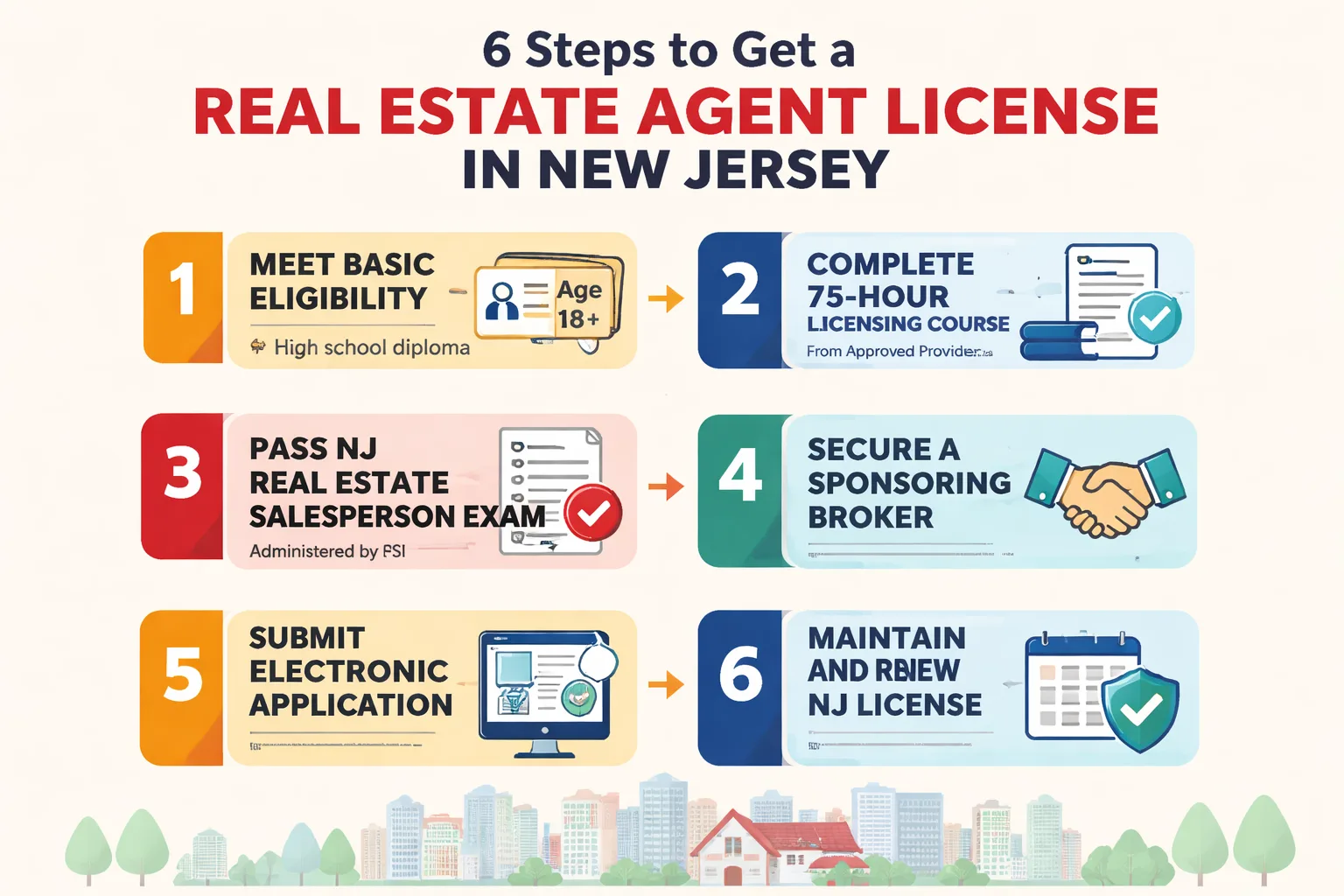
The path to a real estate agent license in NJ requires six sequential steps: meet basic eligibility (age 18+, high school diploma), complete a mandatory 75-hour pre-licensing course from an approved provider, pass the state salesperson exam administered by PSI, secure a sponsoring broker, submit an electronic application to the New Jersey Real Estate Commission (NJREC), and maintain the license through continuing education. The entire process typically takes three to six months and costs between $500 and $1,000 before brokerage fees. According to the NJDOBI licensing requirements page, applicants must apply for their initial license within one year of completing the pre-licensing course, and all applications must be submitted electronically (walk-ins are not accepted).
The demand for licensed agents in New Jersey remains strong. The state's proximity to Manhattan creates a unique market where residential and commercial real estate in NJ overlap. Agents who understand both sides of the transaction, residential and commercial, position themselves for sustained income. Understanding NJ property tax rates by town also gives agents a competitive edge when advising clients.
Step 1. Meet NJ's Basic Eligibility Requirements
The New Jersey Real Estate Commission sets clear baseline requirements before anyone can begin the licensing process. The rules are not arbitrary hurdles. Each one exists to protect consumers from unqualified representation.
Applicants must be at least 18 years old and hold a high school diploma or equivalent (GED). There is no residency requirement. A candidate living in Pennsylvania or New York can obtain a New Jersey license, though out-of-state residents should understand that reciprocity agreements between states have specific conditions that affect how and where they can practice.
A criminal background check is mandatory. The NJREC reviews each applicant's history to determine fitness for licensure. Certain convictions (fraud, theft, forgery) do not automatically disqualify an applicant, but they require disclosure and a review process. Fingerprinting is conducted through a state-approved vendor, and results typically take two to four weeks. Applicants with prior convictions should not self-disqualify. The Commission evaluates each case individually, considering the nature of the offense, time elapsed, and evidence of rehabilitation.
The background check is not a formality. The NJDOBI FAQ page confirms that all applications must be submitted electronically and that the Commission reviews each applicant's background comprehensively. Failing to disclose a prior conviction is far more damaging than the conviction itself. Honesty is the fastest path through the review process.
What Specifically Disqualifies an Applicant?
The NJREC evaluates background check results on a case-by-case basis, but certain patterns trigger automatic review. Felony convictions involving fraud, embezzlement, breach of trust, or forgery receive heightened scrutiny because they directly relate to the fiduciary responsibilities of a real estate agent. Misdemeanor offenses, particularly those involving dishonesty, also trigger review but are less likely to result in denial if sufficient time has passed and the applicant demonstrates rehabilitation.
Traffic violations and minor infractions generally do not affect licensure. However, any offense that suggests a pattern of financial dishonesty or fraud will slow the application. The NJREC may request a personal interview, written explanation, or character references before making a determination. Applicants who proactively submit a written explanation of their circumstances, along with documentation of rehabilitation (completion of probation, employment history, community service), often move through the review process faster than those who wait for the Commission to ask.
The fingerprinting process itself is straightforward. Applicants schedule an appointment with a state-approved vendor (currently IDEMIA, which operates fingerprinting centers throughout New Jersey). The session takes approximately 15 minutes. Results are transmitted electronically to NJDOBI within 7 to 14 business days. The total cost for fingerprinting and the background check is approximately $65 to $85, paid directly to the vendor at the time of scheduling.
Step 2. Complete the 75-Hour Pre-Licensing Course
New Jersey requires 75 hours of pre-licensing education from a school approved by the NJREC. This is the single most time-intensive step in the process, and the quality of the school directly affects exam readiness.
The curriculum covers specific topics mandated by state regulation. Students learn about real property law, contracts, agency relationships, financing, property valuation, fair housing laws, and New Jersey-specific regulations. The course is not a formality. It builds the foundational knowledge tested on the state exam and used in daily practice. According to the NJDOBI requirements page, the 75-hour requirement applies specifically to salesperson applicants. Broker applicants face a steeper requirement: 150 hours total, consisting of a 90-hour general course plus two 30-hour specialized courses.
What the 75-Hour Curriculum Actually Covers
The NJREC mandates specific subject areas for the 75-hour course, and understanding the breakdown helps applicants prepare strategically. The curriculum divides into several major content areas, each weighted differently on the state exam.
Property ownership and land use controls typically accounts for 12 to 15 hours of the course. This section covers forms of ownership (fee simple, joint tenancy, tenancy in common), types of estates, easements, encumbrances, and government restrictions on land use including zoning, building codes, and environmental regulations. Students learn how property rights are transferred, limited, and protected under New Jersey law.
Contracts and agency relationships represents another 12 to 15 hours. This is the legal backbone of real estate practice. Students study the elements of a valid contract, types of real estate contracts (purchase agreements, listing agreements, buyer representation agreements), breach and remedies, and the statute of frauds. The agency portion covers the fiduciary duties owed to clients (loyalty, confidentiality, disclosure, obedience, reasonable care, and accounting) and the difference between a client and a customer under New Jersey law.
Financing and settlement accounts for approximately 10 to 12 hours. Topics include mortgage types (conventional, FHA, VA), loan qualification, interest rate mechanics, amortization, lender requirements, and the settlement process. Students learn how to calculate loan-to-value ratios, debt-to-income ratios, and closing cost allocations. This section is critical because financing questions appear frequently on the state exam.
Property valuation and appraisal covers 8 to 10 hours, focusing on the three approaches to value (sales comparison, cost, income), appraisal methods, and factors that affect property value. Students learn how to read a comparative market analysis and understand the difference between an appraisal and a competitive market analysis.
New Jersey-specific regulations represents 15 to 20 hours of the course. This section covers the New Jersey Real Estate License Act, agency disclosure requirements, the New Jersey Consumer Information Statement, property condition disclosure rules, and the role of the New Jersey Real Estate Commission. This portion is heavily tested on the state section of the exam and cannot be skipped or skimmed.
Fair housing and ethical practices accounts for 8 to 10 hours. Students study the Federal Fair Housing Act, New Jersey's Law Against Discrimination, protected classes, prohibited practices (steering, blockbusting, redlining), and penalties for violations. The National Association of REALTORS (NAR) Code of Ethics is also introduced, though full Code of Ethics training is a post-licensing requirement for REALTOR membership.
Online, In-Person, or Hybrid. Which Format Works?
Approved providers offer three formats. In-person classes provide structure and direct access to instructors, which benefits students who struggle with self-paced learning. Online courses offer flexibility for working professionals, allowing them to complete coursework on their own schedule. Hybrid programs blend both approaches.
Cost varies by provider and format. Online courses typically range from $300 to $500. In-person programs run higher, often $400 to $700, reflecting facility and instructor costs. The cheapest option is not always the best. Students should verify that the school is NJREC-approved and check pass rates and reviews before enrolling.
The National Association of REALTORS offers additional designations and certifications beyond the state minimum, which can differentiate agents in competitive markets. These are post-licensing credentials, not substitutes for the 75-hour requirement.
How to Choose the Right Real Estate School
Selecting a pre-licensing school is the first decision that affects exam performance and career trajectory. The NJREC maintains a list of approved providers on its website, and only schools on that list satisfy the educational requirement. Prospective students should verify approval status directly through the NJREC, not through the school's marketing materials.
Beyond approval status, several factors distinguish quality providers. Instructor experience matters more than brand recognition. A school staffed by active or recently retired brokers who have closed hundreds of transactions provides practical context that a purely academic instructor cannot. Students should ask potential schools about instructor backgrounds: how many years in the business, what types of transactions they have handled, and whether they have experience in both residential and commercial markets.
Pass rate data is the most objective measure of school quality, though not all schools publish this data transparently. Some states (like Texas, through the Texas Real Estate Commission) require providers to publish exam passage rates. New Jersey does not mandate public reporting of pass rates by school. Students should ask providers directly for their pass rate data and be skeptical of schools that refuse to share it or claim rates above 95% without verifiable evidence.
Course format and schedule flexibility should match the student's learning style and availability. A working professional with a full-time job may struggle with an in-person course that meets three evenings per week. An online self-paced course allows that student to study during lunch breaks and weekends. However, self-paced courses require discipline. Students who procrastinate risk the 75-hour course taking six months instead of six weeks, cutting into the one-year application deadline.
Post-course support is an underrated differentiator. The best schools provide exam prep materials, practice tests, and instructor access for questions after the course ends. Some schools include exam prep in the course tuition. Others charge an additional $50 to $150 for a separate exam prep package. Students should factor this into the total cost comparison.
The One-Year Deadline Nobody Mentions
Here is a detail that catches applicants off guard. According to the NJDOBI FAQ page, applicants must apply for their initial license within one year of completing the pre-licensing course. Miss that window, and the 75 hours expire. The course must be retaken in full.
This deadline creates a strategic decision. Some applicants complete the course, then delay the exam while searching for a broker. That delay can become costly. The smarter approach is to begin broker research during the course, take the exam within 30 to 60 days of completion, and submit the application immediately. The one-year clock starts on the course completion date, not the exam date. Treat it as a hard deadline.
Step 3. Pass the NJ Real Estate Salesperson Exam
The state exam is administered by PSI, a third-party testing service contracted by New Jersey. After completing the 75-hour course, candidates receive eligibility to sit for the exam. The exam tests both national real estate concepts and New Jersey-specific laws.
The exam consists of two portions. The national section covers general real estate principles: property ownership, land use, valuation, financing, and contracts. The state section focuses on New Jersey regulations, including agency law, license law, and disclosures specific to NJ practice. Candidates must pass both sections. A passing score requires answering at least 70% of questions correctly on each portion.
Exam Structure and Content Breakdown
The NJ real estate salesperson exam contains approximately 110 to 130 total questions split between the national and state portions. The national portion typically includes 80 to 100 questions covering broad real estate concepts that apply across the United States. The state portion contains 30 to 40 questions focused exclusively on New Jersey law and practice.
The national portion tests knowledge in several content areas. Property ownership and land use controls represents approximately 15% of the national section, covering types of ownership, encumbrances, and government powers (taxation, eminent domain, police power, escheat). Contracts and agency accounts for roughly 20%, testing the elements of valid contracts, types of agency relationships, and fiduciary duties. Financing represents 15%, covering mortgage types, lending regulations, and settlement procedures. Property valuation accounts for 10%, testing appraisal approaches and value concepts. Real estate practice and brokerage covers 15%, including listing agreements, marketing, and closing procedures.
The state portion is where New Jersey-specific knowledge is tested. This section covers the New Jersey Real Estate License Act, agency disclosure requirements (including the Consumer Information Statement that must be provided to consumers), property condition disclosure rules, and the regulatory authority of the NJREC. Questions may cover license renewal requirements, continuing education mandates, and the specific disclosures required in New Jersey transactions that differ from other states.
Candidates have approximately 3.5 hours to complete both portions. The exam is administered on a computer at PSI testing centers, with locations in multiple New Jersey cities including Edison, Fairfield, and Vineland. Remote proctoring is also available for candidates who prefer to test from home, though the technical requirements (reliable internet, quiet room, webcam) must be met.
PSI offers exam scheduling at multiple testing centers across New Jersey, and the exam is also available via remote proctoring. Candidates who fail one section but pass the other only need to retake the failed portion. New Jersey allows multiple retakes, though each attempt requires a separate exam fee.
Preparation matters. The 75-hour course provides the foundation, but most successful candidates supplement with practice exams. PSI offers study materials, and third-party providers sell NJ-specific exam prep packages. The investment in exam prep (typically $50 to $150) pays for itself by avoiding retake fees and delayed income.
Common Exam Topics That Trip Up Candidates
Certain topics consistently produce low pass rates. Agency disclosure requirements are a frequent stumbling block. New Jersey has specific rules about when and how the Consumer Information Statement must be presented to consumers. Candidates who confuse New Jersey's agency rules with those of other states (or with general national concepts) routinely miss these questions.
Property tax calculations also cause difficulty. New Jersey has some of the highest property taxes in the nation, and the exam tests whether candidates understand how assessments, equalization ratios, and tax rates interact. Understanding NJ property tax rates by town before taking the exam gives candidates a practical grounding that pure textbook study does not.
Fair housing law is another common failure point. Candidates must distinguish between federal protected classes and the additional protected classes under New Jersey's Law Against Discrimination, which is broader than federal law. New Jersey prohibits discrimination based on familial status, marital status, domestic partnership status, and other categories not covered at the federal level. Memorizing both sets of protected classes is essential.
Thinking about getting your NJ real estate license and want guidance from a top-producing agent?
Step 4. Find a Sponsoring Broker and Submit Your Application
New Jersey does not issue a salesperson license to unaffiliated agents. Every newly licensed salesperson must work under a sponsoring broker who holds an active New Jersey broker license. The broker assumes supervisory responsibility and ensures the agent operates within legal and ethical boundaries.
What to Look for in a Sponsoring Brokerage
The choice of brokerage shapes the first year of an agent's career. New agents should evaluate several factors: training programs, commission splits, desk fees, mentorship availability, and market focus. Some brokerages cater to residential transactions. Others specialize in commercial real estate in NJ or investment properties. Agents interested in commercial work should seek brokerages with established commercial divisions, as the skill set and client base differ significantly from residential.
Commission structures vary widely. Some brokerages offer high splits (70% to the agent) but charge monthly desk fees. Others provide lower splits (50/50) but include training, marketing support, and lead generation at no additional cost. New agents often benefit from the latter, since training and lead flow matter more than split percentage in year one.
The NJ home buying process involves multiple parties and complex regulations. A brokerage with strong training helps new agents navigate this complexity without making costly mistakes. Interview at least three brokerages before committing. Ask about the training schedule, mentorship structure, and what costs the agent bears versus what the brokerage covers.
Brokerage Interview Questions That Reveal the Most
The brokerage interview is a two-way evaluation. The broker is assessing the candidate's potential, and the candidate should be assessing the broker's fit. Generic questions produce generic answers. The following questions are designed to surface specific, actionable information.
"What does the first 90 days look like for a new agent at your brokerage?" The answer reveals whether the brokerage has a structured onboarding program or simply hands new agents a desk and wishes them luck. A strong answer includes a week-by-week breakdown: week one covers systems and tools training, week two introduces shadowing on client meetings, week three begins prospecting training, and week four starts supervised transaction work. A vague answer ("you'll learn as you go") signals a lack of structure.
"What is the average first-year income for new agents at your brokerage?" This question separates transparent brokerages from those that quote best-case scenarios. A brokerage that provides a realistic range (even if modest) demonstrates honesty. A brokerage that quotes six-figure first-year income without data to support it is either cherry-picking outliers or being dishonest.
"What costs does the agent pay, and what does the brokerage cover?" This is the most important financial question. Some brokerages cover MLS fees, board dues, and errors and omissions insurance. Others pass all costs to the agent. The difference can amount to $1,500 to $3,000 annually. A 70% commission split with $3,000 in annual fees may net less than a 50% split with all fees covered, particularly in year one when transaction volume is low.
"How many transactions did your average agent close last year?" This question reveals the brokerage's productivity level. A brokerage where the average agent closes 8 to 12 transactions annually has a different environment than one where the average agent closes 2 to 4. High per-agent productivity indicates strong lead generation, effective training, and a culture that supports closing.
The Application Process with NJREC
Once a sponsoring broker is secured, the application process moves quickly. According to the NJDOBI FAQ page, all applications must be submitted electronically. Walk-ins are not accepted. The sponsoring broker initiates or confirms the sponsorship through the NJREC online portal, and the applicant submits the required documentation, including proof of course completion, exam passage, and background check results.
The application fee is paid electronically at the time of submission. Processing times vary, but most licenses are issued within two to four weeks of a complete application. The license is not active until the sponsorship is confirmed and the NJREC issues the license number. Agents cannot practice real estate or earn commissions until this step is complete.
The Complete Cost Breakdown for Getting Licensed
Prospective agents should budget for costs beyond the course and exam. The total investment to obtain and maintain a real estate license in New Jersey includes both one-time and recurring expenses.
One-time costs to obtain the license: - Pre-licensing course (75 hours): $300 to $700 depending on provider and format. State exam fee (per attempt): approximately $45 to $75. Fingerprinting and background check: approximately $65 to $85. License application fee: approximately $160. Exam prep materials (optional but recommended): $50 to $150
Total one-time cost: $550 to $1,170
Recurring annual costs to maintain the license and practice: - MLS membership (required to access listings): $200 to $500 annually, depending on the local board. Local board/association dues (required for MLS access in most markets): $150 to $400 annually. Errors and omissions (E&O) insurance: $100 to $300 annually, though some brokerages cover this. Continuing education (12 hours every two years): $60 to $150 per cycle. NJ Realtors membership (optional but recommended for MLS access): $150 to $250 annually
Total recurring annual cost: $660 to $1,600
New agents should also budget for business expenses that are not licensing-related but are essential for practice. These include a real estate CRM ($20 to $50 per month), marketing materials (business cards, signs, flyers: $200 to $500 initially), transportation costs (gas, parking, vehicle maintenance for property showings), and professional attire. First-year business expenses can easily reach $2,000 to $5,000 above licensing costs.
Understanding title fees and closing costs is also essential for new agents, not because they pay these costs, but because clients will ask about them. Agents who can explain closing cost allocations clearly build trust and close more transactions.
Step 5. Maintain and Renew Your NJ License
Obtaining the license is the beginning, not the end. New Jersey requires continuing education (CE) for license renewal. Salespersons must complete 12 hours of CE every two years, including specific core topics mandated by the NJREC. The first renewal cycle for a new license has a special requirement: new agents must complete a 30-hour post-licensing course called the New Jersey Real Estate Salesperson Discretionary Commission Education (DCE) program within the first year of licensure.
License renewal occurs biennially, with renewal deadlines tied to the licensee's birth date. Failing to complete CE requirements results in license inactivation. An inactive license cannot be used to practice real estate. Reinstating an expired license requires additional coursework and fees.
The 30-Hour Post-Licensing Requirement Explained
The Discretionary Commission Education (DCE) program is a one-time, 30-hour requirement that applies only to new salespersons during their first license term. Unlike standard continuing education, which covers 12 hours every two years, the DCE must be completed within the first year of licensure. This requirement catches new agents by surprise because it is not part of the original 75-hour pre-licensing course and is separate from the biennial CE requirement.
The DCE curriculum focuses on practical, applied topics that new agents encounter in their first year of practice. Topics typically include advanced contract review, negotiation strategies, disclosure obligations in real-world scenarios, technology tools for transaction management, and ethical decision-making. The course is designed to reinforce and expand on the foundational knowledge from the pre-licensing course after the agent has had some exposure to actual transactions.
New agents should schedule the DCE early. Waiting until the last month before the deadline risks scheduling conflicts, course availability issues, and the stress of completing 30 hours under time pressure. The best approach is to begin the DCE within the first three months of licensure, when the initial training from the brokerage is still fresh and the course content can be directly applied to early transactions.
Upgrading to a Broker License
The salesperson license is the entry point. For agents who want to operate independently or manage their own brokerage, the broker license is the next step. According to the NJDOBI requirements page, broker applicants must have three years of continuous full-time employment as a licensed New Jersey salesperson before applying. The education requirement jumps to 150 hours: a 90-hour general broker course plus two 30-hour specialized courses covering agency management and ethics, and office management.
The broker license opens doors. Brokers can work independently, sponsor other salespersons, and earn override commissions on their agents' transactions. For agents focused on investment property in NJ or commercial transactions, the broker license adds credibility and operational flexibility.
How Much Do NJ Real Estate Agents Actually Earn?
The question every prospective agent asks. The answer is less straightforward than the question.
Real estate income is commission-based. There is no salary. Agents earn a percentage of each transaction's sale price, split with their sponsoring broker. Commission rates in New Jersey typically range from 2% to 3% per side (buyer or seller) of the transaction value. On a $500,000 home sale, a 2.5% commission generates $12,500, which is then split with the brokerage based on the agreed-upon commission structure.
The Bureau of Labor Statistics reports median annual earnings for real estate sales agents nationally. New Jersey agents tend to earn above the national median due to higher property values, particularly in counties near Manhattan. Agents in Bergen County, Hudson County, and Essex County benefit from proximity to New York City, where transaction values are higher and volume is consistent.
First-year agents should expect modest earnings. Building a client base takes time, and the first six months often produce little to no income. Agents who persist through year one and build referral networks see income accelerate in years two and three. The agents who earn the most are those who specialize. An agent focusing on commercial real estate in NJ or luxury properties near Manhattan can earn significantly more than a generalist residential agent, because transaction values are higher.
The Mashvisor ranking of top real estate companies highlights that brokerage choice also affects earning potential. National franchises offer brand recognition and lead generation. Boutique firms offer higher splits and specialized training. The right choice depends on the agent's target market and career stage.
NJ Agent Salary by Market and Specialization
Earnings vary dramatically by specialization and geographic focus within New Jersey. Understanding these differences helps new agents set realistic income targets and choose a specialization strategically.
Residential generalist agents working in suburban New Jersey markets (single-family homes in the $400,000 to $700,000 range) typically earn $35,000 to $65,000 annually after their first year. With a 2.5% commission and a 60% split to the agent, each transaction generates approximately $6,000 to $10,500 in gross commission income to the agent. An agent closing 6 to 8 transactions per year in this range earns $36,000 to $84,000 before business expenses.
Luxury residential agents focusing on properties above $1.5 million in markets like Alpine, Saddle River, or Jersey City waterfront condos earn significantly more per transaction. A $2 million sale at 2.5% commission generates $50,000 in gross commission, with the agent's split (assuming 70%) yielding $35,000 per transaction. An agent closing 4 to 6 luxury transactions annually earns $140,000 to $210,000. However, luxury transactions take longer to close (90 to 180 days on average) and require a longer client acquisition cycle.
Commercial real estate agents working in Jersey City commercial real estate or industrial markets in Northern New Jersey deal with larger transaction values but face longer sales cycles. A commercial property sale of $5 million at a 2% commission generates $100,000 in gross commission. Even with a 50% split to the brokerage, the agent earns $50,000 per transaction. Commercial agents who close 3 to 5 transactions annually can earn $150,000 to $250,000 or more. However, commercial real estate requires specialized knowledge (cap rates, NOI, lease structures, zoning) that takes years to develop.
Agents serving the Manhattan-adjacent market with dual NJ/NY licenses have the broadest earning potential. These agents can serve clients comparing new condo developments near me in both states, capturing transactions on both sides of the Hudson. The ability to advise a client on whether a $1.2 million condo in Jersey City or a comparable property in Manhattan represents better value is a service that commands premium commission rates and client loyalty.
How to Become a Real Estate Agent in NJ. The Complete Path
The process for how to become a real estate agent in NJ follows the six steps outlined above, but the question deserves a consolidated answer. Prospective agents must be 18 or older with a high school diploma, complete 75 hours of NJREC-approved pre-licensing education, pass the state exam through PSI, secure a sponsoring broker, submit an electronic application to NJDOBI, and complete continuing education to maintain the license. The timeline runs three to six months from start to finish. Total upfront cost falls between $500 and $1,000, covering the course, exam fee, fingerprinting, and application fee. The license opens doors to residential, commercial, and investment real estate transactions across New Jersey.
For those wondering how to become a NJ real estate agent efficiently, the key is sequencing. Start broker research during the course. Schedule the exam within 30 days of course completion. Submit the application the day the broker sponsorship is confirmed. Delays at any step extend the timeline and risk missing the one-year course completion deadline.
A Realistic Week-by-Week Timeline
Understanding the licensing process as a timeline helps applicants plan effectively. Here is what a compressed, efficient path looks like for a motivated candidate who treats the process like a job.
Weeks 1 to 4: Enroll in and begin the 75-hour pre-licensing course. Full-time students (20+ hours per week) can complete the course in 4 weeks. Part-time students (10 to 15 hours per week) need 6 to 8 weeks. During this period, begin researching brokerages. Identify 5 to 10 brokerages that match your target market (residential, commercial, luxury, or mixed). Read their websites, check agent reviews, and note training program details.
Weeks 5 to 6: Complete the course and schedule the exam. Finish the 75-hour course and receive the completion certificate. Immediately register for the PSI exam, scheduling it 2 to 3 weeks out. During this waiting period, invest in exam prep materials and take 3 to 5 full-length practice exams. Continue brokerage research and schedule 2 to 3 brokerage interviews.
Week 7: Take and pass the state exam. Arrive at the PSI testing center (or log in for remote proctoring) with identification and confirmation. Results are typically available immediately after completion. If you pass, proceed immediately to brokerage interviews. If you fail one section, schedule a retake within 2 weeks while the material is fresh.
Weeks 8 to 9: Interview brokerages and select a sponsor. Conduct 2 to 3 brokerage interviews using the questions outlined earlier in this article. Evaluate offers based on training quality, commission structure, fees, and market fit. Once a brokerage is selected, the sponsoring broker initiates the electronic sponsorship through the NJREC portal.
Week 10: Submit the electronic application. Complete the online application through the NJREC portal, uploading the course completion certificate, exam passage confirmation, and background check results. Pay the application fee electronically. The sponsor confirms the sponsorship electronically.
Weeks 11 to 14: Wait for license issuance and prepare for launch. Processing typically takes 2 to 4 weeks. During this waiting period, join the local MLS, pay board dues, obtain E&O insurance, set up the CRM, order business cards, and begin building a sphere-of-influence contact list. By the time the license is issued, the agent should be ready to begin prospecting immediately.
This timeline assumes no delays. Real-world obstacles (fingerprint processing delays, exam retakes, brokerage interview scheduling conflicts) can extend the timeline to 4 to 6 months. Building buffer time into the plan prevents the stress of a compressed schedule.
How Do I Become a Real Estate Agent in NJ Without Prior Experience?
No prior real estate experience is required. The 75-hour pre-licensing course is designed for beginners and covers all foundational knowledge. What matters more than experience is the choice of brokerage. New agents should prioritize brokerages with structured training programs, mentorship opportunities, and a culture that supports new agent development. The first year is about learning the business, building a sphere of influence, and completing initial transactions. Agents who try to go it alone without brokerage support typically struggle. The sponsoring broker relationship is not just a legal requirement. It is the primary learning vehicle for new agents.
Transferable Skills That Accelerate New Agent Success
While no real estate experience is required, certain professional backgrounds give new agents a significant head start. Sales experience in any industry (B2B, retail, insurance) provides familiarity with prospecting, objection handling, and closing techniques that take other new agents months to develop. Financial or accounting backgrounds help agents understand mortgage qualification, cash flow analysis for investment properties, and closing cost calculations. This is particularly valuable for agents working with investment property in NJ clients.
Marketing and communications backgrounds give agents an edge in personal branding, social media prospecting, and listing marketing. Agents who can write compelling property descriptions, shoot and edit photos, and manage social media campaigns generate their own leads rather than relying solely on brokerage-provided leads. Legal or paralegal experience helps with contract review, contingency management, and understanding the legal implications of disclosure obligations.
None of these backgrounds substitutes for the 75-hour course or the state exam. But they do reduce the learning curve in the first year, allowing the agent to focus on the real estate-specific skills (property showings, negotiation, transaction coordination) rather than starting from scratch on sales and marketing fundamentals.
How Do You Become a Real Estate Agent in NJ If You Already Hold a License in Another State?
New Jersey has reciprocity agreements with certain states, but the specifics matter. According to the NJDOBI licensing requirements page, out-of-state licensees may qualify for a waiver of the 75-hour pre-licensing course if their home state's requirements are substantially equivalent. However, all applicants must still pass the New Jersey state portion of the exam, which covers NJ-specific laws and regulations. The national portion may be waived with proof of a passing score on the national exam in another state.
Agents licensed in New York should pay particular attention. The NY licensing process differs from NJ in hours and structure. Agents holding both licenses can serve clients on both sides of the Hudson, which is particularly valuable for buyers comparing Westchester County homes for sale with Northern New Jersey properties. Dual-licensed agents have a competitive advantage in the Manhattan-adjacent market.
NJ vs. NY Licensing. Which Makes Sense for You?
Agents serving the Manhattan-adjacent market often benefit from holding licenses in both New Jersey and New York. The processes share similarities but differ in key areas.
New Jersey requires 75 hours of pre-licensing education. New York requires 77 hours. Both states require passing a state exam and working under a sponsoring broker. New Jersey's background check is more comprehensive. New York's exam is administered by the Department of State rather than a third-party vendor.
The decision to hold both licenses depends on target market. Agents focused on Manhattan luxury apartments and New York investment properties need the NY license. Agents focused on Northern New Jersey residential and commercial transactions only need the NJ license. Agents who want to serve clients relocating between the two states, or investors comparing opportunities on both sides of the Hudson, should pursue both.
The New Jersey Real Estate Investment market offers distinct advantages. Lower property taxes than Westchester (in some towns), proximity to Manhattan, and a growing commercial sector make NJ attractive to investors. Agents who understand both markets can guide clients to the better opportunity based on their specific goals.
For agents interested in the luxury market, understanding new condo developments near me in both NJ and NY is a differentiator. Buyers in the $1 million to $5 million range frequently compare properties across the Hudson, and the agent who can speak fluently about both markets wins those clients. The New York real estate developers building these projects are important contacts for agents who want early access to pre-construction inventory.
Choosing Your Market. Residential, Commercial, or Both?
Newly licensed agents face a strategic choice: focus on residential, commercial, or attempt both. The conventional advice is to pick one and specialize. The contrarian view is that agents serving the NJ-NY corridor benefit from cross-training, because clients in this market frequently have needs that span both categories.
An investor buying commercial real estate in NJ may also need to purchase or sell a residential property. A business owner leasing commercial space may need help with a residential purchase. Agents who can handle both capture more transactions per client.
The challenge is depth. Commercial real estate requires understanding lease structures, cap rates, NOI calculations, and zoning regulations that residential agents rarely encounter. Residential agents need expertise in mortgage products, inspection contingencies, and emotional buyer management. Attempting both without mastering either is a recipe for mediocrity.
The solution is phased specialization. Start residential to build transaction volume and cash flow. Add commercial after 12 to 18 months, once the residential business is stable. This approach reduces risk and allows the agent to develop expertise sequentially rather than simultaneously.
Geographic Specialization Within New Jersey
New Jersey is not a monolithic market. Each region has distinct property types, price points, and client demographics that affect an agent's specialization strategy.
Bergen County is the premier residential market in Northern New Jersey, with towns like Alpine, Saddle River, and Englewood Cliffs commanding some of the highest home prices in the state. Agents specializing in Closter vs. Tenafly and other Bergen County comparisons serve a clientele that values proximity to Manhattan, excellent school districts, and suburban luxury. The average transaction value in top Bergen County towns exceeds $1.5 million, making this a high-commission-per-transaction market.
Hudson County (Jersey City, Hoboken, Weehawken) is the densest urban market in New Jersey and the closest to Manhattan. This market skews toward condos and townhouses, with a mix of first-time buyers, investors, and Manhattan commuters. The Jersey City commercial real estate market is also growing rapidly, with mixed-use developments creating opportunities for agents who understand both residential and commercial transactions.
Essex County (Montclair, Glen Ridge, Maplewood) attracts buyers seeking urban-suburban hybrid living with direct transit access to Manhattan. This market has strong turnover and a mix of price points, making it a good training ground for new agents. The newark nj real estate agent market is also evolving, with redevelopment projects creating investment opportunities.
Monmouth and Somerset Counties offer suburban and rural properties at lower price points than Bergen County, with strong demand from buyers priced out of the northern market. Agents in these counties often work with relocation buyers moving from New York or from other parts of New Jersey. The commercial real estate in Monmouth County NJ market also offers opportunities in retail and office space.
What This Won't Fix. Realistic Expectations for New Agents
Getting licensed solves one problem: legal authorization to practice. It does not solve the harder problems that follow.
A license does not generate leads. New agents frequently assume that obtaining the license will trigger client inquiries. It will not. Lead generation is a separate skill that requires marketing investment, networking, and time. Agents who complete licensing without a plan for lead generation often go months without a closing.
A license does not teach negotiation. The 75-hour course covers contracts and agency law, but the actual mechanics of negotiating a deal, managing emotionally charged transactions, and navigating inspection contingencies come from experience and mentorship. The brokerage choice matters more than the course grade.
A license does not guarantee income. The commission-based model means zero transactions equals zero income. New agents should have six months of living expenses saved before relying on real estate as a primary income source. The failure rate in the first two years is high, and it is almost always attributable to underestimating the time and capital required to build a client base.
Where This Process Breaks Down
The six-step licensing process works for most applicants, but specific scenarios derail it. Financial underestimation is the most common failure point. Applicants who budget exactly $500 for the course and exam, with no buffer for retakes, additional exam prep, or the recurring costs of MLS and board dues, run out of money before the license is active. The agent who passes the exam but cannot afford MLS membership cannot practice. Budget $1,500 to $2,500 for the first year, not $500.
Brokerage selection paralysis is the second failure mode. Some applicants pass the exam, then spend months interviewing brokerages without committing, afraid of choosing wrong. While careful evaluation is smart, prolonged indecision burns through the one-year course completion deadline. The first brokerage is not a lifetime commitment. Agents change brokerages regularly. The goal is to find a brokerage with strong training, not the perfect brokerage.
Background check surprises derail a smaller but significant number of applicants. Candidates who assume a decades-old misdemeanor will not surface are sometimes wrong. The fingerprinting process is thorough. Applicants with any criminal history should proactively prepare documentation of rehabilitation and a written explanation before submitting the background check, rather than waiting for NJDOBI to request it.
FAQ
How long does it take to get a real estate agent license in NJ?
The process typically takes three to six months from starting the 75-hour course to receiving the active license. The course itself takes four to eight weeks depending on format and pace. Exam scheduling usually takes two to four weeks. Application processing takes two to four weeks after submission. Delays occur when applicants postpone the exam or take time to find a sponsoring broker.
How much does it cost to get a real estate license in NJ?
Total upfront costs range from $500 to $1,000. The pre-licensing course costs $300 to $700 depending on provider and format. The exam fee is approximately $45 to $75 per attempt. Fingerprinting and background check cost around $65 to $85. The application fee is approximately $160. Additional first-year costs include MLS membership ($200 to $500 annually), local board dues ($150 to $400), and errors and omissions insurance ($100 to $300 annually).
Can I take the NJ real estate pre-licensing course online?
Yes. The NJREC approves online providers that offer the 75-hour course in a self-paced format. Online courses provide flexibility for working professionals but require self-discipline. Students should verify that the provider is NJREC-approved before enrolling. The course completion certificate is required to sit for the state exam regardless of format.
Do I need to be a New Jersey resident to get a NJ real estate license?
No. New Jersey does not require residency. Out-of-state applicants can obtain a New Jersey license, though they must still complete the 75-hour NJ-approved course and pass the state exam. Agents licensed in other states may qualify for course waivers through reciprocity agreements, but must still pass the New Jersey state portion of the exam.
What happens if I fail the NJ real estate exam?
Candidates who fail can retake the exam. Each retake requires a new exam fee. If one section (national or state) is passed and the other is failed, only the failed section needs to be retaken. There is no limit on the number of retakes, but the one-year deadline from course completion to license application still applies. Candidates should use practice exams and targeted study between attempts.
How much does a real estate agent make in NJ?
NJ real estate agent earnings vary widely based on experience, market, and specialization. First-year agents often earn $20,000 to $40,000 as they build a client base. Experienced agents in high-value markets near Manhattan can earn $80,000 to $150,000 or more annually. Commercial and luxury specialists tend to earn higher incomes due to larger transaction values. Income is entirely commission-based with no salary floor.
What is the difference between a salesperson license and a broker license in NJ?
A salesperson license is the entry-level credential that allows an agent to work under a sponsoring broker. A broker license requires three years of full-time experience as a salesperson plus 150 hours of additional education (a 90-hour general course and two 30-hour specialized courses). Brokers can operate independently, sponsor other salespersons, and earn override commissions. The upgrade from salesperson to broker typically takes 4 to 5 years from the initial license date.
Can I practice real estate in NJ with just a salesperson license?
Yes, but only under the supervision of a sponsoring broker. A salesperson cannot operate independently, cannot hold a license without an active broker sponsorship, and cannot earn commissions directly. All commissions are paid to the brokerage, which then distributes the agent's share according to the agreed-upon commission split. The salesperson license is the starting point. Independent practice requires the broker license.
About the Author
Judy Zhou, Coldwell Banker Realtor®
Judy Zhou is a top-ranked Coldwell Banker Realtor® serving New Jersey and New York, recognized in the top 7% of agents internationally with prestigious awards like the International Diamond Society and President's Elite. Licensed in both NJ and NY, she specializes in luxury homes, investment properties, and commercial real estate, offering seamless bilingual English-Chinese service.
Get personalized advice on launching your real estate career in New Jersey from an internationally recognized Coldwell Banker Realtor who has navigated both residential and commercial markets.