How Much Do Real Estate Agents Actually Make in NY?

By Judy Zhou, Coldwell Banker Realtor®
Key Takeaways
- The median real estate agent salary in NY falls between $75,000 and $95,000 annually, with the mean at roughly $120,000 due to top earners.
- Residential agents in NYC average $95,000 to $150,000 while commercial brokers clear $250,000 to $500,000 in gross commissions.
- 75% of new agents fail within their first year, with beginners often earning under $30,000.
- New York’s median asking rent of $3,500 per month in 2023 drives higher transaction volume and leasing commissions than the national $60,000 average.
In 1922, the National Association of Realtors introduced its first formal code of ethics. A moment that began transforming real estate from a loosely organized trade into a structured profession with standardized commissions. A century later, New York has become the single most complex and lucrative real estate market on the planet, home to commercial real estate brokers in NYC earning millions and to part-time agents barely covering their licensing fees. That hundred-year arc makes the question of NY real estate agent salary one that depends enormously on where, what, and how you sell.
The median real estate agent salary in NY falls between $75,000 and $95,000 annually, but the mean skews higher at roughly $120,000 due to top earners pulling seven figures. The National Association of Realtors reports that agent income is directly tied to experience level and transaction volume, with the top 7% of agents internationally earning designation-level income. In New York City specifically, residential agents average $95,000 to $150,000, while commercial brokers in NYC routinely clear $250,000 to $500,000 in gross commission income. According to Coursera's real estate salary guide, the national average sits around $60,000, making NY a premium market. The NYC rental market hit a median asking rent of $3,500 per month in 2023](https://comptroller.nyc.gov/reports/spotlight-new-york-citys-rental-housing-market/), which drives transaction volume and leasing commissions for agents serving that segment. A commonly cited industry statistic suggests that 75% of new agents fail within their first year, which means the floor for beginners is often under $30,000.
The data tells a story of extreme variance. There is no clean average because the distribution is bimodal. Agents either survive the first 18 months and build a book of business, or they wash out and leave the industry entirely. The middle is thin. Understanding where you fall on that curve requires looking at specific numbers, not platitudes about "working hard."
What Is the Average Real Estate Agent Salary in NY?
The average NY real estate agent salary is misleading on its own because it blends part-time agents selling three houses a year with full-time professionals closing 30+ transactions. The median provides a better picture, but even that number shifts dramatically depending on geography.
Statewide, the median gross income for a licensed real estate agent in New York falls between $75,000 and $95,000. That figure comes from blending NAR member survey data with state-level compensation reports. But break it down by region and the picture fractures.
In New York City, the median jumps to $95,000-$150,000 for residential agents. The drivers are obvious: median home prices in Manhattan exceed $1.1 million, Brooklyn hovers around $900,000, and even Queens has crossed $700,000. Higher price points mean higher absolute commissions even when percentage rates compress. A 2.5% commission on a $1.1M apartment is $27,500. The same percentage on a $250,000 upstate home is $6,250. Same work, different math.
Upstate New York tells a different story. In cities like Buffalo, Rochester, and Syracuse, median home prices sit between $180,000 and $280,000. Agents there rely on volume rather than price-per-unit. The median upstate agent earns $45,000-$65,000, with top producers reaching $90,000-$120,000 by closing 40-60 transactions annually. The Colibri Real Estate career hub notes that borough-level earnings in NYC vary widely, with Manhattan agents out-earning Bronx agents by a factor of two to three times.
Experience level compounds the gap. First-year agents in NY typically earn $25,000-$45,000. By year three, agents who survive see income jump to $60,000-$85,000. Agents with five-plus years of experience who have built referral networks and repeat business routinely clear $100,000-$200,000. The top tier, those specializing in luxury or commercial segments, break $500,000.
| Experience Level | NYC Median | Upstate NY Median | Top 10% (Statewide) |
| Year 1 | $25,000-$45,000 | $20,000-$35,000 | $60,000+ |
| Years 2-3 | $60,000-$85,000 | $40,000-$55,000 | $120,000+ |
| Years 4-5 | $85,000-$130,000 | $55,000-$75,000 | $200,000+ |
| 5+ Years | $100,000-$200,000+ | $65,000-$100,000 | $500,000+ |
The table above makes one thing clear. The gap between year one and year five is not linear. It is exponential. Agents who push through the low-income phase see compounding returns from referrals, brand recognition, and market knowledge.
How Much Would a Real Estate Agent Make on a $300,000 House?
Commission math is the single most misunderstood part of real estate compensation. Agents do not pocket the full commission. The money moves through multiple hands before it reaches their bank account.
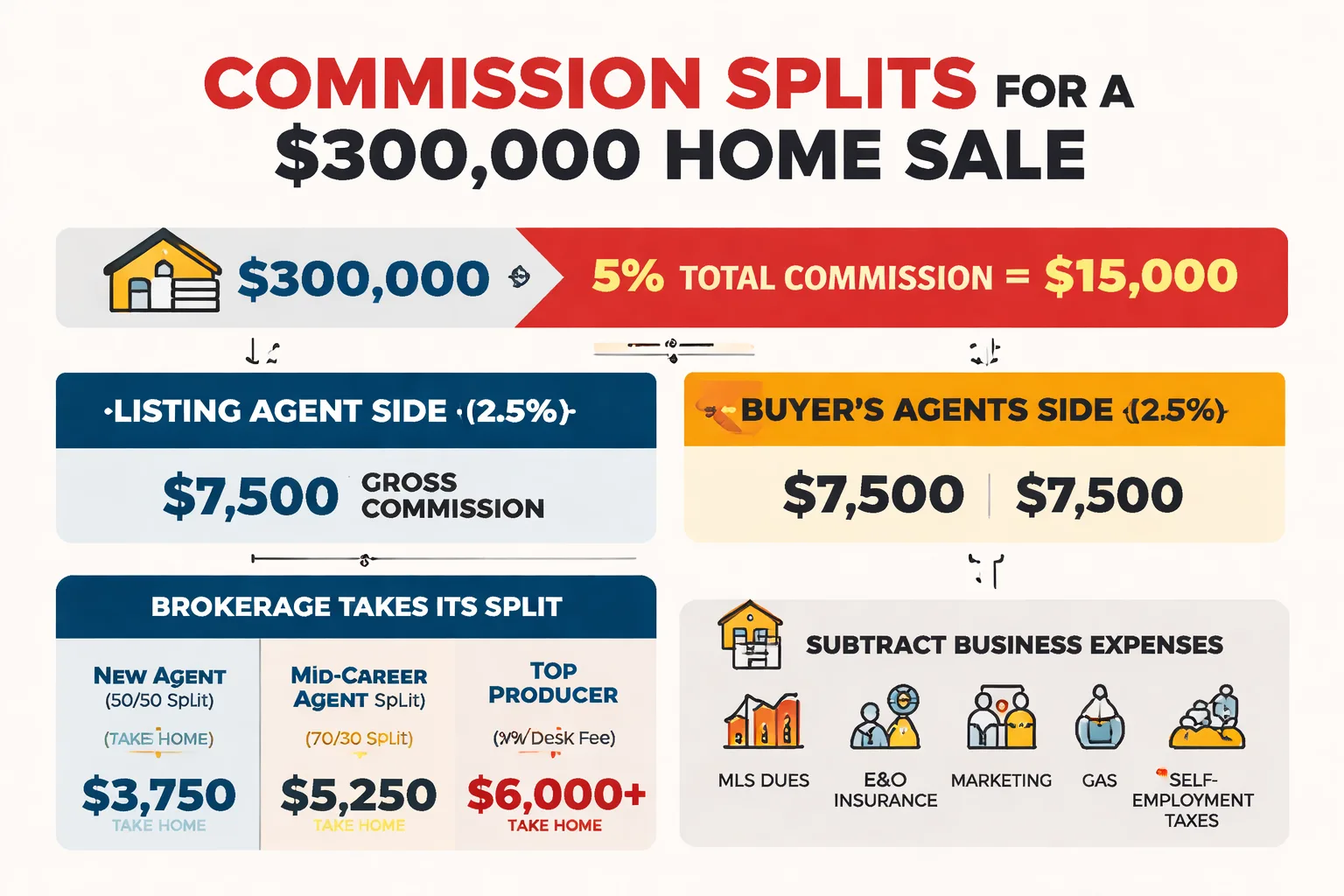
Take a $300,000 home sale in NY. The standard total commission in 2026 runs between 5% and 6%, split between the listing agent and the buyer's agent. After the 2024 NAR settlement changed how buyer commissions are negotiated, the structure has become more transparent but the math remains similar in practice.
Here is the breakdown for a $300,000 sale at 5.5% total commission:
1. Total commission: $300,000 x 5.5% = $16,500 2. Split between two agents: $16,500 / 2 = $8,250 per side 3. Brokerage split (assuming a 70/30 split for a mid-level agent): $8,250 x 70% = $5,775 to the agent 4. Franchise fee and transaction coordination (typically 5-8% of the agent's cut): $5,775 x 0.93 = $5,371 5. Net to agent per transaction: approximately $5,371
That is the reality. A $300,000 sale nets the agent roughly $5,300. Not bad for a single transaction, but consider the work involved: client acquisition, showings, negotiations, inspection coordination, contract management, and closing. A single transaction can span 60-90 days of active work.
Now scale that up. An agent closing 12 transactions per year at that average price point earns about $64,000 in gross commission income. After business expenses (marketing, MLS fees, gas, insurance, continuing education), net income drops to $45,000-$50,000.
The math changes fast at higher price points. On a $1.2M Manhattan apartment at the same 2.75% per side, the agent's gross commission is $33,000. At a 70/30 split, the agent nets $21,450 before fees. One luxury transaction can equal five standard transactions.
This is why agents gravitate toward higher-priced markets. The work per transaction does not scale linearly with price. A $1.2M sale requires marginally more effort than a $400,000 sale, but the commission is three times higher.
Luxury vs. Standard Market: How Commission Tiers Change Everything
The gap between luxury and standard residential sales is not incremental. It is structural. Agents who specialize in Manhattan luxury apartments and high-end properties in NJ-adjacent markets operate in a fundamentally different financial model than agents selling starter homes.
Luxury transactions in NY typically involve properties priced above $2 million. In Manhattan, that threshold starts higher, often at $3M-$5M for true luxury designation. At those price points, a single transaction generates $50,000-$150,000 in commission per side. An agent closing four luxury transactions per year can earn $200,000-$600,000 in gross commission income.
But luxury is not just about price. It is about client expectations, marketing requirements, and sales cycles. A luxury listing in Manhattan may require professional staging, cinematic video tours, targeted digital advertising, and six months of private showings before closing. The upfront cost can run $5,000-$15,000 per listing. Agents without the capital to invest upfront cannot compete.
The standard residential market, by contrast, runs on volume and speed. Agents closing 20-30 transactions per year at $400,000-$600,000 average price points can earn $80,000-$150,000. The work is faster, the clients are more transactional, and the marketing costs are lower. But the ceiling is lower too.
Commercial real estate occupies a different tier entirely. A commercial real estate broker in NYC handling office leases, retail space, or investment property sales can earn commissions that dwarf residential transactions. A single $20M office building sale at a 3% commission generates $600,000. Split between the broker and agent, that one transaction can exceed an entire year of residential income.
The trade-off is deal frequency. Commercial brokers may close 3-8 transactions per year, with each deal taking 6-18 months to complete. The income is lumpy but the per-deal economics are extraordinary. Indeed's career guide on commercial versus residential real estate highlights that commercial agents typically earn higher average incomes but face longer ramp-up periods and require deeper financial analysis skills.
For agents serving the NY-NJ corridor, the most lucrative strategy often involves cross-market specialization. An agent who understands both New York investment properties and New Jersey real estate investment opportunities can serve clients whose portfolios span both states. That dual-market knowledge creates a referral flywheel that compounds over time.
What Factors Determine How Much You Actually Earn?
Six variables separate top earners from average producers. None of them are secret. Most agents simply do not execute on all six simultaneously.
Transaction volume. The NAR reports that agents completing 20+ transactions annually earn 3-4 times more than agents completing 10 or fewer. Volume is the single biggest income driver. But volume requires systems: a CRM, lead generation pipelines, administrative support, and time management discipline. Agents who try to handle every task personally hit a ceiling at 12-15 transactions.
Brokerage split. The commission split between agent and brokerage ranges from 50/50 for new agents to 90/10 or higher for top producers. A 50/50 split on a $8,000 commission nets the agent $4,000. An 80/20 split nets $6,400. Over 20 transactions, that difference equals $48,000 per year. The split matters enormously, but agents often accept unfavorable splits in exchange for leads and training that may or may not materialize.
Market specialization. Residential, commercial, luxury, investment, and rental markets each have different commission structures and income ceilings. The NYC rental market alone generates thousands of leasing transactions monthly, with agents earning one month's rent per lease. At a median of $3,500 per month, an agent closing 30 leases earns $105,000 in gross commission. Specialization allows agents to build deep expertise that commands premium fees.
Bilingual and international client advantage. Agents who serve international buyers, particularly Chinese-American investors in the NY-NJ market, access a client pool that transacts at higher price points and refers within tight community networks. Bilingual English-Chinese service is not a nice-to-have in this market. It is a competitive moat. International buyers often purchase investment properties and luxury homes simultaneously, creating multi-transaction relationships that span years.
Referral networks. Repeat business and referrals account for 60-80% of a top agent's pipeline by year five. Agents who invest in client relationships, stay in contact post-closing, and provide ongoing value (market updates, tax information, investment guidance) build self-sustaining businesses. Agents who treat each transaction as one-off work constantly hunt for new clients.
Geographic positioning. An agent working in Manhattan or Bergen County, NJ has access to a fundamentally different price point than an agent in Syracuse. The NJ home buying process involves specific considerations around property taxes that affect buyer budgets and transaction sizes. For example, the effective property tax rate in New Jersey for 2026 remains among the highest in the nation, which affects affordability and, consequently, commission sizes on residential transactions.
Curious what you could earn in the NY-NJ real estate market?
How Do Commission Splits Actually Work in NY?
Commission splits in NY real estate follow a tiered structure that changes as agents gain experience and production. Understanding the mechanics is essential because the split is the single largest determinant of take-home pay after price point.
New agents typically start at a 50/50 or 60/40 split with their brokerage. In exchange, they receive training, mentorship, desk access, and sometimes leads. The brokerage absorbs the risk of a new agent who may not close a transaction for months. At a 50/50 split on a $300,000 sale (5.5% total commission, $8,250 per side), the agent nets $4,125 before fees.
As agents gain experience and demonstrate production, splits improve. A mid-level agent with 2-4 years of experience and 10+ annual transactions typically negotiates a 70/30 split. At that rate, the same $8,250 commission nets $5,775. Top producers with established books of business command 80/20, 85/15, or even 90/10 splits. Some agents move to 100% commission models where they pay a flat desk fee per month ($500-$2,000) and keep the entire commission.
The 100% model sounds superior but shifts all costs to the agent: marketing, E&O insurance, transaction coordination, and lead generation. For high-volume agents, it is the most profitable structure. For agents closing fewer than 10 transactions per year, the monthly fees can eat into income faster than a higher split.
Dual agency brokers, who represent both buyer and seller in a transaction, can earn both sides of the commission. In NY, dual agency is legal with informed consent from both parties. A dual agency transaction on a $500,000 sale at 5.5% generates the full $27,500 commission rather than $13,750 per side. This practice requires careful ethical navigation and full transparency, but it represents a significant income opportunity for experienced agents handling both sides of a deal.
What Are the Real Costs of Being an Agent in NY?
The costs of running a real estate business in NY are substantial and often underestimated. New agents focus on potential income without calculating the burn rate required to operate.
Licensing and association fees. Initial licensing costs in NY run $400-$600 (pre-licensing courses, exam fee, application). NAR and local board membership (Manhattan Association of Realtors, Long Island Board of Realtors) adds $500-$1,200 annually. MLS access in NY runs $300-$600 per year. These are non-negotiable.
Brokerage desk fees. Depending on the brokerage model, desk fees range from zero (traditional split models) to $2,000+ per month (100% commission models). Over a year, that is $0 to $24,000 in fixed overhead.
Marketing and lead generation. Active agents spend $500-$3,000 monthly on marketing: digital advertising, professional photography, videography, print materials, and lead generation platforms. Luxury agents spend more. A single high-end listing can require $5,000-$15,000 in marketing investment before the property sells.
Transportation. In NYC, subway and rideshare costs run $200-$500 monthly for agents showing properties across boroughs. In suburban NY and NJ markets, car expenses (gas, insurance, depreciation) run $400-$800 monthly. Agents covering Westchester County homes for sale and surrounding areas log significant mileage.
Professional development and continuing education. NY requires 22.5 hours of continuing education every two years, costing $200-$500. Designations (CRS, ABR, GRI) add $300-$1,000 each but signal expertise that commands higher fees.
Errors and omissions insurance. E&O insurance runs $200-$800 annually depending on coverage level and transaction volume.
Total annual cost of business: A typical NY agent spends $8,000-$20,000 per year on business expenses before earning a dollar in commission. New agents should plan for 6-12 months of negative cash flow while building their pipeline.
Agent vs. Broker: How Do the Salaries Compare?
The distinction between a real estate agent and a broker in NY is not just semantic. It fundamentally changes the income ceiling. A licensed real estate agent must work under a sponsoring broker and cannot operate independently. A broker has completed additional education (152 hours in NY, including 90 hours of qualifying education and a 45-hour broker course plus experience requirements), passed the state broker exam, and can own a brokerage, hire agents, and collect override commissions.
The income differential is significant. A producing broker who also owns a brokerage earns income from three streams: personal transaction commissions, a percentage of every agent's commission in the firm (typically 20-40% of what the brokerage collects), and flat desk fees from agents on 100% commission models. A broker with 10 producing agents averaging $100,000 in annual gross commission income each, at a 30% brokerage cut, generates $300,000 in override income alone before closing a single personal transaction.
The NAR agent income data consistently shows that brokers out-earn sales agents by 30-50% at similar production levels. The trade-off is operational responsibility. Brokers spend significant time on compliance, agent training, dispute resolution, and business management. Pure sales agents who want to focus entirely on transacting may actually earn more per hour worked than brokers bogged down in administrative overhead. The decision to pursue a broker license should be driven by whether the agent wants to build a business or simply sell real estate.
How Does the Ramp-Up Phase Work for New Agents?
The first 18 months of a real estate career in NY are a financial gauntlet. Understanding the mechanics of this phase separates agents who survive from those who become statistics.
Months 1-3 are consumed by licensing completion, brokerage onboarding, MLS setup, and learning the local contract forms. Income during this period is effectively zero. Agents should treat this as a paid internship where the payment is deferred. The focus must be on market education, neighborhood immersion, and building a database of contacts. Agents who spend this period cold-calling expired listings and attending broker open houses build a foundation that pays off in months 6-12.
Months 4-9 are when the first transactions typically close. An agent who listed a property in month 4 might see it close in month 6 or 7. First-year agents who close 2-4 transactions typically earn $10,000-$25,000 in gross commission during this window. The emotional challenge is significant because the work feels disproportionate to the reward. Agents who maintain discipline during this phase, continuing to prospect daily even after closing a transaction, are the ones who reach critical mass.
Months 10-18 are the inflection point. Agents who have built a pipeline begin seeing referrals from their first clients. Transaction velocity increases. An agent closing one transaction per month by month 12 is on track for a $60,000-$80,000 second year. The compounding effect of referrals begins to manifest. A client who bought in month 6 refers a colleague in month 14. That referral closes in month 18. The flywheel starts turning.
The agents who fail are typically those who enter the industry without a financial runway, rely entirely on their brokerage for leads, or treat the first six months as a passive waiting period. The 75% attrition rate cited in industry literature is not a random statistic. It reflects the predictable consequence of entering a commission-only business without adequate preparation.
What Role Does Technology Play in Agent Income?
Technology has become a non-negotiable income multiplier in the 2026 NY real estate market. Agents who treat tech as an optional add-on are leaving money on the table at every stage of the transaction cycle.
CRM systems. A properly configured customer relationship management system is the single highest-ROI technology investment an agent can make. Agents using a CRM to track client interactions, automate follow-up sequences, and manage lead pipelines close 30-40% more transactions than agents relying on spreadsheets or memory. The NAR reports that agents who use a CRM consistently see higher conversion rates from their sphere of influence. The cost ($50-$300 monthly) is trivial compared to the income lift.
Lead generation platforms. Paid lead generation through Zillow, Realtor.com, and specialized platforms costs $200-$1,000+ monthly. The conversion rates are low (1-3% of leads typically close), but the math works if the agent has a disciplined follow-up system. A $500 monthly investment generating 50 leads, with a 2% close rate at a $400,000 average price point, produces $24,000 in gross commission from $6,000 in annual lead costs.
Virtual tour and 3D rendering technology. In the luxury and commercial segments, 3D property tours (Matterport, virtual staging) have become table stakes. Listings with 3D tours receive 40-60% more online views and sell faster. For agents handling new condo developments near me or pre-construction sales, virtual rendering technology allows buyers to tour properties before they physically exist, expanding the buyer pool beyond geographic constraints.
Transaction management software. Platforms like Dotloop, DocuSign, and Skyslope streamline the contract process, reducing administrative time per transaction by 5-10 hours. For an agent closing 20 transactions per year, that is 100-200 hours saved annually. Time saved on paperwork is time redirected toward prospecting and client relationships.
Data and market analytics. Agents who invest in market data tools (PropStream, Attom Data, local MLS analytics) can identify off-market opportunities, analyze investment returns for clients, and position themselves as market experts rather than transaction facilitators. This is particularly valuable for agents serving investors. The ability to pull comparable sales data, cap rate analysis, and cash-on-cash return projections in real time during a client meeting commands premium fees and builds referral-worthy credibility.
How Does Team Structure Affect Earnings?
Team structure is one of the most impactful yet least discussed determinants of real estate agent income in NY. The choice between operating as a solo agent, joining a team, or building a team fundamentally changes both the income ceiling and the income floor.
Solo agents keep 100% of their commission (after the brokerage split) but bear 100% of the workload and expense. The advantage is full control and no revenue sharing. The disadvantage is a hard ceiling on transaction volume. A solo agent without administrative support typically maxes out at 15-20 transactions annually. Beyond that, service quality degrades and deals fall through the cracks. Solo agents earning $80,000-$120,000 are common. Solo agents earning $250,000+ are rare because the business model does not scale without support.
Joining a team typically involves a 50/50 to 70/30 split of commission with the team leader in exchange for leads, administrative support, marketing resources, and mentorship. New agents benefit enormously from team structures because they gain access to a lead pipeline they would otherwise spend years building. A team agent closing 15 transactions in their first year (fed by team leads) might earn $40,000-$60,000, compared to $15,000-$25,000 as a solo agent sourcing their own business. The trade-off is lower per-transaction earnings and dependence on the team leader's lead generation capacity.
Building a team is where the income ceiling lifts dramatically. A team leader who recruits 3-5 buyer's agents, handles listings personally, and takes a 30-50% override on team transactions can multiply their effective production without proportionally increasing their personal workload. A team leader with 4 agents, each closing 20 transactions at $400,000 average price points, generates override income of $100,000-$200,000 annually on top of the leader's personal production. Top team leaders in NY earn $300,000-$800,000.
The decision matrix is straightforward. New agents should join teams to accelerate pipeline development. Mid-career agents (years 3-5) should evaluate whether to remain on a team or transition to solo with administrative support. Experienced agents closing 25+ transactions annually should consider building a team to scale beyond their personal capacity.
How Does the NY-NJ Cross-Market Strategy Boost Income?
Agents who hold licenses in both NY and NJ, or who partner with agents across state lines, access a client pool that single-state agents cannot serve effectively. The NY-NJ corridor is one of the most active cross-border real estate markets in the country, with thousands of residents commuting daily between the two states and investors holding portfolios on both sides of the Hudson.
The financial impact is measurable. A client purchasing a primary residence in Bergen County, NJ for the schools and commute, while simultaneously maintaining an investment property in Manhattan, represents two transactions for a dual-licensed agent. The NJ residential transaction at $800,000 generates approximately $22,000 in total commission. The Manhattan investment property at $1.5M generates $41,250. The agent who handles both earns over $40,000 in gross commission from a single client relationship.
Cross-market expertise also creates referral density. An agent who understands the NJ home buying process, including the attorney review period unique to NJ transactions, and can compare it to the NY closing process, becomes a trusted advisor rather than a transaction facilitator. Clients refer agents who provide comparative analysis. The agent who can explain why a $900,000 home in Tenafly, NJ (with its specific property tax implications) compares favorably to a $1.2M apartment in Manhattan provides value that justifies premium service.
The bilingual advantage amplifies this strategy. Chinese-American investors in the NY-NJ market frequently hold real estate portfolios spanning both states. An agent who can negotiate in Mandarin, understand the cultural preferences of the client, and execute transactions across state lines captures a client relationship worth $50,000-$150,000 in lifetime commission value.
Is a NY Real Estate Career Worth It in 2026?
The honest answer depends on three factors: financial runway, market positioning, and willingness to treat real estate as a business rather than a job.
The income ceiling in NY real estate is effectively unlimited. Top agents earn seven figures. Commercial brokers in NYC close deals worth more than entire small-town agencies gross in a year. The floor, however, is brutal. First-year agents earning under $30,000 are common, and the attrition rate reflects that reality. The commonly cited statistic that 75% of new agents fail within their first year underscores how unforgiving the ramp-up period is.
The ramp-up time for new agents typically runs 6-18 months. During that period, income is sporadic and expenses are constant. Agents who enter the industry with 12 months of living expenses saved have a significant survival advantage. Those who need immediate income to pay rent are at a structural disadvantage that compounds stress and impairs decision-making.
What separates top earners from average producers is not talent or charisma. It is systematization. Top agents build repeatable processes for lead generation, client communication, transaction management, and post-closing follow-up. They treat their sphere of influence as a long-term asset rather than a one-time extraction opportunity. They specialize rather than generalize. And they invest in relationships with nyc developers, property managers, attorneys, and lenders who refer business consistently.
For agents willing to specialize in high-value niches, the NY market in 2026 offers extraordinary opportunity. The investment real estate agency model, which combines residential sales with investment property advisory, creates multiple revenue streams from a single client relationship. An agent who helps a client buy a primary residence, then advises on an investment property purchase, and later facilitates a 1031 exchange has created a multi-transaction relationship worth tens of thousands in cumulative commission.
The bilingual advantage cannot be overstated in the NY-NJ market. Agents who serve Chinese-American and international buyers access a community that values long-term relationships, invests heavily in real estate, and refers within trusted networks. This client base transacts at higher price points and demonstrates stronger loyalty than the general market.
Working with an experienced broker who understands both the NY and NJ markets provides a structural advantage that compounds over time. The cross-market knowledge, the referral network, and the bilingual capability create a moat that new agents cannot replicate quickly. For aspiring agents evaluating whether this career path makes sense, the question is not whether NY real estate pays well. It does, for those who survive. The question is whether you have the financial runway, the systems mindset, and the market positioning to survive the first 18 months.
The NY real estate agent salary ranges from under $30,000 for first-year agents to over $500,000 for top producers, with the median falling between $75,000 and $95,000 statewide. The market rewards specialization, volume, and relationship-building. It punishes agents who treat real estate as a side gig. For those willing to commit fully, the NY market remains one of the most lucrative real estate markets in the world.
Frequently Asked Questions
What is the starting salary for a real estate agent in NY?
First-year real estate agents in NY typically earn between $25,000 and $45,000. This figure varies based on brokerage support, market area, and whether the agent has prior sales experience. Agents in NYC generally start higher due to elevated price points, but they also face higher business expenses. New agents should plan for 6-12 months of limited income while building their client pipeline and closing their first transactions.
How much does a real estate agent make on a million-dollar home in NY?
On a $1 million home sale with a 5.5% total commission, each side earns approximately $27,500. After a 70/30 brokerage split, the agent receives roughly $19,250 before franchise fees and transaction costs. The final net take-home typically falls between $17,000 and $18,500 for a single transaction at this price point.
Do commercial real estate brokers make more than residential agents in NYC?
Commercial real estate brokers in NYC generally earn higher average incomes than residential agents, though the income is more variable. Commercial transactions involve larger dollar amounts, which means higher absolute commissions per deal. However, commercial deals take longer to close (6-18 months on average) and require specialized financial analysis skills. Top commercial brokers in NYC can earn $500,000 to several million dollars annually.
What is the difference between a real estate agent and a broker salary in NY?
Brokers typically earn more than agents because they have additional licensing, can operate independently, and often receive override commissions from agents under their supervision. A broker may earn 30-50% more than an agent at similar production levels. Brokers who own their own brokerage earn income from agent commissions, desk fees, and their own transactions, which can significantly exceed individual agent income.
How long does it take to make good money as a real estate agent in NY?
Most agents who survive the first 18 months begin seeing meaningful income growth by year two or three. By year three, agents who have built a referral pipeline and closed 15+ transactions annually typically earn $60,000-$85,000 in NY. Reaching six figures usually requires 3-5 years of consistent production, market specialization, and a self-sustaining referral network.
What costs should new agents budget for in NY?
New NY agents should budget $8,000-$20,000 annually for business expenses including licensing fees, MLS access, board membership, marketing, transportation, continuing education, and errors and omissions insurance. Additionally, agents should maintain 6-12 months of personal living expenses as a financial runway during the ramp-up period.
About the Author
Judy Zhou, Coldwell Banker Realtor®
Judy Zhou is a top-ranked Coldwell Banker Realtor® serving New Jersey and New York, recognized in the top 7% of agents internationally with prestigious awards like the International Diamond Society and President's Elite. Licensed in both NJ and NY, she specializes in luxury homes, investment properties, and commercial real estate, offering seamless bilingual English-Chinese service.
Work with a top-ranked Coldwell Banker Realtor who has built a multi-market, bilingual practice across NY and NJ. Get the roadmap, the referral network, and the market positioning that separates top earners from the 75% who wash out.