How to Buy a Luxury Condo Near Manhattan in 6 Steps

By Judy Zhou, Coldwell Banker Realtor®
Key Takeaways
- Manhattan luxury contracts at $4 million or above hit 133 deals in a four-week window with total volume up 10% year-over-year to $1.12 billion.
- Hudson County median price per square foot stands at $556, down 2.07% year-over-year but up 7.28% over three years.
- New Jersey's 2.23% effective property tax rate is the nation's highest, with NY/NJ closing costs typically ranging 2-5% of purchase price.
- The real barrier to buying a luxury condo near Manhattan is locating honest agents, not paperwork or financing.
Buying a luxury condo near Manhattan is not complicated. But the real estate industry has every incentive to make you believe it is. The six-figure commissions, the mystique around co-op boards, the whisper networks of off-market listings: none of it is as impenetrable as it seems once you understand the actual steps involved. What makes the process genuinely difficult isn't the paperwork or the financing. It's finding luxury real estate agents who are honest enough to guide you rather than steer you.
Manhattan luxury contracts priced at $4 million or above reached 133 deals in a four-week window, with total dollar volume rising 10% year-over-year to $1.12 billion. Ultra-high-end sales above $10 million surged 80% to 34 contracts in the same period, according to Realtor.com's luxury market research. Hudson County's median price per square foot sits at $556 as of August 2026, down 2.07% over one year but up 7.28% over three years, per Realtor.com's residential data library. New Jersey's effective property tax rate of 2.23% is the highest in the nation, and closing costs in NY and NJ typically range from 2% to 5% of the purchase price, with NYC transactions leaning toward the upper end. New Jersey buyers pay approximately $5,410 in closing costs when recording fees are included, according to Rocket Mortgage.
The data tells a story of two markets moving in different directions. Manhattan's ultra-luxury tier is surging. Hudson County is cooling slightly on a one-year basis but appreciating over three years. A buyer who understands this divergence can make a far more informed decision about where to deploy capital.
This is a phased guide. Six steps. Each one ends with something to decide, calculate, or action.
What are my must-haves and budget range?
Before contacting any agent or touring a single building, a buyer needs hard parameters. Not wishful thinking. Not a range that stretches because the kitchen looks nice. Real numbers, written down, with a ceiling that accounts for closing costs, ongoing carrying costs, and the tax differential between jurisdictions.
The budget conversation near Manhattan is more complex than anywhere else in the country. A $2 million purchase in Jersey City carries different math than a $2 million purchase in Manhattan. New Jersey's effective property tax rate of 2.23% is the highest in the nation, meaning annual carrying costs on a $2 million condo can exceed $44,000 before HOA fees. Manhattan condos avoid that property tax burden but face mansion tax (a graduated surcharge starting at 1% on purchases above $1 million and climbing to nearly 4% at higher tiers) and potentially flip taxes if buying new construction.
Closing costs compound the divergence. According to a comprehensive NY/NJ cost guide, closing costs in both states generally range from 2% to 5% of the purchase price, with NYC transactions tending toward the upper end due to the combination of mansion tax, title insurance premiums, and attorney fees. Both NY and NJ require attorney involvement in closings, which adds legal fees that buyers in attorney-free states never encounter. Rocket Mortgage reports that New Jersey buyers typically pay approximately $5,410 in closing costs when recording fees are included, though that figure scales significantly on luxury purchases where percentage-based fees dominate.
A buyer should define four parameters before moving forward:
1. Absolute price ceiling: The maximum amount available for the purchase, including down payment and closing costs. Not the pre-qualification amount. The real number, after liquidating whatever needs liquidating. 2. Monthly carrying cost ceiling: HOA fees plus property taxes plus mortgage plus insurance. This number matters more than purchase price for long-term satisfaction. A $1.5 million condo with $3,000 monthly HOA fees and $30,000 annual property taxes costs the same to carry as a $1.8 million condo with $1,200 HOA fees and lower taxes. 3. Commute tolerance: Maximum door-to-door time to a primary Manhattan destination. This single variable eliminates or validates entire towns. A 20-minute tolerance rules out most of Bergen County. A 45-minute tolerance opens up Westchester County homes for sale and still-undervalued Hudson River Gold Coast corridors. 4. Amenity priorities ranked, not listed: Every buyer wants a gym and a doorman. Rank them. If a 24-hour concierge ranks above an in-unit washer/dryer, that eliminates certain older Manhattan co-ops. If outdoor space ranks first, that shifts the search toward Jersey City waterfront towers with terrace units.
The exercise sounds tedious. It takes 30 minutes. It saves months of wasted tours and prevents the emotional overstretch that turns a dream condo into a financial headache.
Consider the concrete math on a $2.5 million purchase in both markets. In Jersey City or Hoboken, the buyer faces a 2.23% effective property tax rate, which on a $2.5 million assessed value translates to roughly $55,750 annually in property taxes alone. Add a typical luxury condo HOA fee of $1,500 to $2,500 monthly ($18,000 to $30,000 annually), and the total carrying cost before mortgage principal and interest reaches $73,750 to $85,750 per year. On the Manhattan side, the same $2.5 million purchase triggers a 1.5% mansion tax ($37,500) at closing, plus title insurance and attorney fees, but annual property taxes are typically lower on a per-square-foot basis. The tradeoff is clear: New Jersey demands higher ongoing carrying costs, while Manhattan demands higher upfront transaction costs.
For buyers evaluating investment real estate agency options alongside their personal residence purchase, the calculation shifts again. Investment properties carry different financing terms, and the tax treatment of rental income interacts with the buyer's personal tax situation in ways that require a CPA's input, not just an agent's estimate.
How to choose the right luxury agent?
This is where most buyers make their first costly mistake. They confuse agent volume with agent competence. The agent who closes the most transactions in a zip code is not necessarily the agent who understands luxury condo buildings, co-op board politics, or the financial structuring of a $3 million purchase with 25% down.
Luxury real estate agents differ from generalist brokers in four measurable ways, and a buyer should screen for all four.
Credential verification. The New Jersey home buying process requires specific disclosures and attorney review timelines that differ from New York's. An agent licensed in both states (which not all are) can represent a buyer exploring options on both sides of the Hudson without referral friction. Verify the license directly through the New Jersey Real Estate Commission or the New York Department of State. Do not take a business card at face value.
Transaction history at the relevant price tier. An agent who has closed 200 deals at $400,000 may never have navigated a co-op board package or structured a competitive offer on a $3.5 million condo. Ask for specific closed transactions in the buyer's price range over the past 24 months. Not a marketing brochure. Closed addresses and sale prices.
Bilingual and international capability. For international and Chinese-American buyers, bilingual English-Chinese service is not a courtesy. It is a functional necessity for navigating attorney communications, mortgage documentation, and board package preparation. A luxury real estate brokerage that cannot communicate fluently with the buyer's family or legal advisors in their preferred language creates friction at every stage.
Network access. Off-market and pocket listings still exist in the Manhattan luxury market, though less than a decade ago. The right agent hears about these before they hit the MLS. Ask directly: "How many off-market or pre-market listings did you show buyers in the past six months?" If the answer is zero, the agent is working the same inventory the buyer could find on Zillow.
The contrarian point here deserves attention. Many buyers assume that signing with a large luxury real estate brokerage automatically grants access to the best agents. The brokerage brand is not the agent. A top-ranked individual agent at a mid-size firm will outperform a disengaged agent at a marquee brand. The agent's personal track record, availability, and willingness to push back on the buyer's bad ideas matter more than the logo on the sign.
Before signing a buyer's representation agreement, ask these five questions:
1. How many buyers have you represented at this price point in the past 24 months? 2. What is your strategy for a multiple-offer situation on a luxury condo? 3. How do you access off-market or pre-market inventory? 4. What is your process for reviewing HOA financials and building reserve funds before an offer? 5. Can you provide references from two buyers you represented in the past year?
If the agent deflects on any of these, walk away.
The distinction between a luxury broker and a real estate generalist also shows up in how they handle the pre-contract phase. A generalist sends the buyer listings and schedules tours. A luxury broker has already toured the building, knows the board's reputation, has reviewed recent HOA financials for comparable units, and can tell the buyer whether the building has a history of assessment issues before the first visit. This pre-work is invisible to the buyer but determines whether the transaction closes smoothly or collapses at attorney review.
For buyers whose search includes suburban options alongside Manhattan, understanding the Closter vs. Tenafly comparison or similar Bergen County micro-markets requires an agent who has actually sold in those towns. An agent who specializes in Manhattan but claims to cover Bergen County without verifiable closed transactions there is not the right fit for a cross-market search.
Why evaluate the building not the unit?
A gorgeous renovation inside a poorly managed building is a financial trap. The unit's finishes are visible in a 20-minute tour. The building's financial health requires document review, and too many buyers skip it because the marble countertops looked stunning.
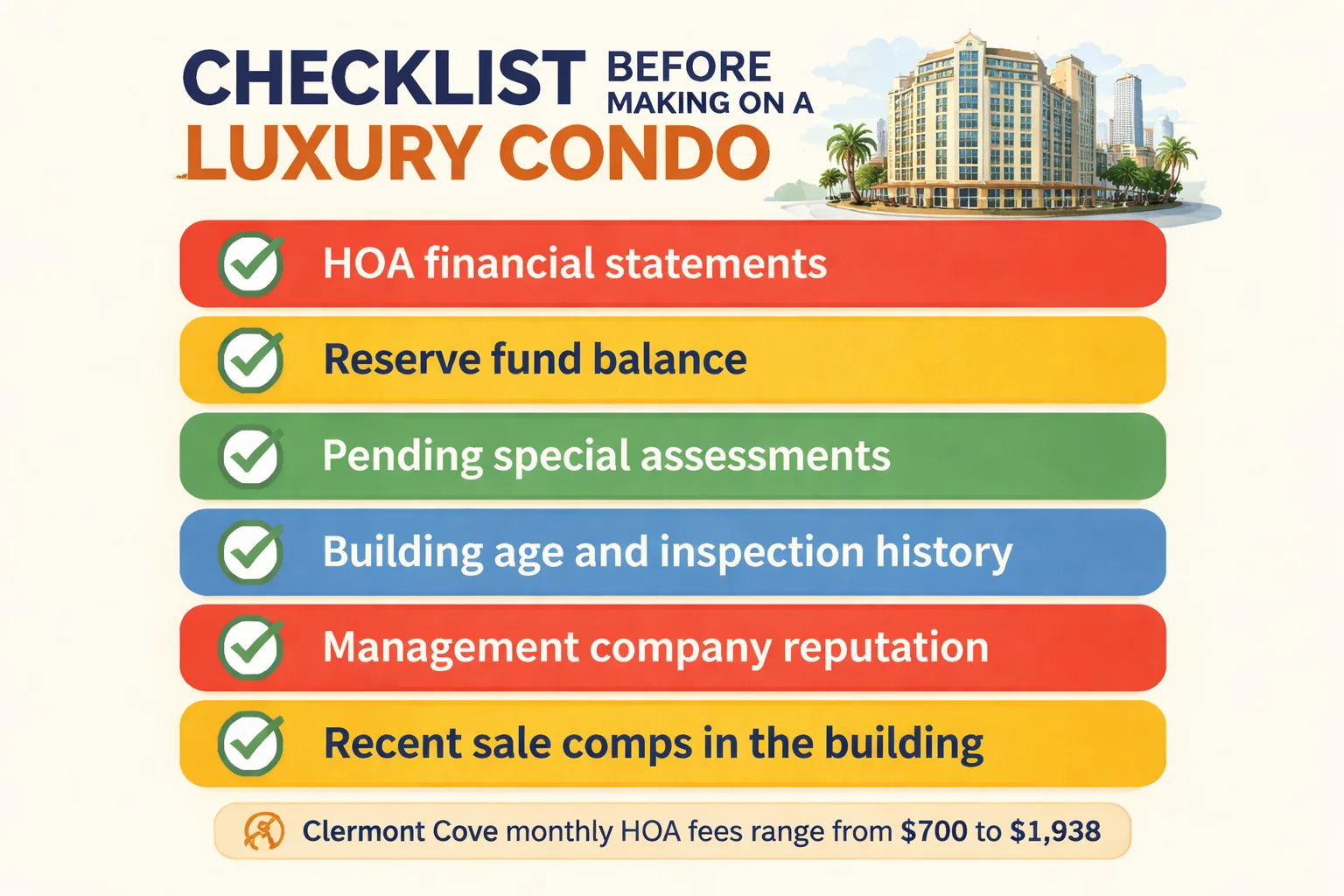
When guiding clients through the condo buying process in Jersey City, especially at buildings like Clermont Cove, one pattern repeats. Buyers get excited about amenities and location, but they do not dig into the financials. At Clermont Cove, monthly HOA fees range wildly from $700 to $1,938. That kind of spread immediately signals there is more to uncover than just what utilities are covered. Buyers should look beyond the listed amenities and scrutinize those documents for potential special assessments or signs of poor management.
An unexpected special assessment for a roof repair or facade work can turn a dream condo into a financial headache, even if the initial purchase price seemed like a steal. This is not hypothetical. It happens regularly in buildings where reserve funds are underfunded and deferred maintenance accumulates.
The due diligence checklist for any luxury condo building should include:
HOA financial statements (last two years). Review the operating budget, the reserve fund balance, and the ratio of reserves to total operating expenses. A healthy reserve fund should cover at least 70% of the building's annual operating budget. Below 50% is a red flag.
Pending or recently completed special assessments. The HOA board meeting minutes from the past 12 months will reveal whether assessments are being discussed. If a building has imposed multiple special assessments in the past five years, the reserve fund is inadequate and the buyer is subsidizing the previous owners' deferred maintenance.
Building age and major system condition. A 30-year-old building with original HVAC, roof, and facade is a candidate for a major assessment within the buyer's ownership period. Newer buildings (under 10 years old) may still be under developer warranty, which has value but also signals that the HOA has not yet transitioned to fully owner-controlled governance.
Management company reputation. The building's management company runs day-to-day operations, collects assessments, and coordinates repairs. A poorly rated management company can degrade the living experience and depress resale value. Ask the agent for the management company name and research their reputation independently.
Recent sale comps within the building. Request the last 12 months of closed sales in the building. If units are selling below asking consistently, or if days-on-market is trending upward, the building may have a reputation issue or financial concern that other buyers have already identified.
For buyers exploring new condo developments near me, the developer's track record matters as much as the building itself. A developer with a history of litigation from prior projects or incomplete punch-list items at handover is a risk. Research the developer's completed projects and talk to residents if possible.
The mechanics of reserve fund analysis deserve deeper explanation. A reserve study is a formal engineering assessment that catalogs every major building system (roof, facade, elevators, HVAC, plumbing, electrical), estimates its remaining useful life, and calculates the annual funding required to replace each system at end of life. Well-managed buildings commission a reserve study every three to five years and fund reserves accordingly. Underfunded buildings skip the study, keep HOA fees artificially low to attract buyers, and then impose six-figure special assessments when the roof fails or the elevator needs replacement. On a $2 million condo, a special assessment of $50,000 to $100,000 (common for facade work on older buildings) represents a 2.5% to 5% post-purchase cost increase that the buyer did not budget for.
The HOA fee spread at buildings like Clermont Cove ($700 to $1,938) often reflects unit size, floor level, and amenity access differences, but it can also signal tiered fee structures or grandfathered rates from prior management contracts. A buyer paying $1,938 monthly needs to understand exactly what that fee covers (water, gas, heat, concierge, gym, pool, exterior maintenance) and whether any of those services are subsidized by reserve funds in a way that is not sustainable. If the operating budget shows the building is drawing from reserves to cover monthly expenses, the HOA fee is effectively understated and an assessment is inevitable.
Step 4. Navigate Financing and International Buyer Considerations
Financing a luxury condo near Manhattan involves layers that conventional mortgage guides do not adequately cover. The purchase price alone does not determine the loan structure. The building type, the buyer's residency status, and the jurisdiction's tax framework all shape what financing makes sense.
Condo vs. co-op financing. Condos are financed like any other real estate. The lender appraises the unit, verifies the buyer's income and assets, and issues a loan. Co-ops are different. The buyer is purchasing shares in a corporation that entitle them to a proprietary lease, not fee simple title to real property. Lenders who finance co-ops require the building to meet specific financial criteria, and co-op boards impose their own debt-to-income requirements that are often stricter than the lender's. A buyer pre-approved for a $3 million condo may find that a co-op board will not approve the same financing structure.
Jumbo loan thresholds. In the NY/NJ metropolitan area, conforming loan limits are higher than the national baseline due to high-cost-area adjustments, but luxury purchases almost always exceed conforming limits and require jumbo loans. Jumbo lenders scrutinize liquidity reserves more heavily. Expect to show 12 to 24 months of principal, interest, taxes, and insurance (PITI) in liquid reserves after the down payment. For a $3 million purchase with 20% down, that means roughly $600,000 in reserves on top of the $600,000 down payment.
International buyer considerations. Foreign buyers face FIRPTA (Foreign Investment in Real Property Tax Act) implications. FIRPTA requires the buyer's title company to withhold 15% of the total amount realized on the sale and remit it to the IRS. However, FIRPTA applies to the seller, not the buyer. The practical impact for a foreign buyer purchasing is that they need to understand their own future sale will trigger this withholding. More immediately, foreign buyers without US credit history face stricter lender requirements and may need to provide international income verification, asset tracing, and sometimes a larger down payment (30% to 40% is common for foreign national loans).
Offer structuring in low inventory. The Manhattan luxury market is not a buyer's market at the ultra-high end. With 133 contracts at $4 million and above in a single month and $10 million-plus sales surging 80% year-over-year, competitive offers need to be structured for speed and certainty. That means:
- Pre-underwritten financing (not just pre-approval). The lender has verified income, assets, and credit, and the file is ready to close. - Proof of funds for the full down payment in accounts that can be wired within 48 hours. - A clean offer with minimal contingencies. In a multiple-offer situation, the buyer who waives the financing contingency (because their financing is pre-underwritten) wins over the buyer who needs 30 days to secure final approval.
For investors evaluating New Jersey real estate investment opportunities alongside luxury condo purchases, the financing strategy may differ. Investment loans carry higher rates and require 25% to 30% down. A buyer purchasing a luxury condo as a primary residence and an investment property simultaneously should work with a lender who understands both loan types and can structure the transactions to avoid cross-collateralization issues.
The mechanics of pre-underwriting deserve elaboration. A standard pre-approval involves a lender reviewing pay stubs, W-2s, and a credit pull, then issuing a letter stating the buyer qualifies for a certain loan amount. Pre-underwriting goes further. The lender collects a full document package (tax returns, asset statements, business financials if self-employed), submits the file to underwriting, and receives a conditional commitment. The only remaining conditions are the property appraisal and title work. A pre-underwritten buyer can close in 21 days. A pre-approved buyer typically needs 30 to 45 days. In a multiple-offer situation where two buyers offer the same price, the seller's agent will recommend the pre-underwritten buyer because the risk of financing falling through is nearly eliminated.
For international buyers, the financing landscape is more restrictive. Foreign national loans (loans to buyers without US residency or credit history) are available through specialized lenders but typically require 30% to 40% down, carry interest rates 0.5% to 1% higher than domestic jumbo loans, and demand a full asset trace showing the source of funds for the down payment. Chinese-American buyers transferring funds from overseas accounts should anticipate a 30 to 60 day timeline for international wire transfers to clear anti-money-laundering (AML) compliance reviews at US banks. Starting this process before the property search begins, not after a contract is signed, prevents closing delays that can breach contract deadlines.
Ready to find the right luxury condo on either side of the Hudson?
Step 5. Make an Offer and Close with Confidence
The offer and closing stage is where NY and NJ diverge most sharply. A buyer who understands both processes can move between markets without surprises.
New Jersey: attorney review and inspection. New Jersey is an attorney-review state. After the buyer and seller agree on price and terms, both parties enter a three-day attorney review period during which either side can cancel the contract without penalty. During this window, the buyer's attorney reviews the contract, negotiates terms, and the buyer typically orders a home inspection. The inspection can reveal issues that reopen price negotiations. After attorney review concludes and the inspection contingency is resolved, the contract becomes binding.
The NJ property tax rates by town vary significantly, and the buyer's attorney should confirm the tax figures used in the closing cost estimate match the actual municipal rate. A discrepancy of 0.5% on a $2 million assessment is $10,000 annually.
New York City: co-op board approvals and condo waivers. Manhattan co-ops require board approval, and the board application is exhaustive. Buyers submit two to three years of tax returns, personal and business financial statements, reference letters (professional and personal), and a detailed asset verification. The board reviews the package, may or may not grant an interview, and has broad discretion to reject any applicant without explanation. A rejection can occur after the buyer has spent thousands on attorney fees, application preparation, and inspection. This is why co-op purchases carry more risk than condo purchases and why the buyer's agent's experience with specific boards matters.
Condos in NYC are simpler. The condo board has a right of first refusal, meaning they can either match the buyer's offer and purchase the unit themselves or waive the right and let the sale proceed. In practice, waivers are routine. But the timeline still matters. From contract execution to closing in a NYC condo, expect 45 to 75 days. In a co-op, add 30 to 60 days for board review.
Closing costs at the table. Both states require attorney involvement, which adds legal fees to the transaction. According to a detailed NY/NJ closing cost comparison, NYC purchases tend toward the upper end of the 2% to 5% closing cost range due to mansion tax, flip tax (if applicable), and title insurance premiums. Title fees and closing costs vary by transaction type and should be reviewed with the attorney before the closing date.
Timeline expectations. From accepted offer to keys:
| Stage | NJ Condo Timeline | NYC Condo Timeline | NYC Co-op Timeline |
| Attorney review | 3 business days | 3 to 5 business days | 3 to 5 business days |
| Inspection | 5 to 7 days | 5 to 7 days | 5 to 7 days |
| Contract to closing | 30 to 45 days | 45 to 60 days | 60 to 90 days |
| Board approval | N/A | 15 to 20 days (waiver) | 30 to 60 days |
| Total offer to close | 35 to 55 days | 60 to 75 days | 90 to 120 days |
The buyer who expects a 30-day close on a Manhattan co-op has not done their homework. The buyer who knows the timeline can plan their lease termination, moving logistics, and interim housing accordingly.
The co-op board package deserves its own deep dive because it is the single most common point of failure in Manhattan luxury transactions. The package typically includes: two to three years of personal and business tax returns, a personal financial statement detailing all assets and liabilities, three to five personal reference letters, three to five professional reference letters, employment verification, and consent to a credit and background check. The board uses this package to assess whether the buyer has the financial capacity to maintain monthly obligations (maintenance fees, potential assessments) and whether they fit the building's culture. Boards can reject for any reason or no reason, and they are not required to explain. A buyer's agent who has successfully placed clients in specific buildings knows what each board expects and can prep the package accordingly. An agent who has never closed in that building is guessing.
For New Jersey buyers, the attorney review period is the critical negotiation window. During those three business days, the buyer's attorney can renegotiate price based on inspection findings, request seller credits for discovered defects, adjust the closing date, or modify contingency clauses. A skilled real estate attorney in NJ will use this window to tighten the contract in the buyer's favor. The seller's attorney is doing the same in the opposite direction. The outcome of attorney review often determines whether the final deal terms favor the buyer or the seller, regardless of the initial agreed-upon price.
What This Won't Fix
This guide covers the mechanics. It does not cover two problems that buyers frequently expect it to solve.
First, no amount of due diligence eliminates market risk. Hudson County's median price per square foot dropped 2.07% over the past year. A buyer who purchased at the peak of that cycle is underwater on paper, regardless of how thoroughly they reviewed the HOA financials. The three-year trend of 7.28% appreciation suggests recovery, but short-term volatility is real. No checklist protects against cyclical downturns.
Second, finding the right agent does not guarantee finding the right unit. Inventory in the Manhattan luxury market moves quickly at the $4 million-plus tier. The 133 contracts signed in a single month represent units that were available, shown, and gone. An agent can identify opportunities, but they cannot manufacture inventory that does not exist. Buyers who are too selective or too slow will lose units to faster, more decisive competitors. The guide optimizes the process. It does not guarantee the outcome.
For buyers ready to move forward, the next step is a conversation. Not a listing search. Not a Zillow deep dive. A conversation with an agent who can assess the buyer's specific parameters, explain the NY/NJ market divergence in the context of the buyer's timeline, and identify whether the right unit exists today or requires patience.
The right agent will tell a buyer when not to buy. That honesty is worth more than any amenity package or building view.
Frequently Asked Questions
What is the difference between a condo and a co-op in Manhattan?
A condo buyer purchases fee simple title to real property. A co-op buyer purchases shares in a corporation that owns the building, along with a proprietary lease granting the right to occupy a specific unit. Co-op boards have broad discretion to approve or reject buyers, require extensive financial disclosure, and often impose restrictions on subletting, renovations, and financing. Condos offer more flexible ownership but typically cost more per square foot. Financing structures differ: condo loans are conventional mortgages, while co-op loans are secured by the shares and proprietary lease.
How much are closing costs for a luxury condo in NY vs. NJ?
Closing costs in both states generally range from 2% to 5% of the purchase price. NYC transactions tend toward the upper end due to the mansion tax (a graduated surcharge starting at 1% above $1 million and reaching nearly 4% at higher tiers), title insurance premiums, and flip taxes in some buildings. New Jersey buyers typically pay approximately $5,410 in base closing costs including recording fees, but luxury purchases scale significantly because percentage-based fees dominate at higher price points. Both states require attorney involvement, adding $2,000 to $5,000 in legal fees.
What credit score and reserves are needed for a jumbo loan on a luxury condo?
Jumbo lenders typically require a minimum credit score of 700, though 720 or above is preferred for the best rates. Reserve requirements are stricter than conventional loans. Expect to show 12 to 24 months of principal, interest, taxes, and insurance (PITI) in liquid assets after the down payment and closing costs. For a $3 million purchase with 20% down ($600,000) and closing costs of roughly $100,000, the buyer needs approximately $600,000 in additional liquid reserves. Self-employed buyers face additional scrutiny and should provide two years of business tax returns and a year-to-date profit and loss statement.
Can international buyers get a mortgage for a Manhattan luxury condo?
Yes, but with restrictions. Foreign national loans are available through specialized lenders and typically require 30% to 40% down, carry interest rates 0.5% to 1% above domestic jumbo rates, and require full asset tracing. International buyers should also anticipate 30 to 60 day timelines for international wire transfers to clear AML compliance reviews at US banks. Buyers should also understand FIRPTA implications on their eventual sale: the buyer's title company will be required to withhold 15% of the sales price and remit it to the IRS, though the seller can apply for a withholding certificate to reduce this amount if the actual tax liability is lower.
How long does it take to close on a luxury condo near Manhattan?
NJ condo transactions typically close in 35 to 55 days from accepted offer. NYC condo transactions take 60 to 75 days. NYC co-op transactions take 90 to 120 days due to the board approval process. The buyer's financing timeline, the building's board review schedule, and attorney review negotiations all affect the final number. Buyers should plan interim housing, lease terminations, and moving logistics based on the specific property type and jurisdiction, not a generic estimate.
What should a buyer look for in HOA financials before making an offer?
Request two years of HOA financial statements, the current operating budget, the reserve fund balance, and 12 months of board meeting minutes. A healthy reserve fund covers at least 70% of the building's annual operating budget. Below 50% is a red flag. Look for pending or recently completed special assessments in the board minutes. Multiple assessments over five years indicate chronic underfunding. Review the management company's reputation and recent sale comps within the building. If units consistently sell below asking or days-on-market is trending up, other buyers may have identified issues the building is not disclosing.
About the Author
Judy Zhou, Coldwell Banker Realtor®
Judy Zhou is a top-ranked Coldwell Banker Realtor® serving New Jersey and New York, recognized in the top 7% of agents internationally with prestigious awards like the International Diamond Society and President's Elite. Licensed in both NJ and NY, she specializes in luxury homes, investment properties, and commercial real estate, offering seamless bilingual English-Chinese service.
Get a free consultation with a bilingual, dual-licensed NJ/NY agent who has closed luxury transactions in both markets and will tell you honestly whether the right unit exists for you today.