
Clermont Cove Condominiums: What Buyers Need to Know
Clermont Cove Condominiums: What Buyers Need to Know
By Judy Zhou, Coldwell Banker Realtor®
Key Takeaways
- Clermont Cove Condominiums charges monthly HOA fees of $700–$800 that cover heat, hot water, water, and parking for its 148 units at 1 Greene Street.
- One-bedroom units start at $569,000, two-bedrooms near $800,000, and three-bedrooms around $1,200,000 in this 1987 warehouse conversion.
- A 1,600-square-foot three-bedroom unit recently rented for $6,500 per month, showing strong rental demand at the building's 93 Walk Score location.
- Buyers should scrutinize Clermont Cove beyond curb appeal, as New York-style assumptions do not always apply to this first Jersey City waterfront condo conversion.
Clermont Cove Condominiums is not the effortless investment opportunity that its marketing materials. Or your enthusiastic buyer's agent. Might suggest. For buyers accustomed to evaluating Manhattan luxury apartments or commercial real estate in NYC, the NJ luxury condo market can feel like a straightforward alternative, but the assumptions that work in New York don't always translate across the Hudson. Before you wire a deposit based on curb appeal and location alone, there are realities about this specific development that demand a more skeptical, strategic eye.
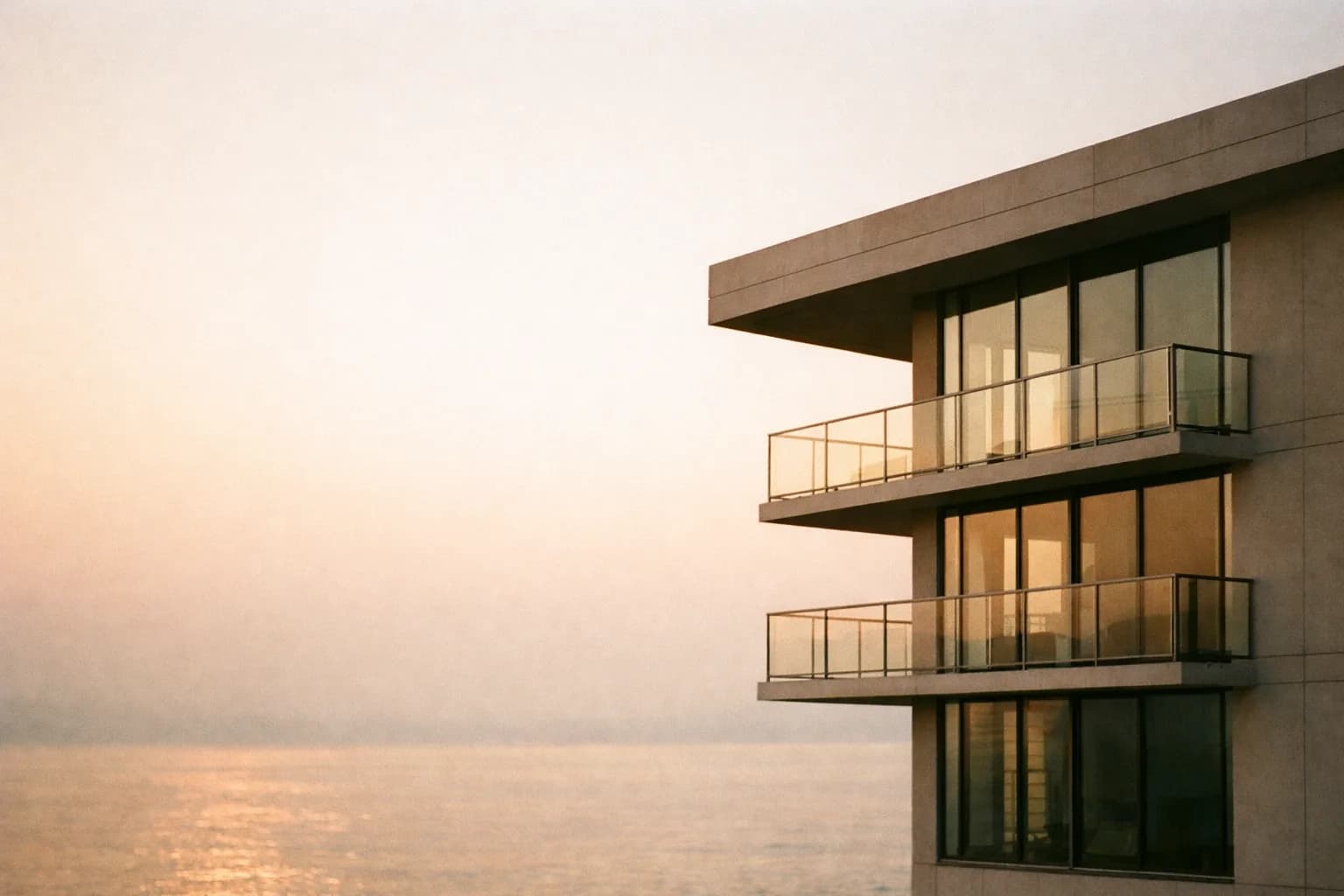
Clermont Cove Condominiums anchors the Paulus Hook waterfront at 1 Greene Street in Jersey City as the neighborhood's first-ever condo conversion, completed in 1987. The 148-unit building delivers panoramic Hudson River and Manhattan skyline views from a nine-story atrium with glass elevators, ceiling heights of 9 to 15 feet, and monthly HOA fees of $700–$800 covering heat, hot water, water, and parking. Unit pricing spans from studios at 598 square feet to 5-bedroom penthouses exceeding 3,100 square feet, with 1-bedrooms starting at $569,000, 2-bedrooms near $800,000, and 3-bedrooms around $1,200,000. A recent Zillow listing shows a 3-bedroom, 2-bath unit (1,600 sq ft) renting at $6,500 per month, signaling the building's rental demand. The building's Walk Score of 93 places it among the most walkable addresses on the Jersey City waterfront.
Introduction: Why Clermont Cove Stands Out
Clermont Cove holds a distinction that no amount of modern marketing can replicate: it was the first condominium conversion on the Jersey City waterfront. Developed by Bomad Inc and named after Robert Fulton's historic steamboat the Clermont, the building converted a warehouse into 148 residences ranging from 640-square-foot studios to 3,100+ square-foot penthouses. That origin story matters because it shapes everything about the building's character today.
The nine-story structure sits in Paulus Hook, the historic district that functions as Jersey City's answer to Manhattan's West Village. Cobblestone streets, 19th-century brownstones, and the Hudson River Walkway frame a neighborhood where residents walk to dinner at Liberty House Restaurant, grab coffee at Modcup, and catch the ferry at the Paulus Hook terminal for a 12-minute crossing to Brookfield Place in lower Manhattan. The PATH train from Exchange Place reaches the World Trade Center in roughly 10 minutes, with connections to Midtown via the 33rd Street line.
What separates Clermont Cove from newer waterfront towers is architectural character. The warehouse conversion preserved ceiling heights of 9 to 15 feet, a nine-story central atrium flooded with natural light, and large industrial windows that newer buildings struggle to replicate. Half of all units offer direct views of the Hudson River, Manhattan skyline, and Statue of Liberty. The building attracted buyers who wanted luxury condos NJ without the sterile glass-box aesthetic that defines many post-2010 developments.
The trade-off is age. A building completed in 1987 carries infrastructure that is nearly four decades old. Elevators, plumbing, HVAC systems, and the building envelope have aging curves that newer towers haven't hit yet. Buyers evaluating Clermont Cove against brand-new construction need to weigh historic character against potential capital expenditures down the line. The HOA's reserve fund and engineering reports become essential reading, not optional due diligence. A building of this vintage will eventually require roof replacement, elevator modernization, pipe repiping, and facade restoration. The question is not whether these projects will come, but when, and whether the reserve fund can absorb them without a special assessment that adds five figures to an owner's annual costs.
How We Evaluated Clermont Cove
The evaluation framework here draws from the same criteria applied to luxury condos NJ across the Hudson waterfront corridor. Five dimensions matter most: unit mix and pricing, amenity package, transit access, HOA financials, and investment fundamentals. Each one reveals something different about whether Clermont Cove fits a specific buyer profile.
Unit mix and pricing. The building offers 148 residences across an unusually wide range. Studios start at 598 square feet, 1-bedrooms run from $569,000 to $678,617, 2-bedrooms hover near $800,000 (854. 1,928 sq ft), 3-bedrooms list around $1,200,000 (1,437. 2,095 sq ft), and 4- and 5-bedroom penthouses exceed 3,100 square feet with pricing available through listing agents. That spread means a first-time buyer and a downsizing executive can both find something here, but the experience of living in a 598-square-foot studio differs dramatically from occupying a 3,100-square-foot penthouse. Floor plans vary because the building is a conversion, not a purpose-built condo. Irregular layouts are common. Some units have odd angles, others have structural columns in unexpected places, and the square footage distribution between living and sleeping areas can differ significantly from unit to unit even within the same bedroom count. Buyers who expect uniform floor plans (as new construction delivers) will need to adjust their expectations.
Amenity package. The building offers a 24-hour concierge and doorman, valet parking, an outdoor swimming pool, jacuzzi, BBQ and grill area, a sky lounge with panoramic NYC skyline views, an on-site fitness center, a resident lounge, a community room, and newly renovated common areas. These are full-service amenities comparable to Manhattan luxury buildings, included in the $700–$800 monthly HOA fee. The outdoor pool and sky lounge are genuine differentiators that many newer Jersey City towers match but few exceed. The pool is seasonal, typically open from Memorial Day through Labor Day, and the sky lounge functions as both a social gathering space and a remote work environment with WiFi. The fitness center has been updated with modern equipment, but buyers expecting a full spa or squash court (amenities some Manhattan buildings offer) will not find them here.
Transit access. The Walk Score of 93 means daily errands rarely require a car. Exchange Place and Pavonia PATH stations are within walking distance, providing direct train service to Manhattan. The Paulus Hook ferry terminal offers a scenic Hudson River crossing to lower Manhattan. Commute times to Midtown range from 30 to 45 minutes depending on destination and time of day, which is competitive with many Manhattan neighborhoods when door-to-door time is calculated honestly. A resident commuting to the Financial District has a shorter door-to-desk trip than someone living on the Upper East Side taking the Lexington Avenue line. The ferry adds a premium commute option that costs more than the PATH but delivers a genuinely pleasant experience during warmer months.
HOA financials. The $700–$800 monthly fee covers heat, hot water, water, and parking, plus all amenities. That structure makes carrying costs more predictable than buildings where utilities are billed separately. But buyers must scrutinize the reserve fund, review minutes from recent board meetings, and check for any pending special assessments. A 1987 building will face capital projects, and an underfunded reserve means owners absorb the cost. Buyers relocating from Manhattan, where co-op financial scrutiny is standard, will find the condo due diligence process less formal but equally important. The NJ home buying process includes a three-day attorney review period unique to New Jersey, giving buyers a window to renegotiate or withdraw after signing the contract. That period is the time to request and review HOA documents, not after closing.
Investment fundamentals. The building's rental demand is documented. The Zillow listing for a 3-bedroom unit at $6,500/month provides a concrete data point for investors evaluating gross rental yield. A $1,200,000 purchase price generating $78,000 in annual gross rent yields approximately 6.5% before HOA fees, property taxes, and vacancy. Investors must also confirm the building's subletting rules and any rental caps in the HOA bylaws before purchasing. Jersey City's rental market has strengthened as Manhattan prices pushed renters across the Hudson, and buildings with full-service amenities command premium rents. But investors should model net yield, not gross, by subtracting HOA fees ($700–$800/month), property taxes (varies by abatement status), insurance, and a 5% vacancy assumption. The investment property landscape in NJ rewards buyers who run these numbers before making an offer.
Comparison Table: Clermont Cove vs. Comparable NJ Luxury Condo Communities
The table below benchmarks Clermont Cove against the general profile of comparable Jersey City waterfront luxury condo communities. Specific competitor buildings are not named here because inventory, pricing, and policies shift frequently. Buyers should consult a licensed nj real estate agent for real-time comparisons.
| Metric | Clermont Cove | Comparable Waterfront Towers (General) |
| Year Built | 1987 (warehouse conversion) | 2008. 2020 (new construction) |
| Unit Count | 148 | 200. 400+ |
| Unit Range | Studios (598 sq ft) to 5-bed (3,100+ sq ft) | Typically 1-bed to 3-bed; fewer large units |
| 1-BR Price | $569,000–$678,617 | $600,000–$850,000+ |
| 2-BR Price | ~$800,000 | $900,000–$1,300,000+ |
| 3-BR Price | ~$1,200,000 | $1,400,000–$2,000,000+ |
| HOA Fees | $700–$800/month (utilities included) | $800–$1,500+/month (utilities often separate) |
| Amenities | Pool, jacuzzi, sky lounge, 24-hr concierge, valet parking, gym | Pool, gym, concierge, rooftop deck; some lack outdoor pool |
| Ceiling Height | 9. 15 feet (conversion character) | 9. 10 feet (standard new construction) |
| Walk Score | 93 | 85. 95 (varies by exact location) |
| PATH Access | Walking distance to Exchange Place & Pavonia | Varies; some require shuttle or longer walk |
| Pet Policy | Pet-friendly (confirm restrictions) | Varies; some restrict by breed/weight |
| Investment Rental (3-BR) | ~$6,500/month (per Zillow data) | $6,000–$8,000+/month (varies) |
The pattern that emerges: Clermont Cove offers lower entry pricing and lower HOA fees than many newer towers, but carries the aging-building risk that comes with a 1987 conversion. The ceiling heights and atrium design are genuine architectural advantages that new construction struggles to match. The trade-off is infrastructure age and potentially irregular floor plans. Buyers who prioritize monthly cost efficiency and architectural character gravitate toward Clermont Cove. Buyers who prioritize modern systems, predictable maintenance, and uniform layouts lean toward newer towers. Neither choice is wrong, but the decision should be made with full awareness of what each building type delivers and what it costs over a 10-year holding period.
Making the Right Choice for Your Budget and Lifestyle
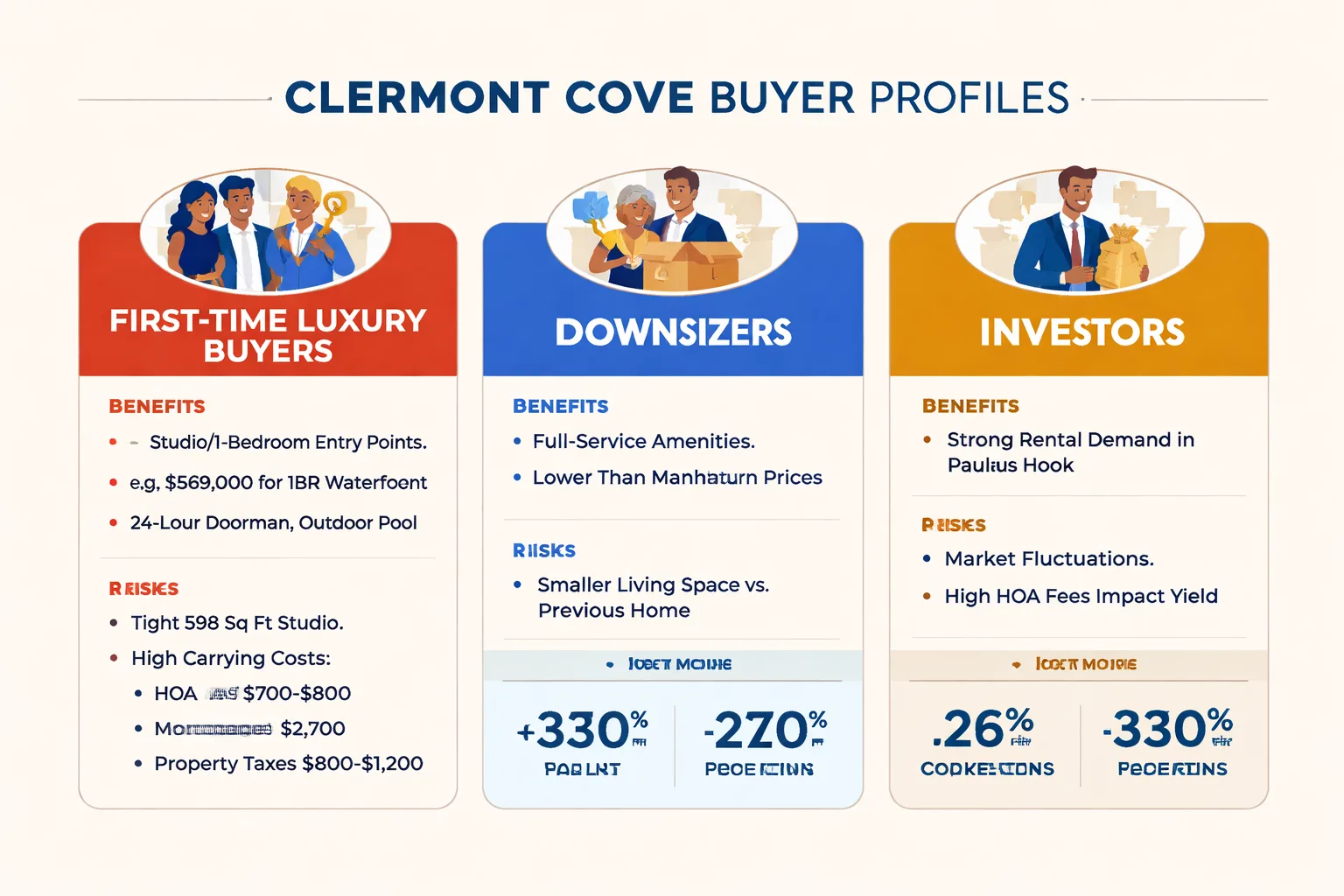
Clermont Cove fits three distinct buyer profiles, but each profile carries a different set of risks and opportunities.
First-time luxury buyers benefit from the studio and 1-bedroom entry points. A $569,000 one-bedroom with waterfront views, a 24-hour doorman, and an outdoor pool is difficult to find in Manhattan at any price. The building's full-service amenities deliver a luxury experience at a fraction of Manhattan costs. The risk is the studio footprint: 598 square feet feels tight, and buyers accustomed to larger spaces should tour in person before committing. The HOA fee of $700–$800 adds meaningfully to monthly carrying costs on top of mortgage payments, so buyers should calculate total monthly outlay (mortgage + HOA + property taxes) before falling in love with the view. A buyer financing $500,000 at current rates with 20% down faces a monthly payment of roughly $2,700 for principal and interest, plus $750 in HOA, plus property taxes that could add another $800–$1,200 monthly depending on abatement status. Total monthly carrying cost approaches $4,200–$4,650, which is the number that matters, not the purchase price alone.
Downsizers are the strongest fit for the 2- and 3-bedroom units. A 2-bedroom at approximately $800,000 with 854. 1,928 square feet, high ceilings, and a private balcony offers the space and character that empty-nesters seek without the maintenance burden of a single-family home. The 3-bedroom units with walk-in closets, dual-sink bathrooms, and large private terraces are particularly well-suited for buyers leaving a large suburban house who want luxury without stairs or exterior upkeep. Downsizers should pay special attention to the building's accessibility features, elevator reliability, and proximity to medical services. Jersey City Medical Center and various specialty practices are accessible within a short drive or rideshare. The building's elevator system, with its glass elevators in the atrium, is visually striking but should be evaluated for reliability and modernization status. Downsizers relocating from suburban areas in Westchester County or Scarsdale should compare property tax burdens, as New Jersey and New York structures differ significantly.
Investors face the most complex evaluation. The documented rental rate of $6,500/month for a 3-bedroom unit provides a concrete starting point for yield calculations, but investors must confirm the building's rental policy before purchasing. Some condo buildings cap the percentage of units that can be rented at any given time, and waiting lists for rental approval can delay cash flow. The building's pet-friendly policy broadens the renter pool, which is a genuine advantage for investment owners. Jersey City's luxury condo market is competitive, with limited inventory and above-ask pricing common when desirable units come to market. Investors should work with a NJ real estate professional who provides real-time MLS alerts and understands the Paulus Hook submarket specifically. The investment real estate agency landscape in New Jersey includes agents who specialize in different submarkets, and finding one who knows the Hudson waterfront corridor specifically is worth the effort.
The red flags that should stop a purchase: an HOA reserve fund below 10% of the annual budget, pending litigation against the board, a history of special assessments in the past five years, and any unit that has not been updated since original conversion. The building's 1987 vintage means some units retain older finishes, and interior quality varies significantly from door to door. In-person tours and professional inspections are strongly recommended. A buyer who skips the inspection to save $500 on a $800,000 purchase is making a decision that could cost tens of thousands in unforeseen repairs.
What Are the HOA Fees and What Do They Cover?
Monthly HOA fees at Clermont Cove range from $700 to $800, depending on the unit. The fee covers heat, hot water, water, and parking, plus all building amenities: 24-hour concierge and doorman service, valet parking, outdoor swimming pool, jacuzzi, BBQ and grill area, sky lounge, fitness center, resident lounge, and community room. This all-inclusive structure is more predictable than buildings where utilities are billed separately, because the largest variable costs (heat and hot water in a waterfront building with large windows) are absorbed by the association.
Buyers should request the full HOA disclosure package before making an offer. The package should include the current annual budget, reserve fund balance, meeting minutes from the past 12 months, any pending or recently completed special assessments, and the building's capital improvement plan. A building of this age should have a documented plan for major systems replacement: roof, elevators, HVAC, plumbing, and facade. If the reserve fund is thin and the capital plan is vague, that is a red flag regardless of how attractive the monthly fee appears. The HOA fee does not cover New Jersey property taxes, which are billed separately. Jersey City property tax rates and any applicable tax abatements should be verified with the city tax assessor's office or a knowledgeable local agent. Some units in Jersey City waterfront buildings carry tax abatements that significantly affect monthly carrying costs, and abatement terms can vary by unit and expiration date.
The HOA fee of $700–$800 is competitive when compared to newer Jersey City waterfront towers, where monthly fees of $1,000–$1,500 are common and often do not include utilities. The all-inclusive nature of Clermont Cove's fee means the effective cost gap is even wider than the nominal difference suggests. A building charging $1,200/month in HOA fees plus $200/month in separate utility bills has a true monthly cost of $1,400, nearly double Clermont Cove's all-in cost. Buyers comparing buildings should calculate total monthly carrying costs (HOA + utilities + taxes), not just the HOA line item. The New Jersey property tax rates vary by town and should be reviewed for comparison.
Is Clermont Cove a Good Investment Compared to Manhattan?
The comparison between Clermont Cove and Manhattan luxury apartments at similar price points reveals a fundamental trade-off: space and views versus location prestige and appreciation velocity.
A $800,000 budget buys a 2-bedroom, 854. 1,928 square foot unit at Clermont Cove with waterfront views, a private balcony, and full-service amenities. The same $800,000 in Manhattan typically buys a 1-bedroom or small 2-bedroom in a full-service building, often without direct waterfront views and with monthly carrying costs (common charges plus real estate taxes) that frequently exceed $1,500–$2,500 for comparable units. The space differential is significant: Clermont Cove delivers 50. 100% more square footage for the same purchase price.
The trade-off is appreciation. Manhattan real estate has a longer track record of value appreciation and liquidity. Jersey City's waterfront has appreciated strongly over the past decade as Manhattan prices pushed buyers across the Hudson, but the market is younger and more sensitive to interest rate shifts and PATH service disruptions. Clermont Cove's position as the first waterfront condo conversion gives it historic prestige within the Paulus Hook market, but it competes with newer towers that offer modern infrastructure and amenities that some buyers prefer.
The rental income comparison favors New Jersey. Lower purchase prices relative to rental rates produce higher gross rental yields. The documented $6,500/month rent for a 3-bedroom unit against a $1,200,000 purchase price yields approximately 6.5% gross, while comparable Manhattan units typically yield 3. 4% gross. Net yields after expenses narrow the gap, but the Jersey City math remains favorable for cash-flow-focused investors. The key risk is rent control and tenant protection regulations, which differ between New York and New Jersey and should be reviewed with legal counsel.
Considering a purchase at Clermont Cove? Get a building-specific market analysis before you make an offer.
How Does the Paulus Hook Neighborhood Compare?
Paulus Hook is the neighborhood that makes or breaks the Clermont Cove lifestyle. The district is Jersey City's oldest residential area, with roots dating to the 17th century. Today, it functions as a dense, walkable enclave of historic brownstones, converted warehouses, and new luxury towers clustered within a few blocks of the Hudson River.
The Walk Score of 93 means residents handle most daily errands on foot. Restaurants within a 10-minute walk include Liberty House Restaurant (waterfront dining with Manhattan views), Madame Claude Bis (French bistro), and Salt House (contemporary American). Coffee shops, grocery stores, pharmacies, and dry cleaners are all walkable. The Hudson River Walkway provides a continuous waterfront promenade for running, walking, and cycling with unobstructed Manhattan views.
Transportation is the neighborhood's killer advantage. Exchange Place PATH station is within walking distance and reaches the World Trade Center in approximately 10 minutes. Pavonia/Newport PATH station is also walkable and connects to the 33rd Street line for Midtown access. The Paulus Hook ferry terminal offers a direct crossing to lower Manhattan. NY Waterway ferries run frequently during peak hours, and the ride itself is a genuine commute upgrade compared to a subway.
The neighborhood's limitation is inventory. Paulus Hook's desirability means units at Clermont Cove rarely sit on the market long. Competitive bidding is common, and above-ask sales happen when desirable units with prime views come available. Buyers who wait for the perfect unit at the perfect price may wait indefinitely. Working with an agent who has relationships in the building and access to off-market or pre-MLS listings can be the difference between securing a unit and losing out.
What Should Buyers Verify Before Signing?
The due diligence checklist for Clermont Cove is more extensive than for a new-construction building because of the conversion's age and the unit-to-unit variation in finishes.
HOA documents. Request the full package: bylaws, house rules, annual budget, reserve study, 12 months of board meeting minutes, and any pending litigation. Pay special attention to rental rules, pet restrictions (size, breed, number limits), and parking allocation. Valet parking arrangements may vary by unit, and buyers should confirm individual parking inclusions before purchase. Some units may include one space, others may include two, and some may have no included parking at all. In a waterfront building where parking is at a premium, this detail alone can affect resale value by tens of thousands of dollars.
Unit-specific inspection. Interior finish quality varies significantly because the building is a 1987 conversion where individual owners have updated (or not updated) their units independently. Some units feature hardwood floors, marble baths, stainless steel appliances, quartz countertops, and modern cabinetry. Others retain older finishes that have not been updated. A professional home inspection is essential, not optional, and should include evaluation of plumbing, electrical, HVAC, windows, and any balcony or terrace waterproofing. Buyers should also request the building's most recent reserve study and any engineering reports on major systems. The NJ closing cost structure includes title insurance and transfer fees that differ from New York, and buyers relocating from Manhattan should budget accordingly.
Financial qualifications. Buyers financing their purchase should confirm that their lender is familiar with the building and that the building meets the lender's condo approval requirements. Some lenders have restrictions on buildings with high investor ratios, commercial space, or pending litigation. A pre-approval that is specifically validated for the building prevents late-stage deal delays.
Tax abatement verification. Jersey City waterfront properties may carry tax abatements that affect monthly carrying costs. The abatement terms, expiration date, and PILOT (Payment in Lieu of Taxes) structure should be verified for the specific unit. Abatements can make monthly costs significantly lower or higher than expected, and they affect resale value as expiration approaches.
Who Should Buy Here and Who Should Pass?
The buyer who thrives at Clermont Cove values architectural character over brand-new finishes. They want high ceilings, an atrium with glass elevators, and the prestige of owning in a landmark building. They are comfortable with a 1987 conversion's quirks: irregular floor plans, aging infrastructure, and the possibility of future assessments. They prioritize waterfront views, full-service amenities, and walkable neighborhood access to Manhattan over the latest smart-home technology or a building constructed in the 2020s.
The buyer who should pass is the one who wants turnkey modern construction with predictable maintenance for the next decade. A 1987 building will require capital investment over time, and if the HOA reserve is not adequately funded, that investment comes from owners. Buyers who are maximally risk-averse about special assessments should focus on newer buildings where the major systems have decades of remaining useful life.
The investor who should buy here understands the Jersey City waterfront rental market and has verified the building's subletting rules. The documented rental rates and the building's pet-friendly policy support a broad renter pool. The investor who should pass is the one who has not confirmed the rental cap rules or who assumes Manhattan-level appreciation rates will apply to a Jersey City condo. The investment property landscape in NJ rewards buyers who understand local market dynamics, not those who import Manhattan assumptions.
For buyers exploring new construction alternatives, the condo development pipeline near Manhattan and the developer landscape in New York provide additional context for benchmarking Clermont Cove against newer options.
What Are the Unit Types and Floor Plans Available?
Clermont Cove offers one of the widest unit-type ranges on the Jersey City waterfront, a direct result of its warehouse-conversion origin. Where purpose-built condo towers tend to offer standardized 1-, 2-, and 3-bedroom layouts, Clermont Cove spans from compact studios to expansive 5-bedroom penthouses, each with distinct characteristics.
Studios (from 598 sq ft). The entry-level units at Clermont Cove are compact but benefit from the building's high ceilings (9 to 15 feet) and large windows, which create an airy feel despite the modest footprint. Studios typically appeal to first-time buyers, pied-à-terre purchasers from Manhattan, and investors targeting single-professional renters. The 598-square-foot starting size is functional for one person but feels tight for couples. Buyers should tour the specific studio unit rather than relying on square footage alone, because layout efficiency varies. Some studios have alcove sleeping areas separated from the living space, while others have a more open, single-room configuration.
1-Bedrooms ($569,000–$678,617). One-bedroom units feature open-concept layouts, high ceilings, and private balconies. These units are the building's most popular seller type because they balance affordability with livable space. The price range within the 1-bedroom category reflects differences in view (Manhattan skyline vs. partial water vs. city-facing), floor level, and renovation status. A renovated 1-bedroom with quartz countertops and stainless steel appliances on a high floor with direct Manhattan views will sit at the top of the range, while an unrenovated unit on a lower floor with city views will sit at the bottom.
2-Bedrooms (~$800,000, 854. 1,928 sq ft). Two-bedroom units include hardwood floors, recessed lighting, and updated kitchens in renovated examples. The square footage range is wide (854 to 1,928), which means some 2-bedrooms are compact while others are expansive. Buyers should clarify which end of the range a specific unit occupies. The larger 2-bedrooms (1,500+ sq ft) approach the size of 3-bedrooms in newer towers and are well-suited for roommates, home offices, or small families.
3-Bedrooms (~$1,200,000, 1,437. 2,095 sq ft). Three-bedroom units offer walk-in closets, dual-sink bathrooms, and large private terraces. These are the building's premium family units and are among the most sought-after layouts when they come to market. The Zillow rental data showing $6,500/month rent for a 3-bedroom confirms the strong demand for this unit type.
4- and 5-Bedrooms (~1,900. 3,100+ sq ft). The largest units in the building are penthouse-level residences with multiple bathrooms, high-end finishes, and expansive living spaces. Pricing for these units is not publicly listed and must be confirmed with a listing agent. These units are rare on the market and typically sell through private channels rather than public MLS listings.
How Does the Buying Process Work for Clermont Cove?
The New Jersey condo buying process differs from Manhattan's in several structural ways that buyers relocating from New York should understand before making an offer.
The three-day attorney review period. New Jersey is unique in requiring a three-day attorney review period after the contract of sale is signed by both parties. During this window, either party can renegotiate terms, request repairs, or withdraw from the transaction without penalty. This period is the buyer's opportunity to request HOA documents, review the reserve fund, inspect the unit, and negotiate based on findings. Buyers should have an attorney lined up before making an offer, not after. The NJ home buying process guide provides a detailed walkthrough of this period and its implications.
Title insurance and closing costs. New Jersey closing costs include title insurance premiums, transfer taxes, recording fees, and attorney fees. These costs typically run 2. 5% of the purchase price, depending on the transaction specifics. Buyers relocating from Manhattan, where closing costs can be higher due to New York's mansion tax and flip taxes in co-ops, may find New Jersey's structure more favorable. The title fees and closing costs breakdown provides specific numbers for New Jersey transactions.
Mortgage and financing. Buyers financing a Clermont Cove purchase should obtain pre-approval from a lender familiar with Jersey City waterfront condos. Some lenders have restrictions on buildings with high investor ratios, pending litigation, or specific structural issues. A pre-approval that is validated for the specific building prevents late-stage deal delays. Buyers should also confirm whether the building is on their lender's approved condo list, as some lenders maintain approved-building databases that streamline financing.
Tax abatement due diligence. Jersey City waterfront properties may carry tax abatements that significantly affect monthly carrying costs. The abatement terms, expiration date, and PILOT (Payment in Lieu of Taxes) structure should be verified for the specific unit. Abatements can make monthly costs significantly lower or higher than expected, and they affect resale value as expiration approaches. The New Jersey property tax rates vary by town and should be reviewed for comparison.
What Is the Resale and Appreciation History?
Clermont Cove's position as the first waterfront condo conversion in Jersey City gives it a resale advantage that newer buildings cannot replicate: historic prestige and established market recognition. The building has weathered multiple real estate cycles since 1987, including the 2008 financial crisis and the post-pandemic Jersey City waterfront boom. Properties in Paulus Hook have appreciated consistently over the long term, driven by the neighborhood's limited supply (it is a historic district with no new land to develop) and increasing demand from Manhattan buyers priced out of their preferred neighborhoods.
The building's resale dynamics favor units with prime views and updated interiors. A renovated 2-bedroom with direct Manhattan skyline views will sell faster and at a higher price per square foot than an unrenovated unit with partial views. The ceiling heights and architectural character command a premium among buyers who value those features, but the premium is not unlimited. Buyers who overpay for a renovated unit in a rising market may find that the renovation premium does not fully carry through in a flat or declining market.
The Zillow listing data provides one concrete rental data point ($6,500/month for a 3-bedroom), but historical sale prices and appreciation rates should be pulled from MLS comps by a licensed agent. Buyers evaluating the building as an investment should request a comparative market analysis (CMA) that includes sale prices and days on market for Clermont Cove units over the past 3. 5 years, compared to similar units in nearby waterfront towers. This data, combined with the New Jersey real estate investment landscape overview, provides the factual basis for an investment decision rather than relying on agent optimism or marketing brochures.
FAQ: Clermont Cove Condominiums
Are units currently available at Clermont Cove?
Inventory at Clermont Cove moves quickly due to the building's desirability and limited 148-unit count. Units do come to market regularly, but desirable layouts with prime views often receive multiple offers. Buyers should work with a local agent who provides real-time MLS alerts and has relationships in the building to access off-market opportunities.
What are the current HOA fees?
Monthly HOA fees range from $700 to $800, covering heat, hot water, water, parking, and all building amenities including 24-hour concierge, outdoor pool, jacuzzi, fitness center, and sky lounge. Buyers should verify the exact fee for their target unit, as fees vary by unit size and location in the building.
Is Clermont Cove a good investment?
The building's rental demand is documented, with a 3-bedroom unit renting at $6,500 per month per Zillow data. A $1,200,000 purchase price against $78,000 in annual gross rent yields approximately 6.5% gross. Investors must confirm subletting rules, rental caps, and HOA financials before purchasing.
How does it compare to Manhattan luxury apartments?
Clermont Cove offers more square footage, lower purchase prices, and lower monthly carrying costs than comparable Manhattan units. A $800,000 budget buys a 2-bedroom at Clermont Cove versus a 1-bedroom or small 2-bedroom in Manhattan. The trade-off is appreciation velocity and Manhattan location prestige.
Is the building pet-friendly?
Clermont Cove is generally pet-friendly, which broadens the renter pool for investment owners. However, buyers should confirm specific size, breed, and number restrictions with building management before purchasing, as policies can vary and may have been updated.
What is the commute time to Manhattan?
The PATH train from Exchange Place reaches the World Trade Center in approximately 10 minutes. The ferry from Paulus Hook terminal crosses to lower Manhattan in about 12 minutes. Door-to-door commute times to Midtown typically range from 30 to 45 minutes depending on destination and time of day.
Are there special assessments or pending capital projects?
Buyers must request the full HOA disclosure package to determine the current reserve fund balance, any pending special assessments, and the building's capital improvement plan. A 1987 building will require ongoing capital investment in major systems (roof, elevators, plumbing, facade), and the reserve fund's adequacy is the key indicator of whether those costs will be absorbed smoothly or passed through to owners as special assessments.
Can I rent out my unit immediately after purchase?
The building's subletting rules and any rental caps must be confirmed through the HOA bylaws before purchasing. Some condo buildings require owners to occupy for a minimum period before renting, while others cap the total percentage of rented units. Buyers should not assume rental is permitted without verifying the specific rules.
About the Author
Judy Zhou, Coldwell Banker Realtor®
Judy Zhou is a top-ranked Coldwell Banker Realtor® serving New Jersey and New York, recognized in the top 7% of agents internationally with prestigious awards like the International Diamond Society and President's Elite. Licensed in both NJ and NY, she specializes in luxury homes, investment properties, and commercial real estate, offering seamless bilingual English-Chinese service.
Don't risk a six-figure mistake on a 1987 waterfront conversion. Schedule a consultation to review Clermont Cove's HOA financials, rental rules, and comparable Jersey City waterfront options with a local expert.