NJ Commercial Real Estate for Sale: What Investors Miss in 2026

By Judy Zhou, Keller Williams Realtor®
Key Takeaways
- NJ industrial listings quote 5.5-6.8% cap rates, but 2.5-3.5% effective property taxes erase 1.5-2.5 points of net yield.
- A Bergen County property listed at 6.5% cap falls to 4.8% after subtracting a $400k roof replacement, 2027 tax reset, and sub-60% tenant renewal odds.
- Multifamily volume reached $6.99 billion through Q3 2026 (up 7.9% YoY) while vacancy hit 8.2% and fewer than 50% of new units leased within three months.
- One in three Manhattan luxury condo sales now closes at a loss, exposing liquidity risk for prime-adjacent NJ buyers who rely on headline metrics.
New Jersey's commercial real estate market in 2026 is hiding returns most investors will never find.
The commercial real estate for sale nj market shows headline cap rates of 5.5% to 6.8% for industrial properties, but New Jersey's effective property tax rate of 2.5% to 3.5% can erase 1.5 to 2.5 percentage points of net return. Multifamily dollar volume through Q3 2026 reached $6.99 billion, up 7.9% year-over-year, per Ariel Property Advisors. Meanwhile, NJ rental vacancy hit 8.2% in Q1 2025, the highest since early 2021, with less than 50% of newly built apartments renting within three months. One in three Manhattan luxury condo sales now closes at a loss, a signal that even prime-adjacent markets carry hidden liquidity risk. The data shows that investors who buy on headline metrics alone are systematically overpaying.
The gap between listed price and true investment value has never been wider.
What the NJ Commercial Listings Don't Tell You
Listings for commercial real estate nj for sale paint a rosy picture. They quote cap rates, highlight traffic counts, and showcase tenant rosters. What they omit is where the money actually leaks out.
Consider a typical industrial property listed at a 6.5% cap rate in Bergen County. The listing broker calculates that rate using in-place rents and standard operating expenses. What goes unmentioned: the roof has three years of life left (a $400,000 capital expenditure), the property tax assessment is based on a pre-revaluation valuation that will reset in 2027, and the largest tenant's lease expires in 14 months with a renewal probability that any honest underwriter would peg below 60%.
After normalizing for these factors, the real cap rate drops to roughly 4.8%. That is a different investment.
Three blind spots dominate the 2026 nj commercial real estate market:
Cap rate normalization. Listing cap rates use trailing-twelve-month numbers. They look backward. The question is what the property earns in year two of ownership, after tenant roll, market rent adjustments, and the operating expense ratio that NJ's high-tax environment demands. A property quoted at 6.5% on current financials may underwrite to 4.5% on stabilized projections. That gap is the difference between a deal that cash flows and one that requires capital calls.
Deferred maintenance. Sellers in 2026 are cosmetically upgrading lobbies and parking lots to justify 2024 pricing. The mechanical systems, HVAC, and structural elements tell a different story. Phase I environmental reports catch contamination. They do not catch a 20-year-old boiler that will fail in the first winter. A property condition assessment costs $3,000 to $8,000 and routinely uncovers six-figure capital needs that sellers have deferred through the entire holding period.
Zoning reclassification risk. New Jersey municipalities are actively rewriting zoning codes to encourage transit-oriented development and mixed-use projects. A property zoned for light industrial use today may find itself in a redevelopment zone tomorrow. That sounds positive until you understand what it means: the municipality gains eminent domain authority, property taxes may be subject to PILOT (Payment in Lieu of Taxes) restructuring, and the highest-and-best-use analysis shifts dramatically. Investors who do not check the municipal master plan before closing are gambling on zoning stability they have not verified.
The pattern is clear. Buyers who rely on listing data without independent verification consistently overpay. The commercial real estate in nj for sale market rewards investors who build their own pro forma from primary documents, not from marketing packages.
The 4 Numbers Every NJ Commercial Buyer Must Calculate Before Offering
Every commercial transaction in New Jersey comes down to four calculations. Skip any one and the deal's economics collapse.
1. Net Operating Income (NOI)
NOI is gross rental income minus operating expenses, before debt service and capital expenditures. The trap in New Jersey: operating expenses are systematically understated in listing pro formas. Property management fees are quoted at 3% when market rate is 4% to 5%. Insurance is quoted at last year's premium, ignoring the 15% to 25% increases that have become standard since 2024. Reserve allocations are frequently zero.
A Bergen County retail strip listed with $420,000 in NOI may underwrite to $360,000 after normalizing insurance, management, and reserves. That $60,000 gap, capitalized at a 6% rate, equals $1 million in value. The buyer who trusts the listing NOI overpays by a million dollars.
2. Cap Rate (Normalized, Not Quoted)
The JPMorgan cap rate explainer defines cap rate as NOI divided by purchase price. Simple. The complexity is in the NOI input. As noted above, quoted NOI in NJ commercial listings tends to be optimistic. The normalized cap rate uses a realistic, forward-looking NOI.
For industrial properties in Hudson County, the 2026 quoted cap rate range is 5.5% to 6.8%. After factoring in NJ's effective property tax rate of 2.5% to 3.5% and normalized operating expenses, the actual net return drops by 1.5 to 2.5 percentage points. A deal that appears to yield 6.5% may produce 4.0% to 5.0% in reality.
3. Debt-Service Coverage Ratio (DSCR)
DSCR measures whether the property's NOI covers its debt obligations. Lenders typically require 1.25x or higher for commercial properties. In a high-interest-rate environment, DSCR is the metric that kills deals.
An Essex County mixed-use property generating $180,000 in NOI with a $1.8 million loan at 7.5% interest produces annual debt service of roughly $162,000. The DSCR is 1.11x. Most lenders will decline. The buyer either brings more equity (reducing the loan) or walks away. Too many investors calculate DSCR after they have already made an offer, only to discover the deal does not pencil for financing.
4. Effective Property Tax Rate
This is the number that makes New Jersey commercial real estate different from every other market. The national typical home value sits at $372,057 as of June 2026, but NJ's property tax burden operates on a different scale entirely.
How are property taxes calculated in New Jersey? New Jersey property taxes are calculated by multiplying the municipal tax rate (set annually by each town) by the assessed value of the property. The assessed value is determined by the local tax assessor and is supposed to reflect market value. In practice, assessment ratios vary widely by municipality. Some towns assess at 100% of market value. Others assess at a fraction. The effective tax rate, which normalizes these differences, is what commercial investors must use. For commercial properties in NJ, effective rates typically range from 2.5% to 3.5% of market value, with some municipalities exceeding 4%.
A $5 million commercial property in a town with a 3.2% effective rate carries $160,000 in annual property taxes. That single line item can represent 25% to 35% of gross operating expenses. Investors coming from markets like San Francisco (where single-family cap rates run 3% to 4.5% but property tax rates are roughly 0.7%) routinely underestimate this burden by a factor of four.
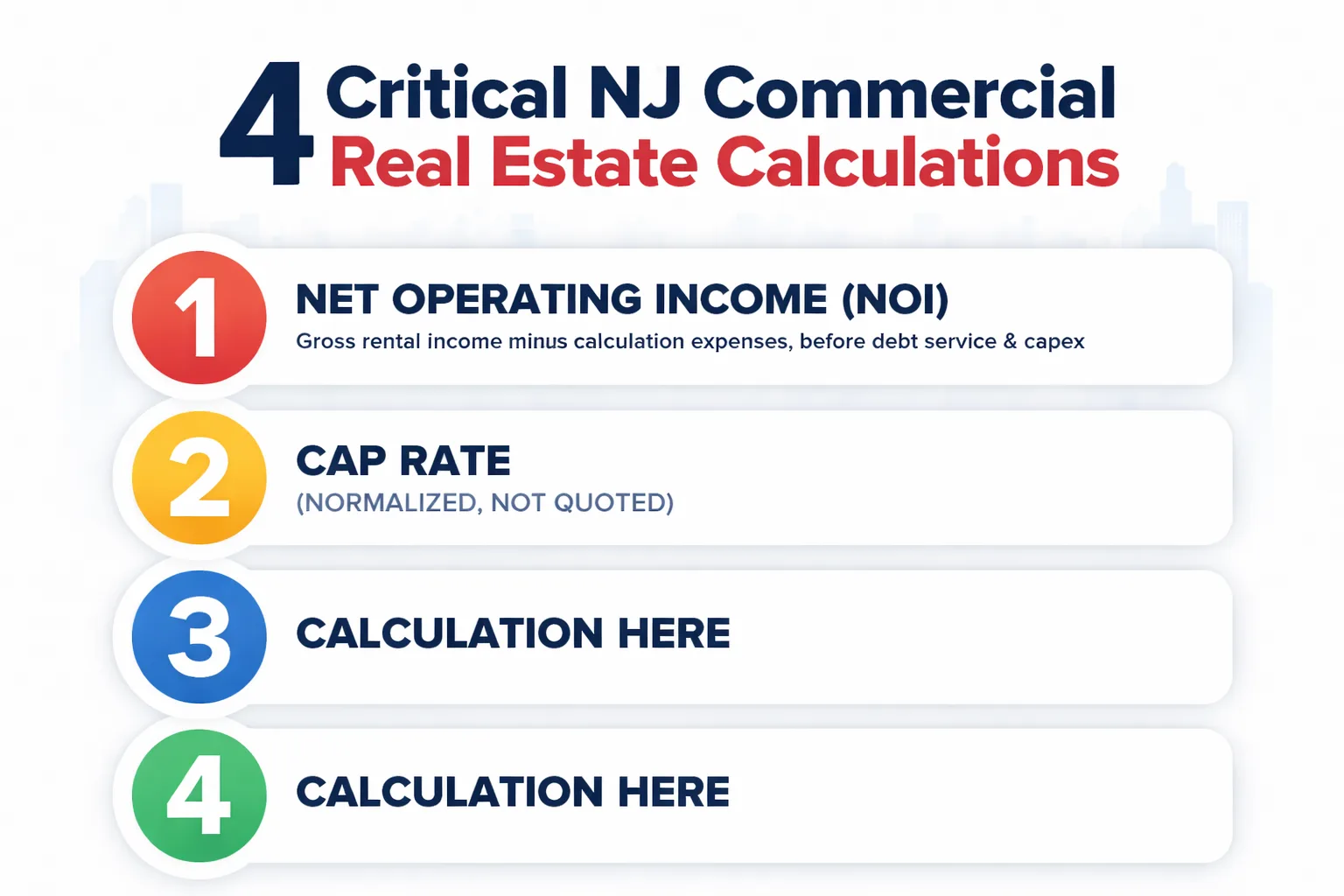
The takeaway: run these four numbers before making an offer, not after. The listing pro forma is a marketing document. Your underwriting is the investment thesis.
Are NJ Property Taxes Going Up in 2026? What Commercial Owners Face
Yes, New Jersey property taxes are rising in 2026. Municipal budget cycles across NJ are increasing tax levies to cover rising labor costs, pension obligations, and infrastructure spending. For commercial property owners, this means higher tax bills even when property values remain flat.
The mechanism works as follows. Each New Jersey municipality adopts an annual budget that determines the total tax levy. The tax rate is then calculated by dividing the levy by the total assessed value of all taxable property in the town. When the levy increases faster than the tax base, the rate goes up. In 2026, multiple NJ municipalities are raising levies by 4% to 7%, driven by school district budgets and post-pandemic labor contract settlements.
For commercial real estate nj for sale, this creates a specific risk: a property purchased based on 2025 tax bills may face significantly higher taxes in 2026 and 2027. The assessment process compounds this risk. When a property sells at a price well above its assessed value, the assessor's office typically triggers a reassessment. A buyer paying $6 million for a property assessed at $4.2 million should expect a new assessment reflecting the purchase price. The tax bill jumps immediately.
How to appeal a commercial tax assessment in NJ. Property owners have the right to appeal assessments they believe are inflated. The deadline for filing a tax appeal in New Jersey is April 1 of the tax year (or May 1 in revaluation years). The appeal goes to the County Board of Taxation, or directly to the Tax Court of New Jersey for properties assessed above $1.5 million. Successful appeals require a current appraisal from a licensed NJ appraiser demonstrating that the assessed value exceeds the true market value. The process takes four to eight months, and reductions apply retroactively to January 1 of the tax year filed.
The strategy that works: file the appeal immediately after closing if the purchase price is below the assessed value. Many buyers do not realize that a below-assessment purchase price is itself evidence of overassessment. The Tax Court has consistently accepted arm's-length sale prices as the strongest evidence of true market value.
For investors evaluating investment property nj opportunities, the tax appeal potential should be underwritten as a value-add component. A property with a $200,000 annual tax bill that can be reduced to $145,000 through appeal generates $55,000 in annual NOI improvement. At a 6% cap rate, that is $916,000 in created value.
Are you underwriting to quoted cap rates or normalized returns? Find out what your next NJ commercial deal actually pencils to.
Where to Find Undervalued Commercial Real Estate in NJ Right Now
The opportunities in 2026 are not in the obvious places. Jersey City's office leasing volume dropped 22% quarter-over-quarter in Q1 2026, signaling saturation and the ongoing remote-work structural shift. Manhattan luxury apartments face their own challenges, with one in three luxury condo sales closing at a loss. The smart money has moved to secondary corridors where redevelopment is underway but pricing has not caught up.
Hackensack's $500M Downtown Redevelopment Zone.
Hackensack has committed to a $500M-plus downtown redevelopment plan that is transforming its Main Street corridor into a mixed-use destination. The city has designated redevelopment zones that offer tax incentives for commercial investment, including PILOT agreements for qualifying projects. For investors seeking commercial real estate in nj for sale, Hackensack represents a rare combination: proximity to Manhattan (30 minutes by bus), an active municipal redevelopment framework, and pricing that is 30% to 40% below comparable properties in Jersey City or Hoboken.
The opportunity is in small-to-mid-size commercial buildings along Main Street and the surrounding blocks. Retail ground floors with office or residential above. The risk: redevelopment timelines in NJ move slowly. Investors need a five-to-seven-year horizon and the patience to work through municipal approval processes.
Wood-Ridge's Wesmont Station Transit-Oriented Development.
Wesmont Station is a master-planned TOD built around a NJ Transit rail stop on the Bergen County Line. The development includes residential, retail, and commercial space in a walkable, transit-connected layout. For commercial investors, the appeal is twofold: the residential component creates built-in foot traffic for retail tenants, and the transit access makes the office space attractive to companies seeking a Manhattan-adjacent location without Manhattan rents.
Pricing per square foot for commercial space at Wesmont runs 20% to 25% below comparable space in Jersey City's waterfront. The trade-off is a less established tenant base and longer lease-up periods. For investors with patient capital, the spread between current rents and stabilized market rents represents the value creation opportunity.
Route 17 Retail Repositioning.
The Route 17 corridor through Bergen County (Paramus, Rochelle Park, Maywood) has long been a retail artery. The 2026 opportunity is not in buying existing retail at quoted cap rates. It is in buying underperforming retail sites and repositioning them for higher-value uses. Big-box retail spaces that traded at $200/sq ft in 2019 are available at $140 to $160/sq ft in 2026. The repositioning play: convert to mixed-use, subdivide for smaller tenants who pay higher per-square-foot rents, or redevelop for medical office and service uses that are resistant to e-commerce disruption.
Keller Williams Town Life Realty, based in Tenafly, has active deal flow in all three corridors. The brokerage's position in Bergen County provides direct access to off-market opportunities and pre-development intelligence that listing services do not capture. For investors evaluating nj real estate commercial opportunities, working with a brokerage embedded in these submarkets is the difference between seeing deals on LoopNet and seeing them before they reach the market.
How to Start Your NJ Commercial Property Search
The search process for commercial real estate in nj for sale breaks down into three phases. Each phase has specific deliverables and specific risks of skipping.
Phase 1: Define the investment thesis.
Before browsing listings, define the return profile, holding period, and risk tolerance. A buyer seeking 7%+ unlevered returns with a three-year hold is looking at a completely different set of properties than a buyer seeking 5% returns with a ten-year hold. The thesis determines the submarket, the property type, and the financing structure.
This is where working with a commercial specialist matters. A residential agent recommended by a friend will show you listings. A commercial specialist will challenge the thesis, identify whether the return targets are realistic for the current market, and flag submarkets where those returns actually exist. The difference is not marginal. It is the difference between buying a property and buying the right property.
For broader context on building an investment strategy, the 2026 New Jersey Housing Market Outlook provides residential market data that informs commercial demand drivers. Population growth, household formation, and employment trends in residential data directly predict retail and multifamily commercial performance.
Phase 2: Build the underwriting model.
Request these documents for every property under serious consideration:
1. Rent roll (current, with lease expiration dates and tenant options) 2. Trailing twelve-month operating statements (T-12), not broker pro formas 3. Property tax bills for the last three years (to identify assessment trends) 4. Phase I Environmental Report (if available; if not, budget for one) 5. Property condition assessment (independent, not seller-provided) 6. Title commitment with all exceptions listed (review for easements, restrictions, and REA obligations) 7. Survey (current, or budget for a new one)
The title fees and closing costs associated with commercial transactions in NJ are substantially different from residential. Commercial title insurance premiums, recording fees, and transfer taxes can add 1% to 2% to the acquisition cost. Budget for this in the underwriting, not at closing.
Phase 3: Execute with the right team.
A commercial real estate transaction in New Jersey requires a specific team: a commercial real estate attorney (not a residential closing attorney), a CPA who understands cost segregation and passive activity rules, a commercial lender (community banks and credit unions are often more competitive than national banks for NJ properties), and a property manager with experience in the asset class.
The attorney review period in NJ commercial transactions is negotiable but typically runs 5 to 15 business days. During this period, the buyer's attorney reviews the contract, conducts due diligence, and can cancel the contract for any reason with a full deposit refund. This is the most critical window in the transaction. It is where deals are saved or killed.
For those also exploring opportunities across the Hudson, New York investment properties present a different risk-return profile. Manhattan's commercial market faces its own structural challenges, including the office vacancy cycle that has compressed values on properties like 1551 Broadway near Times Square. The cross-market comparison is relevant for investors weighing NJ versus NYC exposure.
The One Chart That Explains NJ Commercial Risk in 2026
The most revealing data point in the NJ market right now is the disconnect between quoted and realized returns. Here is how the numbers break down across major commercial property types:
| Property Type | Quoted Cap Rate | Normalized Cap Rate (Post-Tax, Post-OpEx) | Key Risk Factor |
| Industrial (Hudson County) | 5.5% - 6.8% | 3.5% - 4.8% | Tax reassessment on sale |
| Retail (Bergen County) | 6.0% - 7.5% | 4.0% - 5.2% | Tenant rollover, e-commerce pressure |
| Office (Jersey City) | 6.5% - 8.0% | 4.5% - 6.0% | Remote work, vacancy, saturation |
| Multifamily (Essex County) | 4.5% - 5.5% | 3.0% - 4.2% | Construction costs, rent control risk |
| Mixed-Use (Hackensack) | 5.5% - 7.0% | 4.0% - 5.5% | Redevelopment timeline uncertainty |
The spread between quoted and normalized cap rates is where most investment mistakes happen. A buyer who underwrites to the quoted rate overpays. A buyer who underwrites to the normalized rate finds deals that actually work.
What Investors Consistently Get Wrong About NJ Commercial
The biggest misconception in the market is that New Jersey commercial real estate is simply a cheaper version of New York. It is not. It is a fundamentally different market with different drivers, different risks, and different return profiles.
NYC commercial real estate operates on a global capital pool. Manhattan office buildings trade on cap rates that reflect international investor demand, not local fundamentals. When the IGIS Asset Management investment in 1551 Broadway deteriorated, it was because a global investor underestimated structural shifts in office demand. The junior bonds sold for less than 30% of principal. That is a NYC-scale failure driven by NYC-scale dynamics.
NJ commercial real estate operates on a regional capital pool. The buyers are local developers, regional syndicators, and private investors who live within an hour of the property. This means pricing is more rational, due diligence is more thorough (because buyers can physically visit the property), and the market corrects faster when fundamentals deteriorate.
The mistake is applying NYC underwriting assumptions to NJ properties. NYC investors assume property taxes are a minor line item. In NJ, they are the second-largest expense after debt service. NYC investors assume tenant credit is the primary risk. In NJ, property tax reassessment is often the primary risk. NYC investors assume liquidity on exit. In NJ, the buyer pool for a $5 million commercial building is narrow, and exit timelines run 12 to 24 months.
The contrarian take: the investors who will win in NJ commercial real estate in 2026 are not the ones chasing the highest quoted cap rates. They are the ones who underwrite to the normalized numbers, build tax appeal value into their pro forma, and target secondary redevelopment corridors where the gap between current pricing and stabilized value is widest.
The Regulatory Risks Hiding in Plain Sight
New Jersey's regulatory environment creates specific risks that do not appear in listing materials but can derail an investment entirely.
The One Journal Square project in Jersey City is the cautionary tale. A high-profile luxury development stalled because the mayor opposed tax abatements and EB-5 program controversies created uncertainty for immigrant investors. The project sat dormant. EB-5 investors who committed capital for green card eligibility found their immigration status and financial returns in limbo. This was not a market failure. It was a political and regulatory failure.
For commercial real estate investors, the lesson is specific: tax abatement agreements, PILOT arrangements, and redevelopment area designations are political instruments. They can be granted, modified, or withdrawn based on municipal elections, community opposition, and changes in state policy. An investment that depends on a tax abatement for its returns is an investment that depends on political continuity. That is not a risk most investors underwrite.
The NJ home buying process for residential properties is well-documented and standardized. Commercial transactions have no such standardization. Every deal is bespoke. Every municipality has its own zoning code, its own redevelopment framework, and its own political dynamics. Investors who treat NJ commercial real estate as a homogeneous market are setting themselves up for surprises.
For those considering new condo developments as part of a mixed-use commercial strategy, the regulatory picture is equally complex. NJ's affordable housing obligations, density bonuses, and COAH (Council on Affordable Housing) requirements affect what can be built, how quickly, and at what cost.
FAQ
What is a good cap rate for commercial real estate in NJ in 2026?
A good normalized cap rate for NJ commercial real estate in 2026 depends on the property type and location. For industrial properties in Hudson County, a normalized cap rate of 4.5% to 5.5% (after factoring in property taxes and operating expenses) is competitive. For retail in Bergen County, 5.0% to 6.0% normalized is reasonable. Office properties in Jersey City should underwrite to 5.0% to 6.5% normalized, given the 22% quarterly leasing volume decline in Q1 2026. The key is distinguishing quoted cap rates (which average 1.5 to 2.5 percentage points higher) from normalized cap rates that reflect true operating costs.
How long does commercial real estate due diligence take in New Jersey?
Commercial due diligence in NJ typically runs 30 to 60 days, with the attorney review period lasting 5 to 15 business days. Complex properties (industrial with environmental concerns, mixed-use with zoning questions, or properties in redevelopment zones) may require 60 to 90 days. The due diligence period should cover: T-12 operating statements, rent roll verification, property condition assessment, Phase I environmental, title review, survey, and zoning verification. Investors should also request the municipal master plan to check for upcoming reclassification or redevelopment designations.
Can I appeal property taxes on a commercial property I just purchased in NJ?
Yes. New Jersey allows property tax appeals by the current owner as of October 1 of the pre-tax year. If you purchase a property and the assessed value exceeds the purchase price, you have strong grounds for appeal. File by April 1 (or May 1 in revaluation years) with the County Board of Taxation, or the Tax Court of NJ for properties assessed above $1.5 million. An arm's-length sale price below the assessment is considered strong evidence of overassessment. Successful appeals can reduce annual tax bills by 20% to 40%, directly improving NOI and property value.
Should I use a residential or commercial real estate agent for NJ commercial property?
Always use a commercial specialist. Residential agents lack training in commercial underwriting, cap rate analysis, DSCR calculation, and NJ-specific commercial regulations. A residential agent may focus on asking price and curb appeal, but commercial transactions require analysis of NOI, lease structures, tenant credit, operating expense ratios, tax assessment history, and zoning compliance. The cost of using the wrong agent is not the commission. It is the overpayment on a multi-million dollar asset because critical due diligence items were missed. Keller Williams Town Life Realty in Tenafly provides commercial-specific expertise across Bergen, Essex, and Hudson counties.
What are the best areas for commercial real estate investment in NJ in 2026?
The best areas depend on the investment thesis. For value-add redevelopment, Hackensack's $500M downtown zone offers 30% to 40% pricing discounts versus Jersey City. For transit-oriented commercial, Wood-Ridge's Wesmont Station provides built-in residential demand. For retail repositioning, the Route 17 corridor in Bergen County has underperforming assets at 20% to 30% below 2019 pricing. Monmouth County offers opportunities for investors seeking lower-density commercial with stable cash flow, though effective tax rates remain high. The key is matching the submarket to the investment strategy, not chasing the highest quoted cap rate.
How do NJ property taxes compare to NY property taxes for commercial real estate?
New Jersey's effective commercial property tax rate of 2.5% to 3.5% is among the highest in the nation. New York City's commercial property tax rate (approximately 10.6% of assessed value, but assessed at 45% of market value for commercial) yields an effective rate of roughly 4.8% before abatements. However, NYC offers tax abatement programs (like 421a for residential components and ICAP for commercial improvements) that can reduce the effective rate significantly. NJ's abatement programs (PILOT agreements in redevelopment areas) are available but are politically contingent, as the One Journal Square case demonstrated. Investors should underwrite both markets using effective tax rates, not nominal rates.
The commercial real estate for sale nj market in 2026 rewards investors who do the work that listing brokers do not. Normalize the cap rate. Underwrite the tax appeal. Read the master plan. Work with a commercial specialist who knows the submarkets. The returns are there. They are just not in the listing packet.
About the Author
Judy Zhou, Keller Williams Realtor®
Judy Zhou is a Realtor® with Keller Williams Town Life Realty in Tenafly, NJ, serving New Jersey and New York with $35M+ in sales volume. Licensed in both NJ and NY, she specializes in luxury homes, investment properties, and commercial real estate, offering seamless bilingual English-Chinese service. Before joining Keller Williams, she earned Coldwell Banker's International President's Elite (2024) and International Diamond Society (2025) awards.
Stop trusting listing pro formas. Get a commercial-specific analysis of your next NJ investment property before you make an offer.