Is Closter, NJ Really a Wealthy Area Worth Buying Into?
By Judy Zhou, Keller Williams Realtor®
Key Takeaways
- Closter's median home values hover near $1.5 million, ranking it among the top tier of Bergen County's affluent communities with household incomes in the top 15% of New Jersey municipalities.
- Bergen County's median sale price hit $731,000 in January 2026 after a 3.8% drop from the $805,000 June 2025 peak, yet Closter remains dramatically above that county baseline.
- NeighborhoodScout data shows Closter's West neighborhood and Borough Center posted the greatest income growth over the last five years, signaling concentrated rather than dispersed wealth.
- Large lots, mature trees, and architecturally significant homes reflect decades of sustained investment by owners with capital to maintain properties instead of subdividing them.
Closter's identity as a wealthy enclave didn't happen overnight. As far back as the late 19th century, Bergen County's proximity to Manhattan made it a magnet for New York's professional class seeking space, clean air, and community. And Closter quietly positioned itself at the more refined end of that spectrum. Over more than a century, that reputation compounded like interest, attracting doctors, executives, and financiers who reinforced the very conditions that drew them there. To evaluate Closter's real estate today, you have to understand the long arc that created it.
Is Closter, NJ a Wealthy Area?
The short answer is yes. Closter ranks among the top tier of Bergen County's affluent communities, with median home values hovering near $1.5 million and household incomes well above state and national averages. The data paints a picture of sustained, generational wealth rather than a speculative spike. Bergen County itself has become one of New Jersey's most desirable real estate markets, with the countywide median sale price reaching $731,000 in January 2026, down 3.8% year-over-year from a June 2025 peak of $805,000. Closter sits dramatically above that county baseline.
The town's wealth shows up in the fundamentals. Closter's per capita income and average household income consistently rank in the top 15% of New Jersey municipalities. The borough's residential character (large lots, mature trees, architecturally significant homes) reflects decades of investment by owners who had the capital to maintain and expand properties rather than subdivide them. NeighborhoodScout data identifies Closter's West neighborhood and Borough Center as the areas with the greatest income growth over the last five years, signaling that wealth is concentrating, not dispersing. (NeighborhoodScout)
For buyers evaluating whether Closter is a wealthy area worth buying into, the question is not whether the wealth is real. It clearly is. The question is whether entry prices still offer appreciation upside, or whether the market has already priced in the premium. That distinction matters enormously for investment strategy. A town can be undeniably wealthy and still be a poor investment at current prices if the fundamentals (school quality, commute access, inventory levels) are already fully reflected in valuations. The reverse is also true: a town with moderate wealth can be an excellent investment if appreciation drivers are not yet priced in. Closter falls somewhere in the middle. Its wealth is established, its school district is elite, and its inventory is chronically low. Those factors support prices. But they also mean buyers are paying a premium for certainty, not for upside discovery.
The deeper question is how Closter's wealth translates into real estate value over time. Towns with concentrated wealth tend to have more stable price floors during downturns because owners have the financial capacity to wait out market softness rather than sell at a loss. This was visible during the 2008-2010 housing correction, when Bergen County's affluent towns (including Closter, Tenafly, and Alpine) saw smaller price declines than the state average. The same pattern emerged during the 2020 pandemic disruption and the 2023-2024 rate spike cycle. Wealth provides a buffer, and that buffer has real economic value for buyers who plan to hold for 10+ years.
What Towns Are Located Near Closter, NJ?
Closter occupies a geographic sweet spot in northern Bergen County, bordered by Demarest to the south, Norwood to the east, Harrington Park to the southeast, and Alpine to the northeast. Tenafly sits just south of Demarest, and the entire cluster forms what local agents call the "Northern Valley corridor" because these towns feed into the same regional high school district.
This proximity shapes two critical decisions for buyers: commute strategy and school district selection. Closter residents typically commute to Manhattan via bus (the 167/168 lines run through town) or by driving to the ferry terminals in Edgewater. The George Washington Bridge is roughly 20 minutes by car without traffic. Compared to Tenafly, which sits slightly closer to the bridge, Closter adds perhaps five to ten minutes to a Manhattan commute. That difference is enough to create a measurable price gap between the two towns for comparable homes.
Alpine, Closter's northeastern neighbor, operates in a different stratosphere entirely. Alpine consistently ranks among the most expensive zip codes in the United States, with median home values well above $3 million. Closter shares Alpine's quiet, wooded character but at roughly half the entry price. For buyers who want the Northern Valley lifestyle without the Alpine price tag, Closter and Demarest represent the practical middle ground.
The school district overlap matters here too. Closter sends its high school students to Northern Valley Regional High School at Demarest, shared with Demarest, Haworth, and Harrington Park. Tenafly operates its own standalone high school district. For families who prioritize school rankings above all else, the comparison between Northern Valley Demarest and Tenafly High School becomes a defining factor in choosing between these towns. More on that below.
The geographic clustering also affects commercial access. Closter residents who need major retail (Home Depot, Costco, large grocery chains) typically drive to Paramus, which is 15-20 minutes west on Route 4. Englewood, 10-15 minutes south, offers a hospital (Englewood Health), more diverse dining, and a walkable downtown. Norwood and Harrington Park are quieter and more residential, with minimal commercial infrastructure. The practical implication: Closter functions as a residential hub with enough local commercial activity (restaurants, small retail, professional services) to meet daily needs, while relying on neighboring towns for specialized shopping and healthcare.
What Is the Ethnic Breakdown of Closter, NJ?
Closter's demographic composition is one of its defining features and a significant draw for specific buyer segments. The borough's population is approximately 55% White, 21% Korean-American, 14% Hispanic or Latino, and 8% Asian (non-Korean), with the remainder distributed across other groups. The Korean-American community in Closter is among the largest percentages of any municipality in Bergen County, which itself has the highest concentration of Korean-Americans in the New York metropolitan area.
This demographic concentration directly shapes the town's commercial and cultural landscape. Closter's downtown corridor along Closter Dock Road and Schraalenburgh Road features a dense cluster of Korean restaurants, grocery stores, bakeries, and professional services that rival sections of Fort Lee and Palisades Park. For Korean-American buyers, this means access to community resources, language-concordant services, and cultural infrastructure without leaving the borough. For non-Korean buyers, it means a dining and retail scene that punches well above what a town of 8,500 residents would typically support.
The cultural fit question is practical, not abstract. Buyers relocating from Manhattan or from other states often underestimate how much a town's ethnic and cultural composition affects day-to-day quality of life. A buyer from Beijing or Seoul who values proximity to Chinese or Korean grocery stores, bilingual healthcare providers, and community networks will find Closter immediately functional in ways that a demographically homogeneous suburb would not be. This is where working with a bilingual agent who understands both the real estate mechanics and the cultural context becomes not just convenient but strategically important.
The broader implication for property values is this: Closter's Korean-American community has been a consistent source of demand for homes in the $800,000 to $1.5 million range, particularly for larger colonial-style homes on quarter-acre lots. This demand base provides price support that purely demographic analysis might miss. When a town has a deep, culturally motivated buyer pool, prices tend to be more resilient during broader market downturns.
The age distribution in Closter also tells a story worth examining. The median age is approximately 42 years, slightly above the New Jersey state median. The town has a higher concentration of families with school-age children (ages 5-17) than retiree households, which is consistent with the school district's role as the primary value driver. The 25-44 age bracket represents the largest adult cohort, reflecting the influx of Manhattan commuters who move to Closter during their prime family-formation years. This age profile supports continued demand for larger homes (4+ bedrooms, 2,500+ square feet) and limits demand for downsizer-friendly properties (townhomes, condos, small ranches), which trade at a discount relative to family-sized colonials.
What Drives Closter's Property Values in 2026?
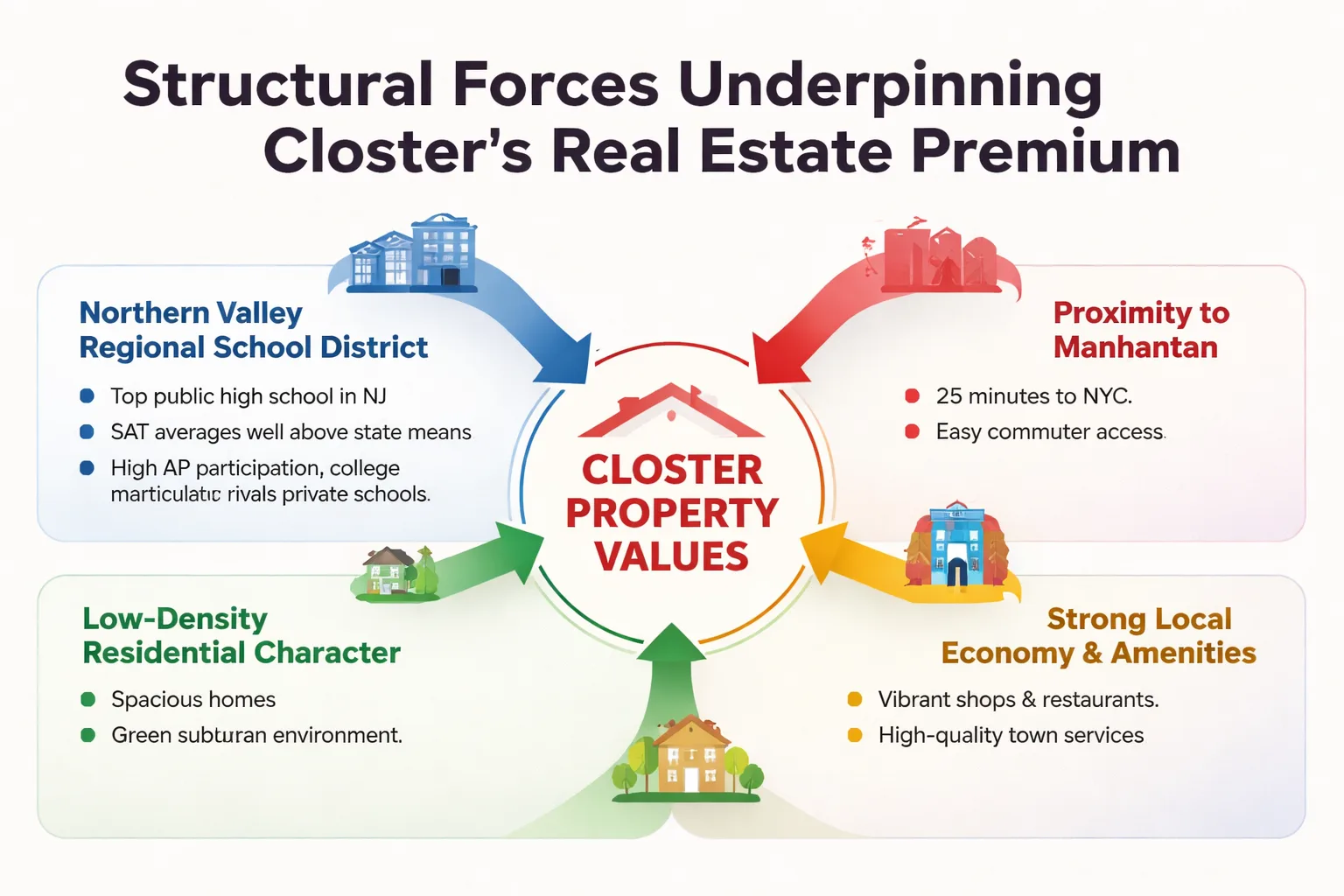
Four structural forces underpin Closter's real estate premium. Understanding each one is essential for any buyer trying to assess whether current prices are justified or inflated.
First: the Northern Valley Regional school district. Northern Valley Regional High School at Demarest consistently ranks among the top public high schools in New Jersey, with SAT averages well above state means, high AP participation rates, and college matriculation numbers that rival private schools. The New Jersey Statewide Data System reports that 66% of NJ high school graduates from recent classes either enrolled in postsecondary education or joined the NJ workforce immediately. Northern Valley Demarest's college enrollment rate exceeds that statewide benchmark substantially. For families, this single factor drives a massive portion of Closter's price premium. Homes in the Northern Valley Demarest sending district command prices 15-25% higher than comparable homes in districts with lower-ranked schools.
The school district's impact on property values is not just anecdotal. Multiple studies have confirmed that school quality is one of the strongest predictors of home prices in suburban markets, with a 5% improvement in school test scores associated with a 2-4% increase in home values. Northern Valley Demarest's consistent top-10 ranking in New Jersey (a state with over 400 public high schools) places it in the 97th+ percentile. That ranking translates directly into buyer willingness to pay a premium, and that premium is baked into every home sold in the Closter sending district.
Second: chronically low inventory. Closter has approximately 3,000 housing units, and the turnover rate is low. Owners stay in their homes for 15-20 years on average. When a property does hit the market, especially a renovated colonial on a good street, it attracts multiple offers within the first two weeks. The Bergen County data bears this out at the macro level: the county's sale-to-list ratio was 101.8% in early 2026, meaning homes on average sold above their list price. In Closter specifically, well-priced homes regularly close at 102-105% of asking.
The inventory dynamics in Closter are structural, not cyclical. The town is essentially built out. There is minimal vacant land for new construction, and the zoning (minimum 10,000-15,000 square foot lots in most residential zones) prevents subdivision. This means supply cannot expand to meet demand. The only way supply increases is through existing owners selling, and with 15-20 year average holding periods, that happens slowly. For buyers, this means waiting for the market to soften is not a viable strategy. When a good property comes available, the window to act is narrow.
Third: Manhattan commuter demand. Closter's bus commute to Port Authority runs approximately 50-60 minutes during peak hours. That is long by Bergen County standards (Tenafly and Fort Lee are closer), but it is short enough to keep Closter firmly in the Manhattan commuter shed. The town attracts buyers who are priced out of Tenafly and Alpine but still want the Northern Valley school district and a quiet residential environment. This buyer pool has been expanding as hybrid work arrangements allow commuters to tolerate slightly longer trips in exchange for more house and more land.
Fourth: low commercial density. Closter has deliberately limited commercial development to its downtown corridor. There are no large strip malls, no big-box retail, and no highway-style commercial sprawl. This preserves the town's residential character and keeps traffic patterns predictable. The trade-off is that residents drive to neighboring towns (often Englewood or Paramus) for major shopping, but most residents consider that an acceptable exchange for the quiet streets and minimal commercial traffic.
How Does Closter Compare to Other Affluent Bergen County Towns?
The comparison that matters most is Closter versus Tenafly, because these two towns compete directly for the same buyer profile: families who want top-tier public schools, a Manhattan commute under an hour, and a residential community with cultural amenities. The Closter vs Tenafly comparison is one of the most common questions from buyers exploring the Northern Valley corridor.
Tenafly has a larger population (about 14,500 vs Closter's 8,500), a standalone school district (Tenafly High School ranks comparably to Northern Valley Demarest), and a slightly shorter commute. Tenafly also has more commercial activity along its main corridors, which some buyers see as a convenience and others see as a drawback. Home prices in Tenafly have historically run slightly below Closter for comparable properties, though the gap has narrowed considerably in recent years as Tenafly's reputation has grown.
Old Tappan, located further northwest, offers a similar residential character but with a longer commute and less commercial infrastructure. Cresskill, south of Closter, has smaller lot sizes and a more compact feel, with prices that run somewhat lower. Demarest, Closter's immediate southern neighbor, shares the Northern Valley Demarest high school and offers very similar housing stock at marginally lower prices. For buyers who want the Northern Valley school district without paying the full Closter premium, Demarest is often the first alternative explored.
Alpine remains in a category of its own. With median home values above $3 million and minimum lot sizes of two acres in many sections, Alpine serves a different buyer entirely. Closter is not competing with Alpine. Closter competes with Tenafly, Demarest, and Old Tappan for the $900,000 to $1.8 million family home market.
The strategic question for buyers is not "which town is best" but "which town offers the best value for my specific priorities." A family that ranks schools first, commute second, and lot size third will get a different answer than a family that ranks commute first, walkability second, and schools third. This is where working with an agent who has deep, data-driven knowledge of each town's micro-market becomes essential. Generic advice does not work in the Northern Valley corridor because price differences of $100,000-$200,000 between towns often come down to factors (school district boundaries, commute time differentials, lot size averages) that only a local specialist can quantify accurately.
A concrete example illustrates this. A buyer considering a 4-bedroom, 2.5-bath colonial on a 0.25-acre lot might find comparable properties in Closter listed at $1.45 million, in Demarest at $1.32 million, and in Tenafly at $1.38 million. The $130,000 gap between Closter and Demarest for essentially the same house in the same school district raises a legitimate question: is the Closter address worth the premium? Sometimes the answer is yes (if the specific street is more desirable, if the lot is larger, if the renovation quality is higher). Sometimes the answer is no. The data needed to make that judgment is not available on Zillow. It requires comparable sale analysis at the street level, knowledge of pending sales not yet reflected in public records, and an understanding of which micro-neighborhoods within each town command premiums.
What Are the Cost of Living and Tax Implications?
Wealth and affordability are different questions. Closter is wealthy, but that does not mean it is affordable. The cost of living in Closter runs well above both state and national averages, driven primarily by housing costs and property taxes.
New Jersey has the highest property taxes in the nation, and Bergen County municipalities sit at the upper end of that distribution. Closter's effective property tax rate is approximately 2.3-2.5% of assessed value, meaning a $1.5 million home carries an annual tax bill of roughly $34,500-$37,500. That is a significant carrying cost that buyers (especially those relocating from states like Texas or Florida with no state income tax and low property taxes) often underestimate. The NJ property tax rates by town vary considerably even within Bergen County, and Closter's rate is moderate for the area but still substantial in absolute dollars.
For investment property buyers, the tax burden directly affects cash flow projections. A $1.5 million rental property in Closter with a $35,000 annual tax bill needs to generate enough rent to cover taxes, insurance, maintenance, and a reasonable return on equity. Rents in Closter are strong (the wealth of the area supports premium rental rates), but the math still requires careful analysis. The 2026 New Jersey housing market outlook provides broader context on where the state market is heading, and the specifics matter: Bergen County's median price decline of 3.8% year-over-year from the June 2025 peak suggests the market is normalizing, which could create buying opportunities but also requires patience.
The cost of living extends beyond housing. Groceries, dining, and services in Closter run at premium prices consistent with the area's demographics. The trade-off is quality: the town's restaurant scene, particularly its Korean and Japanese establishments, offers quality that rivals Manhattan at somewhat lower (though still premium) prices. For buyers coming from Manhattan, the overall cost of living in Closter (excluding housing) is often comparable or slightly lower. For buyers coming from lower-cost areas, the sticker shock is real.
Property tax assessment in New Jersey also has quirks that out-of-state buyers need to understand. Assessments do not always track market value. A home purchased for $1.5 million might have an assessed value of $900,000 based on a town-wide revaluation done years ago. The tax bill is calculated on assessed value, not purchase price, but towns can (and do) perform revaluations that bring assessments in line with current market values. A revaluation after purchase could cause a tax bill to jump significantly. Buyers should always check the current assessment and any planned revaluation schedule before closing.
The SALT (State and Local Tax) deduction cap, currently set at $10,000 at the federal level, hits Closter homeowners particularly hard. With property taxes of $35,000+ and New Jersey state income tax on top, most Closter homeowners far exceed the $10,000 cap. This means a portion of property taxes is effectively non-deductible for federal tax purposes, increasing the after-tax cost of homeownership. Buyers relocating from states without income tax (Florida, Texas, Nevada) need to model the full tax picture: New Jersey income tax (top rate 10.75%), property tax, and the reduced federal deductibility. The combined effect can add $20,000-$40,000 in after-tax carrying costs compared to what the buyer was paying in their previous state.
Are you weighing Closter against other Bergen County towns for your next home or investment?
Is Closter the Right Move for Your Budget and Goals?
This is where the analysis shifts from data to strategy. Closter is the right move for a specific buyer profile, and it is the wrong move for others. Being honest about which category you fall into is the most important step in the decision process.
Closter is ideal for:
1. Families with school-age children who prioritize public school quality. The Northern Valley Demarest sending district is a top-10 New Jersey public high school, and the K-8 Closter school district feeds into it. If public education is a priority, Closter delivers results that rival or exceed $40,000/year private schools.
2. Buyers who want a quiet, residential environment with large lots and minimal commercial disruption. Closter's zoning and town planning have deliberately preserved a low-density residential character. If you want walkable urbanism, Closter is the wrong choice. If you want privacy, trees, and space, it is hard to beat in this price range.
3. Manhattan commuters with hybrid schedules who can tolerate a 50-60 minute commute. The commute is not short, but it is manageable, and the housing value relative to closer-in alternatives (Tenafly, Fort Lee) is meaningful.
4. Korean-American and Chinese-American buyers who value cultural infrastructure. Closter's demographics create a community where bilingual services, cultural familiarity, and community networks are immediately accessible. For international buyers relocating from Asia, this can dramatically reduce the friction of settling into a new country.
Closter is wrong for:
1. Buyers who need a sub-40 minute commute to Manhattan. If you are going into the office five days a week, the commute will wear on you. Englewood, Fort Lee, or Edgewater are better geographic choices.
2. Investors seeking high cash-on-cash returns. Closter's price-to-rent ratio does not support strong cash flow. Properties appreciate, but rental yields are modest relative to purchase prices. For cash-flow-focused investors, commercial real estate in NJ or multifamily properties in higher-density towns offer better numbers.
3. Buyers who want urban walkability and nightlife. Closter is quiet. The downtown has essential services and good restaurants, but it is not a lifestyle district. If walkability matters, look at Englewood or Ridgewood instead.
What This Won't Fix
A common mistake buyers make is assuming that buying into a wealthy town automatically means a good investment outcome. It does not. Wealth preservation is not the same as wealth creation. Closter's market has already priced in its school district, commute access, and demographic stability. Buyers entering at $1.5 million are paying for proven fundamentals, not discovering hidden value.
The second mistake is treating Closter as a Manhattan luxury condo substitute. The two markets behave differently. Manhattan luxury condos (as tracked by Realtor.com Research, where the NYC-area luxury entry point sits at $2.62 million for the priciest 10% of listings) offer liquidity, rental flexibility, and a different appreciation curve. Closter homes are illiquid by comparison. Selling a $1.5 million home in Closter takes 60-90 days in a normal market. Selling a Manhattan condo at a similar price point can happen in 30 days if priced correctly. Buyers who may need to relocate quickly should factor this liquidity difference into their decision.
The third issue: property taxes in Closter are not a one-time cost. They compound. A $35,000 annual tax bill on a $1.5 million home means the owner pays $350,000 in taxes over a ten-year holding period, before accounting for annual increases. That is real money that needs to be factored into any total cost of ownership calculation. New Jersey's property tax burden is the highest in the nation, and buyers who fail to model this accurately will overestimate their returns.
How to Navigate the Closter Market as a Buyer
The practical steps for buying in Closter differ from a generic New Jersey home purchase. The NJ home buying process provides the general framework, but Closter's market requires specific adaptations.
Start with school district verification. Closter's K-8 district is straightforward, but the high school sending agreement to Northern Valley Demarest is the critical value driver. Confirm that any property under consideration falls within the correct sending district. Boundary changes are rare but not impossible, and a property's school district assignment should never be assumed based on address alone.
Next, analyze comparable sales with precision. Closter's low inventory means that standard 6-month comparable searches often return too few data points. A skilled agent will expand the search to include Demarest and Harrington Park comparables (which share the high school district) to build a more robust pricing model. The goal is to understand what homes in the Northern Valley Demarest sending district actually sell for, not just what Closter-specific comps show.
For international and out-of-state buyers, the process requires additional layers. Proof of funds must be verified and translated if necessary. Financing through a US lender requires establishing credit history or working with lenders who specialize in foreign national buyers. The title fees and closing costs in New Jersey include specific line items (mansion tax on properties over $1 million, transfer fees, title insurance) that out-of-state buyers may not expect. Budget an additional 2-4% of the purchase price for closing costs.
For buyers who are also evaluating new condo developments as an alternative to single-family homes in Closter, the comparison is worth making. New construction condos in nearby urbanized areas (Jersey City, Hoboken, Fort Lee) offer different risk profiles: lower maintenance, potential rental restrictions, HOA costs, but also better liquidity. Closter's single-family homes offer land, privacy, and school district access that condos cannot match. The right choice depends on the buyer's 10-year plan, not just their current budget.
The negotiation dynamics in Closter also require specific knowledge. In a market where well-priced homes receive multiple offers within two weeks, traditional negotiation leverage (contingencies, inspection demands, price reductions) is limited. The leverage shifts to pre-offer preparation: having proof of funds ready, having an inspector identified who can complete inspections within the attorney review window, and understanding which contingencies are standard in Bergen County versus which ones make an offer uncompetitive. New Jersey's attorney review period (3 business days after contract signing) provides a window for due diligence, but in a multiple-offer situation, buyers who waive certain contingencies (while still completing inspections for informational purposes) often win. The risk calculus of this approach should be discussed with an agent who has specific experience in Closter transactions.
What Does the Investment Potential Look Like Beyond Appreciation?
Pure price appreciation is the lazy way to evaluate Closter real estate. The more sophisticated question is what total return looks like when you factor in carrying costs, tax implications, rental income potential, and alternative investment opportunities.
Closter's appreciation trajectory has been strong but not linear. The Bergen County market data shows a peak in June 2025 ($805,000 county median) followed by a 3.8% decline to $731,000 by January 2026. Closter's own price movements are less volatile because its low inventory and motivated buyer pool provide price support. But no market is immune to macroeconomic forces. Rising interest rates, changes to the SALT deduction cap, and shifts in Manhattan employment patterns all affect Closter's demand base.
Rental income in Closter is a secondary consideration for most owners, but it matters for buyers who plan to rent the property before occupying it (a common strategy for international buyers awaiting visa processing). A renovated 4-bedroom colonial in Closter can rent for $4,500-$6,500/month depending on condition and location. Against a $1.5 million purchase price, that is a gross yield of 3.6-5.2% before taxes, maintenance, and vacancy. That is not a strong cash flow investment by itself, but it can cover carrying costs during a transition period.
For buyers whose primary goal is investment return rather than lifestyle, the question becomes whether Closter's appreciation potential justifies the carrying costs. The answer depends on the holding period. Over 10+ years, Closter's school district quality, demographic stability, and limited supply provide a strong case for steady appreciation. Over 3-5 years, transaction costs (closing costs, agent fees, transfer taxes) can eat 8-10% of the purchase price, meaning the property needs to appreciate at least that much just to break even.
The contrarian view: buyers who are purely investment-focused may find better risk-adjusted returns in investment real estate strategies that target emerging markets or value-add opportunities rather than buying into an already-expensive market. Closter is a wealth preservation play, not a wealth creation play. Buyers who understand that distinction will make better decisions.
What About Luxury Buyers and High-End Properties in Closter?
The luxury segment of the Closter market (homes above $2 million) operates by different rules than the mainstream market. While the $1-$1.5 million range is competitive and fast-moving, luxury properties in Closter can sit for 90-180 days as the buyer pool narrows considerably. This creates a different negotiation dynamic and a different risk profile.
Luxury homes in Closter tend to fall into three categories. First, fully renovated or new-construction estates on premium streets (Homans Avenue, Piermont Road area, High Street) with 5,000+ square feet, custom finishes, and landscaped lots. These properties trade at $2-$3.5 million and compete with luxury inventory in Tenafly and Alpine. Second, older estates on large lots (1+ acres) that offer land value and renovation potential. These trade at $1.8-$2.5 million and attract buyers who want to customize. Third, properties with unique features (water proximity, historical significance, architectural pedigree) that are priced based on their specific attributes rather than comparable sales.
For luxury buyers coming from Manhattan, the value proposition of a Closter estate is compelling. A $2.5 million budget that buys a 1,200-square-foot two-bedroom in Manhattan buys a 5,000+ square-foot home on a quarter-acre lot in Closter with top public schools. The trade-off is liquidity and flexibility. Manhattan condos can be rented out easily if the owner's plans change. Closter luxury homes are harder to rent (the rental market for $8,000+/month single-family homes is thin) and slower to sell.
The luxury buyer's due diligence process should also include checks that mainstream buyers can sometimes skip. Well water testing (some Closter properties are on private wells), septic system inspection (properties not connected to municipal sewer), and careful review of any additions or renovations for permit compliance. Older luxury homes in Closter may have had significant work done without permits, which creates liability and financing complications. A luxury real estate agent with specific experience in Closter's high-end market will know which streets have municipal water and sewer versus well and septic, which lots have wetlands or easement issues, and which properties have a history of permit violations.
What Are the Future Growth Drivers for Closter Real Estate?
Looking beyond current market conditions, several structural trends support Closter's long-term property values. Understanding these drivers helps buyers distinguish between short-term market noise and fundamental value support.
The first is the continued strength of Northern Valley Regional High School at Demarest. School rankings are not static, but Northern Valley Demarest has maintained its top-10 position for over a decade through consistent investment in academic programs, AP course offerings, and college counseling. As long as the school maintains its ranking, the sending district towns (Closter, Demarest, Haworth, Harrington Park) will continue to attract families willing to pay a premium for public education. Any sign of ranking decline would be an early warning signal for property values across the district.
The second is the infrastructure investment in the broader region. The Gateway Program (the Hudson River rail tunnel project) is expected to improve transit access to Manhattan from Bergen County once completed. While Closter is a bus-commute town rather than a rail town, improved regional transit reduces overall commute friction and supports property values across the northern New Jersey commuter shed. The exact timeline for Gateway completion remains uncertain, but the project's progress is a positive long-term signal.
The third is demographic stability. Closter's Korean-American community continues to grow, providing a steady stream of motivated buyers for homes in the $800,000-$1.5 million range. This demographic trend shows no signs of reversing, and it provides a demand floor that many other affluent suburbs lack. Towns with homogeneous demographics are more vulnerable to demand shifts; towns with diverse, culturally motivated buyer pools are more resilient.
The fourth is the limited risk of overdevelopment. Closter's zoning (minimum 10,000-15,000 square foot lots), its built-out status, and its community's demonstrated willingness to resist commercial expansion all protect against the supply shocks that can destabilize property values. A town that cannot add significant new housing supply is a town where existing homes retain their scarcity premium.
For buyers evaluating whether Closter is a wealthy area worth buying into, these long-term drivers matter more than short-term price fluctuations. The Bergen County median price decline of 3.8% from the June 2025 peak is a market correction, not a structural weakness. The fundamentals (schools, inventory, demographics, zoning) remain intact. Buyers who can hold through the current normalization cycle are acquiring assets with strong long-term value support.
FAQ
What is the median home price in Closter, NJ?
Closter's median home value sits at approximately $1.5 million as of 2026, well above the Bergen County median of $731,000. Renovated colonials on desirable streets regularly exceed $1.8 million. Entry-level homes (smaller lots, older construction) start around $900,000-$1.1 million.
How long is the commute from Closter to Manhattan?
The bus commute from Closter to Port Authority runs 50-60 minutes during peak hours. Driving to the George Washington Bridge takes approximately 20 minutes without traffic. The ferry from nearby Edgewater adds another option at roughly 40 minutes total.
What school district does Closter, NJ belong to?
Closter operates its own K-8 district (Closter Public Schools) and sends high school students to Northern Valley Regional High School at Demarest, which consistently ranks among New Jersey's top public high schools.
Is Closter, NJ a good investment?
Closter is a strong wealth preservation market with steady long-term appreciation, but it is not a high cash-flow investment. Property taxes and purchase prices limit rental yields. Buyers should view Closter as a lifestyle and education investment first, with appreciation as a secondary benefit.
How does Closter compare to Tenafly?
Closter and Tenafly compete for similar buyers. Tenafly has a shorter commute, a standalone high school district, and slightly more commercial activity. Closter offers larger lots, a quieter residential character, and a strong Korean-American community. Prices are comparable, with Closter running slightly higher for equivalent properties.
What is the property tax rate in Closter, NJ?
Closter's effective property tax rate is approximately 2.3-2.5% of assessed value. A $1.5 million home carries an annual tax bill of roughly $34,500-$37,500, among the most significant carrying costs for buyers to model.
Closter's wealth is real, documented, and structurally supported. The town delivers on its promise: excellent schools, quiet streets, cultural infrastructure, and proximity to Manhattan. For the right buyer, it is worth every dollar. For the wrong buyer, it is an expensive lesson in mismatched priorities. The difference between those two outcomes comes down to honest self-assessment and working with an agent who can translate data into strategy. Whether you are looking for nj luxury condos or a single-family home in a top school district, the key question is not whether Closter is wealthy. It is whether Closter's wealth serves your goals.
About the Author
Judy Zhou, Keller Williams Realtor®
Judy Zhou is a Realtor® with Keller Williams Town Life Realty in Tenafly, NJ, serving New Jersey and New York with $35M+ in sales volume. Licensed in both NJ and NY, she specializes in luxury homes, investment properties, and commercial real estate, offering seamless bilingual English-Chinese service. Before joining Keller Williams, she earned Coldwell Banker's International President's Elite (2024) and International Diamond Society (2025) awards.
Get a data-driven Closter market analysis tailored to your budget, commute needs, and investment goals before you make an offer.