What Is a Chinese-American Real Estate Agent — and Why It Matters in NJ

What Is a Chinese-American Real Estate Agent. And Why It Matters in NJ
By Judy Zhou, Keller Williams Realtor®
Key Takeaways
- Chinese-American agents in NJ prevent up to $40,000 in overpayments by recognizing days-on-market signals that bilingual-only agents miss.
- A 1% property tax variation between NJ towns costs $8,000–$10,000 annually on a $1M home, making hyper-local expertise essential.
- Buyers should select agents fluent in Mandarin or Cantonese who also master school districts, feng shui, and cross-border financing to avoid structural disadvantages.
- NAR data shows international Chinese buyers without culturally attuned representation face consistent financial losses in competitive NJ markets.
When you're making the largest financial decision of your life. Whether that's a luxury condo in Jersey City, a multi-family investment property in Edison, or a commercial space in Bergen County. Does it matter whether your real estate agent understands not just the market, but you? For Chinese and Chinese-American buyers navigating New Jersey real estate, the answer turns out to be more consequential than most people expect, and it shapes everything from how offers get structured to which neighborhoods even make the shortlist.
A chinese american real estate agent nj is a licensed Realtor® fluent in Mandarin and/or Cantonese who combines deep local market expertise with cultural fluency in Chinese-American buyer priorities: school district quality, community proximity, feng shui considerations, and cross-border transaction mechanics. Research from the Federal Reserve's international housing study documents how Chinese investment in U.S. residential real estate follows distinct patterns shaped by cultural preferences. Agents who understand these patterns help clients avoid costly mistakes — sometimes as much as $40,000 in overpayment when property days-on-market signals go unrecognized. The right agent also navigates property tax rate variations of up to 1% between towns, which on a $1M home means $8,000-$10,000 annually in holding costs. Bilingual capability without local expertise is a recipe for financial loss, and the data from NAR's international transaction reports confirms that international buyers face structural disadvantages without proper representation.
What 'Chinese-American Real Estate Agent' Actually Means
The label gets thrown around loosely. A bilingual real estate agent nj who can converse in Mandarin is not automatically a chinese american real estate agent nj in any meaningful sense. The distinction matters because clients who select agents based on language alone routinely discover gaps that cost real money.
A Chinese-American real estate agent is a licensed New Jersey Realtor® who operates at the intersection of three competencies. First, linguistic fluency in Mandarin and/or Cantonese, sufficient to negotiate contract terms, explain disclosure obligations, and translate inspection reports without losing critical nuance. Second, cultural literacy in the priorities that drive Chinese-American property selection: school district rankings (often weighted more heavily than commute time), proximity to established Chinese-American community infrastructure, layout preferences that account for multi-generational living arrangements, and feng shui considerations that affect resale value. Third, transactional experience with the specific structures international and diaspora buyers encounter: cross-border fund transfers, EB-5 investment visa implications, and the documentation chain required when buyers maintain addresses in multiple countries.
The problem is that many agents who market themselves as bilingual deliver only the first competency. They can chat comfortably in Mandarin about neighborhood amenities. They cannot explain the difference between a dual agency relationship and a designated agency relationship in terms that make the conflict of interest clear. They have never processed a wire transfer from a Bank of China account. They do not know which Bergen County towns have the highest-rated school districts or why that specific question gets asked in every first consultation with a Chinese-American family.
This gap between surface-level bilingualism and genuine cultural competence is where financial damage occurs. A client who trusts an agent because they share a language may never discover that the agent lacks the local market depth to recognize when a property has been sitting on the market 23 days longer than the local average of 9. That kind of oversight translates directly into overpayment. The agent who catches that signal negotiates a price reduction. The agent who misses it lets the client pay full ask.
Consider the specific case of a Bergen County property listed at $1.2M. The home had been sitting for 32 days in a market where the average absorption rate was 9 days. A culturally fluent agent with local depth would immediately recognize this as a leverage signal. The seller is likely experiencing anxiety about the listing going stale. A well-structured offer at $1.15M with clean terms and a fast closing timeline would likely be accepted. An agent who lacks that market awareness would advise the client to offer at asking price, costing the buyer $50,000 in equity on day one. This is not a hypothetical scenario. This is the kind of pattern that repeats across Bergen County transactions every quarter, and it is entirely preventable with the right representation.
The third competency, transactional experience with cross-border structures, deserves its own emphasis. Many Chinese-American buyers maintain financial accounts and business interests in both the United States and China. An agent who has never navigated the documentation requirements for a buyer who needs to transfer a 30% down payment from a Shanghai-based account to a New Jersey title company within a 14-day escrow period is an agent who will create unnecessary stress and potential deal failure. The agent who has done it a dozen times coordinates the wire transfer timeline with the title company, the mortgage broker, and the client's bank as a matter of routine. That operational competence is what the term "Chinese-American real estate agent" should mean in practice.
Why Cultural Fluency Goes Beyond Language
Language is the entry-level requirement. Cultural fluency is where outcomes diverge. The difference shows up in three places: property selection, negotiation style, and relationship architecture.
Property selection is where cultural knowledge generates the most measurable impact. Chinese-American buyers consistently weight school district quality above nearly every other factor, sometimes prioritizing it over purchase price and commute convenience. An agent who understands this instinctively shortlists properties in Tenafly, Cresskill, and Englewood Cliffs because those towns combine top-rated public schools with established Chinese-American community presence. An agent without that cultural literacy might show a client a larger house in a town with mediocre schools, thinking they are doing the client a favor by offering more square footage per dollar. The client tours the house, feels confused about why the agent thought it was a fit, and loses trust in the process.
The school district question is not a vague preference. It is often the single most important variable in the property selection process for Chinese-American families. Parents will sacrifice square footage, accept longer commutes, and pay premium prices to ensure their children attend a top-rated public school. An agent who does not understand the intensity of this priority wastes everyone's time by showing properties in towns that do not meet the school district threshold. Worse, an agent who does not know the specific school district boundaries within a town may show a property that is technically in the right zip code but zoned for a different school. That mistake, discovered after an offer is accepted, can kill a transaction and destroy client trust.
Negotiation style is the second divergence point. Chinese business culture tends to value relationship-building before transaction execution. Clients often expect to spend time establishing rapport before discussing numbers, and they may interpret an agent's push for a fast offer as a sign of disrespect or desperation. An agent who understands this rhythm paces the relationship correctly. They invest time in the first two meetings understanding the client's family situation, investment timeline, and long-term goals before pushing for a specific property. When it comes time to negotiate, the trust bank is full. The client accepts the agent's recommendation on offer price because the agent has demonstrated genuine understanding of their priorities.
The negotiation itself follows different conventions. In Chinese business culture, the initial offer is often expected to be significantly lower than the final price, with both parties understanding that multiple rounds of counter-offers are part of the process. An agent who pushes their client to make a strong initial offer close to asking price may be acting in the client's best interest by Western standards, but the client may feel that the agent is not fighting hard enough on their behalf. Conversely, an agent who understands this cultural expectation can explain the Western negotiation norm, where a lowball offer may offend the seller and kill the deal, while still advocating aggressively for the client's interests. That translation of cultural expectations is a critical agent function that pure language fluency does not address.
Relationship architecture extends beyond the transaction itself. Chinese-American clients often expect their real estate agent to function as a gateway to broader services: a mortgage broker who understands foreign national loan programs, an immigration attorney who can advise on EB-5 implications, a property manager for investment units, and a tax professional who understands the intersection of U.S. and Chinese tax obligations. Agents who have spent years building these referral networks deliver value that extends far beyond the closing table. Agents who have not simply hand clients off to whoever answers the phone at a generic service provider.
The NAR's international transaction data consistently shows that international buyers face unique structural challenges in U.S. real estate transactions. Cultural fluency in an agent is not a luxury. It is the mechanism by which those structural disadvantages get neutralized.
Which NJ Markets Value Chinese-American Agents Most?
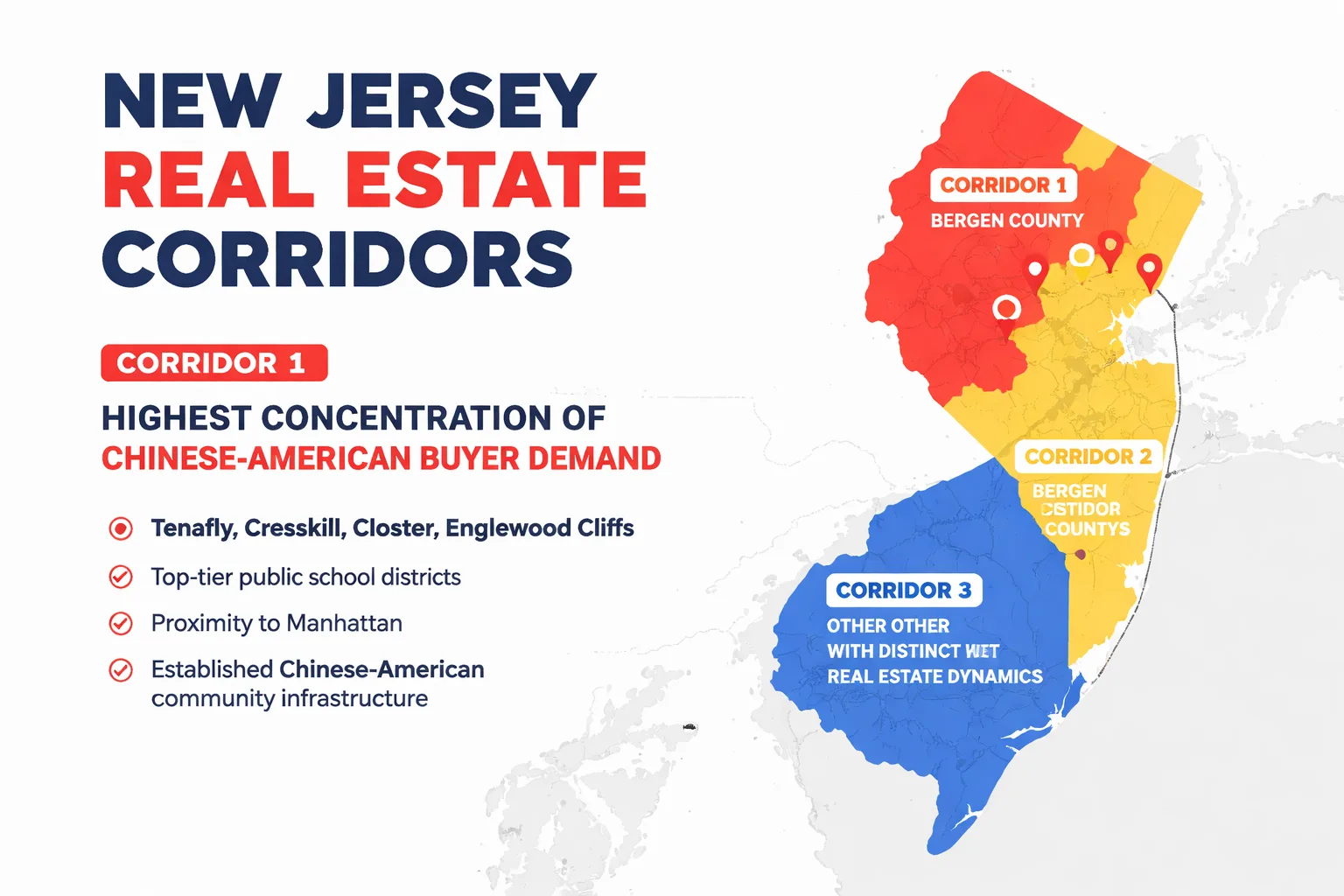
New Jersey's Chinese-American population is concentrated in three distinct corridors, each with different real estate dynamics. A new jersey chinese real estate agent who knows these markets at a granular level delivers value that a generalist cannot replicate.
Bergen County represents the highest concentration of Chinese-American buyer demand in New Jersey. Towns like Tenafly, Cresskill, Closter, and Englewood Cliffs combine top-tier public school districts with proximity to Manhattan and established Chinese-American community infrastructure. These are the towns where Chinese-American families consistently target their searches, and where a bilingual agent's network delivers genuine off-market access. Properties in these towns often sell before they hit the public MLS because agents with deep community ties connect sellers directly with buyers within their network. An agent outside that network never sees the listing. An agent inside it gets the first call.
The Bergen County market also illustrates why property tax knowledge is non-negotiable. Tax rates can vary by as much as 1% between neighboring towns, which translates to $8,000-$10,000 annually on a $1M home. For a Chinese-American investor evaluating a 10-year hold, that is $80,000-$100,000 in differential holding costs. Agents who can recite those rates from memory and factor them into investment projections deliver value that goes beyond finding a nice house. Detailed property tax rate analysis by town is the kind of resource that separates a serious investment advisor from a tour guide.
The specific town dynamics within Bergen County matter enormously. Tenafly and Cresskill share a border but have different school district structures, different average home prices, and different property tax rates. An agent who treats them as interchangeable is doing the client a disservice. The comparison between Closter and Tenafly illustrates the kind of granular analysis that a competent agent should deliver. Closter offers a slightly different value proposition: larger lots, a different school district configuration, and a different commute profile. A Chinese-American family evaluating both towns needs an agent who can articulate those differences in concrete terms, not generalities.
Essex County draws Chinese-American buyers to Livingston and Short Hills, where the school district reputation and luxury housing stock create a different value proposition. These markets attract buyers at higher price points who are often looking for larger lots and more established neighborhoods. The 2026 New Jersey housing market outlook suggests these luxury segments face different inventory pressures than entry-level markets, making agent expertise in pricing strategy even more consequential. In Short Hills, the average sale price sits well above the Bergen County median, and the buyer pool is thinner. Pricing a property correctly in that market requires an agent who understands the specific buyer demographics and the seasonal absorption patterns that affect luxury inventory.
Hudson County corridors, particularly Jersey City and Edgewater, attract a different buyer profile: professionals who want Manhattan proximity without Manhattan prices, investors looking at rental yield, and buyers interested in new condo developments near transit. The Chinese-American buyer in Hudson County is often weighing luxury waterfront real estate options against Manhattan alternatives, and an agent licensed in both NJ and NY can execute that comparison with real numbers rather than hand-waving. The waterfront condo market in Edgewater and Jersey City has specific dynamics: HOA fees that vary dramatically between buildings, flood zone considerations that affect insurance costs, and transit access that determines rental demand. An agent who specializes in these properties knows which buildings have strong reserves and which ones are facing special assessments.
The Jersey City market also carries specific regulatory risk that culturally fluent agents flag early. The One Journal Square project demonstrated how local political opposition to tax abatements and EB-5 program controversies can derail even high-profile luxury developments. Chinese-American investors who entered that project expecting clean returns and immigration pathway certainty found themselves in a stalled investment with uncertain timelines. An agent with deep local knowledge would have flagged the political risk around that project before the client committed capital. That is the difference between an agent who processes paperwork and an agent who protects client interests.
How to Verify an Agent's Credentials and Track Record
This is where the article delivers its most practical value. Most Chinese-American buyers select agents through WeChat group recommendations or personal referrals. That approach feels safe because it relies on community trust. It also routinely produces bad outcomes because community trust does not equal professional competence.
About a third of new clients who switch to a more rigorous agent after a bad experience report that something felt off with their previous agent from the first interaction. The issues typically fall into three categories: the agent could not clearly explain contract terms in a way that made sense, the negotiation style clashed with client expectations due to cultural misunderstanding, or the agent lacked the local market depth to answer basic questions about school districts and cross-border fund transfers.
The solution is independent verification. Here is the checklist.
Step 1: Verify the NJ real estate license. Use the New Jersey Real Estate Commission license lookup to confirm the agent's license is active and in good standing. This takes 30 seconds and eliminates the risk of working with an unlicensed individual. The search volume for terms like nj real estate agent license and real estate agent license nj suggests that many buyers are already aware this step exists, but the number of clients who skip it remains high. A license lookup also reveals any disciplinary actions or complaints filed against the agent, which is information that a WeChat referral will never mention.
Step 2: Verify sales volume and transaction history. An agent's sales volume is not the only metric that matters, but it is a baseline indicator of market activity and experience. Judy Zhou, a Realtor® with Keller Williams Town Life Realty in Tenafly, NJ, has closed over $35M in sales volume, holds licenses in both New Jersey and New York, and earned Coldwell Banker's International President's Elite (2024) and International Diamond Society (2025) awards at her previous brokerage. These are verifiable credentials that demonstrate sustained transaction volume and institutional recognition. Ask any agent for their sales volume figure and the brokerage where they achieved it. An agent who cannot answer the question directly, or who inflates the number, is an agent who will be equally unreliable in negotiation.
Step 3: Ask for client references, specifically from clients with similar profiles. A Chinese-American buyer relocating from Shanghai has different needs than a Chinese-American family upgrading from a starter home in Edison. Ask the agent for references from clients in a comparable situation: similar price range, similar buyer profile, similar transaction complexity. An agent who cannot provide relevant references is an agent who has not done enough comparable transactions. When calling references, ask specific questions: Did the agent explain contract terms clearly? Did the agent identify any red flags during the transaction? Would the client work with the agent again? The answers to these questions reveal more about agent competence than any marketing material.
Step 4: Test the agent's local knowledge in the first consultation. Ask specific questions that a generalist cannot answer. What is the property tax rate in Tenafly versus Cresskill? How do the school districts in Closter compare to Englewood Cliffs? What is the average days-on-market for homes in the $1-2M range in Bergen County? An agent who answers with specifics is an agent who works that market daily. An agent who deflects with generalities is an agent who will miss the signals that protect client money. The first consultation is also the time to ask about the agent's experience with cross-border transactions. How many international buyers has the agent represented in the past 12 months? What is the typical timeline for a wire transfer from a Chinese bank to a U.S. title company? Which mortgage brokers in the area specialize in foreign national loans?
Step 5: Ask about dual agency and conflict of interest policies. Dual agency, where the same agent represents both buyer and seller, creates inherent conflicts of interest. Chinese-American buyers who are unfamiliar with U.S. real estate practices may not understand the implications of agreeing to dual agency. A competent agent explains the risks clearly, in the client's language, and gives the client the option to decline. An agent who glosses over this disclosure is not acting in the client's interest.
Step 6: Evaluate the agent's professional network. A competent Chinese-American real estate agent should have established relationships with mortgage brokers who understand foreign national loan programs, immigration attorneys who can advise on visa implications, tax professionals who handle cross-border tax issues, and property managers for investment properties. Ask the agent to describe their referral network. An agent who has a ready answer has invested in building that infrastructure. An agent who hesitates or gives vague responses has not.
Why Investment Properties Demand Commercial Expertise
Chinese-American investors in New Jersey rarely stop at residential purchases. Many expand into multi-family properties, commercial spaces, or business acquisitions. This is where the agent selection process gets more dangerous, because residential agents who lack commercial experience routinely take on commercial transactions they are not equipped to handle.
First-time commercial investors in high-tax areas like Monmouth County have been burned by residential agents who focused on asking price and curb appeal while completely overlooking operational costs and tax assessments during due diligence. A residential agent might evaluate a property based on comparable sales and aesthetic appeal. A commercial agent evaluates based on cash flow projections, cap rates, lease analysis, and the specific tax structure of the property. The difference in approach can mean the difference between a profitable investment and a significant loss.
For investors evaluating commercial real estate opportunities, the agent must bring commercial-specific expertise from the first conversation. That means comprehensive tax and holding cost analysis at the beginning of the transaction, not as an afterthought. It means understanding lease clauses, assignment agreements, and the operational details that determine whether a business sale closes or falls apart 72 hours before the deadline.
Business sales in the restaurant and bubble tea shop category illustrate this risk sharply. Deals in Bergen County and Essex County have collapsed days before closing because sellers had not secured lease renewal rights or had expired health permits. A residential agent listing the business might never think to check those items. A commercial agent who understands restaurant transactions reviews them on day one. The investment real estate agency model requires that level of operational diligence, and Chinese-American investors who are new to commercial real estate need to understand that their agent must bring it.
The same principle applies to closing costs and title fees, which vary significantly between residential and commercial transactions. An agent who only processes residential closings may not anticipate the fee structure differences that affect commercial deal economics. For Chinese-American investors evaluating commercial property as an investment for the first time, these cost differences can erode projected returns if they are not modeled into the initial underwriting. Commercial transactions also involve different inspection timelines, environmental assessment requirements, and zoning compliance checks that a residential agent may not know to order. A commercial property with an unresolved environmental lien or a zoning variance issue can become a financial trap that takes years to unwind.
The bubble tea shop market in New Jersey provides a concrete example of why commercial expertise is non-negotiable. These businesses operate on thin margins, depend on specific lease terms (particularly regarding exclusive use clauses and co-tenancy provisions), and require health permits that must transfer cleanly to the new owner. An agent who has never sold a restaurant may not know to verify that the lease allows assignment without landlord consent, or that the health permit is current and transferable. When these details surface three days before closing, the deal collapses. The seller loses a qualified buyer. The buyer loses weeks of due diligence time. Both parties lose money. A commercial agent who specializes in business sales reviews these items at the listing stage, not the closing stage.
The Cross-Border Transaction Challenge
International Chinese buyers face a specific set of transactional hurdles that domestic buyers never encounter. Cross-border fund transfers from Chinese financial institutions require documentation that satisfies both U.S. anti-money-laundering requirements and Chinese capital controls. The process can take weeks, and an agent who has never navigated it cannot advise clients on timing.
Wire transfers from Bank of China accounts to U.S. title companies require specific documentation chains. The agent must coordinate with the title company, the mortgage broker (if financing is involved), and the client's bank to ensure that funds arrive on time for closing. Delays in this process are the most common reason that international Chinese buyer transactions fall through, and they are entirely preventable with an experienced agent.
The mechanics of cross-border transfers deserve specific attention. Chinese capital controls limit individuals to transferring $50,000 USD per year out of the country. For a $1M property purchase requiring a $300,000 down payment, a single buyer cannot transfer the funds in one transaction. The buyer must either structure the transfer across multiple family members, use a corporate entity with different transfer limits, or access funds already held in offshore accounts. Each approach has different documentation requirements and different timelines. An agent who has never navigated these constraints cannot advise the client on which approach to use or how long it will take. The result is a closing date that gets pushed back repeatedly, a seller who loses patience, and a transaction that ultimately collapses.
EB-5 investment visa implications add another layer. Buyers who are using EB-5 investment capital for real estate purchases need to understand how the property purchase interacts with their immigration timeline. The One Journal Square case in Jersey City demonstrated what happens when EB-5 investors commit capital to a project that subsequently stalls due to political opposition to tax abatements. The investors found their immigration goals and their investment returns both in limbo. An agent with experience in EB-5 transactions would have flagged the political risk around that specific project before the client committed.
The Federal Reserve's study on Chinese investment in U.S. housing documents the systemic patterns of Chinese capital flowing into U.S. residential real estate. Understanding those patterns is part of what distinguishes a chinese american real estate agent nj from a generalist who happens to speak Mandarin. The study highlights how Chinese investment in U.S. real estate responds to exchange rate fluctuations, changes in Chinese capital control policies, and shifts in U.S. immigration policy. An agent who stays current on these macro-level factors can advise clients on optimal timing for property purchases, financing structures that minimize tax exposure, and investment strategies that align with both U.S. and Chinese regulatory environments.
Are you working with an agent who truly understands your priorities, or just your language?
What Non-Chinese Clients Gain From This Expertise
Here is the contrarian take that most articles on this topic miss. A chinese american real estate agent nj is not only valuable to Chinese-American clients. Non-Chinese sellers who want to market their property to the Chinese-American buyer pool benefit enormously from working with an agent who has deep community ties.
Chinese-American buyers represent a significant segment of the luxury market in Bergen County and Hudson County. A seller whose agent has access to WeChat groups, Chinese-language listing platforms, and community networks gets exposure to a buyer pool that a monolingual agent cannot reach. That expanded exposure can mean the difference between a property sitting for 60 days and a property receiving multiple offers in the first week.
Non-Chinese buyers also benefit. An agent who understands Chinese-American buyer preferences can advise a non-Chinese seller on how to prepare a property for that market segment: which features to highlight (school district, community proximity, layout flexibility), which features to downplay, and how to price competitively for a buyer pool that may weight different factors than the general market. For example, a non-Chinese seller listing a home in Tenafly might not realize that Chinese-American buyers will pay a premium for a home with a layout that accommodates multi-generational living, or that certain feng shui characteristics (such as a front door orientation or staircase placement) can affect how quickly the property sells within that buyer segment.
The NAR international transactions report underscores the growing significance of international buyer activity in U.S. residential markets. Sellers who ignore this buyer segment leave money on the table. The marketing strategy for reaching Chinese-American buyers goes beyond translating a listing description into Mandarin. It involves understanding which platforms Chinese-American buyers actually use to search for properties (WeChat, specific Chinese-language real estate apps, community forums), how to present a property in a way that resonates with Chinese-American cultural preferences, and how to leverage community networks to generate word-of-mouth interest. An agent who has spent years building that marketing infrastructure delivers measurable value to any seller in a market with significant Chinese-American buyer presence.
Finding the Right Agent for Your Specific Transaction
The framework for selecting an agent should match the transaction type. A buyer purchasing a $2M luxury home in Tenafly needs a different agent profile than an investor acquiring a $5M commercial property in Jersey City. Comparing Closter versus Tenafly is the kind of analysis a residential agent should deliver fluently, but commercial transactions demand a different knowledge base entirely.
For residential buyers, the priority order is: local market depth first, cultural fluency second, transaction volume third. An agent who knows the Bergen County market intimately but has moderate sales volume will outperform an agent with high sales volume who cannot distinguish between school districts in Cresskill and Closter. For commercial investors, the priority shifts: commercial transaction experience first, local market knowledge second, cultural fluency third. A commercial agent who understands cap rates, lease analysis, and business valuation but does not speak Mandarin will outperform a bilingual residential agent who has never processed a commercial transaction.
For sellers, the priority shifts again: marketing reach within the Chinese-American community first, pricing strategy second, negotiation experience third. A seller who wants maximum exposure to Chinese-American buyers needs an agent with active community presence, not just language capability. That means an agent who is active in Chinese-American business associations, participates in community events, and has a track record of successfully marketing properties to Chinese-American buyers.
The Westchester County homes for sale market illustrates how cross-market expertise benefits clients who are comparing options across state lines. An agent licensed in both NJ and NY can execute that comparison with real data, which is a meaningful advantage for buyers who are open to properties in either market. For a Chinese-American buyer weighing a luxury condo in Edgewater against a comparable property in Manhattan, the agent can provide a side-by-side analysis of purchase price, monthly carrying costs (including HOA, property tax, and insurance), rental yield potential, and resale liquidity. That analysis requires deep knowledge of both markets, not just one.
The New York real estate developers landscape also matters for Chinese-American investors evaluating pre-construction opportunities. Understanding which developers have a track record of delivering projects on time and on budget, and which ones have a history of delays and litigation, is critical information that a generalist agent will not possess. Chinese-American investors who have been burned by stalled projects like One Journal Square are particularly sensitive to developer risk, and an agent who can provide that context adds significant value to the investment decision.
The Role of Professional Associations
Chinese-American real estate professionals in New Jersey participate in several industry associations that provide networking, education, and advocacy. The Asian Real Estate Association of America (AREAA) is the most prominent national organization focused on advancing sustainable homeownership in Asian-American communities. AREAA chapters in the New York metro area host regular events that connect agents, lenders, and service providers who specialize in serving Asian-American clients. Membership in AREAA signals an agent's commitment to understanding the specific needs of Asian-American homebuyers and investors.
The Chinese American Real Estate Association (CAREA) serves a similar function with a specific focus on Chinese-American community needs. These associations provide their members with continuing education on topics like foreign national lending programs, cross-border tax implications, and immigration-related real estate transactions. An agent who actively participates in these organizations is more likely to stay current on the regulatory and market changes that affect Chinese-American clients.
However, association membership alone is not a substitute for the verification steps outlined above. An agent can be a member of AREAA and still lack the local market depth to advise on Bergen County school districts or the commercial expertise to evaluate an investment property. Association membership is a positive signal, not a guarantee of competence. Use it as one data point in the verification process, not as the sole criterion for agent selection.
The Bottom Line on Agent Selection
The recurring pattern is clear. Chinese-American buyers who select agents based on language alone lose money. The losses are not catastrophic in a single transaction, but they compound across multiple purchases and investment decisions. A $40,000 overpayment on a residential purchase, $10,000 annually in unrecognized property tax differentials, a commercial deal that falls through because the agent missed a lease assignment clause. These are the costs of surface-level agent selection.
The solution is rigorous verification. License lookup. Sales volume confirmation. Client references from comparable transactions. A first consultation that tests local knowledge with specific questions. An explicit conversation about dual agency and conflict of interest policies. These steps take an afternoon. They protect against losses that take years to recover.
For Chinese-American buyers, sellers, and investors in New Jersey, the right agent is not the one who speaks the same language. It is the one who speaks the same language, knows the local market at a granular level, understands the cultural priorities that drive property selection, and has the transactional experience to navigate cross-border complexity. That combination exists. Finding it requires looking past the WeChat recommendation and doing the verification work.
A chinese american real estate agent nj who delivers all four competencies is worth every dollar of commission. An agent who delivers only the first one is a liability dressed in professional clothing. The difference shows up in the numbers. Check them.
FAQ
What is the difference between a bilingual agent and a Chinese-American real estate agent?
A bilingual agent speaks Mandarin and/or Cantonese. A Chinese-American real estate agent combines that linguistic fluency with cultural literacy in Chinese-American buyer priorities (school district weight, community proximity, feng shui, multi-generational living) and transactional experience with cross-border fund transfers, EB-5 visa implications, and international documentation requirements. Language is one of three competencies. Agents who deliver only that one leave clients exposed to financial losses that compound across transactions.
Which NJ counties have the highest Chinese-American buyer demand?
Bergen County (Tenafly, Cresskill, Closter, Englewood Cliffs) leads in Chinese-American buyer concentration, driven by top-tier school districts and proximity to Manhattan. Essex County (Livingston, Short Hills) attracts buyers at higher price points seeking larger lots. Hudson County (Jersey City, Edgewater) draws professionals and investors interested in luxury condos and rental yield near transit. Each market requires different agent expertise, from school district knowledge in Bergen to regulatory risk awareness in Hudson.
How much can property tax rates vary between NJ towns?
Property tax rates can vary by as much as 1% between neighboring towns in Bergen County alone. On a $1,000,000 home, that differential translates to $8,000-$10,000 annually in holding costs. Over a 10-year investment hold, the gap compounds to $80,000-$100,000. Agents who cannot recite these rates from memory cannot properly advise investment clients on long-term holding costs.
Should I verify my agent's license before working with them?
Yes. The New Jersey Real Estate Commission provides an online license lookup tool that confirms an agent's license status in under 30 seconds. Skipping this step risks working with an unlicensed individual or an agent whose license has lapsed. It is the most basic verification step and the one most commonly skipped by buyers who rely on community referrals without independent due diligence.
Can a non-Chinese seller benefit from working with a Chinese-American agent?
Absolutely. Chinese-American buyers represent a significant segment of the luxury market in Bergen and Hudson Counties. A seller whose agent has access to WeChat groups, Chinese-language listing platforms, and community networks gains exposure to a buyer pool that monolingual agents cannot reach. That expanded exposure can reduce days-on-market and generate competitive offers from a buyer segment that consistently prioritizes school district quality and community infrastructure.
What questions should I ask during the first consultation with a potential agent?
Ask about their experience with buyers in your specific price range and situation. Test their local knowledge with specific questions about school districts, property tax rates, and average days-on-market in the towns you are targeting. Ask how many international buyers they have represented in the past 12 months and how they handle cross-border fund transfers. Ask about their dual agency policy and how they handle conflicts of interest. The answers should be specific and confident, not vague or deflective.
About the Author
Judy Zhou, Keller Williams Realtor®
Judy Zhou is a Realtor® with Keller Williams Town Life Realty in Tenafly, NJ, serving New Jersey and New York with $35M+ in sales volume. Licensed in both NJ and NY, she specializes in luxury homes, investment properties, and commercial real estate, offering seamless bilingual English-Chinese service. Before joining Keller Williams, she earned Coldwell Banker's International President's Elite (2024) and International Diamond Society (2025) awards.
Schedule a consultation with a bilingual Realtor® licensed in both NJ and NY, with $35M+ in verified sales volume and the local market depth to protect your investment.