Is Tenafly, NJ Worth It? What Bergen County Buyers Need to Know

Is Tenafly, NJ Worth It? What Bergen County Buyers Need to Know
By Judy Zhou, Coldwell Banker Realtor®
Key Takeaways
- Tenafly's median sale price hit $1,564,167 in June 2026, up 9% year-over-year, while median listings sit at $1,745,000 with 36 active homes.
- Homes in Tenafly sell in a median of 31 days and command $5,750 monthly rents, signaling persistent tight supply in both ownership and rental markets.
- The borough delivers top-ranked schools, a protected tree canopy, and a 40-minute commute to Midtown Manhattan from its Palisades location 10 miles north of the George Washington Bridge.
- Strict zoning and heavy education investment since 1894 have helped Tenafly hold value across market cycles better than many comparable Bergen County suburbs.
Tenafly incorporated as a borough in 1894, carved out of Harrington Township by residents who wanted local control over their own schools and roads. That self-determination instinct never really left. For well over a century, Tenafly bergen county has operated with an unusual degree of civic intentionality. Protecting tree canopies, maintaining strict zoning, and investing heavily in public education. Understanding that history isn't just trivia; it explains why the town has held its value through multiple market cycles when comparable suburbs did not.
Tenafly's median sale price hit $1,564,167 in June 2026, up 9.0% year-over-year per Zillow's Home Value Index. Meanwhile, Realtor.com data shows 36 active listings and a median listing price of $1,745,000 as of August 2026. The gap between those two numbers (sale vs. list) tells the real story: buyers are negotiating, but the underlying asset keeps appreciating. Homes move in a median of 31 days, and the median rent sits at $5,750/month, signaling tight supply across both the ownership and rental markets.
The question isn't whether Tenafly is desirable. The data settles that. The question is whether the price of admission, the property tax burden, and the lifestyle tradeoffs make sense for a specific buyer's financial picture and commute tolerance.
What Is Tenafly Famous For?
Tenafly is famous for three things that compound each other: top-ranked public schools, an aggressively protected tree canopy, and a 40-minute commute to Midtown Manhattan. The borough sits roughly 10 miles north of the George Washington Bridge, positioned along the Palisades with elevation changes that give many properties sweeping Hudson River views. That geography is not accidental to the town's identity. The Palisades Interstate Park Commission, established in 1900, locked in the western shoreline of the river against development, which means Tenafly's scenic advantage is permanently insulated from the kind of overbuilding that has eroded views in other Bergen County towns.
The school system is the primary demand driver. Tenafly High School consistently ranks in the top tier of New Jersey public schools, with SAT scores and college placement metrics that rival elite private institutions. For families evaluating suburbs, the school district functions as a proxy for property value stability. Homes in districts with top-50 state rankings historically retain value better during downturns, and Tenafly's district has held that position for over a decade. The district sends a high percentage of graduates to top-50 national universities, and the AP course catalog spans subjects from computer science to studio art. This is not a district that achieves rankings through test prep alone. The breadth of the curriculum and the depth of extracurricular programs, including award-winning music and debate programs, create an environment that families pay a premium to access.
The town also has a notably strong Chinese-American community, which has grown substantially over the past 15 years. This isn't a superficial demographic note. The presence of bilingual services, Chinese grocery options along County Road, and community networks creates a self-reinforcing attraction pattern. International buyers, particularly those relocating from Manhattan or directly from overseas, often prioritize towns where cultural infrastructure already exists. Tenafly delivers that in a way that most Bergen County suburbs do not. Chinese-language weekend schools, cultural celebration events, and established social networks reduce the isolation that often accompanies international relocation.
The downtown area along Washington Street and Piermont Road is compact but functional. Restaurants, a small movie theater, hardware store, and specialty shops serve daily needs. Nobody mistakes it for Montclair's restaurant scene, but that is part of the appeal for buyers who want quiet residential streets over a bustling nightlife district. The Tenafly Farmers Market, held seasonally, draws residents from surrounding neighborhoods and reinforces the small-town civic engagement that defines the community's self-image.
Is Tenafly, NJ a Good Area to Live In?
Yes, with caveats that depend entirely on what a buyer prioritizes. The quality-of-life metrics are strong across the board, but the town's character creates specific tradeoffs that generic rankings do not capture.
Safety is not a concern. Tenafly consistently reports crime rates well below state and national averages, with violent crime nearly nonexistent. The borough's police department is well-funded (a direct result of the tax base), and the small geographic footprint means response times are fast. Residents routinely cite safety as the number-one reason they chose Tenafly over neighboring towns with comparable housing stock.
The school ratings speak for themselves. Tenafly's public schools serve roughly 3,400 students across four elementary schools, a middle school, and the high school. Class sizes average in the high teens to low twenties. The district invests heavily in AP course offerings, STEM programs, and extracurriculars. For families, this is the single largest value proposition. Private school tuition in the New York metro area runs $30,000 to $60,000 annually per child. A Tenafly home at $1.5 million with higher property taxes still costs less over a 10-year horizon than a cheaper home in a weaker district plus private school for two children. The math is straightforward. Two children in private school at $45,000 each per year equals $90,000 annually, or $900,000 over a decade. The incremental property tax cost of a Tenafly home over a similarly sized home in a weaker district might be $10,000 to $15,000 per year, or $100,000 to $150,000 over the same decade. The savings exceed $750,000, and the home itself appreciates.
The community vibe is best described as quietly affluent and family-centric. Sports leagues, scouting, and school events dominate the social calendar. The Tenafly Nature Center, a 400-acre preserve with hiking trails and environmental education programs, anchors the town's outdoor life. The Tenafly Recreation Department runs programs year-round for children and adults, including summer camps, adult softball leagues, and senior programming.
Here is the honest caveat. Tenafly is not a town for people who want walkable urban density, late-night dining, or a vibrant arts scene. The downtown closes early. Public transit within the town is virtually nonexistent. Getting around requires a car. Young professionals without children may find the pace too slow and the social infrastructure too family-oriented. The town's appeal skews heavily toward buyers in their mid-30s to late 50s with school-age children.
The property tax burden is real and must be factored into any affordability calculation. Bergen County property taxes are among the highest in the United States, and Tenafly is no exception. A $1.5 million home in Tenafly can carry annual property taxes of $25,000 to $35,000 depending on the specific lot and assessment. Buyers coming from Manhattan, where property taxes on condos are notoriously low, experience sticker shock. That tax cost needs to be underwritten into the monthly housing budget before falling in love with a listing. For a detailed breakdown of how Tenafly's tax rate compares to neighboring towns, the NJ property tax rates by town analysis covers the specifics.
Tenafly Real Estate: What Prices and Inventory Look Like in 2026
The Tenafly housing market in 2026 is defined by a tension between rising sale prices and softening list prices. That divergence is not a contradiction. It reflects a market where sellers are testing higher asking prices but buyers are negotiating down to fair value, with the final settled prices still trending upward.
According to Zillow's data, the median sale price in June 2026 was $1,564,167, representing a 9.0% year-over-year increase. That is a substantial appreciation rate for a mature, high-priced suburb. By contrast, Realtor.com's August 2026 data shows a median listing price of $1,745,000 with a -17.69% year-over-year change in list price and $445 per square foot. The per-square-foot figure actually surged 123% year-over-year, which suggests that the mix of homes being listed has shifted toward smaller properties or that sellers are pricing more aggressively on a per-unit basis while the underlying land value continues to climb.
Inventory sits at 36 active listings. For a town of approximately 15,000 residents, that is a thin market. The median days on market is 31, which means well-priced homes move quickly. The median sold price for the 2025-2026 period was approximately $1,200,000, which is notably lower than both the current median list and sale prices. This gap suggests that the market has accelerated rapidly in the past 12 to 18 months, with the most recent transactions pulling the median upward.
What does this mean for buyers? Competition for turnkey homes in the Tenafly school district is intense. Homes that are updated, well-located (particularly in the East Hill section), and priced under $1.8 million tend to receive multiple offers. Properties above $2 million sit longer because the buyer pool narrows. The luxury segment in Tenafly is real but it is not liquid. Sellers in the $2.5 million-plus range need to be patient and realistic about days on market.
For investors, the rental market tells an important story. The median rent of $5,750 per month indicates strong demand for rental housing. However, Tenafly is not a rental-heavy town. The zoning favors single-family homes, and multi-family properties are scarce. Investors looking for cash flow will find better opportunities in neighboring towns with more rental inventory. Tenafly is better suited for investors focused on appreciation and long-term hold strategies. The New Jersey real estate investment guide covers comparative investment metrics across Bergen County towns in more detail.
The housing stock is predominantly single-family colonial, split-level, and contemporary homes on lots ranging from 0.25 to over 1 acre. New construction exists but is limited by zoning and lot availability. When a teardown occurs, the replacement is typically a large custom home priced at $2 million or above. Condo and townhouse inventory is minimal, which constrains entry-level buyers and those seeking lower-maintenance living. Buyers specifically looking for NJ luxury condos will find very limited options within Tenafly itself and may need to look at nearby Edgewater or Fort Lee for condo-style living.
Considering a move to Tenafly? Find out what your budget gets you in today's market.
Who Buys in Tenafly. And Why International Buyers Choose It
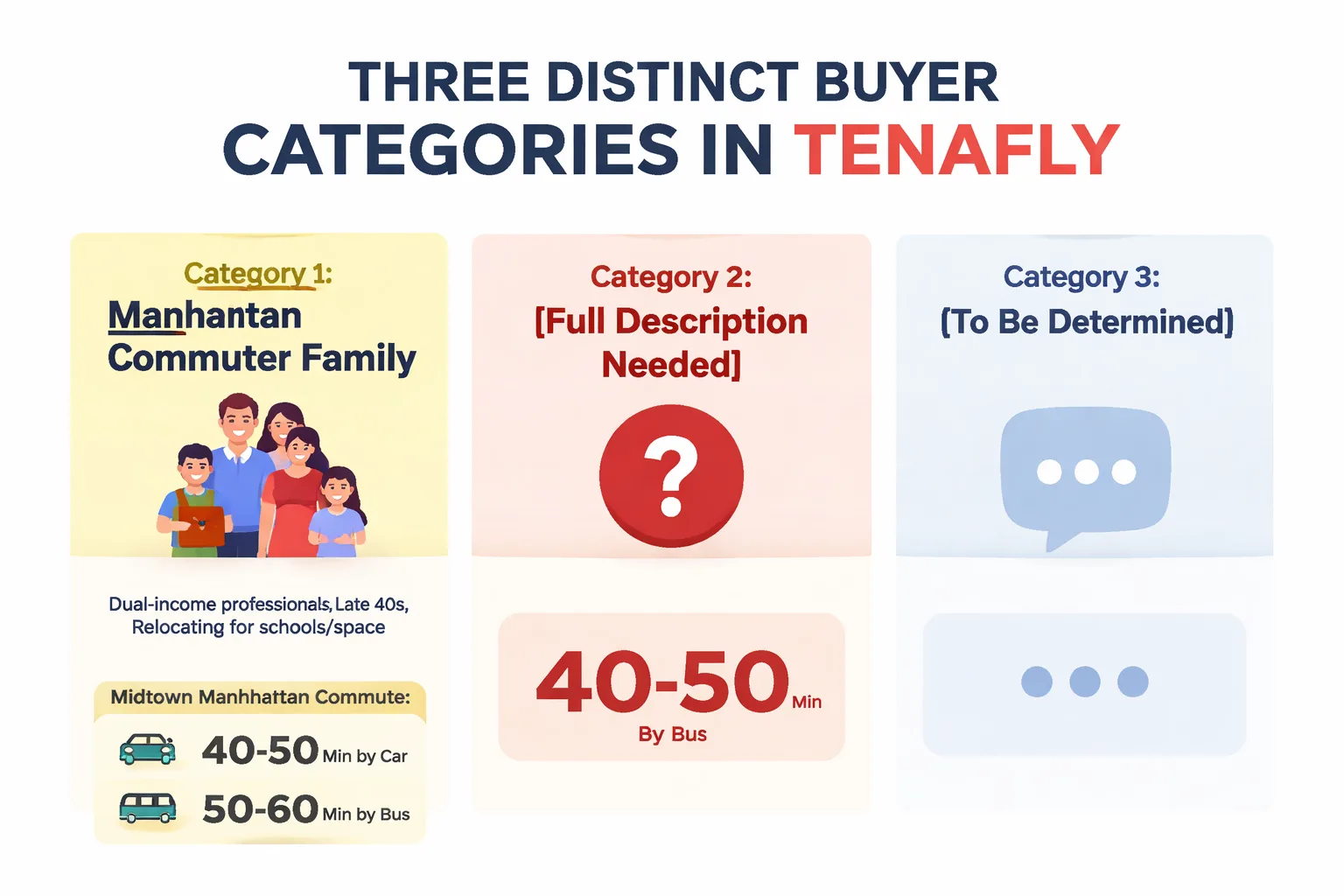
The Tenafly buyer profile breaks down into three distinct categories, each with different motivations and different sensitivity to price changes.
The first category is the Manhattan commuter family. These are typically dual-income professionals in their late 30s to late 40s who have been renting or owning in Manhattan and are relocating for schools and space. The commute from Tenafly to Midtown Manhattan is approximately 40 to 50 minutes by car via the George Washington Bridge, or 50 to 60 minutes using bus service to the Port Authority. The NJ home buying process differs significantly from the New York closing process, and Manhattan buyers often need guidance on attorney review periods, inspection contingencies, and the differences in closing costs. The title fees and closing costs breakdown covers the specific numbers buyers should expect.
The second category is the Chinese-American family, often relocating from Manhattan, Queens, or Jersey City. This buyer group is drawn to Tenafly for a combination of factors: the school district reputation, the existing Chinese-American community infrastructure, bilingual services, and proximity to Asian grocery stores and restaurants along Route 4 and in nearby Palisades Park and Fort Lee. For these buyers, the decision is often driven by a combination of educational outcomes for children and the desire for a community where cultural identity is shared rather than explained. The presence of Chinese-language real estate services, Chinese-speaking attorneys, and community networks reduces the friction of the home-buying process for buyers who may be navigating the U.S. real estate system for the first time or transitioning from a different market.
The third category is the international investor. These buyers are typically purchasing for a combination of reasons: a home for a child attending school in the area, a long-term investment property, or a safe-haven asset for capital preservation. Tenafly appeals to this group because of its track record of value retention. The town has not experienced the boom-and-bust cycles seen in some exurban New Jersey markets. International buyers tend to focus on the East Hill neighborhood, where larger lots and newer construction command premium prices but offer the best resale liquidity.
A contrarian observation is worth stating here. Many real estate guides frame international buyers as a monolithic group driven purely by school districts. That is incomplete. The data from JLL's high-value talent migration study shows that New York continues to lead in attracting high-value talent, and that talent pool drives secondary housing demand in the surrounding suburbs. International buyers in Tenafly are not just parents chasing school rankings. They are often professionals who have relocated for work in Manhattan's financial, tech, or pharmaceutical sectors and are choosing Tenafly as a long-term base. The school district is a factor, but so is commute access, community stability, and the fact that Tenafly properties have historically appreciated at a rate that outperforms inflation. The investment thesis is as important as the lifestyle thesis.
For buyers working with a real estate agent new york ny licensed professional who also holds a New Jersey license, the advantage is seamless navigation of both markets. Understanding the pricing dynamics in Manhattan directly informs what constitutes a fair price in Tenafly, and vice versa. The investment real estate agency resource covers how dual-market expertise benefits cross-state buyers.
How Does Tenafly Compare to Other Bergen County Towns?
Tenafly occupies a specific position in the Bergen County hierarchy. It is more expensive than Englewood, more residential than Fort Lee, and more established than newer luxury developments in Closter. The direct comparison that buyers most often request is Tenafly versus Closter, and for good reason. Both towns share the Northern Valley school district boundary proximity, both have strong Chinese-American communities, and both are priced in the seven-figure range for quality homes. The Closter vs. Tenafly comparison breaks down the differences in school districts, commute times, price per square foot, and community character.
The short version: Tenafly has a stronger historical brand and slightly higher median prices, while Closter offers more new construction and a marginally better value proposition for buyers prioritizing modern layouts over established neighborhoods. Englewood, directly south of Tenafly, offers more housing diversity and a more urban downtown but has a more variable school district reputation. Englewood Cliffs, adjacent to Tenafly, is known for its excellent schools and large-lot zoning but has almost no downtown or commercial infrastructure.
For buyers considering bergen county luxury real estate more broadly, Tenafly competes with towns like Alpine (far more expensive, larger lots, minimal commercial activity), Cresskill (smaller, slightly more affordable, good schools), and Demarest (similar profile, slightly lower prices). The choice between these towns usually comes down to specific street-level preferences, school district boundaries, and commute specifics rather than macro-level differences.
Is Tenafly Right for You? Key Questions to Ask Before Buying
The decision to buy in Tenafly should be driven by a structured evaluation, not an emotional reaction to a beautiful home. Here are the questions that need honest answers before making an offer.
What is your actual commute tolerance? The Google Maps estimate is not the real commute. A 45-minute drive to Midtown at 7:00 AM can become 75 minutes at 8:30 AM. Bus service is reliable but subject to Lincoln Tunnel and GW Bridge traffic. If more than 60 minutes of commute time each way is a dealbreaker, test the commute during the hours you would actually travel before committing to a purchase.
Can you absorb the property tax burden comfortably? Tenafly's property taxes are not a surprise. They are the cost of the school district and municipal services that make the town desirable. But they must be underwritten into the monthly housing budget. A $1.5 million home with a 30-year mortgage at current rates and $30,000 in annual property taxes carries a total monthly housing cost that may exceed $12,000. Buyers should calculate their debt-to-income ratio including taxes, not just principal and interest.
Are you buying for schools, investment, or both? If the primary driver is school access, the timing of the purchase matters. Buying when a child is entering kindergarten means a 13-year hold in the district. Buying when a child is entering high school means a shorter hold and less time to amortize the transaction costs. If the primary driver is investment, the analysis shifts to appreciation potential, rental income feasibility, and exit strategy liquidity. Tenafly is a strong appreciation play but a weak cash-flow play due to limited rental inventory and high carrying costs.
Single-family home or condo? This is a genuine constraint in Tenafly. The condo inventory is minimal. Buyers seeking lower-maintenance living or a lower price point may need to look at nearby towns. The tradeoff is that single-family homes in Tenafly offer better appreciation potential and more control over the property. Condo buyers should understand that the limited supply in Tenafly means fewer comparable sales, which makes pricing less transparent.
Do you need bilingual representation? For Chinese-American buyers and international investors, working with a bilingual agent who understands both the U.S. real estate process and the cultural nuances of the buyer's background is not a luxury. It is a practical necessity. Misunderstandings during attorney review, inspection negotiations, or mortgage contingencies can cost tens of thousands of dollars. A bilingual agent who is licensed in both New Jersey and New York can also facilitate transactions that involve selling a Manhattan property to fund a Tenafly purchase.
What Are the Downsides of Living in Tenafly?
A balanced evaluation requires acknowledging what Tenafly does not offer. The town is not for everyone, and buyers who move there without understanding the tradeoffs often express regret.
The lack of nightlife and late dining is the most common complaint. Tenafly's restaurants and retail close early. For buyers accustomed to Manhattan's 24-hour convenience or even Jersey City's growing late-night scene, this is an adjustment. The nearest significant dining and entertainment clusters are in Englewood, Fort Lee, and Edgewater, all a 10 to 15 minute drive.
Public transportation within the town is effectively nonexistent. There is no internal bus system or shuttle. Every errand, school drop-off, and social engagement requires a car. Households that relied on walking or public transit in their previous location need to factor in the cost and logistics of a second (or third) vehicle.
The property tax burden, while justified by school quality, is a real drag on monthly cash flow. Buyers who are house-rich but cash-flow-sensitive may find themselves stretched. The fix is not to find a lower-tax town with weaker schools, because that defeats the purpose of moving to Tenafly. The fix is to buy less house than the maximum pre-approval allows, leaving room in the budget for taxes, maintenance, and the higher utility costs associated with larger homes.
Finally, the market's price level creates a high barrier to entry. With median sale prices above $1.5 million, Tenafly is not accessible to first-time buyers or middle-income households. This is by design. The zoning, lot sizes, and school district create a self-selecting buyer pool. That exclusivity protects property values but it also means the town lacks socioeconomic diversity, which some buyers find limiting.
Which Tenafly Neighborhood Fits Your Buyer Profile?
Tenafly is not a monolithic market. The town breaks down into distinct neighborhoods, each with different price points, lot sizes, and buyer profiles. Understanding these micro-markets is the difference between a well-targeted search and a frustrating one.
East Hill is the prestige section. Located east of Tenafly Road and rising toward the Palisades, East Hill features the town's largest lots, newest construction, and highest price points. Homes here regularly trade above $2 million, with custom builds on acre lots pushing past $3 million. The streets are quiet, the tree canopy is mature, and many properties offer partial or full Hudson River views. East Hill attracts the most affluent buyers, including international investors and executives who want privacy and space. The tradeoff is that East Hill is the farthest from the downtown area and bus stops, making the commute slightly longer and increasing dependence on driving.
Central Tenafly (the area around Washington Street and the downtown corridor) offers walkability to shops, restaurants, and the middle school. Homes here tend to be older colonials and split-levels on quarter-acre lots. Prices range from $1.1 million to $1.8 million depending on condition and updates. This section appeals to buyers who prioritize walkability and community engagement over lot size. The tradeoff is tighter lot lines, more street traffic, and less privacy compared to East Hill.
West Tenafly (bordering Englewood) offers the most accessible price point in town. Homes here start around $900,000 to $1.1 million for smaller, older properties that need work. The section is popular with buyers who want Tenafly schools at the lowest possible entry price and are willing to invest in renovations. The tradeoff is proximity to busier roads and smaller lots.
The Hillside Avenue corridor features a mix of mid-century homes and newer construction on moderately sized lots. Prices typically range from $1.3 million to $1.7 million. This area attracts families who want a balance of lot size, modern layout, and reasonable commute access to bus routes along River Road.
Buyers should drive through each of these sections at different times of day before narrowing a search. Street traffic patterns, school bus routes, and neighbor proximity vary significantly within a single zip code.
What Does the Future Hold for Tenafly Property Values?
Predicting real estate values with certainty is a fool's game, but the structural factors supporting Tenafly's market are durable. The school district is not going to decline in the near term. The zoning is not going to loosen. The proximity to Manhattan is not going to change. These three factors form a floor under Tenafly property values that few other suburbs can match.
The risk factors are macroeconomic. If interest rates rise significantly, the buyer pool for $1.5 million homes shrinks because monthly carrying costs increase. If New York City's economy contracts and high-value talent stops migrating to the metro area, demand from Manhattan commuters softens. The NAR migration trends research provides ongoing data on these patterns.
On the supply side, Tenafly is effectively built out. New construction requires teardowns, which are expensive and subject to zoning approvals. This means supply growth is constrained, which supports existing property values. The town's commitment to preserving its character, evidenced by decades of strict zoning enforcement, suggests that no wave of development will disrupt the market equilibrium.
For buyers with a 10-year or longer horizon, Tenafly remains a strong value proposition. The combination of school quality, commute access, community stability, and limited supply creates a market that is more resilient than most. The price of admission is high, but the cost of being wrong about Tenafly is low compared to the cost of being wrong about a less established town.
How Does Tenafly's Cost of Living Compare to Manhattan and Nearby Suburbs?
The cost of living comparison between Tenafly and Manhattan is not straightforward because the two markets reward different spending patterns. Manhattan buyers are accustomed to low property taxes, high purchase prices per square foot, and minimal maintenance costs in condos. Tenafly inverts that structure: lower purchase price per square foot, dramatically higher property taxes, and substantial maintenance costs for single-family homes.
A 1,200-square-foot Manhattan condo priced at $1.5 million might carry annual property taxes of $8,000 to $12,000 and monthly maintenance of $1,500 to $2,500. A 3,500-square-foot Tenafly home priced at $1.5 million carries property taxes of $25,000 to $35,000 annually, plus maintenance, utilities, and upkeep that can easily add $15,000 to $25,000 per year. The larger home provides more space and a yard, but the total carrying cost is significantly higher.
Utility costs in Tenafly are also a factor. Heating a 3,500-square-foot home with oil or gas through a Bergen County winter costs substantially more than heating a Manhattan apartment where shared walls and building systems create efficiency. Lawn care, snow removal, and property maintenance add costs that condo buyers may not have previously budgeted for. A realistic annual maintenance budget for a Tenafly home at the $1.5 million price point is $20,000 to $30,000, covering landscaping, HVAC servicing, roof repairs, and general upkeep.
Compared to other Bergen County suburbs, Tenafly's cost of living is high but not anomalous. Alpine and Saddle River are more expensive. Englewood and Cresskill are slightly less expensive. The differentiator is what the tax dollars deliver. Tenafly's tax rate funds a school district that outperforms most neighboring towns, which creates a value justification that pure cost comparisons miss. Buyers should evaluate the tax burden against the educational outcome, not against an abstract benchmark.
Grocery and dining costs in Tenafly are comparable to surrounding Bergen County towns. The local trade-off is selection. Tenafly has a limited number of restaurants and grocery options within the borough. Major shopping requires a drive to Englewood, Paramus, or Fort Lee. Buyers who value walking to restaurants and markets will find this limiting.
What Should Investors Know About Tenafly's Rental and Commercial Market?
Tenafly is primarily a residential market, but investors evaluating the town need to understand both the rental dynamics and the limited commercial real estate picture.
The residential rental market is tight. With a median rent of $5,750 per month, rental demand is strong but supply is constrained. The town's zoning heavily favors single-family homes, and there are few multi-family properties or apartment complexes. Investors seeking rental income in Tenafly face a structural supply problem. The properties available for rent are typically single-family homes being rented by owners who are temporarily relocated, not purpose-built rental inventory. This creates an inconsistent and unpredictable rental market.
For investors considering purchasing a property to rent out, the math is challenging. A $1.5 million home with $30,000 in property taxes, $20,000 in maintenance, and a mortgage at current rates carries a total annual cost that far exceeds the $69,000 in gross rental income at $5,750 per month. The property would be cash-flow negative even before accounting for vacancy, management fees, and capital expenditures. This confirms that Tenafly is an appreciation play, not a cash-flow play.
Commercial real estate in Tenafly is minimal. The downtown commercial corridor along Washington Street and Piermont Road has limited retail space, and the town's zoning actively restricts commercial expansion. There are no significant office parks or industrial properties within the borough. Investors looking for commercial real estate opportunities in Bergen County should look to nearby Englewood, Hackensack, or Paramus, which have more developed commercial zones. The NAR's commercial real estate market research provides broader market context for commercial investment in the region.
For investors specifically interested in the Tenafly market, the viable strategy is long-term hold with appreciation as the primary return driver. A buyer who purchases a home in the East Hill section, holds for 10 years, and benefits from the town's structural appreciation and school-driven demand may see meaningful capital gains. But that investor must have the financial capacity to carry the property through the holding period without relying on rental income to cover costs.
FAQ
What is the median home price in Tenafly, NJ in 2026?
The median sale price in Tenafly was $1,564,167 in June 2026 per Zillow, up 9.0% year-over-year. The median listing price was $1,745,000 in August 2026 per Realtor.com, with 36 active listings and a median of 31 days on market.
How long is the commute from Tenafly to Manhattan?
The commute from Tenafly to Midtown Manhattan is approximately 40 to 50 minutes by car via the George Washington Bridge during off-peak hours. During rush hour, it can extend to 60 to 75 minutes. Bus service to the Port Authority takes approximately 50 to 60 minutes.
Are property taxes high in Tenafly?
Yes. Property taxes in Tenafly are consistent with Bergen County averages, which are among the highest in the United States. A $1.5 million home typically carries $25,000 to $35,000 in annual property taxes. These taxes fund the highly rated school district and municipal services.
Is Tenafly a good investment for rental income?
Tenafly is a weak market for rental cash flow due to limited multi-family inventory and high carrying costs. The median rent is $5,750 per month, but rental properties are scarce. Tenafly is better suited for investors focused on long-term appreciation rather than monthly cash flow.
Does Tenafly have condos and townhomes?
Condo and townhome inventory in Tenafly is minimal. The housing stock is overwhelmingly single-family homes. Buyers seeking condo-style living should consider nearby Edgewater, Fort Lee, or Jersey City for more options.
What school district does Tenafly belong to?
Tenafly is served by the Tenafly Public School District, which operates four elementary schools, Tenafly Middle School, and Tenafly High School. The district consistently ranks among the top public school districts in New Jersey, with strong SAT scores and college placement records.
For buyers evaluating whether tenafly bergen county is the right move, the data points to a market that rewards careful analysis. The schools justify the prices. The commute justifies the location. The taxes justify the services. The question is whether those justifications align with a specific buyer's budget, timeline, and lifestyle priorities. The answer is yes for many families. It is not yes for everyone. Getting that distinction right is what separates a sound real estate decision from an expensive mistake.
About the Author
Judy Zhou, Coldwell Banker Realtor®
Judy Zhou is a top-ranked Coldwell Banker Realtor® serving New Jersey and New York, recognized in the top 7% of agents internationally with prestigious awards like the International Diamond Society and President's Elite. Licensed in both NJ and NY, she specializes in luxury homes, investment properties, and commercial real estate, offering seamless bilingual English-Chinese service.
Get a personalized Tenafly market analysis and bilingual representation for your Bergen County home search. Licensed in NJ and NY.