Is Short Hills, NJ Really One of America's Wealthiest Zip Codes?
By Judy Zhou, Coldwell Banker Realtor®
Key Takeaways
- Short Hills ZIP 07078 posts a median listing price of $3,695,000 and median sold price of $2,499,500 ($562 per sq ft) as of August 2026.
- Homes in Short Hills sell after a median of 42 days, matching the tier of Alpine ($4.14M median ask) and Brookside ($3.12M).
- Buyers targeting short hills nj homes for sale enter a market with only 52 active listings at a $3.695M median, anchored by Olmsted-designed streets and Midtown Direct rail.
- The $562-per-square-foot price buys direct access to one of America's wealthiest enclaves, consistently ranked by Forbes among New Jersey's top ZIP codes.
In the late 19th century, wealthy New York businessmen began fleeing Manhattan's crowded streets for a quiet, heavily wooded enclave in Millburn Township. A place that would eventually be known as Short Hills. The Olmsted Brothers, sons of legendary landscape architect Frederick Law Olmsted, helped design its winding, park-like streetscapes. More than a century later, that original vision of curated affluence still defines the neighborhood. Today, buyers searching short hills nj homes for sale are purchasing into one of America's most deliberately designed wealthy communities. And the history shows in every lot line.
Short Hills (ZIP code 07078) consistently ranks among America's wealthiest communities, with a median listing price of $3,695,000 as of August 2026 and 52 active listings on the market. The median sold price sits at $2,499,500, translating to $562 per square foot. Homes move in a median of 42 days. Forbes has tracked New Jersey's most expensive ZIP codes for years, with Alpine, NJ (07620) hitting $4.14 million in median asking price and Brookside, NJ (07926) reaching $3.12 million. Short Hills belongs firmly in that same tier of ultra-affluent New Jersey enclaves, distinguished by its Olmsted-designed streetscapes and direct Midtown Direct rail access.
The question isn't whether Short Hills is wealthy. The data settles that. The real question is whether the premium buyers pay here, often well above $3 million for a listing, is justified by what they get in return. The answer requires looking past the price tag and into the community's architecture, schools, commute, and the specific type of lifestyle that $562 per square foot actually buys.
Is Short Hills, NJ a Wealthy Area?
Yes. Short Hills is unambiguously one of America's wealthiest communities, with a median listing price of $3,695,000 as of August 2026, 52 active listings, and a median sold price of $2,499,500, according to Realtor.com's market data. The ZIP code 07078 sits in Essex County, within Millburn Township, and has been a destination for affluent New York families since the 1870s.
Forbes has tracked America's most expensive ZIP codes for over a decade. In their full ranking of 500 ZIP codes, New Jersey communities dominate the top tier. Alpine, NJ (07620) claimed the #1 spot with a $4.14 million median asking price. Brookside, NJ (07926) ranked #10 at $3.12 million. The accompanying Forbes analysis noted a 7% average drop in asking prices across all 500 ZIP codes during the 2009 downturn, yet Short Hills and its neighboring enclaves maintained their position as premier addresses.
The wealth here isn't just about home prices. It's structural. Short Hills was designed from the ground up for affluence. The Olmsted Brothers, carrying forward their father's legacy of designing Central Park and Prospect Park, laid out streets that wind through dense tree canopy rather than cutting straight grid lines. Lot sizes are large. Setbacks are deep. The visual effect is one of privacy and permanence. That deliberate design choice, made over a century ago, is why Short Hills doesn't look like a wealthy suburb that got wealthy by accident. It looks like a place that was always meant to be exactly what it is.
The median household income for Short Hills reflects this concentration of wealth. While Forbes reported a median household income of $128,287 for Alpine, NJ, at the top of the 2009 list, Short Hills' income profile runs in a similar elevated range, supported by a professional and executive demographic that commutes to Manhattan. The community's wealth is not driven by a single industry or employer. It's driven by the self-selection of families who can afford the entry price and who choose Short Hills specifically for its combination of schools, commute, and community design.
The population density of Short Hills is notably low, which is itself a marker of wealth. Forbes reported Alpine's population density at just 363 people per square mile. Short Hills, while more densely settled than Alpine, maintains a spacious, suburban feel with large lots and minimal multi-family housing. This low density is enforced by zoning regulations that have preserved the community's character for decades. The result is a neighborhood that feels exclusive without gates, and private without walls.
Short Hills belongs in the same conversation as Alpine, Brookside, and other top-tier New Jersey ZIP codes, but its distinction is that the wealth was engineered into the landscape from day one.
Is It Expensive to Live in Short Hills, NJ?
Yes, Short Hills is expensive by any standard. Median listing prices hit $3,695,000 in August 2026, with sold prices at $2,499,500 and $562 per square foot, per Realtor.com data. But the purchase price is only the beginning. The true cost of living here includes property taxes, maintenance on large estates, and lifestyle expenses that scale with the community.
New Jersey has the highest property taxes in the nation. Millburn Township, which includes Short Hills, levies an effective property tax rate that places it among the higher-taxed municipalities in Essex County. On a $2.5 million home, annual property taxes can easily exceed $30,000 to $40,000 depending on the lot size, assessed value, and any exemptions. Buyers moving from Manhattan are often shocked by this, even though they're coming from a city with its own substantial tax burden. The difference is visibility. In New York City, taxes are often baked into monthly maintenance or mortgage escrow in ways that feel abstract. In Short Hills, the tax bill arrives as a separate, six-figure line item that cannot be ignored.
Beyond taxes, the cost of maintaining a Short Hills estate is substantial. Many homes here sit on lots of half an acre or more. Landscaping, pool maintenance, snow removal, and exterior upkeep on properties that often exceed 4,000 to 6,000 square feet add up quickly. Homeowners in this market routinely budget $20,000 to $50,000 annually just for property maintenance. For buyers coming from apartment living in Manhattan, where a building superintendent handles everything, this transition can be jarring.
Private school tuition is another factor. While the Millburn public school district is among the best in New Jersey (more on that below), many Short Hills families also send children to elite private schools in the area. Tuition at schools like Newark Academy, Pingry School, or Delbarton School can range from $35,000 to $55,000 per year per child. For families with two or three children, that's $100,000 to $165,000 annually in after-tax dollars.
Everyday expenses in Short Hills are also elevated. The nearest grocery stores, restaurants, and retail options cater to an affluent demographic. Dining out at local establishments in nearby Summit, Maplewood, or Morristown routinely costs more than comparable experiences in less wealthy communities. The cost of services, from house cleaning to personal training to home organization, reflects the local market rate for high-income labor.
The total annual carrying cost for a $2.5 million Short Hills home, including taxes, maintenance, and elevated living expenses, can reach $80,000 to $120,000 on top of the mortgage. Buyers need to underwrite not just the purchase but the lifestyle.
For those considering the broader financial picture of buying in New Jersey, understanding the NJ home buying process and NJ property tax rates by town is essential before making an offer.
Is Short Hills, NJ a Good Place to Live?
Short Hills is widely regarded as one of the best places to live in New Jersey, combining top-rated public schools, a 35-minute direct train commute to Manhattan, low crime rates, and a community designed around privacy and green space. The quality of life here is not accidental. It was planned.
The Millburn Township Public Schools district, which serves Short Hills, is consistently ranked among the top districts in New Jersey. Millburn High School regularly appears on lists of the state's best public high schools. The district benefits from the tax base that multi-million-dollar homes provide, which funds small class sizes, advanced placement courses, and extensive extracurricular programs. For families relocating from Manhattan or Brooklyn, the school district is often the single biggest draw. Parents who were paying $50,000-plus per year for private school in the city find that Short Hills offers comparable educational quality through the public system, which is effectively prepaid through property taxes.
Safety is another defining feature. Short Hills has a consistently low crime rate. The community is small enough that residents know each other, and the Essex County police presence in Millburn Township is well-funded and visible. For families coming from urban environments, the peace of mind that comes with a safe, walkable, low-crime neighborhood is a significant quality-of-life upgrade.
The commute to Manhattan is one of Short Hills' most practical advantages. The Short Hills train station is on NJ Transit's Morris & Essex Line, which offers Midtown Direct service to New York Penn Station in approximately 30 to 35 minutes. That puts Short Hills closer to Midtown than many neighborhoods in Brooklyn, Queens, or even parts of Manhattan itself. For executives who need to be in the city daily but want a suburban lifestyle, this commute is the deciding factor. The train runs frequently during peak hours, and the station has parking for residents.
Dining and retail in Short Hills center on the Short Hills Mall, a small but upscale shopping center, and the nearby downtown areas of Millburn and Summit. The Mall at Short Hills includes luxury retailers and high-end dining options. Millburn's downtown offers a more local, community-oriented mix of restaurants, coffee shops, and small businesses. Summit, a 10-minute drive, provides additional upscale retail and dining. The area is not a nightlife destination, but that's by design. Short Hills residents who want theater, concerts, or fine dining at the highest level take the train into Manhattan.
Community character is perhaps the most intangible but most important quality-of-life factor. Short Hills was designed by the Olmsted Brothers to feel like a park. The streets wind through mature trees. Homes are set back from the road. There are no through-streets cutting through residential areas. The effect is a neighborhood that feels secluded and private, even though it's a 35-minute train ride from the most densely populated island in America. Residents describe the community as close-knit, family-oriented, and quietly confident. There's a culture here that values education, privacy, and understated wealth over ostentation.
For families who prioritize schools, safety, commute access to Manhattan, and a community designed around green space, Short Hills delivers a quality of life that justifies its premium pricing for the right buyer.
Who Lives in Short Hills? Community Profile
Short Hills has attracted notable residents over the years, including business executives, entertainment figures, and professional athletes who value the combination of privacy, proximity to Manhattan, and community quality. The demographic profile skews heavily toward high-income families, often dual-income professional households in finance, law, medicine, and technology. The community has also seen growing interest from international buyers, including Chinese-American families who are drawn to the top-tier school district and the suburban lifestyle within commuting distance of Manhattan.
The educational attainment in Short Hills is exceptionally high. While Census Bureau data shows that 37.8% of adults age 25 and older in metropolitan areas held a bachelor's degree or higher during the 2020-2024 American Community Survey period (up from 34.2% in 2015-2019), Short Hills' educational attainment runs well above that metro benchmark. The community's concentration of advanced degrees, professional certifications, and executive-level careers is a defining demographic feature. The American Community Survey (ACS) methodology and the NCES Education Demographic and Geographic Estimates Program provide frameworks for understanding how educational attainment correlates with community wealth, and Short Hills is a textbook case of that correlation.
What draws high-net-worth buyers to Short Hills specifically, rather than to other affluent New Jersey suburbs, comes down to a few factors. First, the school district. For families with school-age children, Millburn schools are a primary motivator. Second, the commute. The Midtown Direct line makes Short Hills one of the most Manhattan-accessible suburbs in New Jersey. Third, the community character. The Olmsted-designed streetscapes and the culture of understated wealth appeal to buyers who want affluence without ostentation. Fourth, the housing stock. Short Hills offers a range of architectural styles, from century-old estates to newer construction, that provides options for different tastes within the luxury market.
International and Chinese-American buyers represent a growing segment of the Short Hills market. These buyers often prioritize education above all else, and the Millburn school district's reputation is a powerful draw. For families relocating from Asia or from Manhattan's private school world, Short Hills offers a transition to suburban life without sacrificing educational quality. Bilingual service and cultural fluency matter in these transactions. Buyers who need assistance in both English and Chinese, or who want an agent who understands the cultural priorities of international families, find that working with a bilingual luxury real estate broker makes the process smoother and more effective.
For buyers who also maintain residences or business interests in New York, having an agent licensed in both NJ and NY provides a significant advantage. The ability to handle transactions on both sides of the Hudson, whether that's selling a Manhattan apartment to purchase a Short Hills estate or managing investment properties while relocating to the suburbs, is a value that few agents provide.
What Buyers Need to Know Before Purchasing in Short Hills in 2026
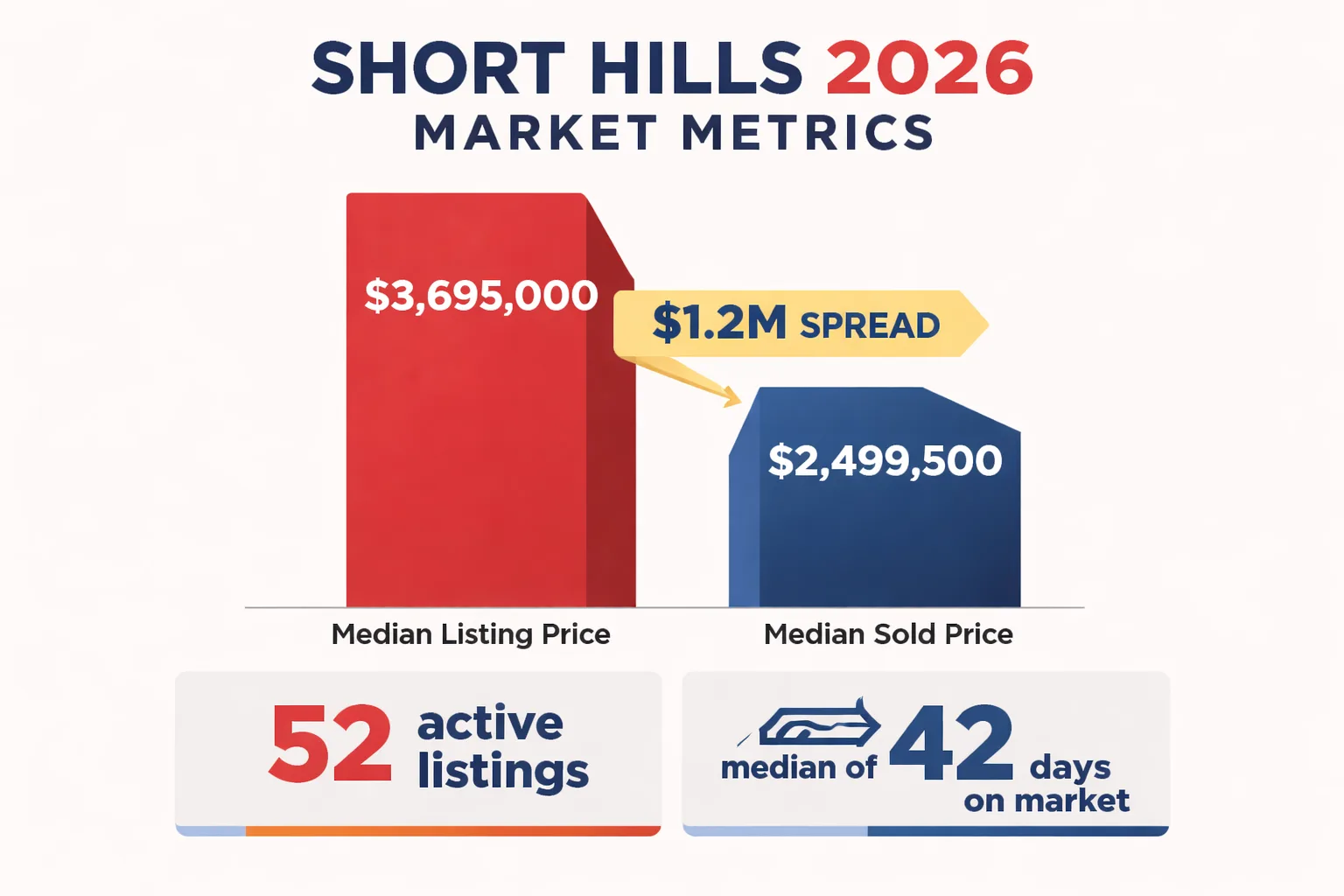
The Short Hills market in 2026 presents a specific set of dynamics that buyers need to understand before entering. With 52 active listings and a median of 42 days on market, the market is neither frozen hot nor cold. It's selective. Well-priced homes in prime locations sell quickly. Overpriced or poorly positioned listings sit.
The gap between median listing price ($3,695,000) and median sold price ($2,499,500) tells an important story. It indicates that buyers in this market are disciplined. They're not chasing listings at any price. They're negotiating, and they're winning. The $1.2 million spread between ask and sale suggests that sellers who price aggressively are being rewarded with faster sales, while sellers who list at aspirational prices are facing price reductions and extended days on market.
For buyers, this means patience and preparation are the winning strategy. The buyer who has financing pre-arranged, who understands the local property tax implications, and who has a clear sense of which neighborhoods within Short Hills fit their needs will be positioned to act decisively when the right listing appears. The buyer who is still getting organized when the right home hits the market will lose it.
Working with an agent who understands both the Short Hills market and the broader New York/New Jersey luxury landscape provides a structural advantage. Buyers relocating from Manhattan often need to sell a Manhattan apartment while simultaneously purchasing in Short Hills. The timing, financing, and logistics of that dual transaction require an agent who can operate fluently on both sides of the river. For buyers who also manage investment properties or commercial real estate interests, having an agent with commercial real estate experience and a license in both NY and NJ provides a level of service that a single-state agent simply cannot match.
For investors considering Short Hills, the calculus is different from owner-occupants. Short Hills is not a cash-flow market. It's an appreciation and wealth preservation market. Properties here have historically held value through market cycles because the factors driving demand (schools, commute, community, design) are structural and durable. Investors who buy in Short Hills are buying a store of value with potential for long-term appreciation, not a monthly income stream. For those more interested in cash-flow-oriented investment property in NJ, other markets in the state offer better yield profiles.
Buyers who close in Short Hills in 2026 are buying into a community that was designed for wealth 150 years ago and has spent every decade since reinforcing that design. The question isn't whether the price is justified. The data shows it is. The question is whether the lifestyle, the schools, the commute, and the community match what the buyer is looking for. For the right family, Short Hills is one of the best decisions they'll make. For the wrong buyer, the premium is a burden with no offsetting joy.
Understanding the full financial picture, including title fees and closing costs, is essential before making an offer in a market where transactions routinely exceed $2 million.
How Does Short Hills Compare to Other Wealthy NJ Towns?
Short Hills exists in a cluster of ultra-affluent New Jersey communities, each with its own character. Alpine, NJ, holds the distinction of being New Jersey's most expensive ZIP code, with a Forbes-recorded median asking price of $4.14 million. Alpine is known for large estates, significant privacy, and a roster of celebrity residents. But Alpine lacks the train commute that Short Hills offers. For buyers who need Manhattan access, Alpine's location in Bergen County adds significant travel time compared to Short Hills' 35-minute Midtown Direct ride.
Brookside, NJ (07926), ranked #10 on the Forbes list at $3.12 million, offers a more rural, small-town feel. It's quieter, more secluded, and less connected to Manhattan. Buyers choosing between Short Hills and Brookside are choosing between commute-accessible luxury and rural retreat luxury. They're different products.
Closer to Short Hills, communities like Summit, Chatham, and Madison offer similar school quality and suburban character, often at slightly lower price points. Summit, in particular, shares many characteristics with Short Hills: strong schools, a Midtown Direct train station, and an upscale downtown. But Summit's housing stock tends to be more varied, with a wider range of prices and styles, while Short Hills maintains a more consistently luxury-tier inventory.
For buyers also considering the New York side of the river, Westchester County homes for sale and communities like Scarsdale offer an alternative. Westchester provides similar school quality and Manhattan commute options, though the tax structure and housing stock differ. Some buyers find that Westchester offers more square footage per dollar, while Short Hills offers more established luxury and a tighter community identity. The decision often comes down to tax considerations, school preferences, and whether the buyer's social and professional network is more New Jersey or New York oriented.
Short Hills' competitive position is defined by its combination of Olmsted-designed community character, top-tier public schools, and a 35-minute direct train to Manhattan. No other wealthy NJ town offers all three at this level.
What Investment Potential Does Short Hills Offer?
Investing in Short Hills real estate requires a different mindset from typical investment property strategies. This is not a market for buyers seeking monthly cash flow or high cap rates. It's a market for wealth preservation, long-term appreciation, and portfolio diversification through real estate.
The historical resilience of Short Hills home values is the primary investment case. During the 2009 downturn, Forbes data showed that the 500 most expensive ZIP codes in America experienced an average 7% drop in asking prices. Short Hills and its neighboring communities weathered that cycle better than most, because the factors driving demand (schools, commute, community design) don't disappear in a recession. Families still need top-tier schools. Executives still need to commute to Manhattan. The Olmsted-designed streetscapes don't lose their appeal when the stock market drops.
For investors who already hold primary residences in Short Hills, the investment angle often involves purchasing additional properties in the broader New Jersey market for cash flow. The strategy of holding a Short Hills home for appreciation while owning cash-flowing investment properties elsewhere in New Jersey is a common approach among high-net-worth investors. This allows them to benefit from Short Hills' wealth preservation characteristics while generating income from markets with better yield profiles.
The New Jersey real estate investment landscape offers opportunities in markets like Jersey City, Newark, and the Jersey Shore that provide different risk-return profiles. Investors who want exposure to both luxury appreciation and cash-flow income benefit from working with an investment real estate agency that understands both sides of the market.
For buyers considering new construction as an investment or primary residence, understanding the track record of New York real estate developers and their New Jersey counterparts is important. In Short Hills, new construction is relatively rare compared to renovations and additions to existing homes. The community's architectural heritage and lot configurations mean that most new inventory comes from teardowns and rebuilds, which are subject to local zoning and historic preservation considerations.
Short Hills is not an investment market for the impatient. It's a market for buyers who understand that the factors driving value here are structural, durable, and designed to last for generations.
Considering a move to Short Hills? Find out what your current home is worth in today's market.
What Types of Homes Are Available in Short Hills?
The housing stock in Short Hills is dominated by single-family detached homes. This is not a market of condominiums or townhomes. The community was designed for estate living, and the zoning reflects that. Buyers searching short hills new jersey homes for sale will find a range of architectural styles, but the common thread is scale. Homes here are large, lots are generous, and the streetscapes preserve a sense of privacy that is increasingly rare in suburban New Jersey.
Colonial and Tudor Revival homes form the backbone of the Short Hills inventory. Many of these homes date to the early 20th century, built during the community's original development boom. They feature traditional floor plans with formal living and dining rooms, large kitchens, and multiple bedrooms. The craftsmanship in these older homes, from moldings to staircases to masonry, is a draw for buyers who appreciate architectural detail that is expensive to replicate in new construction.
Mid-century and contemporary homes are also present, though in smaller numbers. These properties tend to attract buyers who want more open floor plans, larger windows, and a different aesthetic than the traditional Colonials. Contemporary homes in Short Hills often sit on the most private lots, tucked into the winding streets that the Olmsted Brothers designed.
New construction in Short Hills typically involves teardowns of older, smaller homes and the construction of large, modern estates. These properties often exceed 6,000 square feet and include amenities like home theaters, wine rooms, indoor pools, and smart home systems. The price point for new construction routinely exceeds $4 million to $5 million, depending on lot size and finishes. Buyers considering new construction should be aware that the permitting process in Millburn Township can be lengthy, and zoning restrictions may limit what can be built on certain lots.
For buyers specifically looking at short hills nj houses for sale as opposed to condos or townhomes, the market is straightforward. There is essentially no condo market in Short Hills proper. Buyers who want condo or townhome options in the immediate area should look to nearby Summit or Morristown, where luxury condo developments offer a lower-maintenance alternative to estate living. The new condo developments near me resource provides information on luxury condo options in the broader New York metro area for buyers who want to compare Short Hills estate living with condo alternatives.
The price per square foot in Short Hills, at $562 according to Realtor.com, reflects the premium that buyers pay for both the home and the land. In a market where lot sizes often exceed half an acre, the land value is a significant component of the total price. This is different from Manhattan real estate, where price per square foot is almost entirely about the building and the location, with land value being a negligible factor. In Short Hills, the land is the asset.
Why Does Short Hills Attract Manhattan Buyers?
The relationship between Short Hills and Manhattan is symbiotic. Short Hills was built by Manhattan businessmen who wanted a retreat from the city. That dynamic continues today, with a significant portion of Short Hills buyers relocating from Manhattan or maintaining residences in both locations.
The primary driver is the commute. A 35-minute train ride to Penn Station makes Short Hills one of the most Manhattan-accessible luxury suburbs in the region. For executives, finance professionals, and business owners who need to be in Midtown daily, the Midtown Direct line eliminates the need for a transfer. That single-seat ride is a quality-of-life factor that cannot be overstated. It means leaving the house at 7:30 AM and being at a desk in Midtown by 8:15 AM. It means attending an evening event in the city and being home by 10:00 PM. The commute transforms what would otherwise be a distant suburb into a practical daily option.
The second driver is the transition from apartment living to estate living. Manhattan buyers, particularly those who have lived in luxury apartments, are often ready for more space, privacy, and outdoor area. Short Hills provides that transition at a high level. A buyer selling a $3 million Manhattan apartment can purchase a $2.5 million Short Hills home with 5,000 square feet, a half-acre lot, and a private backyard. The trade-off is the property tax bill and the maintenance responsibility, but for many buyers, the quality-of-life upgrade is worth the cost.
The third driver is schools. Manhattan families with children approaching school age face a difficult decision: pay $50,000-plus per year for private school or move to a suburb with top-tier public schools. Short Hills offers the latter option at a high level. The Millburn school district's reputation is well-known among Manhattan parents, and the transition from city private schools to Millburn public schools is a well-trodden path.
For buyers who are also considering luxury options on the New York side, the comparison often comes down to lifestyle preference. Manhattan luxury apartments offer proximity, cultural access, and a vertical lifestyle. Short Hills offers space, privacy, community, and a horizontal lifestyle. Some buyers maintain residences in both locations, using the Short Hills home as a primary residence and keeping a Manhattan apartment for business or social purposes. This dual-residence strategy is common among high-net-worth families and is one reason why having an agent licensed in both NJ and NY is valuable.
The Manhattan buyer who chooses Short Hills is not leaving the city. They are extending their footprint to include the kind of space and community that Manhattan cannot provide.
What Are the Hidden Costs of Buying in Short Hills?
Beyond the visible costs of purchase price and property taxes, Short Hills buyers encounter several expenses that can surprise the unprepared. Understanding these costs before making an offer is essential for accurate financial planning.
Home inspection costs in the luxury market are higher than in standard residential transactions. A thorough inspection of a 5,000-plus square foot home, including structural, mechanical, environmental, and termite inspections, can cost $1,500 to $3,000 or more. For older homes, specialized inspections for asbestos, lead paint, radon, and underground oil tanks may be necessary. The discovery of an underground oil tank, which is common in older New Jersey homes, can trigger remediation costs ranging from $3,000 to $30,000 depending on whether a leak has occurred.
Insurance costs in Short Hills reflect the high value of the homes and the replacement cost of luxury finishes. A standard homeowners insurance policy on a $2.5 million home can cost $3,000 to $6,000 annually. If the home includes high-value features like custom millwork, imported stone, or specialized systems, additional riders may be necessary. Flood insurance, while not typically required in Short Hills, may be worth considering for homes near water features or in low-lying areas.
Utility costs are another factor. Heating and cooling a 5,000-square-foot home in the Northeast climate is expensive. Annual utility costs for a home of this size in Short Hills can easily reach $8,000 to $15,000, depending on insulation, system efficiency, and thermostat settings. Older homes, which much of Short Hills' inventory comprises, may have less efficient insulation and windows, driving utility costs higher.
Homeowners association fees, while not universal in Short Hills, apply to certain neighborhoods and developments. For communities with shared amenities like pools, tennis courts, or private roads, HOA fees can range from $1,000 to $5,000 annually. Buyers should check whether a property is subject to HOA governance before making an offer.
The closing costs themselves, including title insurance, attorney fees, transfer taxes, and mortgage origination fees, can add 2% to 5% to the purchase price. On a $2.5 million home, that's $50,000 to $125,000 in closing costs. Understanding the title fees and closing costs specific to New Jersey is essential for buyers coming from New York, where the closing cost structure differs.
How Does the Short Hills Market Compare to Nearby Alternatives?
Buyers evaluating Short Hills often compare it to nearby alternatives. The most common comparisons are Summit, Chatham, and Madison in New Jersey, and Scarsdale and Bronxville in New York.
Summit, NJ, shares many characteristics with Short Hills. It has a Midtown Direct train station, strong schools, and an upscale downtown. Summit's median home prices are generally lower than Short Hills, making it an attractive alternative for buyers who want the Short Hills lifestyle at a slightly lower entry point. The trade-off is that Summit's housing stock is more varied, with a wider range of styles and conditions, while Short Hills maintains a more consistently luxury-tier inventory.
Chatham and Madison, further west on the Morris & Essex Line, offer excellent schools and a slightly longer commute. These communities tend to have more new construction and larger lots at comparable price points. Buyers who prioritize lot size over commute time may find better value in Chatham or Madison.
For buyers considering comparing NJ towns like Closter vs Tenafly, the analysis is similar. Northern New Jersey has multiple pockets of affluence, each with its own character and trade-offs. Closer to the George Washington Bridge, towns like Closter and Tenafly offer strong schools and large homes, but the commute to Midtown is longer and requires a bus or car rather than a direct train. Short Hills' Midtown Direct access is a structural advantage that these Bergen County towns cannot match.
On the New York side, Scarsdale and Bronxville offer comparable school quality and commute access to Manhattan. The trade-off is that Westchester property taxes are also among the highest in the nation, and the housing stock in Westchester tends to be older and on smaller lots than in Short Hills. Buyers who work with a real estate agent in New York NY can evaluate both sides of the river before making a decision.
The comparison ultimately comes down to three factors: commute time, school quality, and housing stock. Short Hills offers a unique combination of all three that few other communities can match. The premium buyers pay here is the cost of that combination.
FAQ
What is the median home price in Short Hills, NJ?
The median listing price in Short Hills as of August 2026 is $3,695,000, with a median sold price of $2,499,500. The price per square foot is $562. Data comes from Realtor.com's market analysis of MLS-listed homes.
How long do homes stay on the market in Short Hills?
The median days on market for Short Hills homes is 42 days as of August 2026. Well-priced homes in prime locations sell faster, while overpriced listings can sit significantly longer.
What school district serves Short Hills?
Short Hills is served by the Millburn Township Public Schools district, which is consistently ranked among the top public school districts in New Jersey. Millburn High School is recognized for its academic excellence and college placement records.
How long is the commute from Short Hills to Manhattan?
The Short Hills train station offers Midtown Direct service on NJ Transit's Morris & Essex Line, with travel time to New York Penn Station of approximately 30 to 35 minutes during peak hours.
What are the property taxes like in Short Hills?
Property taxes in Short Hills (Millburn Township) are among the higher rates in Essex County. On a $2.5 million home, annual property taxes can exceed $30,000 to $40,000. New Jersey has the highest property taxes in the nation, and Millburn's rate reflects the premium services and schools the community provides.
Is Short Hills a good investment?
Short Hills is a wealth preservation and long-term appreciation market, not a cash-flow investment market. The structural factors driving demand (schools, commute, community design) are durable through market cycles. Investors seeking cash flow should look at other New Jersey markets, while those seeking appreciation and portfolio diversification may find value in Short Hills.
For buyers searching short hills nj homes for sale, the decision ultimately comes down to whether the community's specific combination of schools, commute, design, and character matches their priorities. The data confirms the wealth. The history confirms the design. The market confirms the demand. The only remaining question is whether Short Hills is the right fit for the next chapter of your life.
About the Author
Judy Zhou, Coldwell Banker Realtor®
Judy Zhou is a top-ranked Coldwell Banker Realtor® serving New Jersey and New York, recognized in the top 7% of agents internationally with prestigious awards like the International Diamond Society and President's Elite. Licensed in both NJ and NY, she specializes in luxury homes, investment properties, and commercial real estate, offering seamless bilingual English-Chinese service.
Get a private consultation with a bilingual luxury real estate agent licensed in both NJ and NY to explore Short Hills homes that match your family's needs.