How to Buy NJ Commercial Real Estate in 5 Clear Steps

By Judy Zhou, Keller Williams Realtor®
Key Takeaways
- Nearly 80% of commercial transactions fail during due diligence because buyers use residential agents who miss lease assignment clauses, environmental red flags, and tax discrepancies.
- Manhattan office cap rates range from 6.0% to 8.5% while free-market multifamily sits at 4.0% to 5.0%, per Skyline Properties data.
- New Jersey contains 191 million square feet of office space and 642 million square feet of industrial space, according to Cushman & Wakefield.
- Define goals before browsing listings, secure financing before offers, and conduct due diligence like an audit to succeed in NJ commercial acquisitions.
Most investors lose money on NJ commercial real estate before they ever close.
The data shows that nearly 80% of commercial transactions fail during due diligence, primarily because buyers use residential agents who miss lease assignment clauses, environmental red flags, and tax assessment discrepancies. For investors evaluating nj real estate commercial opportunities in 2026, Manhattan office cap rates range from 6.0% to 8.5% while free-market multifamily sits at 4.0% to 5.0%, according to Skyline Properties, but no benchmark report provides direct comparisons for northern New Jersey Class B properties. CBRE Research found that leasing-to-ownership transitions deliver the most positive impact on capital efficiency, making ready-to-use property acquisitions strategically superior to ground-up development. New Jersey's commercial market contains 191 million square feet of office space and 642 million square feet of industrial space, per Cushman & Wakefield's NJ market data, creating a deep inventory pool that demands specialized navigation.
The investors who succeed treat commercial acquisition as a structured process, not a transaction. They define goals before browsing listings. They secure financing before making offers. They conduct due diligence with the rigor of an audit. And they work with professionals who understand the difference between a residential closing and a commercial one.
This guide breaks that process into five steps.
Why NJ Commercial Real Estate Attracts Investors in 2026
New Jersey's commercial market exists in Manhattan's economic shadow, and that proximity is its single greatest advantage. Office space in Jersey City sits minutes from the World Financial Center via PATH. Industrial warehouses in the Meadowlands serve the entire New York metropolitan consumer base. Retail corridors in Bergen County capture spending from commuters who work in Manhattan but live in suburban New Jersey.
The demand drivers are structural, not cyclical. New York's commercial tenants face persistently high rents, and New Jersey offers relief without sacrificing access. Jersey City nj commercial real estate benefits from this spillover directly, with office leasing absorbing Manhattan overflow even as remote work reshapes occupancy patterns. The disconnect between advertised occupancy and actual usage remains substantial in 2026, which affects retail ground-floor tenants and shared property management costs. But that disconnect also creates opportunities for buyers who can verify real usage data before bidding.
Investment property nj appeals to a broad investor pool for another reason: the state's infrastructure. NJ Transit rail lines, the Turnpike, the Parkway, and port access create logistics advantages that industrial tenants will pay premiums for. Cushman & Wakefield's New Jersey operation, with approximately 200 employees across three offices and over 45 years of presence, has represented more than 700 sales and leasing transactions in this market. That depth of activity signals a liquid market where buyers can enter and exit positions without months of stagnation.
The counterargument is that New Jersey's property tax burden erodes returns. That is true in some counties and irrelevant in others. The investor's job is to run the numbers county by county, not to accept or reject the entire state based on a statewide average that obscures massive local variation. Monmouth county nj commercial real estate, for example, presents a fundamentally different tax profile than Hudson County, and both differ from Bergen. The investors who profit are the ones who model these differences before making an offer, not after.
How to define investment goals and asset type?
Before scanning a single listing, an investor needs to answer four questions with specificity. What asset type fits the investment thesis? What return metrics define success? What holding period is realistic? What operational involvement is acceptable?
Asset type selection drives everything downstream. Retail properties in commercial real estate nj for sale listings include strip malls, single-tenant net-leased buildings, and mixed-use structures with ground-floor retail and residential above. Each carries different risk profiles, financing options, and management demands. Industrial properties, particularly those near port and highway infrastructure, have seen sustained demand from logistics tenants. Office space requires careful underwriting given the ongoing remote-work shift. Multifamily buildings offer more predictable income but face rent regulation considerations in certain New Jersey municipalities.
Return metrics must be defined numerically. A target cap rate of 7% means something specific. It means the property's net operating income divided by purchase price equals 0.07. Investors who say they want a "good return" without specifying a number will negotiate poorly because they have no anchor. The target should account for financing costs. If a lender requires a 1.25x debt service coverage ratio and the property's DSCR is 1.15x at the asking price, the deal does not work at that number. The investor needs to know that before submitting a letter of intent, not after the lender's rejection.
Holding period matters because transaction costs in commercial real estate are substantial. Title fees and closing costs can consume 2% to 5% of the purchase price, and that capital must be recovered through operating cash flow before the investment generates actual profit. A buyer planning to flip within 18 months faces a different math problem than one planning a seven-year hold. Short holds require value-add strategies where the investor can force appreciation through rent increases, expense reductions, or repositioning. Long holds can rely on market appreciation and debt paydown.
Operational involvement is the most under-discussed filter. Some investors want passive income and should buy single-tenant net-leased properties where the tenant handles maintenance. Others want active management and should pursue value-add multi-tenant retail or underperforming office buildings. Mismatched operational expectations lead to investor burnout and neglected properties.
Step 2: Secure Financing Before You Search
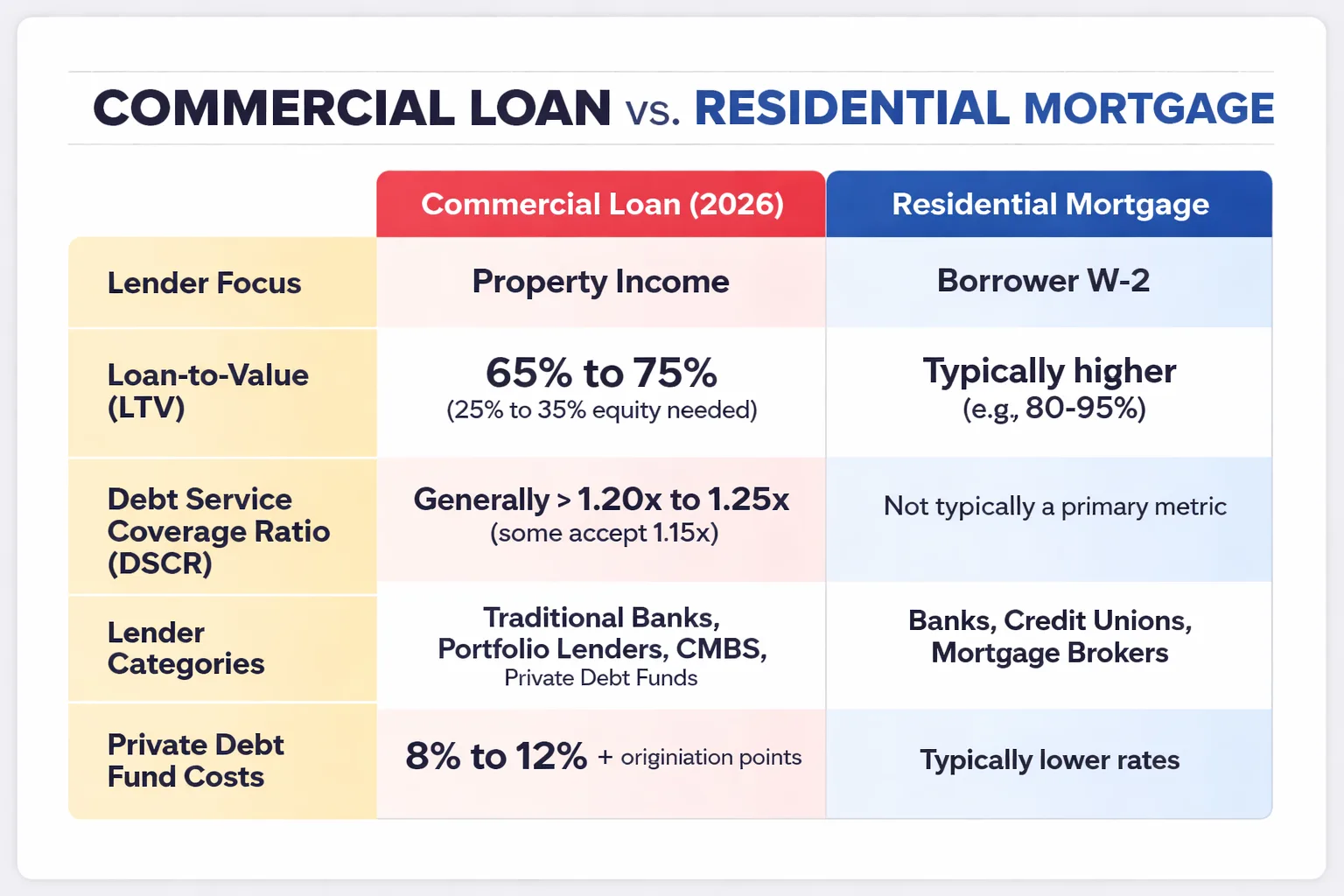
Commercial investment property loans in 2026 look nothing like residential mortgages. Lenders evaluate the property's income, not the borrower's W-2. Loan-to-value ratios typically cap at 65% to 75%, meaning buyers need 25% to 35% equity. Debt service coverage ratios must generally exceed 1.20x to 1.25x, though aggressive lenders may accept 1.15x on stronger assets.
The financing landscape divides into several lender categories. Traditional banks offer the lowest rates but have the strictest underwriting and longest timelines. Portfolio lenders and credit unions provide more flexibility on property type and borrower profile but charge slightly higher rates. CMBS lenders securitize loans and offer non-recourse options with favorable terms on stabilized assets, though prepayment penalties can be severe. Private debt funds move fastest but carry the highest costs, often 8% to 12% plus origination points.
The critical mistake investors make is shopping for properties before securing financing. Sellers in commercial real estate in nj routinely reject offers without proof of funds or a lender's term sheet. A buyer who finds the right property and then spends four weeks securing financing will lose the deal to a prepared buyer who already has capital lined up.
According to MetLife Investment Management's model, a 100 basis point increase in Baa corporate yields correlates to approximately a 92 basis point increase in transaction cap rates, per MetLife's research. This means interest rate movements directly compress or expand the cap rates buyers can underwrite. An investor who secured financing at 6.5% in early 2026 faces a fundamentally different return profile than one financing at 7.5% six months later. Locking in financing terms early protects the investment thesis from rate drift during the search period.
For international investors, particularly Chinese-American buyers investing in New Jersey and New York markets, financing adds another layer. Foreign national loans exist but typically require 30% to 40% down and carry rates 100 to 200 basis points above domestic borrower terms. Working with a nj real estate agent who understands cross-border transactions and can connect buyers with lenders experienced in foreign national financing eliminates weeks of friction.
Step 3: Search Listings and Build a Shortlist
Commercial real estate listings do not aggregate the way residential properties do on Zillow. The market is fragmented across multiple platforms, broker networks, and off-market channels. Investors who rely on a single source will miss opportunities.
Online platforms like LoopNet and Crexi list commercial properties, but the best deals often trade before reaching public listing sites. This is where a commercial real estate broker with local market presence creates value. Brokers at firms like Cushman & Wakefield, CBRE, and Marcus & Millichap maintain databases of off-market and pocket listings. They know which owners are considering selling before a listing goes live.
The search should be geographically targeted. Commercial real estate jersey city nj attracts investors seeking Manhattan-adjacent office and mixed-use properties. Monmouth county nj commercial real estate draws investors looking for retail and industrial assets with different tax profiles. Bergen County offers suburban retail and office opportunities with strong demographic fundamentals. Each submarket has its own pricing dynamics, tenant profiles, and risk factors.
Building a shortlist requires systematic evaluation. For each property, the investor should gather the current rent roll, trailing 12-month operating statements, tax bills, and lease abstracts. These documents allow preliminary underwriting before spending money on formal due diligence. A property listed at a 7% cap rate that, upon examination of actual expenses, delivers a 5.5% cap rate is not a bargain. It is a mispriced asset that an uninformed buyer will overpay for.
The 2026 New Jersey housing market outlook provides broader context for mixed-use properties where residential and commercial components interact. Mixed-use buildings in transit-oriented developments benefit from both residential demand and commercial tenant interest, but their valuation requires understanding both markets simultaneously.
Ready to find the right commercial property in New Jersey?
Step 4: Conduct Due Diligence Like an Auditor
Due diligence is where commercial transactions live or die. The process is not a formality. It is the investigation that confirms or refutes every assumption the investor made when deciding to make an offer.
Financial due diligence starts with verifying every number the seller provided. Trailing 12-month operating statements must be reconciled with tax returns and bank deposits. Rent rolls must be confirmed against actual leases. Security deposits must be verified. Any discrepancy between reported income and bank records signals a problem that demands explanation. In practice, the mismatch between financial statements and bank records, combined with unconfirmed lease assignment clauses, accounts for the majority of the nearly 80% of deals that collapse during this phase.
Physical due diligence requires professional inspections. Commercial property condition assessments identify structural, mechanical, and roofing issues that carry five- and six-figure repair costs. Environmental Phase I assessments are not optional in New Jersey. The state's industrial history means soil contamination, underground storage tanks, and vapor intrusion risks are real. A Phase I that reveals recognized environmental conditions triggers a Phase II investigation, which may reveal remediation costs that make the deal uneconomical. Investors who skip environmental assessment to save $3,000 on a Phase I report routinely inherit $300,000 remediation liabilities.
Zoning due diligence confirms the property's legal use. New Jersey municipalities have specific zoning ordinances that govern permitted uses, parking requirements, signage, and expansion possibilities. A property operating as a restaurant under a legal nonconforming use cannot be re-tenantied as a different restaurant without municipal approval in some jurisdictions. An investor who assumes they can change the tenant mix without checking zoning will discover the limitation after closing, when the municipality denies the use variance application.
Title due diligence identifies liens, easements, and encumbrances. Commercial title searches are more complex than residential because commercial properties often have multiple easements for utilities, access rights for neighboring properties, and recorded covenants that restrict use. A title commitment that reveals an access easement benefiting a neighboring property may limit the owner's ability to redevelop or reconfigure the site.
Lease due diligence is specific to income-producing properties. Every lease must be reviewed for remaining term, renewal options, rent escalation schedules, tenant improvement obligations, co-tenancy clauses, and assignment restrictions. A retail property where an anchor tenant's lease expires in 18 months with no renewal option is worth less than the same property with a 10-year lease. A multi-tenant office building where leases allow tenants to reduce space by 50% upon giving 90 days' notice carries hidden vacancy risk that the rent roll does not reflect.
The attorney review period in New Jersey commercial transactions differs from residential transactions. In residential deals, attorney review is a statutory three-day window. In commercial transactions, the review period is negotiated as part of the contract. A well-drafted contract gives the buyer 30 to 60 days for due diligence with the right to terminate and recover earnest money if material issues arise. An investor who accepts a 10-day due diligence period on a complex commercial property is gambling, not investing.
Step 5: Negotiate, Close, and Manage the Asset
Negotiation in commercial real estate begins with the letter of intent. The LOI is a non-binding document that outlines purchase price, earnest money deposit, due diligence period, closing timeline, and any contingencies. It sets the framework for the purchase contract. A well-structured LOI demonstrates seriousness and gives the seller's attorney a template for drafting the contract.
Price negotiation extends beyond the headline number. Sellers may accept a lower price in exchange for a shorter due diligence period, a larger earnest money deposit, or fewer contingencies. Buyers who understand these tradeoffs can structure offers that win competitive situations without overpaying. A buyer offering full asking price with a 15-day due diligence period and non-refundable earnest money after day 10 is more attractive to a seller than a buyer offering 95% of asking with a 60-day due diligence period and fully refundable earnest money.
Closing costs in commercial transactions catch buyers off guard. Beyond the standard title insurance, recording fees, and attorney fees, commercial closings may include transfer taxes, mortgage recording taxes, lender origination points, appraisal fees, environmental assessment costs, survey costs, and escrow setup for taxes and insurance. Buyers should budget 3% to 5% of the purchase price for closing costs on a financed transaction. Cash transactions run lower but still carry title, survey, and legal costs.
Post-closing management determines whether the investment thesis plays out. Commercial properties require active management. Tenants must be retained through lease renewals. Maintenance must be performed on schedule. Tax assessments must be monitored and appealed when they exceed market value. Insurance must be reviewed annually for coverage adequacy and premium competitiveness.
For out-of-state and international investors, property management becomes a critical decision. Hiring a professional management company typically costs 3% to 6% of gross revenue for retail and office properties. Industrial properties often cost less to manage because tenants handle maintenance under triple-net leases. The management company selection should happen before closing, not after, so the transition is seamless on day one.
CBRE Research found that ready-to-use property acquisitions are linked to stronger capital efficiency than properties requiring significant repositioning, per CBRE's strategic acquisitions report. This finding has practical implications for post-closing strategy. Investors who buy stabilized assets and focus on operational efficiency outperform those who buy distressed assets and attempt aggressive repositioning, unless the investor has specific expertise in turnaround situations.
Which NJ Counties Have the Highest Property Taxes
New Jersey's property tax burden is the highest in the United States, and commercial properties bear a disproportionate share. The effective commercial tax rate varies dramatically by county, and this variation directly impacts net operating income and achievable cap rates.
According to the Altus Group US Real Property Tax Benchmark Report, property tax benchmarks vary significantly across major markets. For New Jersey commercial real estate investors, the county-level differences are substantial enough to make or break an investment thesis. An investor underwriting a 7% cap rate in a county with a 3.5% effective commercial tax rate faces a fundamentally different return profile than one investing in a county at 2.0%.
The table below summarizes representative effective commercial tax rates for key New Jersey counties where commercial real estate in nj transactions concentrate. These figures reflect approximate effective rates (assessed value multiplied by tax rate, divided by market value) and should be verified against current municipal tax records for any specific property.
| County | Approx. Effective Commercial Tax Rate | Typical Property Types | Impact on Cap Rate |
| Essex County | 3.2% - 3.8% | Office, retail, mixed-use | High tax burden compresses NOI significantly |
| Hudson County | 2.5% - 3.2% | Office, residential, mixed-use | Moderate burden; Jersey City abatements may apply |
| Bergen County | 2.0% - 2.8% | Retail, office, industrial | Lower burden supports stronger NOI |
| Monmouth County | 1.8% - 2.5% | Retail, industrial, office | Favorable for cash flow investors |
| Union County | 2.8% - 3.5% | Industrial, retail, office | Higher burden; verify before underwriting |
| Middlesex County | 2.2% - 2.9% | Industrial, office, retail | Moderate burden with strong logistics demand |
The investor's process should be straightforward. Take the property's projected market value. Multiply by the county's effective commercial tax rate. Subtract that figure from gross operating income before calculating NOI. An investor who skips this step and uses the seller's pro forma tax figure will discover the discrepancy when the next tax bill arrives, and the actual cap rate will be lower than underwritten.
Tax appeals provide a potential remedy. If a property is assessed above market value, the owner can file a tax appeal with the county tax board. New Jersey allows tax appeals by April 1 of the tax year (May 1 in revaluation years). Successful appeals reduce the assessment and generate ongoing tax savings. This is not a strategy for reducing a fair assessment. It is a tool for correcting an unfair one. Investors should verify the current assessment ratio before closing and factor potential appeal outcomes into their underwriting.
How Does Financing Differ for Commercial Versus Residential?
Commercial loans are underwritten on the property's income, not the borrower's personal income. Residential lenders calculate debt-to-income ratios using W-2 earnings and pay stubs. Commercial lenders calculate debt service coverage ratios using the property's net operating income divided by annual debt service. A property generating $150,000 in NOI with $110,000 in annual debt service has a 1.36x DSCR, which meets most lenders' minimum requirements. The borrower's personal credit and liquidity matter, but the property's cash flow is the primary underwriting driver.
Loan terms are also fundamentally different. Residential mortgages offer 30-year fixed rates with no balloon payments. Commercial loans typically have terms of 5, 7, or 10 years with amortization schedules of 20 to 25 years and a balloon payment at term end. The investor must refinance or sell at the end of the term, which introduces interest rate risk. A buyer who finances at 6.5% in 2026 may face 8% or higher at refinancing in 2031, compressing returns or requiring additional equity.
What Environmental Checks Does NJ Require?
New Jersey's Industrial Site Recovery Act (ISRA) applies to properties where certain industrial operations occurred. ISRA requires environmental investigation and remediation before a business can close or transfer ownership of a contaminated site. Buyers of industrial properties must determine whether ISRA applies and whether the seller has completed or is in the process of completing required remediation.
Beyond ISRA, the New Jersey Department of Environmental Protection maintains databases of known contaminated sites. A Phase I Environmental Site Assessment reviews historical records, regulatory databases, and site conditions to identify recognized environmental conditions. If the Phase I identifies concerns, a Phase II involves soil and groundwater sampling. In New Jersey's industrial corridor, particularly along the Turnpike and in the Meadowlands, Phase II assessments frequently reveal issues that require negotiation of price reductions, remediation escrows, or seller-funded cleanup before closing.
The Rutgers University Policy Lab documented the challenges of vacant commercial properties in New Jersey, noting that environmental contamination is a leading barrier to redevelopment. Investors evaluating distressed or vacant commercial properties should budget for environmental investigation as a standard due diligence cost, not an optional add-on.
Why Do You Need a Commercial Broker?
A residential agent recommended by a friend is the wrong choice for a commercial transaction. Residential agents specialize in pricing homes, marketing to homebuyers, and navigating residential mortgage contingencies. Commercial brokers specialize in income property valuation, lease analysis, investor representation, and commercial financing structures. The skill sets do not overlap.
The cost of using the wrong agent is measurable. A residential agent who overlooks a $40,000 annual expense in a commercial property's operating statement causes the buyer to overpay by approximately $570,000 at a 7% cap rate. That $40,000 expense, capitalized at the market cap rate, represents real value that the buyer is paying for income that does not exist. A commercial broker would catch that expense during the financial review phase, before the offer is made.
For investors seeking new york investment properties or New Jersey commercial assets, working with a broker licensed in both states creates efficiency. Transactions that cross state lines, such as a New York investor buying in New Jersey or a New Jersey investor expanding into Manhattan, benefit from a broker who understands both markets' legal frameworks, financing environments, and tenant dynamics.
What This Won't Fix
A structured buying process does not eliminate market risk. An investor who follows every step perfectly can still lose money if market conditions deteriorate. Office properties in markets with 20%+ vacancy rates may not recover regardless of how carefully the buyer underwrites. A property purchased at a 7% cap rate in a submarket where cap rates expand to 9% loses value even with stable NOI, because the market has repriced the asset.
This guide also does not substitute for legal counsel. The attorney review period, contract negotiation, and closing process require a real estate attorney licensed in New Jersey with commercial transaction experience. An investor who uses a family lawyer who handles residential closings will receive residential-level advice on a commercial transaction. The gap between those two service levels is where deals break.
Finally, no process compensates for a bad deal. If the purchase price is too high relative to the property's income potential, disciplined due diligence will reveal that fact. But the investor must be willing to walk away when it does. Buyers who fall in love with a property and rationalize negative findings during due diligence are setting themselves up for losses that no post-closing strategy can recover.
FAQ
What is the average cap rate for commercial real estate in New Jersey?
Cap rates in New Jersey vary by property type, location, and condition. Industrial properties near logistics corridors typically trade at 5.5% to 7.5%. Office properties range from 6.5% to 9% depending on submarket and tenant quality. Retail properties vary from 5% for single-tenant net-leased national credit tenants to 8% or higher for multi-tenant centers in secondary locations. Investors should underwrite to specific submarket comps rather than relying on statewide averages.
How long does it take to close a commercial real estate deal in NJ?
A typical commercial transaction takes 60 to 120 days from signed contract to closing. The due diligence period accounts for 30 to 60 days of that timeline. Financing adds another 30 to 45 days if the lender requires appraisal, environmental review, and third-party reports. Cash transactions can close in 30 to 45 days. Complex deals with environmental remediation or zoning approvals may extend to six months or longer.
Do I need a New Jersey attorney for a commercial real estate purchase?
Yes. New Jersey is an attorney state for real estate transactions, meaning an attorney must handle the closing. For commercial transactions, the attorney reviews the contract, negotiates terms during the review period, conducts title examination, and manages the closing. The attorney should have commercial real estate experience, not just residential. Commercial contracts involve provisions that residential attorneys may not be equipped to negotiate, such as tenant estoppel certificates, SNDAs, and environmental indemnities.
Can foreign investors buy commercial real estate in New Jersey?
Yes. Foreign investors can purchase commercial property in New Jersey without restrictions on ownership. Financing options are more limited, with foreign national loans typically requiring 30% to 40% down payments and carrying rates above domestic borrower terms. Foreign investors should also consider FIRPTA withholding requirements, which mandate that buyers withhold 15% of the sales price when selling to foreign sellers. Working with a broker experienced in cross-border transactions streamlines the process.
What is the difference between a letter of intent and a purchase contract?
A letter of intent is a non-binding document that outlines the key terms of a proposed transaction: purchase price, due diligence period, closing timeline, and contingencies. It signals serious interest and gives the seller's attorney a framework for drafting the binding purchase contract. The purchase contract is a legally binding agreement that replaces the LOI and includes all enforceable terms. Earnest money is typically deposited after the contract is signed, not after the LOI.
How do property tax appeals work for commercial properties in NJ?
Property tax appeals in New Jersey are filed with the county tax board by April 1 of the tax year (May 1 in revaluation years). The property owner must demonstrate that the assessment exceeds market value, typically through a recent appraisal or comparable sales data. If successful, the assessment is reduced, generating ongoing tax savings. The appeal process takes three to six months, and the reduction applies retroactively to the beginning of the tax year. Investors should verify assessment ratios before closing and factor potential appeal outcomes into their underwriting.
About the Author
Judy Zhou, Keller Williams Realtor®
Judy Zhou is a Realtor® with Keller Williams Town Life Realty in Tenafly, NJ, serving New Jersey and New York with $35M+ in sales volume. Licensed in both NJ and NY, she specializes in luxury homes, investment properties, and commercial real estate, offering seamless bilingual English-Chinese service. Before joining Keller Williams, she earned Coldwell Banker's International President's Elite (2024) and International Diamond Society (2025) awards.
Get expert guidance from a bilingual commercial real estate professional licensed in both NJ and NY, with $35M+ in sales volume and a track record of protecting investor interests.