Why Is Short Hills, NJ So Expensive? The Real Drivers
By Judy Zhou, Keller Williams Realtor®
Key Takeaways
- Short Hills median home values hit $1.89 million, a $250,000–$600,000 premium over Livingston despite comparable school rankings.
- The 1880s Lackawanna Railroad extension created under-one-hour Manhattan commutes that triggered estate building and lasting exclusivity.
- Schools alone fail to explain prices, as the $1.89 million median reflects added factors of commute access, luxury retail, and constrained supply.
- Short Hills 07078 ZIP code commands a sharp premium inside Millburn Township’s shared schools and tax base due to housing limits.
In the 1880s, the Lackawanna Railroad extended its Morris and Essex line deeper into New Jersey, and a small elevation above the Millburn flatlands. Called Short Hills. Suddenly became commutable to Manhattan in under an hour. Wealthy New York merchants and financiers took notice almost immediately, purchasing land and building estates along what would become the defining residential corridor of Essex County. That single infrastructure decision, made over a century ago, set in motion a chain of exclusivity, zoning precedent, and school investment that still explains, more than any other factor, why Short Hills, NJ is so expensive today.
What Makes Short Hills One of America's Priciest ZIP Codes
Short Hills is not a separate town. It is an unincorporated community within Millburn Township, sharing the same school district, municipal government, and tax base. But the Short Hills mailing address (07078) carries a price premium that separates it sharply from the rest of Millburn and from neighboring affluent communities. The question of why is Short Hills, NJ so expensive comes down to four interlocking forces: school district ranking, Manhattan commute access, luxury retail infrastructure, and constrained housing supply.
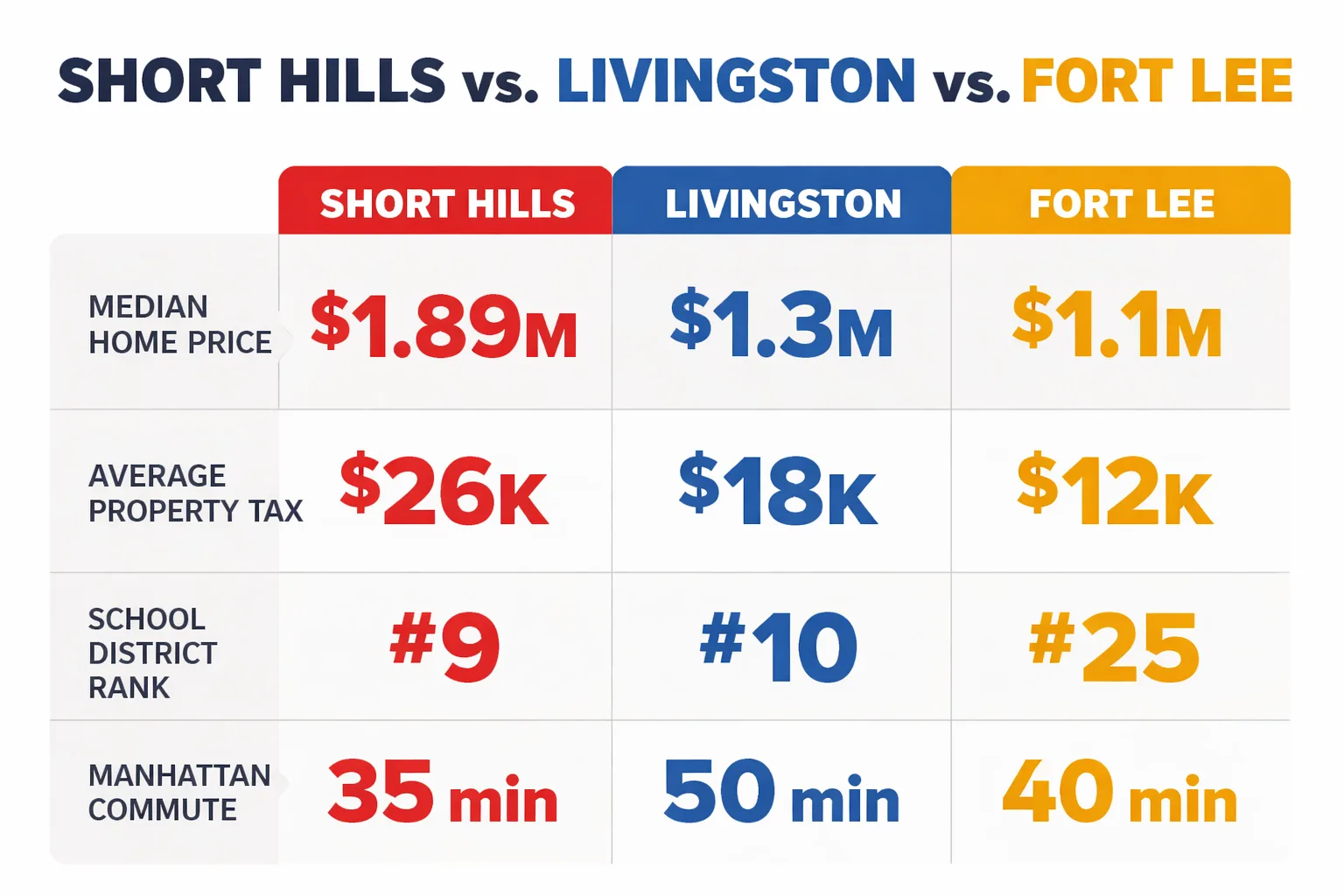
The data tells the story. Short Hills median home values hover near $1.89 million according to Zillow's ZHVI index, placing it among the top ZIP codes in New Jersey and in the upper tier nationally. For comparison, neighboring Livingston (which shares a similar school ranking tier, with Millburn schools ranked approximately #9 to #10 in New Jersey alongside Livingston) sees median home prices in the $1.2 million to $1.4 million range. That gap of roughly $250,000 to $600,000 between communities with comparable school rankings suggests that schools alone do not explain the price premium, as noted in a Livingston vs. Short Hills comparison by Prodigy Real Estate.
The broader New York-area luxury market provides additional context. According to Realtor.com Research, the entry point for luxury listings in the NYC metropolitan area sits at approximately $2.62 million (defined as the priciest 10% of listings). Short Hills sits just below that threshold, which positions it as a relative value for buyers seeking luxury living with Manhattan access without paying Manhattan luxury prices. For buyers exploring options across the region, the Fort Lee vs. Short Hills comparison breaks down how these two premium New Jersey markets stack up against each other.
Short Hills also benefits from a demographic profile that reinforces pricing. The community has exceptionally high median household income, low turnover rates, and a resident base dominated by executives, finance professionals, and business owners who commute to Manhattan. This creates a self-reinforcing cycle: affluent residents fund strong schools through property taxes, strong schools attract more affluent buyers, and those buyers compete for a limited housing supply, driving prices higher.
The historical context matters here. Stewart Hartshorn, the developer who founded Short Hills in the 1870s and 1880s, deliberately planned the community around large lots, curvilinear streets that followed the natural topography, and deed restrictions that prevented commercial intrusion into residential areas. That original planning vision persists today in Millburn Township's zoning code, which maintains minimum lot sizes of roughly half an acre to one acre in the most exclusive sections. The result is a community where new construction is nearly impossible at scale, and where the existing housing stock represents a finite, non-reproducible asset. This is the foundational supply constraint that underpins every other pricing driver.
The housing stock itself also contributes to the price floor. Short Hills is dominated by custom-built single-family homes, many constructed between 1920 and 1980, with architectural styles ranging from Tudor and Colonial revivals to mid-century modern and contemporary new builds. These are not tract homes. Each property represents a unique combination of lot characteristics, architectural design, and renovation history. This heterogeneity means that comparable sales analysis in Short Hills requires more nuance than in a typical subdivision community, where identical floor plans trade in tight price bands. The 2026 New Jersey Housing Market Outlook details how housing stock composition varies dramatically across North Jersey submarkets and why this matters for accurate valuation.
Why Is Short Hills, NJ So Expensive?
Short Hills, NJ is expensive because four forces converge: the top-ranked Millburn school district (rated A+, approximately #16 in New Jersey), a 35-minute direct train to Midtown Manhattan, The Mall at Short Hills as a luxury retail anchor, and a constrained housing supply on large wooded lots that prevents new development from diluting exclusivity.
Each driver reinforces the others. The school district, Millburn Township Public Schools, consistently ranks among the best in New Jersey. Real estate professionals including Prodigy Real Estate, the Gonnella Team, and Century 21 Cedarcrest all cite the "highly regarded Millburn Township Public Schools, consistently ranked among the best school districts in New Jersey" as a primary driver of buyer interest. Yet no published hedonic pricing model or peer-reviewed study quantifies the exact dollar impact of school quality on Short Hills home values. The correlation is strong and observable, but the causal dollar figure remains unmeasured in academic literature.
The commute is the second pillar. The Short Hills station sits on the Morris and Essex Line, offering direct service to Hoboken and Newark Broad Street, with connections to Midtown via PATH or NJ Transit's Midtown Direct service. Travel time to Manhattan runs approximately 35 minutes on express trains. This commute time places Short Hills in the sweet spot for Manhattan executives: close enough for a daily commute, far enough to offer privacy, large lots, and suburban tranquility. The 2026 New Jersey Housing Market Outlook details how commute accessibility continues to drive premium pricing across North Jersey corridors.
The Mall at Short Hills is the third driver. It is not just a shopping center. It is one of the most upscale retail destinations in the United States, anchored by Neiman Marcus, Nordstrom, and Macy's, with luxury boutiques including Louis Vuitton, Hermès, and Cartier. The mall serves as a commercial anchor that signals exclusivity and draws high-net-worth residents who expect luxury amenities within minutes of their front door. This retail infrastructure also supports local commercial property values, making the area attractive for commercial real estate in NJ investors evaluating retail and mixed-use opportunities near premium residential corridors.
The fourth driver is supply constraint. Short Hills was developed in the late 19th and early 20th centuries as a planned community with large lots, many exceeding half an acre. Zoning in Millburn Township preserves these lot sizes, and the wooded, rolling terrain limits dense redevelopment. With minimal new construction and low turnover (residents tend to stay for decades), the supply of available homes remains tight. When short hills nj homes for sale do hit the market, they face immediate competition from buyers who have been waiting for inventory.
The interaction between these four drivers is what makes Short Hills different from other affluent New Jersey communities. Summit has excellent schools and a comparable commute. Chatham has charm and strong test scores. Mountain Lakes has beautiful lakes and large lots. But none of these communities combine all four forces at the same intensity. Short Hills has the school ranking, the commute, the luxury retail, and the supply constraint all operating simultaneously. Remove any one of the four, and the price premium would likely compress by 10% to 20%. Remove two, and Short Hills would resemble Livingston or Summit rather than standing alone at the top of the Essex County pricing hierarchy.
What Are the Taxes on a High-Value Short Hills Home?
Property taxes are the hidden cost that catches many Short Hills buyers off guard. New Jersey has the highest effective property tax rate in the nation, and Millburn Township's rate reflects the premium services, top-tier schools, and small-town governance that residents expect.
On a $2 million home in Short Hills, annual property taxes typically run approximately $26,000 to $28,000. The effective tax rate in Millburn Township hovers around 1.3% to 1.4% of assessed value, which is actually below the New Jersey state average of approximately 2.23%. However, because home values are so high, the dollar amount is substantial. A buyer purchasing a $1.89 million median-value Short Hills home should budget roughly $25,000 per year in property taxes alone.
For comparison, Livingston property taxes on a comparable median home run approximately $18,000 annually. That $7,000 to $8,000 annual tax difference compounds over a 10-year holding period into $70,000 to $80,000 in additional carrying costs. Buyers evaluating whether the Short Hills premium is justified need to factor this ongoing expense into their total cost of ownership, not just the purchase price. The title fees and closing costs breakdown provides a full picture of what buyers should expect at closing and beyond.
New Jersey's property tax system also offers a homestead benefit program and a property tax deduction for primary residences, which can offset a portion of the annual burden. However, these benefits are capped and means-tested, meaning high-income Short Hills residents may see limited relief. Buyers should also understand that assessed values in Millburn Township do not always align with market values, and periodic revaluations can cause tax bills to jump unexpectedly. Working with a knowledgeable nj real estate agent who understands the local tax landscape is essential for accurate budgeting.
The tax calculation works differently than many out-of-state buyers expect. In New Jersey, property taxes are calculated by multiplying the assessed value of the home by the local tax rate, which is expressed as a rate per $100 of assessed value. Millburn Township's total tax rate typically falls in the range of 2.8 to 3.0 per $100 of assessed value. However, the assessment ratio (the relationship between assessed value and true market value) in Millburn Township has historically hovered around 45% to 50%. This means a home with a market value of $2 million might have an assessed value of approximately $900,000 to $1 million. The tax bill is then calculated on that assessed figure, not the full market value. This is why the effective tax rate (total tax divided by market value) comes out lower than the nominal rate.
The practical implication for buyers is significant. A buyer purchasing a $2.5 million home in Short Hills should expect annual property taxes in the range of $32,000 to $35,000. A buyer purchasing a $3 million estate should budget $38,000 to $42,000 annually. These are not one-time costs. They recur every year, and they typically increase as municipal budgets grow and school district spending rises. Over a 10-year ownership period, a $2.5 million Short Hills home will generate approximately $330,000 to $350,000 in cumulative property tax payments. That figure should be factored into any investment analysis alongside mortgage interest, insurance, and maintenance costs.
Buyers should also be aware of the property tax appeal process in New Jersey. If a home is purchased for less than its assessed value implies, the buyer may have grounds to appeal the assessment and reduce the tax bill. This is a technical process with strict filing deadlines (typically April 1 of the tax year, or within 45 days of a bulk mailing of assessment notices). The appeal requires comparable sales data and sometimes a professional appraisal. Buyers who successfully appeal can save thousands annually, but the process is not guaranteed and requires professional guidance.
Is Short Hills, NJ an Affluent Area?
Yes. Short Hills is one of the most affluent communities in the United States, not just in New Jersey. The demographic profile confirms what the housing prices suggest.
Median household income in the Short Hills ZIP code (07078) consistently ranks among the highest in New Jersey, typically exceeding $250,000 per year. The community has a high concentration of residents in executive, managerial, and professional occupations, with a significant percentage working in finance, technology, and healthcare in Manhattan. Educational attainment is exceptionally high, with the vast majority of adult residents holding bachelor's degrees and a large percentage holding graduate or professional degrees.
A demographic analysis published by the Rutgers University Center for Urban Policy Research provides broader context on New Jersey residential demographic multipliers, illustrating how household composition in affluent suburban communities like Short Hills differs from state averages in terms of income, education, and pupil generation rates.
For buyers, this affluence has practical implications. Competition is fierce. Homes in Short Hills typically spend fewer days on market than the Essex County average, and multiple-offer situations are common for well-priced properties. Buyers should expect to move quickly, present clean offers without excessive contingencies, and work with an agent who has deep relationships in the local market. The luxury real estate brokers who consistently close deals in Short Hills are those who understand the community's social dynamics, school admission patterns, and the unwritten norms of offer presentation.
Affluence also means that the buyer pool is self-selecting. Sellers in Short Hills are often in no rush to sell, which means lowball offers are routinely rejected and negotiation leverage tends to favor sellers. Buyers who understand this dynamic and approach transactions with realistic expectations and strong financial positioning are far more likely to succeed. For buyers also considering New York options, working with a real estate agent in NY who understands both markets can provide a comparative advantage in evaluating cross-state opportunities.
The wealth concentration in Short Hills also affects the negotiation dynamics in ways that surprise out-of-area buyers. In a typical New Jersey suburban market, a home listed at $1.5 million might receive offers ranging from $1.35 million to $1.55 million, with most clustering near the asking price. In Short Hills, the offer distribution is different. Because the buyer pool is smaller and more sophisticated, offers tend to cluster in tighter bands, and the spread between the highest and lowest offers is often narrower. This means that winning a multiple-offer situation in Short Hills is less about dramatically outbidding competitors and more about presenting the cleanest, most certain offer. Contingency removal, flexible closing timelines, and proof of funds matter more than a $20,000 increment in price.
The social fabric of Short Hills also plays a role in market dynamics. The community has a strong network of neighborhood associations, parent groups, and civic organizations that create social capital beyond the financial metrics. New residents are drawn not only by the schools and the commute but by the established community of peers with similar backgrounds, values, and expectations. This social infrastructure is intangible but real. It affects how quickly homes sell (word-of-mouth referrals within the community often generate buyer interest before a listing goes public) and how pricing expectations are set (sellers compare their homes to specific neighborhood comparables, not just township-wide averages).
How Does the Short Hills Commute Compare?
The commute is the single most quantifiable driver of Short Hills pricing. A 35-minute direct train to Midtown Manhattan is not a luxury. It is a daily economic decision that hundreds of buyers make when choosing between Short Hills and competing communities.
The Morris and Essex Line runs through the Short Hills station, with direct Midtown Direct service to New York Penn Station during peak hours. Off-peak and weekend service requires a connection at Newark Broad Street or Hoboken. For Manhattan-bound commuters, this places Short Hills in a competitive commute band alongside communities like Summit, Chatham, and Madison. However, Short Hills tends to command higher prices than these neighbors because of the combined effect of school ranking and retail infrastructure.
The commute comparison becomes even more favorable when measured against Westchester County and Connecticut alternatives. A comparable home in Scarsdale, NY, with similar school quality and a 35-minute commute to Grand Central, typically costs more than a Short Hills equivalent. A home in Greenwich, CT, with comparable schools and a 45-minute commute, costs significantly more. Short Hills offers a rare combination of Manhattan accessibility, top-tier schools, and relative value within the premium suburban market.
For investors evaluating New Jersey real estate investment opportunities, the commute corridor along the Morris and Essex Line remains one of the most reliable predictors of sustained property value. Communities with direct Midtown access have historically maintained pricing resilience even during market downturns, because the commuter buyer pool replenishes continuously.
The mechanics of the commute matter for daily quality of life, not just for resale value. The Short Hills station is a smaller stop compared to the Millburn station (which is the larger hub approximately one mile away). This means Short Hills residents often walk or drive to the Short Hills station for a quieter, less crowded boarding experience, while Millburn station offers more parking options and more frequent service. Parking permits at both stations are in high demand, with wait lists that can extend months or years. Buyers evaluating Short Hills should factor parking availability into their decision, as the daily commute experience is significantly different when parking is guaranteed versus when it requires circling neighborhood streets.
The commute also varies by time of day and service type. Midtown Direct trains during peak commuting hours (approximately 6:30 AM to 9:30 AM inbound, 4:30 PM to 7:30 PM outbound) offer the fastest service to Penn Station. Off-peak trains require a transfer at Newark Broad Street or Hoboken, adding 10 to 15 minutes to the journey. Buyers who work non-traditional hours or who commute to downtown Manhattan (rather than Midtown) should test the actual commute during their expected travel times before committing to a purchase. The difference between a 35-minute commute and a 55-minute commute, repeated 250 times per year, represents approximately 83 additional hours annually.
What Role Does The Mall at Short Hills Play?
The Mall at Short Hills is not just a retail destination. It is a brand signal that reinforces the community's identity as a luxury enclave.
Anchored by Neiman Marcus, Nordstrom, and Macy's, with luxury tenants including Louis Vuitton, Hermès, Tiffany & Co., Cartier, and Burberry, the mall draws shoppers from across northern and central New Jersey. It serves as a commercial anchor that supports local employment, generates tax revenue for Millburn Township, and creates a halo effect that extends to nearby residential property values. The presence of luxury retail within a five-minute drive of multi-million-dollar homes is a tangible amenity that competing communities cannot replicate.
The mall also matters for commercial real estate investors. Retail space near The Mall at Short Hills commands premium rents, and the surrounding commercial corridor along Route 24 and Morris Turnpike has seen sustained demand from high-end service businesses, medical practices, and professional offices that want proximity to an affluent client base. For investors evaluating commercial property as an investment in the Short Hills submarket, the mall's anchor effect provides a floor on commercial valuations that is rare in suburban New Jersey.
However, the retail landscape is shifting. The post-pandemic evolution of luxury retail has favored experiential destinations over traditional mall formats. The Mall at Short Hills has adapted better than most regional malls, maintaining high occupancy and attracting new luxury tenants even as competing properties in northern New Jersey have struggled. This resilience speaks to the spending power of the surrounding community and the mall's position as a destination rather than a convenience stop.
The tax revenue generated by The Mall at Short Hills is a critical but underappreciated component of the Short Hills value equation. Commercial properties in Millburn Township, with The Mall as the dominant contributor, generate significant tax revenue that offsets the residential tax burden. Without this commercial tax base, Millburn Township would need to raise residential property tax rates to maintain the same level of school funding and municipal services. In effect, the mall subsidizes the school district that drives residential property values. This creates a positive feedback loop: luxury retail attracts affluent residents, affluent residents support luxury retail, and the resulting commercial tax revenue keeps residential tax rates (as a percentage of assessed value) below the state average despite the premium level of services provided.
The mall's role as a community gathering space also contributes to the social infrastructure that makes Short Hills desirable. During holiday seasons, the mall hosts community events, charity drives, and seasonal displays that draw residents from across the township. The Starbucks and dining options within the mall serve as informal meeting spaces for local professionals, parents, and community groups. This social function is not captured in any hedonic pricing model, but it contributes to the quality of life that motivates buyers to pay the Short Hills premium.
Are you weighing a Short Hills purchase against other North Jersey luxury markets?
How Do Millburn Schools Actually Drive Home Values?
The school district is the most cited driver of Short Hills pricing, yet it is also the least quantified. This paradox deserves careful examination.
Millburn Township Public Schools consistently ranks among the top districts in New Jersey. The district comprises five elementary schools (South Mountain, Wyoming, Glenwood, Hartshorn, and Deerfield), Millburn Middle School, and Millburn High School. Millburn High School in particular has a reputation for academic excellence, with high SAT scores, strong AP participation rates, and a high percentage of graduates attending top-tier colleges and universities. Niche.com and similar school rating platforms typically assign Millburn an A+ overall grade, with specific rankings placing it in the top 16 districts statewide.
The mechanism by which school quality drives home values is well understood in theory, even if it is not precisely quantified for Short Hills specifically. Families with school-age children prioritize school quality when selecting a home. They are willing to pay a premium, both in purchase price and in property taxes, to access top-rated public schools. This willingness to pay creates demand concentration in specific ZIP codes served by desirable districts. In Short Hills, this demand concentration is amplified by the limited housing supply, creating intense competition for homes within the Millburn school district attendance boundaries.
The comparison with Livingston is instructive. As noted by Prodigy Real Estate, Millburn schools rank approximately #9 to #10 in New Jersey, while Livingston schools rank in a similar tier (#9). Yet Short Hills median home prices run $250,000 to $600,000 higher than Livingston. If school quality were the sole driver, the price gap should be minimal. The fact that it is substantial points to the interaction effect of schools with the other three drivers (commute, retail, and supply). Schools are necessary but not sufficient to explain the Short Hills premium.
This distinction matters for buyers. If school quality is the primary motivation for purchasing in Short Hills, buyers should evaluate whether the marginal improvement in school ranking over alternatives like Livingston, Summit, or Chatham justifies the price premium and the higher property tax burden. For families where school quality is the deciding factor, the answer may be yes. For buyers without school-age children, the school district premium represents a cost paid for an amenity they will not directly use, though it still contributes to resale value.
Buyers should also understand that school district boundaries in Millburn Township do not always align perfectly with the Short Hills mailing address. Some addresses with a Short Hills ZIP code may fall within different school attendance zones, and some Millburn addresses may feed into the same schools. This is a critical detail that affects both home values and buyer decisions. A knowledgeable nj real estate agent with experience in the Millburn market can verify school assignment for any specific property, which is essential information that should be confirmed before making an offer.
The school district's impact on home values also extends beyond test scores and rankings. The social capital of a school community (the network of involved parents, the quality of extracurricular programs, the college counseling resources, and the peer group that students join) creates value that is real but difficult to quantify. Families who move to Short Hills for the schools are not just buying access to a curriculum. They are buying into a peer environment where academic achievement is the norm, college matriculation to top institutions is expected, and the parent network provides social and professional connections that extend well beyond the school years.
Who Is the Ideal Short Hills Buyer in 2026?
The Short Hills market is not for everyone. Understanding who the ideal buyer is helps clarify whether the premium is justified for any individual purchaser.
The primary buyer profile is a family with school-age children, where at least one parent commutes to Manhattan or to a major employment center in northern New Jersey (such as the pharmaceutical corridor in Morris County or the financial services cluster in Jersey City). Household income typically exceeds $400,000 annually, which is necessary to support a mortgage on a $1.5 million to $2.5 million home plus property taxes of $20,000 to $35,000 per year, plus maintenance, insurance, and lifestyle costs consistent with the community's standard of living.
The secondary buyer profile is an empty-nester or retiree who already owns a home in Short Hills and is downsizing within the community. These buyers value the familiarity of the area, the social network they have built over decades, and the proximity to New York's cultural amenities. They typically purchase smaller homes or townhomes within the Short Hills area, trading lot size and maintenance burden for convenience while retaining access to the community they know.
A tertiary buyer profile is the international buyer, particularly buyers from China and other Asian countries who are seeking premium U.S. real estate with strong school districts and Manhattan access. Short Hills has attracted international buyers who value the combination of educational quality, safety, community prestige, and investment stability. For these buyers, working with an agent who offers bilingual services and understands the specific concerns of international purchasers (including tax implications, financing options, and school admission processes for non-native English speakers) is essential.
The buyer profile that does not fit Short Hills well is the pure investor seeking rental yield. Short Hills is an owner-occupied community with minimal rental inventory. Rental demand exists (primarily from families relocating to the area who want to rent before purchasing, or from executives on temporary assignment), but the rental market is thin and rental rates do not consistently cover carrying costs on a $2 million property. Investors seeking cash flow should look to New Jersey real estate investment opportunities in transit-oriented developments with stronger rental demand, such as Jersey City, Hoboken, or Fort Lee.
Another buyer profile that struggles in Short Hills is the buyer who is stretching financially to enter the market. A buyer purchasing at the top of their budget, with minimal down payment and a mortgage that consumes 35% or more of gross income, is vulnerable to any disruption (job loss, interest rate increase, major repair expense). The carrying costs in Short Hills are high, and the margin for error is thin. Buyers should model a stress scenario (10% reduction in income, 15% increase in property taxes, $50,000 in unexpected repairs) before committing to a Short Hills purchase.
Is the Short Hills Price Tag Worth It in 2026?
The honest answer depends entirely on the buyer profile. For the right buyer, Short Hills represents one of the best risk-adjusted luxury real estate investments in the New York metropolitan area. For the wrong buyer, it can become an expensive lesson in carrying costs and illiquidity.
Appreciation trends support the bullish case. Short Hills has demonstrated sustained long-term appreciation, with median values rising from approximately $1.75 million in 2012 to near $1.89 million in 2026. The growth rate has decelerated compared to the rapid appreciation years of 2020 through 2023, but the trajectory remains positive. The constrained supply that defines Short Hills provides a natural floor on values, because new construction cannot meaningfully increase inventory.
Rental demand is a secondary consideration. Short Hills is primarily an owner-occupied community, and the rental market is thin compared to communities like Jersey City or Hoboken. Investors seeking rental yield will find better opportunities elsewhere. However, for buyers who plan to occupy the home for 7 to 10 years and then sell, the resale liquidity in Short Hills is strong. Well-maintained homes in prime locations within the ZIP code consistently attract buyer interest, and the community's reputation ensures a steady stream of incoming executives and professionals.
The ideal Short Hills buyer in 2026 is a family with school-age children, a commute to Manhattan, household income exceeding $400,000, and a time horizon of at least 7 years. This buyer benefits from the school district, values the commute, and has the financial capacity to absorb property taxes and maintenance costs without financial strain. For investors or buyers without school-age children, the premium paid for the school district may not be justified, and neighboring communities like Summit or Chatham offer comparable commute access at lower price points.
For buyers evaluating new condo developments as an alternative to single-family homes in Short Hills, the tradeoff is clear. Condos offer lower carrying costs and reduced maintenance responsibility, but they do not provide the lot size, privacy, and school district access that define the Short Hills value proposition. The decision between a luxury condo in a transit-oriented development and a single-family home in Short Hills comes down to lifestyle priorities and time horizon.
The 2026 market context adds another layer to the value analysis. With New Jersey's average home value projected near $555,000 and growth rates decelerating, the broader state market is cooling. Short Hills is not immune to macro trends, but its supply constraint provides insulation that generic suburban markets lack. When inventory rises statewide, Short Hills inventory rises marginally because there is so little to begin with. When buyer activity slows, Short Hills still attracts the high-income, school-motivated buyer pool that is less rate-sensitive than the median buyer. This does not mean Short Hills is recession-proof. It means the downside risk is structurally lower than in markets where supply can expand rapidly in response to demand shifts.
Buyers should also consider the opportunity cost of a Short Hills purchase. A $2 million investment in Short Hills represents $2 million not deployed in other assets. Over a 10-year period, the total cost of ownership (mortgage interest, property taxes, maintenance, insurance) on a $2 million Short Hills home will likely exceed $800,000 to $1 million. The home must appreciate by at least that amount (plus selling costs of approximately 5% to 6% of sale price) for the buyer to break even on a cash basis. Whether Short Hills appreciation will deliver that return depends on macroeconomic conditions, interest rate trends, and the continued strength of the four drivers analyzed in this article.
For buyers who also work with a ny real estate agent and are comparing Manhattan luxury apartments to Short Hills single-family homes, the analysis is instructive. Manhattan luxury condo prices have appreciated from approximately $480 per square foot in 1999 to projections near $1,952 per square foot in 2026. But a surprising proportion of luxury condo sales in Manhattan occur at a loss, suggesting that luxury real estate is not a guaranteed investment return in any market. Short Hills, with its owner-occupied stability and limited speculative buying, may offer more predictable (if slower) appreciation than Manhattan's more volatile luxury condo segment.
Where This Analysis Breaks Down
No market analysis is complete without acknowledging its limitations, and Short Hills has three vulnerabilities that buyers should understand before committing.
First, the school district premium is unquantified. No published study isolates the dollar impact of Millburn school quality on home values. If school rankings decline, or if New Jersey expands school choice programs that weaken the link between ZIP code and school access, the premium could compress. Buyers are paying a documented premium for an undocumented driver.
Second, property tax risk is real. New Jersey's property tax burden is the highest in the nation, and Millburn Township's reliance on residential property taxes creates exposure to state-level policy changes. A shift in state aid formulas or a mandated revaluation could significantly increase annual carrying costs. Buyers who stretch to afford a Short Hills home should model a 20% property tax increase scenario before committing.
Third, the luxury retail anchor is not permanent. The Mall at Short Hills has performed well, but the broader retail sector faces structural headwinds from e-commerce and changing consumer behavior. If the mall were to lose anchor tenants or experience significant vacancy, the halo effect on residential values would weaken. This is a low-probability scenario in the near term, but it is a tail risk that buyers should acknowledge.
What This Actually Means for Buyers
Short Hills is expensive for reasons that are structural, not speculative. The school district, the commute, the retail infrastructure, and the constrained supply create a pricing floor that has held through multiple market cycles. The community is not a bubble. It is a self-reinforcing ecosystem where each driver supports the others.
But structural support does not mean every buyer should pay the premium. The right decision depends on whether the specific drivers align with the buyer's needs. A family with school-age children and a Manhattan commute will extract value from every dollar of the Short Hills premium. A buyer without those needs is paying for amenities they will not use.
The data is clear. Short Hills median values near $1.89 million, property taxes averaging $26,000 annually, and a 35-minute commute to Midtown create a market that rewards informed buyers and punishes uninformed ones. The gap between a well-negotiated purchase and an overpayment in this market can easily exceed $40,000 to $100,000, as comparable properties in the same neighborhood can vary significantly based on lot position, condition, and days on market.
For a personalized analysis of Short Hills opportunities, including current inventory, recent comparable sales, and a tailored financial model that accounts for property taxes, carrying costs, and projected appreciation, the next step is a consultation with an agent who has closed transactions in this specific market. Short Hills NJ homes for sale move quickly when they are well-priced, and the window for informed negotiation narrows with each day a property sits on the market.
FAQ
Why is Short Hills, NJ so expensive?
Short Hills commands premium prices due to four interlocking factors: top-ranked schools, direct Manhattan commute access via the historic Lackawanna Railroad line, luxury retail infrastructure, and tightly constrained housing supply. Median home values sit near $1.89 million, well above comparable nearby towns. These elements trace back to an 1880s infrastructure decision that created lasting exclusivity.How does history explain Short Hills' high cost of living?
In the 1880s, the Lackawanna Railroad extended its Morris and Essex line, turning the Short Hills elevation into a sub-hour commute to Manhattan. Wealthy New York merchants and financiers quickly bought land and built estates, establishing zoning precedents and school investment that persist today. This single decision set the chain of exclusivity that still drives prices.Why do Short Hills homes cost more than those in Livingston despite similar schools?
Although Millburn and Livingston schools rank similarly (around #9. 10 in New Jersey), Short Hills' 07078 ZIP carries a $250,000–$600,000 premium over Livingston's $1.2. 1.4 million medians. The gap stems from superior commute access, luxury retail, and limited housing inventory rather than schools alone. Short Hills remains an unincorporated section of Millburn Township sharing the same government and tax base.Is Short Hills a separate town from Millburn?
No, Short Hills is an unincorporated community inside Millburn Township with the same school district, municipal government, and tax base. Its distinct mailing address (07078) nonetheless commands a sharp price premium over the rest of Millburn. This shared structure still benefits from the historic infrastructure and supply constraints that elevate values.About the Author
Judy Zhou, Keller Williams Realtor®
Judy Zhou is a Realtor® with Keller Williams Town Life Realty in Tenafly, NJ, serving New Jersey and New York with $35M+ in sales volume. Licensed in both NJ and NY, she specializes in luxury homes, investment properties, and commercial real estate, offering seamless bilingual English-Chinese service. Before joining Keller Williams, she earned Coldwell Banker's International President's Elite (2024) and International Diamond Society (2025) awards.
Get a personalized Short Hills market analysis with current inventory, comparable sales, and a full carrying-cost breakdown before you make an offer.