What Is Investment on Commercial Property? The 2026 Investor's Primer

What Is Investment on Commercial Property? The 2026 Investor's Primer
By Judy Zhou, Keller Williams Realtor®
Key Takeaways
- Commercial tenants sign 5-to-15 year leases backed by business revenue, unlike 12-month residential leases backed by personal income.
- Investors need $200,000 to $500,000 in equity for a down payment and reserves on a strip mall in Bergen County or small industrial warehouse outside Newark.
- Manhattan drove the majority of New York City's investment sales volume in the first half of 2026 per Ariel Property Advisors' H1 2026 report.
- Commercial property delivers superior long-term returns, predictable income, and stronger leverage than residential real estate in New York and New Jersey markets.
Residential real estate is not the safe starting point for investors that most financial influencers make it out to be. For serious wealth-building in the New York and New Jersey markets, investment on commercial property. Office, industrial, retail, and mixed-use. Consistently delivers superior long-term returns, more predictable income streams, and significantly stronger leverage opportunities. The myth that commercial real estate is only for institutional players with deep pockets has kept thousands of capable individual investors parked on the sidelines for far too long.
The core distinction is contractual: commercial tenants sign 5-to-15 year leases backed by business revenue, while residential tenants sign 12-month leases backed by personal income. That single structural difference changes everything about risk, return, and financing. Commercial tenants operate businesses from the property, meaning the rent is an operating expense paid from revenue, not a discretionary personal expense. According to Ariel Property Advisors' H1 2026 Manhattan report, Manhattan alone drove the majority of New York City's investment sales volume in the first half of 2026, proving that institutional capital is actively rotating into commercial assets right now.
The barrier to entry is real but lower than most assume. A strip mall in Bergen County or a small industrial warehouse outside Newark requires $200,000 to $500,000 in equity for a down payment and reserves. That is within reach for a household that already owns a home and has retirement savings. The barrier is not capital. The barrier is knowledge.
This primer exists to close that knowledge gap.
The Core Definition of Commercial Investment
Investment on commercial property means purchasing income-producing real estate that is zoned, financed, and leased for business use rather than primary residential habitation. The asset classes are broad. Office buildings, retail centers, industrial warehouses, multifamily apartment buildings with five or more units, and mixed-use properties combining street-level retail with upstairs apartments all qualify.
The dividing line between residential and commercial is not aesthetic. It is legal and financial. A four-unit apartment building is residential. A five-unit building across the street is commercial. That one-unit difference triggers entirely different financing, appraisal, and tax treatment. Residential lenders qualify borrowers on personal income and credit score. Commercial lenders qualify the property's cash flow. The borrower's personal credit matters, but the debt-service coverage ratio (DSCR) matters more.
This is why commercial investing rewards analytical thinking over sentiment. A residential buyer might fall in love with a kitchen renovation. A commercial buyer is calculating the net operating income against the asking price to determine whether the cap rate justifies the capital deployment. The property is a business. Treat it like one.
For a deeper grounding in how commercial assets differ from residential ones in structure and strategy, the comprehensive guide to commercial real estate breaks down the foundational concepts.
What Are the Main Asset Classes?
Commercial real estate is not a monolith. Each asset class behaves differently, carries different risk profiles, and responds to economic cycles in its own way. Understanding these distinctions is the first step in building a portfolio that survives downturns.
Office has been the most controversial sector since 2020. Remote work hollowed out demand in major metros, and vacancy rates remain elevated across secondary markets. The opportunity is in value-add plays: Class B and C office buildings trading at steep discounts that can be converted to residential or mixed-use under new zoning incentives. The risk is that conversion costs are enormous, and the timeline is unpredictable.
Retail divides into two categories. Grocery-anchored strip malls remain resilient because people need food regardless of economic conditions. Inline retail in struggling downtown corridors is a different story. The winners are properties with strong co-tenancy clauses and national credit tenants on long leases.
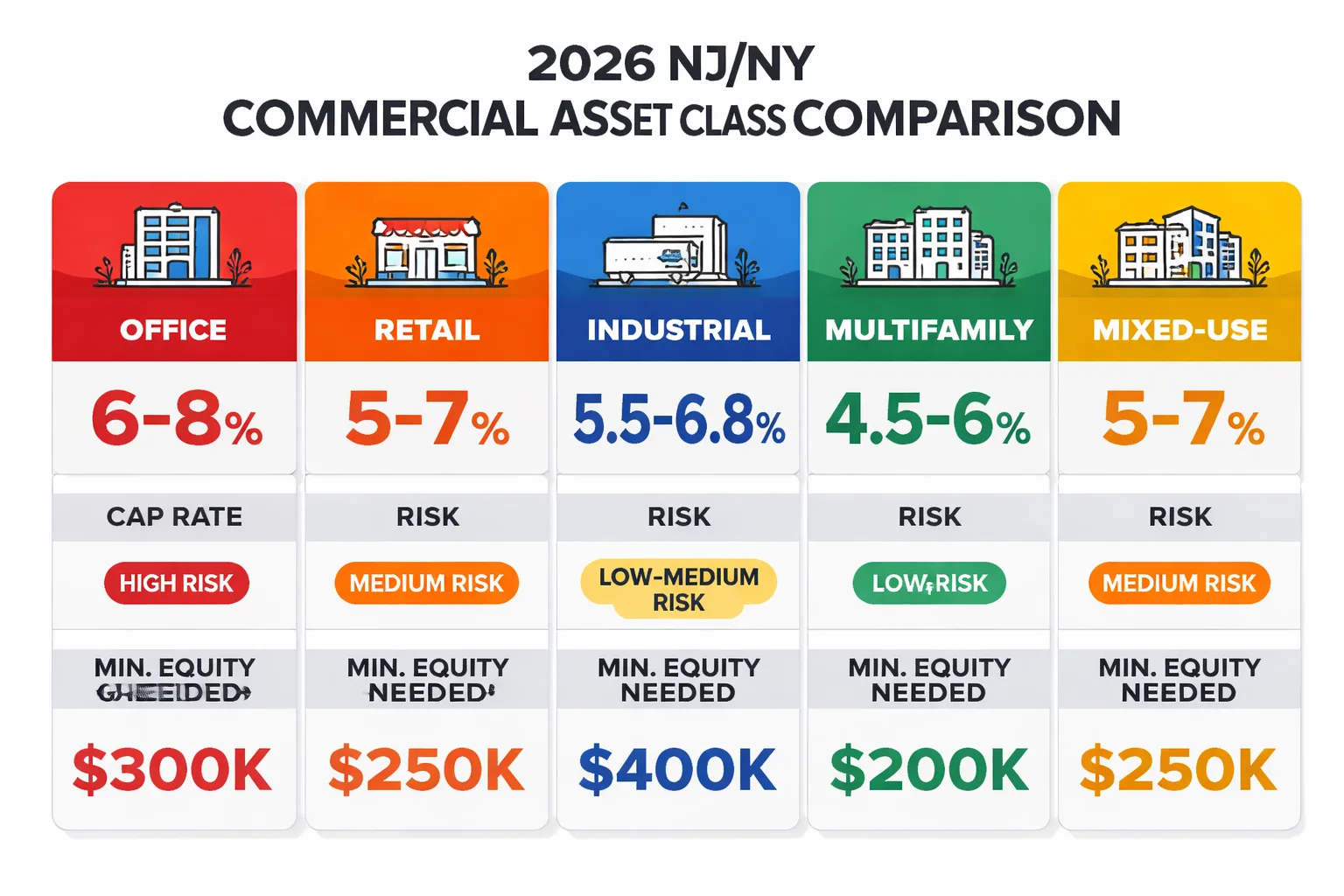
Industrial is the quiet champion of the 2026 cycle. Last-mile logistics warehouses serving e-commerce and regional distribution are in sustained demand. Cap rates for industrial assets in the NJ/NY corridor have compressed to 5.5% to 6.8% in 2026, reflecting aggressive institutional bidding for quality inventory.
Multifamily (5+ units) is the most accessible entry point for investors transitioning from residential. Apartment buildings generate predictable monthly income, benefit from persistent housing demand, and offer scale efficiencies in management. The 2026 New Jersey housing market outlook provides context on rental demand trends driving this sector.
Mixed-use combines retail or office on the ground floor with residential above. These properties are common in NJ transit towns and NYC outer boroughs. They offer income diversification but require more sophisticated management.
Here is where a critical reality check matters. A quoted industrial cap rate of 6.5% in New Jersey looks attractive on a flyer. After property taxes at an effective rate of 2.5% to 3.5% of assessed value, insurance, and management fees, the actual net return to the investor's pocket can drop by 1.5 to 2.5 percentage points. The headline number is a starting point for negotiation, not a guarantee of yield.
How Do Commercial Real Estate Investment Property Loans Work?
This is where most first-time commercial investors hit a wall. The financing structure is fundamentally different from a residential mortgage, and misunderstanding it leads to deals collapsing at closing.
Commercial real estate investment property loans are underwritten primarily on the property's cash flow, not the borrower's personal income. The lender calculates the debt-service coverage ratio (DSCR): the property's net operating income divided by the annual debt service. Most lenders require a DSCR of 1.25 or higher, meaning the property must generate 25% more income than is needed to cover the loan payments.
The loan-to-value (LTV) ratio on commercial investment property loans typically ranges from 65% to 75%, compared to 80% to 95% on residential mortgages. That means a larger down payment. A $2 million commercial property at 70% LTV requires $600,000 in equity, plus closing costs and reserves.
Loan terms are shorter. Commercial loans commonly run 5, 7, or 10 years with amortization schedules of 20 to 25 years. This creates a balloon payment or refinance requirement at the end of the term. Residential borrowers are accustomed to 30-year fixed-rate mortgages that never require refinancing. Commercial borrowers must plan for rate risk at maturity.
Interest rates on commercial loans for investment property are typically 50 to 150 basis points above comparable residential rates, reflecting the higher perceived risk. However, commercial loans offer something residential mortgages do not: assumability and flexibility in structure. Commercial loans can be structured with interest-only periods, partial recourse, or seller financing components that residential lenders would never entertain.
The key loan metrics to understand before approaching a lender:
- LTV (Loan-to-Value): 65-75% is standard for commercial. Higher LTV means higher risk and higher rate. - DSCR (Debt-Service Coverage Ratio): 1.25 minimum is the market standard. Below 1.0 means the property loses money. - Amortization: 20-30 years is typical. Longer amortization means lower payments but more interest paid over time. - Recourse: Full recourse means the lender can pursue personal assets. Non-recourse limits the lender to the property itself. Non-recourse loans require higher equity and stronger properties.
For investors exploring New Jersey real estate investment opportunities, understanding these loan structures before property hunting saves wasted time on deals that cannot be financed.
What Are the Taxes on a Commercial Investment Property?
New Jersey has the highest property tax burden in the United States. For commercial investors, this is not a footnote. It is the single largest line item in the operating budget, and it can make or break a deal.
New Jersey commercial property taxes are calculated by applying the local tax rate to the assessed value of the property, which for income-producing real estate is heavily influenced by the property's income potential. Municipal assessors in NJ use income capitalization as one method to determine assessed value for commercial properties. This means a property generating higher net operating income may be assessed at a higher value, triggering higher taxes even if the market value of the building has not changed.
The effective commercial property tax rate in high-tax NJ counties like Bergen, Hudson, and Essex can reach 2.5% to 3.5% of assessed value annually. On a $2 million commercial property, that translates to $50,000 to $70,000 per year in property taxes alone. This is why the question 'what are the taxes on a $2 million house' takes on a completely different dimension in a commercial context.
For a $2 million commercial property in a 3% effective tax rate jurisdiction:
- Annual property tax: $60,000. Monthly tax burden: $5,000. Per-square-foot impact (on a 10,000 sq ft building): $6.00/sq ft
If the gross rent is $20 per square foot and operating expenses (excluding taxes) are $6 per square foot, the net operating income before debt service is $80,000 annually on a $2 million asset. That is a 4% cap rate before loan payments. After a commercial loan at 7% interest, the property is cash-flow negative.
This is not a hypothetical. This is the math that sinks first-time commercial investors who rely on residential agents unfamiliar with commercial tax assessment methodology. The title fees and closing costs breakdown provides additional context on the upfront costs that compound the tax burden at acquisition.
Tax appeals are a critical tool. Many commercial properties in NJ are over-assessed, particularly after market corrections. Filing a tax appeal can reduce the assessed value and generate savings that flow directly to the bottom line. The appeal window in New Jersey typically runs from February 1 to April 1 of the tax year. Investors who do not appeal are leaving money on the table.
Why Does Cap Rate Mislead NJ Investors?
The cap rate is the most cited metric in commercial real estate. It is also the most misunderstood.
A capitalization rate is the net operating income divided by the purchase price, expressed as a percentage. It is a snapshot of unleveraged yield. It tells you what the property returns before financing, before taxes on profit, and before capital expenditures.
The headline cap rate for industrial properties in NJ might be quoted at 6.5%, but after property taxes at 3% effective rate, insurance increases, and management fees, the actual net return can drop to 4.0% to 5.0%. That 1.5 to 2.5 percentage point gap is where investors lose money they did not budget for losing.
The problem is that brokers quote cap rates based on trailing twelve months of operating data. If the current tenant is paying below-market rent and the lease expires in six months, the trailing cap rate overstates the future return. If the roof needs replacement in year two and the HVAC is at end of life, the cap rate does not account for those capital expenditures.
Sophisticated investors calculate multiple cap rate scenarios: in-place cap rate, stabilized cap rate (after lease-up or renovation), and exit cap rate (the expected rate at sale). They stress-test each scenario against interest rate movements and tax assessment changes. Novice investors look at the headline number and make an offer.
This is why working with a commercial real estate specialist matters. A residential agent recommended by a friend may be excellent at pricing homes and staging kitchens. That skill set does not transfer to analyzing a triple-net lease, calculating effective rent after tenant improvement allowances, or negotiating a tax appeal. The comparison between Fort Lee and Short Hills illustrates how different NJ submarkets carry vastly different tax burdens and investment profiles, even within the same state.
The Hidden Risks Nobody Mentions
Every investment article lists risks. Few name the specific risks that actually destroy capital in the NJ/NY commercial market.
Regulatory and political risk is the silent killer of commercial returns. The One Journal Square project in Jersey City is a case study. A high-profile luxury development stalled for years because the mayor opposed tax abatements and EB-5 visa program controversies drove away capital. Investors who committed capital based on the projected returns saw their timelines stretch from 3 years to 7+ years, with no income and uncertain recovery.
This is not an isolated incident. Tax abatement policies in NJ change with every municipal election. Rent stabilization laws in NYC can cap revenue growth on multifamily properties. Zoning changes can restrict or expand development rights overnight. Environmental remediation requirements on industrial sites can trigger six-figure cleanup costs that wipe out years of cash flow.
Market saturation is the second hidden risk. Office leasing volume in Jersey City dropped 22% quarter-over-quarter in early 2026. The disconnect between advertised occupancy and actual daily usage is enormous in the post-remote-work era. A building that reports 85% leased may have 50% actual daily occupancy because tenants are paying for space they rarely visit. Ground-floor retail tenants depend on foot traffic from office workers. When that traffic disappears, retail tenants break leases or negotiate rent reductions, and the building's income drops.
Vacant commercial property is a persistent problem across New Jersey. A Rutgers policy report documented the causes and consequences of commercial vacancy, noting that vacant properties drag down surrounding values and create maintenance liabilities that compound over time. Investors who purchase vacant commercial properties expecting quick re-tenanting often discover that the local market cannot support the rent assumptions in their pro forma.
The third risk is liquidity. Commercial real estate is illiquid by nature. Selling a commercial property takes 6 to 18 months in normal market conditions. In a downturn, the bid-ask spread widens and transactions stall. Investors who need to access capital quickly may be forced to sell at a discount or refinance into unfavorable terms.
Are you evaluating a commercial property investment in NJ or NY?
When Should You Invest in Commercial Property?
Not every investor should be in commercial real estate. The decision depends on capital, risk tolerance, time horizon, and willingness to operate what is effectively a small business.
Minimum capital threshold: $200,000 in liquid equity is the realistic floor for a first commercial investment in the NJ/NY market. This covers a 25-30% down payment on a $600,000 to $800,000 property, plus closing costs, reserves for repairs, and 6 months of operating expenses. Investors with less capital should consider syndication or REITs before direct ownership.
Risk tolerance: Commercial investing requires the ability to absorb a vacant unit for 3 to 6 months without financial distress. If a single tenant departure would force the investor to sell or take on high-interest debt, the investor is undercapitalized for the position.
Time horizon: 5 to 10 years is the minimum realistic hold period for commercial property. The transaction costs alone (broker fees, legal, transfer taxes, loan origination) can consume 5-8% of the purchase price. Short holds rarely generate enough appreciation to recover these costs.
Management capacity: Commercial properties require active management. Even with a property management company, the owner must approve capital expenditures, review financials, and make strategic decisions about leasing and tenant retention. Passive investors should stick to REITs.
For investors who meet these criteria, the current market presents genuine opportunity. Distressed office assets are trading at 30-40% discounts to replacement cost. Industrial properties in logistics corridors near Port Newark and the Holland Tunnel approach remain in structural demand. Small-bay industrial properties in Bergen County and Hudson County are particularly attractive for first-time commercial investors because the tenant pool (local trades, contractors, small distributors) is deep and the lease terms (3-5 years) provide flexibility.
The Closter September 2026 market trends analysis and the broader 2026 New Jersey housing market outlook provide data on specific submarkets where commercial demand is concentrated.
The Contrarian Case for Starting Commercial
Here is what most financial advisors get wrong: they tell clients to start with residential real estate, build equity, then graduate to commercial. That sequence sounds logical. It is actually backwards.
Residential investing teaches bad habits. It teaches investors to rely on appreciation rather than cash flow. It teaches them to evaluate properties emotionally. It trains them to use residential financing tools that do not exist in the commercial world. Then, when they finally transition to commercial, they have to unlearn everything.
Starting with a small commercial property forces discipline from day one. The investor must underwrite cash flow, understand DSCR, negotiate commercial leases, and manage business tenants. The learning curve is steeper, but the skills are transferable. A residential investor who starts with a duplex learns how to collect rent and fix toilets. A commercial investor who starts with a small retail strip learns how to read a lease, calculate effective rent, and manage multiple tenant relationships.
The counterargument is risk. Residential properties are perceived as safer because housing demand is constant. That perception is partially correct but incomplete. A residential property with a bad tenant, deferred maintenance, and a soft rental market can lose money just as fast as a commercial property. The difference is that the commercial investor is forced to confront the numbers upfront, while the residential investor can hide behind appreciation hopes for years before reality catches up.
The data supports this. Manhattan luxury one-bedroom apartments averaged over $6,000 per month in rent in 2025, yet roughly 1 in 3 luxury condo sales occurred at a loss, according to market data on NYC's 2025 housing landscape. Buying luxury residential is not a guaranteed investment return. The same capital deployed into a commercial property with a 6% cap rate and a 10-year lease from a credit tenant would have generated predictable income without dependence on market timing for appreciation.
Building Your Commercial Investment Strategy
A strategy is not a property. It is a framework for deciding which properties to buy, how to finance them, and when to sell.
Step 1: Define the return objective. Is the goal cash flow, appreciation, or tax shelter? Each objective points to different asset classes. Cash flow investors should target multifamily and industrial. Appreciation investors should look at value-add office and mixed-use in gentrifying corridors. Tax-motivated investors should explore opportunity zones and 1031 exchanges.
Step 2: Set the capital budget. How much equity is available, and how much leverage is appropriate? A 65% LTV on a $1.5 million property requires $525,000 in equity. Add 5% for closing costs and 5% for reserves, and the total capital needed approaches $630,000.
Step 3: Choose the market. NJ and NY offer distinct submarkets with different risk-return profiles. Jersey City and Hoboken offer transit-oriented mixed-use opportunities but carry regulatory risk. Bergen County suburbs offer stable retail and small industrial with lower volatility. Manhattan offers trophy assets at compressed cap rates with institutional competition. The guide to working with a real estate agent in Yonkers, NY illustrates how local expertise varies even within the broader NY metro area.
Step 4: Build the team. A commercial real estate broker, a commercial mortgage broker, a real estate attorney, and a CPA with commercial real estate experience. The broker finds deals. The mortgage broker structures financing. The attorney negotiates contracts and reviews leases. The CPA manages tax strategy. Skipping any of these roles is a false economy.
Step 5: Execute due diligence. Phase 1 environmental assessment, property condition assessment, title search with easement review, lease audit, and tax assessment review. These cost $10,000 to $25,000 upfront and save hundreds of thousands in avoided mistakes. The listing agreement guide explains the contractual frameworks that govern broker relationships in these transactions.
What This Actually Means for 2026 Investors
The commercial real estate market in 2026 is bifurcated. Trophy assets in prime Manhattan locations trade at record-low cap rates because institutional capital is seeking safe harbors. Distressed and value-add assets in secondary NJ markets trade at wider spreads because the expertise required to reposition them filters out casual buyers.
That filtering effect is the opportunity. Investors who understand commercial loan structures, tax implications, and tenant credit analysis can acquire properties that residential-focused competitors cannot evaluate, finance, or close. The barrier to entry is not capital. It is competence.
The NJ/NY corridor remains one of the most resilient commercial markets in the country. Population density, transit infrastructure, and proximity to the Port of New York and New Jersey create sustained demand for industrial, retail, and multifamily properties. The New York real estate developers shaping the market are directing capital toward mixed-use and transit-oriented development, signaling where future demand will concentrate.
For investors ready to move beyond residential, investment on commercial property offers a path to predictable income, tax advantages through depreciation and 1031 exchanges, and equity buildup through tenant-paid mortgage amortization. The risks are real and documented here. The returns, for investors who do the work, are equally real.
The next step is not browsing listings. It is defining a strategy, assembling a team, and running the numbers on a specific property type in a specific submarket. That is how commercial portfolios are built. One disciplined acquisition at a time.
Frequently Asked Questions
What is the minimum down payment for investment on commercial property?
Commercial lenders typically require 25% to 35% down, translating to a 65% to 75% loan-to-value ratio. On a $1 million property, expect to put down $250,000 to $350,000 in equity, plus 3% to 5% in closing costs and reserves. Some SBA-backed loans for owner-occupied commercial properties allow 10% to 15% down, but these do not apply to pure investment properties.
How long do commercial leases typically last?
Commercial leases generally run 3 to 10 years, with 5 years being the most common term for small to mid-size properties. Industrial and retail leases often extend to 10 years or more, especially with national credit tenants. Longer leases provide income stability but may include tenant improvement allowances or free rent periods that reduce effective income in early years.
Can I use a residential mortgage to buy a mixed-use property?
If the property is zoned mixed-use and has more than 4 residential units, it requires commercial financing. A mixed-use building with 4 or fewer residential units and commercial space on the ground floor may qualify for residential financing in some cases, but lenders evaluate these on a case-by-case basis. The property's income potential and zoning classification determine the loan type.
What is a good cap rate for commercial property in NJ in 2026?
Cap rates in NJ vary by asset class and location. Industrial properties trade at 5.5% to 6.8%, retail at 5% to 7%, office at 6% to 8% (higher for distressed assets), and multifamily at 4.5% to 6%. However, after NJ property taxes and operating expenses, the net return to the investor is typically 1.5 to 2.5 percentage points lower than the quoted cap rate.
How do property tax appeals work for commercial real estate in NJ?
New Jersey allows property owners to file tax appeals annually, typically between February 1 and April 1. The appeal must demonstrate that the assessed value exceeds the market value through comparable sales or income capitalization analysis. Successful appeals can reduce the assessed value, lowering the tax bill for the current and future years. Commercial property owners should review their assessments annually.
Should I work with a commercial broker or a residential agent?
Commercial transactions require expertise in lease analysis, cap rate calculation, commercial financing, and tax assessment that residential agents typically do not possess. A commercial real estate broker understands investment underwriting, tenant credit evaluation, and market-specific factors affecting commercial income. Working with a residential agent on a commercial deal is a common and costly mistake for first-time investors.
About the Author
Judy Zhou, Keller Williams Realtor®
Judy Zhou is a Realtor® with Keller Williams Town Life Realty in Tenafly, NJ, serving New Jersey and New York with $35M+ in sales volume. Licensed in both NJ and NY, she specializes in luxury homes, investment properties, and commercial real estate, offering seamless bilingual English-Chinese service. Before joining Keller Williams, she earned Coldwell Banker's International President's Elite (2024) and International Diamond Society (2025) awards.
Get a cash flow and tax analysis on your target commercial property before you make an offer, not after.