What Are Luxury Condos in NJ? The 2026 Buyer's Definition

By Judy Zhou, Keller Williams Realtor®
Key Takeaways
- Toll Brothers delivered 6,641 homes averaging $1 million each in Q2, generating $2.65 billion and proving volume alone does not create luxury status.
- Bergen County’s median sale price of $731,000 in January 2026, down 3.8% year-over-year with just 1,666 active listings, shows expensive prices do not equal luxury.
- River Edge residential properties averaged $816,796 in 2024, up 4.2% from 2023, yet still fail to meet true luxury criteria beyond price.
- Define any NJ luxury condo by construction quality, location scarcity, amenity permanence, and resale liquidity rather than marketing or doorman presence.
Most so-called luxury condos in New Jersey are not luxury. And the buyers who know this are the ones building real wealth. The term has been so thoroughly diluted by developers, listing platforms, and eager sales teams that it now functions as marketing noise rather than meaningful classification. In 2026, any serious buyer, investor, or real estate agent nj salary professional needs a working definition that goes beyond granite countertops and a doorman. The condos that genuinely qualify are fewer than you think, and they behave very differently as investment assets.
The data tells a blunt story: Toll Brothers delivered 6,641 homes at an average price of $1 million in Q2 alone, generating $2.65 billion in revenue, per Propmodo. That volume proves the luxury label is being slapped on anything above a price threshold. Meanwhile, Bergen County's median sale price sat at $731,000 in January 2026, down 3.8% year-over-year, with active listings at just 1,666 units. River Edge, NJ saw residential properties average $816,796 in 2024, up roughly 4.2% from $783,745 in 2023, according to local market data. But none of these figures define "luxury." They define "expensive." The gap between the two is where buyers lose money.
A real luxury condo in NJ is defined by construction quality, location scarcity, amenity permanence, and resale liquidity, not by marketing brochures or a doorman with a nice uniform.
What Qualifies as a Luxury Condo in New Jersey?
A luxury condo in New Jersey is not a price point. It is a combination of structural quality, location scarcity, amenity permanence, and resale liquidity. The market is flooded with buildings that charge luxury prices without delivering luxury fundamentals. Buyers who cannot tell the difference will overpay, then discover at resale that the market never agreed with the developer's positioning.
The price threshold for luxury condos in NJ varies by submarket but generally starts above $1.2 million for units in Bergen County and Hudson County corridors near Manhattan. That figure comes from cross-referencing Toll Brothers' $1 million average delivery price (which includes single-family homes nationally) with the premium that condo-specific product commands in NJ transit-adjacent locations. A condo priced below that threshold can still be excellent, but it is not luxury. It is premium.
The construction quality bar is where most "luxury" buildings fail. Real luxury means floor-to-ceiling windows with thermal performance ratings, not just tall glass. It means separate drains for every sink and shower (a detail the r/nyc community correctly identifies as a hallmark of genuine high-end construction that marketing brochures never mention). It means HVAC systems sized for the unit, not undersized to save developer margin. It means soundproofing between units that actually works, not just resilient channels on the plans.
Location scarcity is the second pillar. A luxury condo must be in a location where supply cannot easily expand. That means waterfront positions, transit-adjacent sites within walking distance of ferry or rail to Manhattan, or established luxury corridors where land is built out. Generic suburban locations with new condo towers do not qualify, regardless of finish quality, because supply can always flood in next door.
Amenity permanence separates real luxury from amenity theater. A doorman, a gym, and a roof deck are baseline 2026 expectations, not luxury features. Genuine luxury amenities include full-service concierge with package handling, on-site management (not remote), climate-controlled storage, dedicated parking with EV infrastructure, and common areas designed by named architects. The test is simple: would the amenity still function and add value in ten years, or is it a marketing feature that will break and never get fixed?
Resale liquidity is the final and most overlooked qualifier. A luxury condo must have a deep enough buyer pool that an owner can sell within 90 days at fair market value without steep price cuts. Buildings with odd unit mixes, poor HOA financials, or locations that only appeal to a narrow niche fail this test. The 2026 New Jersey Housing Market Outlook provides broader context on which NJ submarkets are maintaining liquidity as inventory shifts.
How NJ Luxury Condos Differ From NYC Luxury Condos
The comparison between NJ and NYC luxury condos is not apples-to-apples. It is apples-to-steak. Both are food, but they serve different purposes, carry different cost structures, and appeal to different buyer profiles. Understanding the differences is essential for anyone weighing new york investment properties against NJ alternatives.
Price-per-square-foot is the most visible difference. Manhattan luxury condos have projected prices reaching $1,952 per square foot for Q2 2026, based on long-term appreciation trends from $480 per square foot in 1999. NJ luxury condos in premium Bergen County locations typically range from $600 to $900 per square foot, depending on building age, waterfront access, and transit proximity. That means a buyer getting 2,000 square feet in NJ would pay $1.2 to $1.8 million, while the same square footage in Manhattan could cost $3.5 to $4 million.
But the price gap is only the beginning. The carrying cost structure is fundamentally different, and this is where NJ buyers gain an advantage that compounds over time.
| Factor | NJ Luxury Condo | Manhattan Luxury Condo |
| Price per sq ft | $600-$900 | $1,400-$1,952 |
| Monthly carrying costs (HOA + taxes) | $1,500-$3,500 | $3,000-$8,000+ |
| Outdoor space availability | Common (balconies, terraces) | Rare and expensive |
| Typical unit size | 1,500-3,000 sq ft | 800-1,800 sq ft |
| Commute to Midtown | 30-60 min (ferry/rail) | 0-20 min |
| Resale buyer pool | NJ + NYC commuters | Global + domestic |
The HOA fee structure in NJ tends to be more predictable. Manhattan condos often carry common charges that escalate aggressively due to labor costs, aging building infrastructure, and insurance premium increases. NJ buildings, particularly newer construction in Bergen and Hudson counties, tend to have HOA fees that track closer to inflation. That said, buyers must scrutinize HOA reserves and pending assessments in both markets. A low monthly fee with an underfunded reserve is a ticking special assessment.
Outdoor space is where NJ luxury condos win decisively. Manhattan luxury apartments rarely offer private outdoor space at any reasonable price point. NJ luxury condos frequently include balconies, terraces, or even ground-level patios. For buyers relocating from Manhattan, this is often the single factor that drives the move.
The lifestyle trade-off is real. Manhattan offers walkability, cultural density, and a global prestige factor that NJ cannot match. NJ offers space, lower carrying costs, better schools (in districts like Tenafly, Closter, and Alpine), and a quieter daily rhythm. The right choice depends on the buyer's life stage, investment horizon, and liquidity needs.
For investors specifically, the NJ market offers better rental yield potential on a price-to-rent basis, though with higher vacancy risk in non-transit-adjacent locations. Manhattan offers lower yields but stronger appreciation and a deeper tenant pool. The Fort Lee vs. Short Hills comparison illustrates how two NJ luxury submarkets serve completely different investor profiles.
Key Terms Every NJ Luxury Condo Buyer Should Know
The vocabulary of condo buying is designed to confuse. Terms that sound interchangeable carry different legal and financial implications. Misunderstanding them is how buyers end up surprised by costs, restrictions, or resale complications they never anticipated.
Co-op vs. condo. A condominium (condo) means the buyer owns the unit outright as real property, plus a fractional interest in the common areas. A cooperative (co-op) means the buyer owns shares in a corporation that owns the building, and receives a proprietary lease for their unit. Co-ops are rare in NJ luxury condo developments but common in Manhattan. Co-op boards can reject buyers without explanation, require extensive financial disclosure, and impose subletting restrictions. Condos have far fewer restrictions. For NJ buyers, this distinction matters most when comparing NJ condo options to Manhattan co-op alternatives.
HOA vs. condo fee vs. common charges. These terms are often used interchangeably but have precise meanings. In NJ, the HOA (Homeowners Association) fee covers maintenance of common areas, amenities, building insurance, and sometimes utilities. "Common charges" is the technically correct term for condos in some jurisdictions, referring to the owner's share of common area operating expenses. Property taxes are separate and billed directly by the municipality in NJ, unlike some states where taxes are escrowed into the monthly payment. Buyers should request the last two years of HOA financial statements and the most recent reserve study before committing.
Offering plan. The offering plan (also called a prospectus) is the legal document filed with the state when a condo is newly constructed or converted. It details the unit specifications, HOA budget, rules, bylaws, and any sponsor (developer) retained units or financing arrangements. For new construction luxury condos, the offering plan is the single most important document. It reveals whether the developer has retained too many units (a red flag for HOA control), whether assessments are planned, and what the actual HOA budget projects versus the marketing pitch.
Certificate of occupancy. The certificate of occupancy (CO) is the municipal document certifying that a building complies with building codes and is safe for habitation. A unit cannot legally close without a CO. In new construction, CO delays are one of the most common reasons closings get pushed. Buyers should never sign a contract without understanding the CO timeline and what happens if it slips. The title fees and closing costs guide breaks down how CO delays interact with closing cost timing.
Attorney review period. In New Jersey, residential real estate contracts include a mandatory three-business-day attorney review period after contract signing. Either party's attorney can cancel or modify the contract during this window without penalty. This is a NJ-specific protection that does not exist in New York transactions. For luxury condo buyers, this period is critical for renegotiating terms based on offering plan review, HOA financial audit, or inspection findings.
Sponsor unit. A sponsor unit is a unit still owned by the developer. Buying a sponsor unit can mean bypassing board approval (in co-ops) or getting a better price, but it also means the developer may be desperate to sell, which can signal building-wide sales problems. Sponsor units in new luxury buildings often come with developer-financing incentives that sound attractive but carry higher long-term costs.
Is Buying a Luxury Condo in NJ a Good Investment in 2026?
The investment case for NJ luxury condos in 2026 is strong but selective. Not every luxury condo will appreciate. Not every building will maintain rental demand. The buyers who make money are the ones who buy into specific submarkets with proven liquidity, transit access, and constrained supply.
Appreciation trends are moderate but positive in well-positioned NJ submarkets. River Edge residential properties averaged $816,796 in 2024, up approximately 4.2% from $783,745 in 2023, per local market tracking. That is a general residential figure, not luxury-condo-specific, but it signals the broader Bergen County appreciation environment. Luxury condos in transit-adjacent locations (Fort Lee, Edgewater, Weehawken, Jersey City waterfront) tend to outperform the county average because their buyer pool includes Manhattan commuters who are priced out of NYC but demand proximity.
The Manhattan comparison is instructive. Manhattan luxury condo prices have appreciated from $480 per square foot in 1999 to a projected $1,952 per square foot by Q2 2026. That looks extraordinary on paper. But a critical and often-overlooked data point: approximately 1 in 3 luxury condo sales in Manhattan are happening at a loss. That statistic should reframe how investors think about "guaranteed" luxury appreciation. High carrying costs, a limited secondary buyer pool for ultra-expensive units, and market timing all contribute to this loss rate. NJ luxury condos, with lower entry prices and lower carrying costs, face less of this pressure.
Rental yield potential favors NJ over Manhattan for cash-flow investors. A $1.5 million NJ luxury condo can command $4,000 to $5,500 in monthly rent in transit-adjacent Bergen County locations, producing a gross yield of 3.2% to 4.4%. A $3.5 million Manhattan equivalent might rent for $8,000 to $12,000 monthly, producing a gross yield of 2.7% to 4.1%. The NJ yield is competitive or better, with a fraction of the capital at risk. However, NJ investors must account for vacancy risk, particularly in non-waterfront locations where the tenant pool is thinner. The NJ real estate investment guide covers these yield calculations in depth.
Resale liquidity is the make-or-break factor. Bergen County had 1,666 active residential listings in January 2026, down 0.2% year-over-year, with a median of 87 days on market (up 7 days YoY). Tight inventory supports resale liquidity, but the 87-day median means buyers should plan for a three-month sales window at minimum. Luxury condos specifically may take longer because the buyer pool is narrower. Buildings with strong HOA financials, desirable locations, and clean offering plans sell faster. Buildings with deferred maintenance, special assessments, or sponsor control sit longer.
For international and Chinese-American buyers specifically, NJ luxury condos offer several advantages: lower entry costs than Manhattan, bilingual service availability (critical for navigating contracts, HOA documents, and closing processes), and proximity to Manhattan for personal use or rental management. The NJ market is also less saturated with foreign investor competition than Manhattan, which means less bidding pressure on quality inventory.
The regulatory risk factor cannot be ignored. The One Journal Square project in Jersey City demonstrates how local politics, tax abatement disputes, and EB-5 program controversies can derail even high-profile luxury developments. Investors should evaluate the political and regulatory environment of any NJ submarket before committing capital. Established luxury corridors with multiple completed projects and stable municipal governance carry lower risk than emerging areas where a single project's failure can depress values across the submarket.
Why the Agent You Choose Changes the Outcome
The agent representing a luxury condo buyer in NJ directly affects the purchase price, the terms negotiated, and the hidden costs caught before closing. This is not a generic statement about agent value. It is a specific, measurable reality in the NJ luxury condo market.
Consider the economics. The question of a real estate agent nj salary is really a question of what value the agent creates for the buyer or seller. A commission-based agent who closes one $1.5 million luxury condo transaction at 2.5% buyer-side commission earns $37,500. That sounds like a strong income, but it reflects a fraction of the value a skilled agent preserves for the client. An agent who identifies that a building's HOA reserves are underfunded, triggering a price renegotiation of $50,000, has created more value for the buyer in one transaction than the commission itself. An agent who catches an unfavorable clause in the offering plan during attorney review can save the buyer from a special assessment of $20,000 to $80,000 down the line.
The bar for a competent nj real estate agent is higher than most buyers realize. It requires deep market analysis skills (interpreting comparable sales, days-on-market trends, and inventory absorption rates), legal literacy (understanding dual agency risks, attorney review mechanics, and offering plan red flags), and transaction problem-solving (navigating CO delays, financing contingencies, and inspection negotiations). Agents who lack these skills cost their clients money. Buyers have overpaid by $40,000 or more because their agent missed critical market data signals or failed to identify the optimal offer timing.
For buyers working with a ny real estate agent who also holds NJ licensure, the advantage is market comparison. An agent who understands both the Manhattan and NJ luxury markets can identify when a NJ condo is overpriced relative to Manhattan alternatives or when a Manhattan listing is negotiable below NJ price-per-square-foot parity. That cross-market expertise is rare but valuable for buyers weighing both options.
The Closter September 2026 market data and the Is Closter NJ really a wealthy area worth buying into analysis demonstrate how hyper-local expertise within Bergen County changes investment outcomes. Two towns five miles apart can have completely different appreciation trajectories, school district impacts on resale, and inventory dynamics.
Looking at luxury condos in NJ but not sure which buildings actually hold value?
What Should Buyers Do Before Making an Offer?
The pre-offer phase is where luxury condo buyers either protect themselves or set up future losses. The steps are specific and non-negotiable.
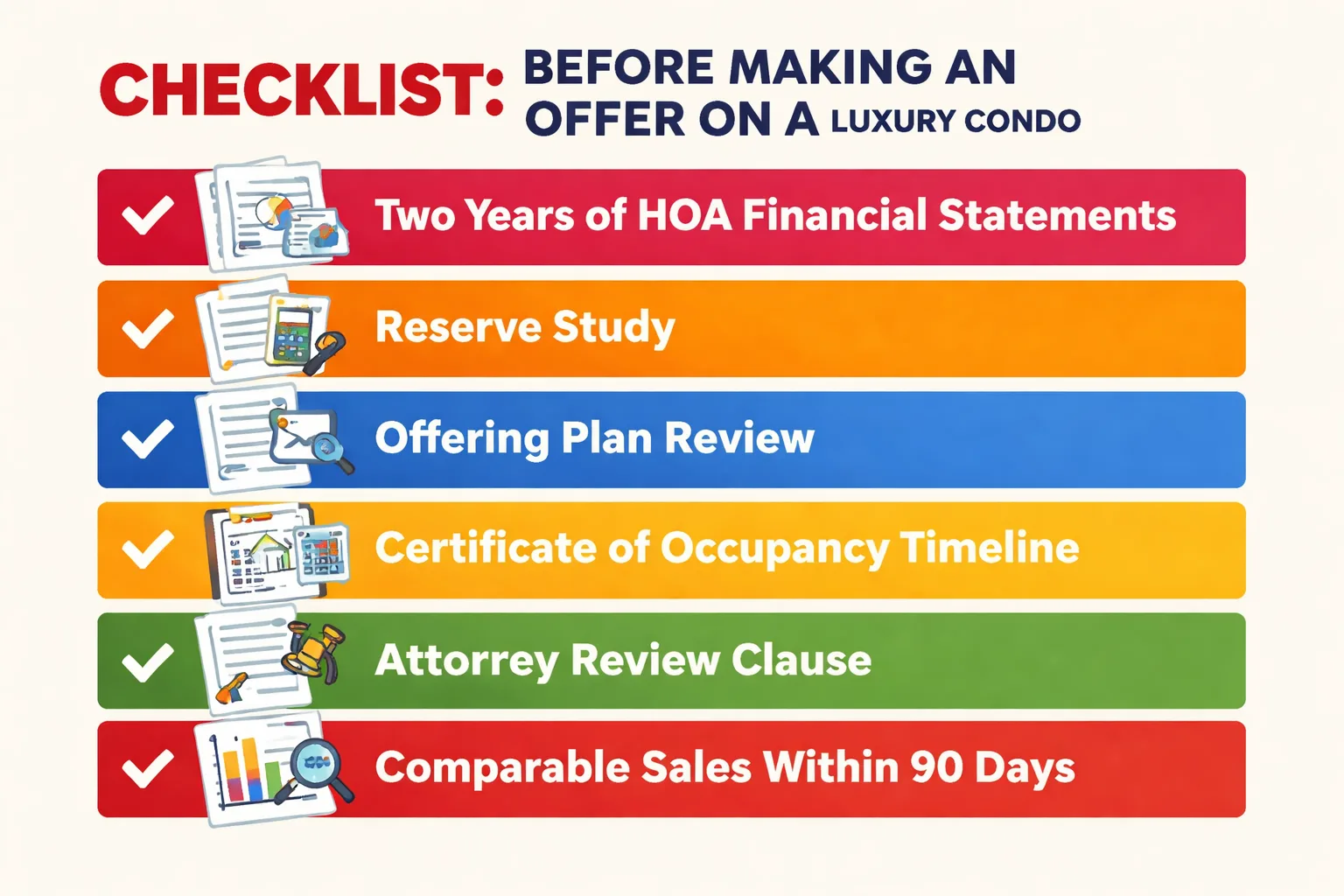
First, request and review the last two years of HOA financial statements and the most recent reserve study. These documents reveal whether the building has the cash reserves to handle major repairs without special assessments. An underfunded reserve is the single most common source of unexpected costs for condo buyers. If the reserve is below 70% of the recommended funding level, walk away or negotiate the price down by the projected assessment amount.
Second, read the offering plan. For new construction, this is the bible. For resale units, the offering plan still governs the rules, restrictions, and any developer obligations. Look for sponsor-retained units (more than 20% of units still sponsor-owned is a red flag), flip restrictions, and any pending litigation against the HOA.
Third, run comparable sales within the last 90 days, not the last six months. The luxury condo market moves fast enough that older comparables are misleading. An agent with MLS access and local expertise should provide a comparable sales analysis that adjusts for unit size, floor level, view, and condition. If the asking price is more than 5% above the adjusted comparable average, the price is negotiable.
Fourth, understand the NJ property tax landscape before committing. NJ has some of the highest property taxes in the nation, and luxury condos are not exempt. Property taxes on a $1.5 million condo in Bergen County can range from $18,000 to $30,000 annually depending on municipality. That number must be factored into the carrying cost calculation, not discovered at closing.
Fifth, engage a real estate attorney before signing anything. NJ's attorney review period is a protection, but only if the attorney is involved from the start. The attorney should review the contract, offering plan, and HOA documents concurrently with the inspection period. Waiting until after signing to involve an attorney limits the ability to renegotiate.
The Contrarian Take: Stop Chasing Amenities
Here is what most buyers get wrong about luxury condos in NJ: they overpay for amenities and underpay attention to fundamentals.
The market is saturated with buildings that market themselves as luxury based on amenity lists: rooftop decks, fitness centers, dog spas, wine rooms, golf simulators. These features sound impressive in a sales gallery. They are marketing hooks, not value drivers. The maintenance cost of these amenities is baked into HOA fees forever. When the roof deck needs resurfacing in year seven, or the golf simulator breaks in year four, the repair cost comes from the reserve. If the reserve is underfunded (and it usually is in amenity-heavy buildings), the difference comes from a special assessment.
The buildings that hold value are the ones with boring, permanent fundamentals: good construction, sound HOA financials, transit proximity, and unit layouts that make sense. A building with a solid reserve fund, 10-minute walk to the ferry, and no wine room will outperform a building with a wine room, an underfunded reserve, and a 25-minute commute. Every time.
Buyers who understand this are the ones who build wealth through luxury condo ownership in NJ. Buyers who chase the amenity list are the ones who sell at a loss in five years and wonder what went wrong.
For those also considering commercial real estate in NJ, the same principle applies: fundamentals over flash. The commercial real estate investor's guide covers how to evaluate commercial properties with the same rigor.
What This Actually Means for 2026 Buyers
The NJ luxury condo market in 2026 rewards buyers who define luxury correctly, scrutinize fundamentals relentlessly, and work with agents who bring cross-market expertise. The data is clear: inventory is tight (1,666 active listings in Bergen County, down 0.2% YoY), prices are moderating ($731,000 median, down 3.8% YoY), and well-positioned submarkets are appreciating at 4%+. The opportunity is real. The risk of overpaying for a fake luxury label is equally real.
The buyers who win are the ones who treat a luxury condo purchase as an investment decision, not a lifestyle purchase. That means demanding HOA financials, reading offering plans, running 90-day comparables, and choosing an agent who can identify the difference between a $1.2 million condo that will appreciate and a $1.2 million condo that will sit on the market for 120 days when it is time to sell. The right real estate agent nj salary question is not how much the agent earns, but how much value the agent preserves.
For buyers navigating both NJ and NY markets, the advantage of working with a licensed agent in both states is clear. Cross-market comparison, coordinated closing logistics, and access to inventory in both jurisdictions create leverage that single-state agents cannot provide. Whether the target is a luxury condo in Fort Lee, a brownstone in Manhattan, or a commercial investment property in Jersey City, the fundamentals of due diligence do not change. Only the address does.
FAQ
What is the minimum price for a luxury condo in NJ?
Luxury condos in NJ generally start above $1.2 million for units in Bergen and Hudson County corridors near Manhattan. Below that threshold, condos are premium but not luxury. The distinction matters because luxury-priced condos without luxury fundamentals (construction quality, location scarcity, HOA financial health) will not hold value at resale. Buyers should verify the price against comparable sales, not the developer's asking price.
Are NJ luxury condos cheaper than Manhattan luxury condos?
Significantly. NJ luxury condos typically range from $600 to $900 per square foot, while Manhattan luxury condos project to $1,952 per square foot by Q2 2026. A 2,000-square-foot NJ condo costs $1.2 to $1.8 million versus $3.5 to $4 million for the same size in Manhattan. Carrying costs (HOA plus taxes) are also roughly half in NJ. The trade-off is commute time and Manhattan's cultural density.
How long does it take to sell a luxury condo in NJ?
The median days on market for Bergen County residential properties was 87 days in January 2026, up 7 days year-over-year. Luxury condos specifically may take longer because the buyer pool is narrower. Well-positioned units in transit-adjacent buildings with strong HOA financials can sell in 45 to 60 days. Units with deferred maintenance, special assessments, or poor locations can sit for 120 days or more. Pricing correctly from the start is the single biggest factor in sale speed.
Do I need an attorney to buy a luxury condo in NJ?
Yes. New Jersey's three-business-day attorney review period is a consumer protection that allows either party's attorney to cancel or modify the contract without penalty. An attorney should review the contract, offering plan, and HOA documents before the review period expires. For new construction, the offering plan review is especially critical because it reveals sponsor-retained units, pending assessments, and HOA budget projections that marketing materials never mention.
Can international buyers purchase luxury condos in NJ?
Yes. International buyers, including Chinese-American investors, can purchase condos in NJ without special restrictions. Condos (unlike co-ops) do not require board approval. The main considerations are financing (foreign nationals may face higher down payment requirements), tax implications (consult a tax advisor on FIRPTA and foreign ownership structures), and currency transfer logistics. Working with a bilingual agent and attorney streamlines the process significantly.
What is the difference between common charges and property taxes in NJ condos?
Common charges (the HOA fee) cover maintenance of common areas, amenities, building insurance, and shared utilities. Property taxes are separate and billed directly by the municipality. In NJ, property taxes on a $1.5 million condo can range from $18,000 to $30,000 annually depending on the town. Buyers must factor both costs into their monthly carrying cost calculation. Requesting the last two years of HOA financial statements and the current tax bill is standard due diligence.
About the Author
Judy Zhou, Keller Williams Realtor®
Judy Zhou is a Realtor® with Keller Williams Town Life Realty in Tenafly, NJ, serving New Jersey and New York with $35M+ in sales volume. Licensed in both NJ and NY, she specializes in luxury homes, investment properties, and commercial real estate, offering seamless bilingual English-Chinese service. Before joining Keller Williams, she earned Coldwell Banker's International President's Elite (2024) and International Diamond Society (2025) awards.
Get a private consultation to identify NJ luxury condos with real appreciation potential before you make an offer.