Real Estate Agent Salary in NY: What You Actually Earn
By Judy Zhou, Keller Williams Realtor®
Key Takeaways
- Real estate agents in the New York-Newark-Jersey City metro earned a median annual wage of $103,550 in May 2025, 96% above the U.S. median of $52,830.
- Among 8,320 agents in the metro area, the top 20% capture the lion's share of commission dollars while the rest generate little to no revenue.
- A Rochester agent selling a median $230,000 home earns roughly $6,900 in total commission per transaction before the typical 70/30 brokerage split.
- The metro area's cost of living index of 112.6 reduces the purchasing power of those elevated earnings relative to the U.S. baseline of 100.
Picture a Monday morning team meeting at a mid-sized brokerage in Rochester, NY. The broker pulls up last quarter's numbers on a whiteboard: twelve agents on the roster, four of them closed at least one deal, two of them generated nearly all of the office's revenue. The other eight are technically active. Attending trainings, updating their Zillow profiles, refreshing their inboxes. This scene repeats itself at brokerages across New York State every single week, and it explains why the average real estate agent salary figure you find online is almost meaningless without more context.
Real estate agents in the New York-Newark-Jersey City metro earned a median annual wage of $103,550 in May 2025, according to BLS OEWS data, roughly 96% above the U.S. median of $52,830. But that single number masks a brutal income distribution. Upstate markets like Rochester and Buffalo tell a completely different financial story than Manhattan or Brooklyn. The cost of living index for the metro area sits at 112.6 (with the U.S. baseline at 100), which means those elevated earnings buy less than they appear to. And the roughly 8,320 agents employed across the metro area are chasing a finite pool of transactions, with the top 20% capturing the lion's share of commission dollars.
The national commission rate hovers between 5 and 6%, but what an individual agent takes home depends on the split with their brokerage, the average sale price in their territory, and how many deals they actually close. A real estate agent in rochester ny working median-priced homes at $230,000 generates roughly $6,900 in total commission per transaction. After a 70/30 split with the brokerage, that is $4,830 before taxes and fees. Close ten deals in a year and gross income lands near $48,000. The same agent volume in Manhattan, where median sale prices exceed $1.1 million, produces a fundamentally different financial picture.
How Much Do Real Estate Agents Earn Across New York State?
New York State is not one real estate market. It is at least five distinct markets stitched together by a single licensing system, and the income data reflects that fragmentation. The BLS figures for the New York-Newark-Jersey City metropolitan area provide the most reliable benchmark, with a median wage of $103,550 and a mean wage of $113,500 as of May 2025. But those numbers represent the NYC-dominated metro, not the state as a whole.
Upstate markets operate on a different economic engine. A real estate agent rochester ny faces a median home price near $230,000, which means each closed transaction generates roughly $5,750 to $6,900 in total commission (at a 2.5 to 3% per-side rate). An agent in Buffalo encounters a similar pricing environment, with median home values around $250,000. Albany sits slightly higher, with median prices in the $290,000 range, producing commission checks of approximately $7,250 to $8,700 per side.
Downstate, the math changes entirely. Manhattan's median sale price has consistently hovered above $1.1 million, meaning a single transaction at a 2.5% commission rate generates $27,500 in gross commission income. Brooklyn and Queens have seen median prices climb past $700,000 and $650,000 respectively, creating per-deal commissions of $17,500 and $16,250 at the same rate. A real estate agent in staten island ny works in a market with median prices closer to $580,000, producing per-side commissions around $14,500.
The practical implication is stark. An agent closing 8 deals per year in Rochester grosses roughly $38,600 to $46,400 in commission income. The same deal count in Manhattan produces $220,000. That 5x gap exists before accounting for brokerage splits, desk fees, marketing costs, or the higher cost of living downstate.
Here is where it gets more granular. Markets like Syracuse, Binghamton, and Watertown operate at even lower price points, with median home values between $180,000 and $220,000. A real estate agent syracuse ny or a real estate agent binghamton ny needs to close significantly more transactions to match the income of a colleague working the Hudson Valley or Westchester County, where median prices sit between $550,000 and $750,000. The transaction volume required to earn a living wage multiplies as you move away from the NYC metro.
And for agents working the Bronx market, the picture is more nuanced than pure NYC numbers suggest. A real estate agent bronx ny or a real estate agent in bronx ny faces median prices around $525,000, which is higher than most upstate markets but well below Manhattan. The per-deal commission of roughly $13,125 at 2.5% means Bronx agents need consistent volume to build a sustainable income, but the density of the borough and the turnover rate of its housing stock can support that volume for agents who build strong referral networks.
What Drives the Income Gap Between NY Markets?
Three variables explain nearly all of the income disparity between a real estate agent in rochester ny and a Manhattan agent: average sale price, commission split structure, and deal volume capacity. Get any one of these wrong and the income projection falls apart.
Average sale price is the most obvious lever. A $230,000 home in Rochester at a 2.5% per-side commission generates $5,750. A $1.1 million Manhattan condo at the same rate generates $27,500. Same license, same effort, same hours spent showing properties and negotiating offers. The agent in Manhattan earns 4.8x more per transaction simply because the asset costs more. This is why agents in high-priced markets can sustain a living on 6 to 8 deals per year while upstate agents need 15 to 25.
Commission splits vary by brokerage model and experience level. New agents typically start at a 50/50 or 60/40 split with their brokerage, graduating to 70/30 or 80/20 as their production increases. Keller Williams, for example, operates on a commission cap model where agents keep 70% of their commission until they hit a annual cap (which varies by market center), after which they keep 100% for the remainder of the year. A capped agent in Rochester earning $5,750 per deal keeps $4,025 at 70%. A capped agent in Manhattan earning $27,500 per deal keeps $19,250. The split is the same. The dollar gap is $15,225 per transaction.
Deal volume capacity is the hidden variable that most aspiring agents underestimate. Manhattan agents working luxury apartments or new condo developments often handle fewer but higher-value transactions. A real estate agent astoria ny or a real estate agent in queens ny might close 12 to 15 deals per year at median prices of $650,000 to $850,000, producing gross commission income between $195,000 and $318,750 at 2.5% per side. Upstate agents need to close 20 to 30 transactions to reach even half that figure, which requires a fundamentally different lead generation strategy and time commitment.
Brokerage fees add another layer. Some brokerages charge monthly desk fees ranging from $200 to $1,500, transaction fees of $100 to $500 per deal, and franchise fees of 5 to 7% on top of the commission split. An agent paying $500 per month in desk fees and $250 per transaction in franchise fees sees their net income erode by $8,500 to $12,000 annually before taxes. In Rochester, where per-deal commissions are lower, these fixed costs consume a larger percentage of gross earnings.
The cost of living differential partially offsets the income gap. The BLS data shows the NYC metro cost of living index at 112.6, roughly 13% above the national baseline. Rochester's cost of living runs about 7% below the national average. An agent earning $50,000 in Rochester has roughly the same purchasing power as one earning $60,000 in the NYC metro. But the gap in commission income between markets far exceeds the cost of living differential, which is why so many upstate agents eventually migrate downstate or obtain reciprocal licenses to work the NJ/NY corridor.
How to Get Your Real Estate Agent License in NY State
The path to becoming a real estate agent in ny state follows a specific sequence mandated by the New York Department of State Division of Licensing. The process takes most candidates 4 to 8 weeks from enrollment to license issuance, assuming they pass the exam on the first attempt.
The requirements are straightforward but non-negotiable. Candidates must be at least 18 years old, have no felony convictions (certain misdemeanors also disqualify), and be a U.S. citizen or lawful permanent resident. There is no college degree requirement and no prior real estate experience needed.
Step 1 is the 77-hour pre-licensing course. This is the foundational education requirement, and it must be completed through a school approved by the NY Department of State. The course covers real estate law, agency relationships, contracts, valuation, financing, and ethics. Most providers offer the course online, in-person, or in a hybrid format. The cost ranges from $300 to $600 depending on the school and delivery format.
Step 2 is the state licensing exam. After completing the 77-hour course, candidates receive a certificate that allows them to schedule the exam through the state's testing provider (currently PSI Services). The exam consists of 75 multiple-choice questions (plus 5 pre-test questions that are not scored), and candidates must answer at least 70% correctly to pass. The exam fee is $15. The exam covers both national real estate concepts and New York-specific laws, including the state's agency disclosure requirements and license law provisions.
Step 3 is securing a sponsoring broker. New York does not allow agents to practice as independent agents. A sponsoring broker must be identified on the license application, and the agent cannot perform any licensed activities until the broker has submitted the necessary sponsorship paperwork. This is where choosing the right brokerage matters enormously. The sponsoring broker determines the commission split, training quality, and operational support an agent receives during their critical first year.
Step 4 is submitting the license application. The application goes to the NY Department of State with a $55 fee, the exam pass notice, the course completion certificate, and the sponsoring broker information. Processing typically takes 2 to 4 weeks. Once approved, the license is valid for two years, after which it must be renewed with 22.5 hours of continuing education (including 3 hours of fair housing training and 1 hour of agency law).
For those researching how to become real estate agent in ny or how to become real estate agent ny, the total upfront cost breaks down as follows: $300 to $600 for the pre-licensing course, $15 for the exam, $55 for the license application, and approximately $150 to $400 for MLS access and association dues (paid through the sponsoring broker). Total entry cost: $520 to $1,070 before any marketing or business expenses.
One important note for agents considering working across state lines: New York has reciprocity agreements with several states, including New Jersey. A licensed NY agent can obtain a NJ real estate license by completing a reciprocal education course and passing the NJ-specific portion of the state exam. This is a significant advantage for agents working in the tri-state corridor, particularly those handling transactions in areas like Bergen County, NJ, or Rockland County, NY, where buyers and sellers frequently cross state lines.
Is a NY Real Estate License Worth It in 2026?
The honest answer depends on three factors: market selection, brokerage fit, and personal financial runway. The license itself is an entry ticket, not a guarantee of income. The data on what agents actually earn suggests that the first year is almost always a net loss when accounting for course costs, association fees, marketing spend, and the time invested in building a client pipeline.
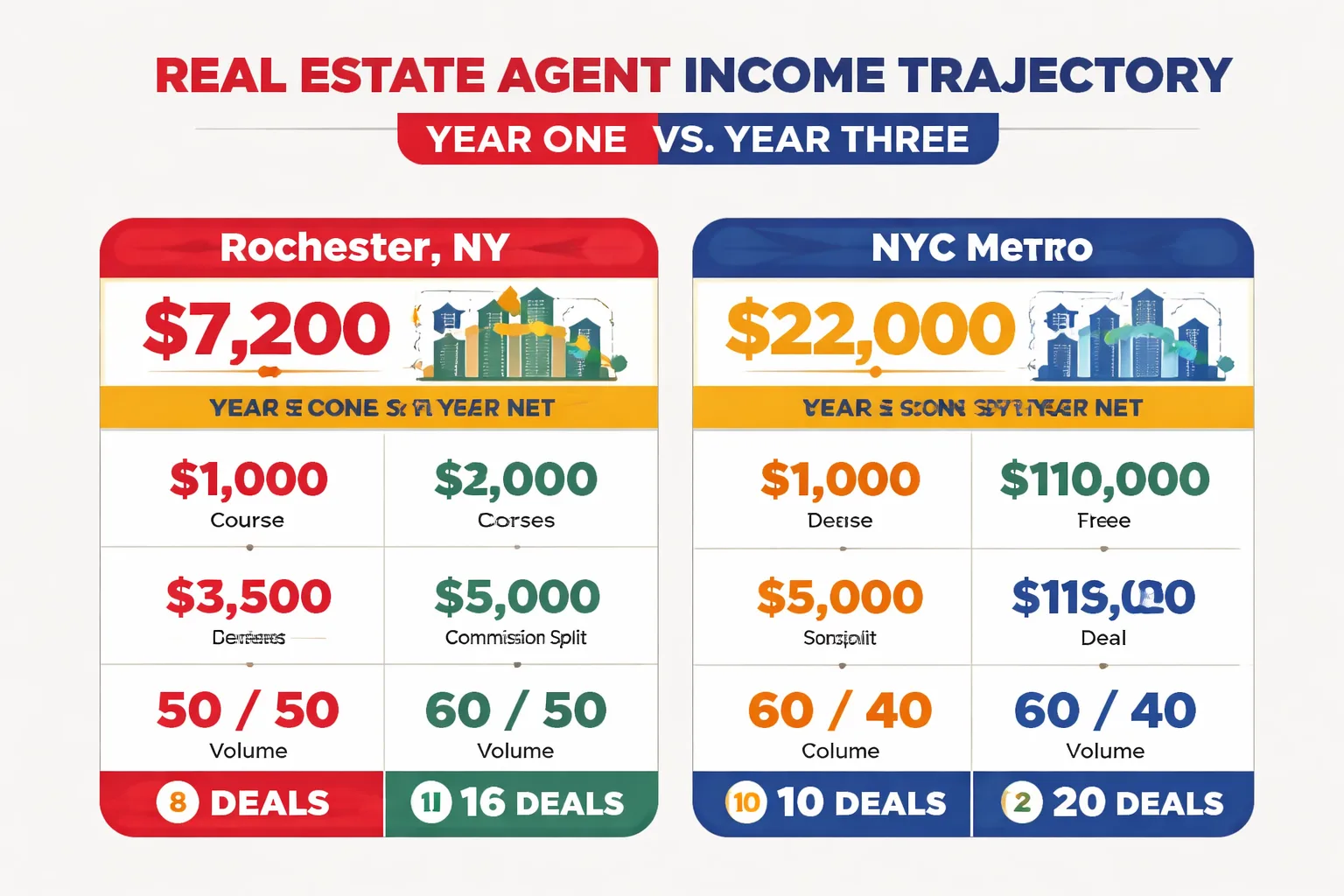
Year one income for a new real estate agent in ny state typically ranges from $15,000 to $35,000, assuming the agent closes 3 to 6 transactions. This assumes a 60/40 starting split with a brokerage and median-priced homes in their market. An agent in Rochester closing 4 deals at $230,000 each with a 2.5% commission and a 60% split nets approximately $13,800 in commission income. Subtract $1,000 in course and licensing costs, $2,400 in annual desk fees, $1,200 in MLS and association dues, and $2,000 in marketing expenses. Net year-one income: approximately $7,200.
Year three is where the financial picture shifts for agents who survive the initial ramp. By year three, an agent who has built a referral network and refined their lead generation process can expect to close 12 to 20 transactions annually. At a 70% split in Rochester, 15 deals at $230,000 and 2.5% commission produces gross commission income of $60,375. After brokerage splits and expenses, net income typically lands between $35,000 and $45,000. The same trajectory in the NYC metro, with higher price points, can produce net incomes of $80,000 to $150,000 by year three.
The question of whether becoming a real estate agent in ny is worth it in 2026 also depends on the regulatory environment. The post-NAR-settlement landscape has introduced new requirements for buyer agency agreements, which changed how agents are compensated on the buyer side. Agents who adapt to these changes and build transparent fee structures into their client conversations are better positioned than those relying on the old model where commission was simply extracted from the seller's proceeds.
The Reciprocity Advantage: Working Both NY and NJ Markets
Agents who obtain both a NY and NJ license gain access to a broader transaction territory and a more diverse client base. This is particularly valuable for agents serving the Chinese-American community and international investors who frequently purchase properties across state lines. A bilingual agent licensed in both states can represent buyers looking at manhattan luxury apartments one week and Bergen County single-family homes the next, without referring the client to another agent and losing the commission.
The NJ reciprocity process requires completing a 50-hour reciprocal course (shorter than the full 75-hour NJ pre-licensing requirement) and passing the NJ state exam. The total cost is approximately $400 to $700. For agents working the tri-state corridor, this investment pays for itself with a single cross-border transaction. A buyer purchasing a $1.1 million home in Tenafly, NJ generates a per-side commission of $27,500 at 2.5%, which more than covers the cost of obtaining the reciprocal license.
The strategic advantage extends beyond commission capture. Agents licensed in both states can provide clients with comparative market analysis across jurisdictions, helping buyers evaluate whether a property in Rockland County, NY or Bergen County, NJ offers better value when accounting for property tax differences, school district quality, and commute times to Manhattan. This level of service differentiates a top real estate agent in ny from a transactional agent who only operates in a single market.
Commercial Real Estate: A Different Income Calculus
Residential agents are not the only ones earning commissions in New York. A commercial real estate broker nyc operates on a fundamentally different compensation model, with lease commissions calculated as a percentage of total lease value (typically 4 to 6% for smaller leases, scaling down to 1 to 2% for large institutional deals) and sale commissions ranging from 3 to 6% depending on asset type and deal complexity.
Commercial brokers handling investment property nj or NY transactions often work on engagements that take 6 to 18 months to close but produce six-figure commissions on single deals. A $10 million office building sale at a 3% commission generates $300,000 in gross commission income. Split between two brokers (listing and selling side) and then between broker and agent at 70%, the individual agent earns $105,000 from a single transaction.
The barrier to entry is higher. Commercial real estate requires deeper financial analysis skills, market knowledge specific to asset classes (office, retail, industrial, multifamily), and relationships with institutional buyers and sellers. Most successful commercial brokers spend 2 to 3 years as associates under senior brokers before originating their own deals. But for agents willing to invest in that specialization, the per-deal economics dwarf residential commissions in any market, including Manhattan.
Where This Breaks Down: Three Scenarios Where the Numbers Do Not Hold
The income projections above assume consistent deal flow, functional brokerage support, and a market that cooperates with your timing. Here are three scenarios where those assumptions collapse.
First, agents who enter the market during a transaction slowdown. If interest rates spike or inventory tightens to the point where deal volume drops 30% across a market, a year-two agent projecting 10 deals may close 5. In Rochester, that means gross commission income drops from $57,500 to $28,750, and net income after expenses falls below $15,000. The fixed costs (desk fees, MLS dues, insurance) do not adjust downward when deal volume contracts.
Second, agents who join brokerages with poor training and lead support. The 60/40 split looks attractive until the agent realizes the brokerage provides no leads, no mentorship, and no administrative support. These agents often burn through their savings in 4 to 6 months without closing a deal, because they lack the systems to generate their own pipeline. The right brokerage match matters more than the commission split in year one.
Third, agents who underestimate the time to first commission. Even with a strong brokerage, the average new agent takes 3 to 6 months to close their first transaction. That means 3 to 6 months of expenses (gas, marketing, association dues, course cost amortization) with zero commission income. Agents who do not have 6 months of living expenses saved before starting are forced to take part-time jobs, which splits their focus and extends the ramp period further.
Are you considering getting your NY real estate license in 2026?
How Does the Attorney Review Period Affect Agent Income?
New Jersey's 3-day attorney review period is a unique regulatory feature that affects agents working both sides of the Hudson. In NY, there is no equivalent statutory review period, which means contracts are generally binding upon execution (subject to any contingencies negotiated within the contract itself). For agents licensed in both states, understanding this difference is critical for managing client expectations and transaction timelines.
The attorney review period does not directly reduce commission income, but it introduces a window where deals can unravel. An agent representing a buyer in NJ who has also shown properties in NY needs to clearly explain that NJ contracts can be cancelled for any reason during the first three business days after both parties sign. This affects how agents schedule inspections, appraisals, and mortgage commitments. Agents who fail to explain this distinction risk losing deals and damaging client relationships, which indirectly impacts referral income in subsequent years.
What About Agents in Smaller NY Markets?
Not every agent works in Rochester, Buffalo, or Manhattan. Markets like Plattsburgh, Watertown, and Amherst have smaller transaction volumes but also lower competition and lower operating costs. A real estate agent plattsburgh ny or a real estate agent watertown ny might close 10 to 15 deals per year at median prices between $190,000 and $240,000, producing gross commission income of $23,750 to $36,000. After splits and expenses, net income ranges from $14,000 to $24,000.
These markets can support agents who have low overhead, strong local relationships, and supplementary income sources (property management, notary services, or a spouse's income). The advantage of smaller markets is that competition for listings is lower, and a well-connected agent can dominate a territory within 2 to 3 years. The disadvantage is that the ceiling on income is lower unless the agent expands into adjacent markets or obtains additional licenses.
A real estate agent amherst ny (a suburb of Buffalo) benefits from slightly higher median prices ($260,000 to $280,000) and proximity to a mid-sized urban center. These suburban markets often offer the best balance for new agents: enough transaction volume to build experience, but not so much competition that leads are impossible to generate. Agents in Westchester County face a different dynamic, with median prices above $650,000 but intense competition from established agents and NYC-based brokers who expand northward.
How to Verify a NY Agent's License and Track Record
Before partnering with a brokerage or hiring an agent, the NY Department of State offers an online license verification tool commonly known as the real estate agent lookup ny. This database allows anyone to search by name, license number, or brokerage to confirm that an agent is actively licensed and in good standing. The lookup also reveals any disciplinary actions or license suspensions.
This tool is essential for two groups. First, aspiring agents should use it to research potential sponsoring brokers, verifying that the brokerage is active and checking for any disciplinary history. Second, consumers should use it before signing a buyer agency agreement, which is now mandatory under the post-NAR-settlement regulatory framework. An agent's license status, years of experience, and disciplinary record are the baseline data points for evaluating whether they are qualified to represent a client in a transaction worth hundreds of thousands of dollars.
The lookup also allows verification of reciprocal licenses. An agent claiming to be licensed in both NY and NJ should appear in both state databases. This is particularly relevant for clients working with agents who market themselves as tri-state specialists. If an agent claims a NY license but does not appear in the database, that is an immediate red flag, regardless of how polished their marketing materials appear.
What This Actually Means for Aspiring NY Agents
The decision to pursue a NY real estate license in 2026 should be driven by a clear-eyed assessment of three numbers: the median home price in your target market, the commission split offered by your prospective brokerage, and the number of transactions you can realistically close in year one. Multiply those three figures together, subtract 30% for taxes and 15% for business expenses, and the result is your projected net income. If that number does not meet your financial needs, either change markets, negotiate a better split, or build a longer runway before going full-time.
The agents who succeed in NY real estate are not the ones with the most charisma or the best headshot. They are the ones who understand the math, choose their market deliberately, and build systems that generate consistent deal flow. The license is the starting line. The income is earned in the years that follow, one closed transaction at a time, in a market where the difference between Rochester and Manhattan is not just geography but a 5x multiplier on every hour invested.
FAQ
How long does it take to become a real estate agent in NY state?
Most candidates complete the 77-hour pre-licensing course in 4 to 8 weeks, pass the state exam within 2 to 3 weeks of course completion, and receive their license 2 to 4 weeks after submitting the application. The total timeline from enrollment to active license is typically 2 to 3 months, assuming no exam retakes or application delays.
What is the real estate agent commission rate in NY?
Commission rates in NY typically range from 4 to 6% of the sale price, split between the listing and buyer's agent. Post-NAR-settlement, commission is negotiated separately rather than automatically offered through the MLS. Per-side commissions commonly land between 2 and 3% of the sale price.
Can a NY real estate agent also work in NJ?
Yes. New York and New Jersey have a reciprocity agreement that allows licensed NY agents to obtain a NJ license by completing a 50-hour reciprocal course and passing the NJ state exam. This is advantageous for agents working the tri-state corridor and serving clients who buy properties in both states.
How much does a real estate agent in Rochester NY earn?
A real estate agent in Rochester NY closing 10 deals per year at a median price of $230,000 with a 2.5% per-side commission and a 70% split earns approximately $40,250 in gross commission income. After taxes, fees, and business expenses, net income typically ranges from $25,000 to $32,000.
What is the real estate agent lookup NY tool?
The NY Department of State Division of Licensing provides an online search tool that allows anyone to verify a real estate agent's license status, check for disciplinary actions, and confirm brokerage affiliations. This tool is available at no cost and should be used before signing any agency agreement.
Is the NY real estate exam hard?
The NY state licensing exam consists of 75 scored multiple-choice questions covering national real estate concepts and New York-specific laws. A score of 70% or higher is required to pass. Most candidates who complete the 77-hour pre-licensing course pass on the first or second attempt, though the New York-specific sections on agency law and license requirements require focused study.
About the Author
Judy Zhou, Keller Williams Realtor®
Judy Zhou is a Realtor® with Keller Williams Town Life Realty in Tenafly, NJ, serving New Jersey and New York with $35M+ in sales volume. Licensed in both NJ and NY, she specializes in luxury homes, investment properties, and commercial real estate, offering seamless bilingual English-Chinese service. Before joining Keller Williams, she earned Coldwell Banker's International President's Elite (2024) and International Diamond Society (2025) awards.
Get personalized guidance on licensing, brokerage selection, and cross-state opportunities from an agent licensed in both NY and NJ.