How to Sell Your NJ Business: 4 Steps That Actually Work

By Judy Zhou, Coldwell Banker Realtor®
Key Takeaways
- 34% of M&A engagements fail to close, with 24% collapsing over valuation gaps and 21% due to no real buyer market, proving most deals die from poor preparation before cash flow is ever tested.
- Secure lease renewals and active health permits before marketing, as NJ deals in Bergen and Essex Counties have collapsed three days before closing over these exact lapses.
- Price and structure your business correctly upfront, since only 15% of failures trace to insufficient cash flow while the rest stem from mismatched expectations or nonexistent demand.
- Treat business sales as operationally complex unlike homes that move in 30-55 days, requiring lease assignments, license transfers, and equipment valuations handled by specialists to avoid standard NJ failure modes.
Selling your New Jersey business will be the most expensive mistake you ever make. Unless you follow the right steps.
The data is unforgiving: 34% of M&A engagements never reach closing, according to Pepperdine's 2026 Private Capital Markets Report. Of those failures, 24% collapse because of a valuation gap between buyer and seller expectations, and 21% fail because no real market exists for the business. Only 15% fail due to insufficient cash flow to support the asking price. The pattern is clear. Most deals die before financing ever becomes an issue. Businesses are not structured or priced correctly before they ever reach the market.
The commercial real estate nj landscape adds another layer of complexity that residential agents are not equipped to handle. Lease assignments, liquor license transfers, health permit renewals, and equipment valuation each carry their own legal traps. Deals in Bergen County and Essex County have fallen apart just three days before closing because sellers had not secured lease renewal rights or allowed a health permit to lapse. These are not edge cases. They are the standard failure modes for unprepared sellers.
Why Selling a Business in NJ Is Different From Selling a Home
Residential real estate operates on a relatively simple value proposition. A home is worth what a comparable property recently sold for in the same neighborhood. Days on market for New Jersey homes hover around 30 days per NJ.com data, and DeFalco Realty's February 2026 report shows residential median days on market around 55 days. NAR existing-home sales data tracks similar residential velocity.
Business sales operate on an entirely different timeline. And confusing residential days-on-market with business sale timelines is one of the most common research errors sellers make.
A business sale involves transferring intangible assets: brand value, customer relationships, supplier contracts, and operational systems. The physical space (the lease or owned property) is only one component. A bubble tea shop in Jersey City might have daily revenue tied to foot traffic patterns that a residential agent would never think to document. A restaurant in Newark could hold a liquor license worth more than the equipment itself. These assets require specialized valuation approaches that go far beyond a comparative market analysis.
New Jersey's regulatory environment adds specific hurdles. The state's vacant commercial property problem has prompted municipalities to scrutinize business transfers more carefully, particularly around zoning compliance and certificate of occupancy requirements. Lease assignment clauses in commercial leases often require landlord consent, and landlords can use that consent as leverage to renegotiate terms mid-sale. A seller who has not verified assignment rights before listing can find themselves unable to close regardless of buyer interest.
The NJ home buying process follows a well-documented path with attorney review, inspection, and closing. Business sales follow a parallel but distinct path that includes due diligence on financials, equipment appraisal, license transfers, and often a non-compete agreement. Each of these steps can introduce a deal-killing delay if not managed proactively.
Consider the case of a bubble tea franchise transfer in Bergen County. The seller had operated the shop for four years, built a steady customer base, and had two years remaining on a five-year lease with a renewal option. A residential agent listed the business as if it were a property sale, focusing on square footage and location. The listing attracted a buyer who offered full asking price. Three days before closing, the buyer's attorney discovered that the lease required landlord consent for assignment, the landlord had not been contacted, and the health permit was set to expire in two weeks. The deal collapsed. The seller lost two months of marketing time, the buyer walked, and the business sat unlisted for another four months while the seller scrambled to resolve the lease and permit issues. A commercial broker would have flagged both issues before the business ever went to market.
The difference between residential and business transactions extends to the financial documentation required. Residential buyers need mortgage pre-approval and a credit check. Business buyers need personal financial statements, business plans, SBA loan pre-qualification, and sometimes investment capital verification. The seller's financial records must withstand a level of scrutiny that residential closing documents never face. Tax returns are restated to remove owner's personal expenses. Bank statements are reconciled against reported revenue. Equipment is appraised at replacement value, not book value. Every number on the profit and loss statement gets questioned.
How to get business valuation and gather financials?
Valuation is where most deals begin to unravel. The Pepperdine data shows that 24% of failed M&A engagements collapse because of a valuation gap between what the seller expects and what the market will pay. This gap exists because sellers often base their asking price on emotion, sweat equity, or generic industry multipliers rather than on verifiable financial data.
A proper business valuation requires three to five years of clean financial statements, tax returns, and a normalized earnings calculation (often called Seller's Discretionary Earnings or SDE). For a bubble tea shop generating $400,000 in annual revenue, the SDE might be $90,000 to $120,000 after deducting owner's salary, personal expenses run through the business, and one-time costs. The market multiplier for a small food service business in NJ typically ranges from 1.5 to 2.5 times SDE, but that range varies dramatically based on lease terms, location, equipment age, and brand strength.
Practical tip: Gather three years of tax returns, 12 months of bank statements, a current equipment list with replacement values, and your lease agreement with any renewal options before speaking to a broker. Sellers who arrive with these documents pre-organized command higher offers because they signal operational competence.
Common mistake: Inflating valuation based on projected growth. Buyers do not pay for projections. They pay for trailing twelve months of actual performance. A seller who says "we're on track to double revenue next year" will hear a buyer say, "come back when you have."
For sellers with investment property in NJ, the real estate component of the business sale needs separate appraisal. The New Jersey real estate investment market has its own valuation methodology based on cap rates, NOI, and comparable sales. A business that owns its building has two distinct assets to price, and conflating them creates confusion that buyers exploit during negotiation.
The mechanics of SDE calculation deserve attention because they directly determine the asking price. Start with net profit on the tax return. Add back the owner's salary and payroll taxes. Add back personal expenses that ran through the business: family member salaries who do not work in the business, personal vehicle payments, health insurance premiums for the owner's family, non-business travel, and one-time expenses like legal fees for a lawsuit or equipment repair after an accident. The result is the true earning power of the business. A bubble tea shop showing $60,000 in net profit on the tax return might have an SDE of $110,000 after these add-backs. That $50,000 difference changes the valuation by $75,000 to $125,000 at a 1.5-2.5x multiplier.
The quality of financial records matters as much as the numbers themselves. Buyers and their lenders will request monthly bank statements to verify that reported revenue matches deposits. They will compare point-of-sale system reports to tax returns. Discrepancies between these documents kill deals. A seller whose POS system shows $450,000 in annual revenue but whose tax return reports $380,000 has a credibility problem that no broker can overcome. The fix is to reconcile these numbers before listing, not during due diligence.
Equipment valuation follows a similar principle. A buyer's appraiser will value equipment at fair market value, which is typically lower than replacement cost. A $40,000 espresso machine purchased three years ago might appraise at $18,000. Sellers should obtain their own equipment appraisal before listing to set realistic expectations and avoid a renegotiation triggered by the buyer's lower appraisal.
Step 2: Engage a Bilingual Commercial Real Estate Broker
The broker selection decision determines whether the deal closes at all. The Pepperdine report found that 21% of failed M&A engagements collapsed because no real market existed for the business. That statistic points directly to broker failure. A broker who cannot identify and reach qualified buyers has not built the right network.
New Jersey's commercial real estate market spans multiple submarkets with distinct characteristics. Jersey City commercial real estate operates on different fundamentals than Monmouth County or Newark. A broker who claims to cover "all of NJ" without demonstrating specific transaction history in the seller's submarket is not the right fit.
For Chinese-American business owners, language capability is not a convenience. It is a deal necessity. Many bubble tea shop owners, restaurant operators, and retail business owners in NJ's Asian-American communities conduct their primary business relationships in Mandarin or Cantonese. A broker who cannot communicate fluently in Chinese cannot effectively market to the buyer pool that is most likely to understand and value the business. The bilingual capability also matters for navigating financial documents, lease terms, and legal disclosures where nuances in translation can prevent costly misunderstandings.
The investment real estate agency model that works best for business sales combines commercial transaction expertise with deep local market knowledge. A broker who understands that a bubble tea shop's value depends on supplier relationships, seasonal demand patterns, and local foot traffic (not just square footage and lease rate) will price and market the business more accurately.
Practical tip: Ask potential brokers for three specific metrics: the number of business sales they closed in the last 12 months, the average days on market for their listings, and the list-to-sale-price ratio. A broker who cannot or will not provide these numbers is not running a data-driven practice.
Common mistake: Choosing a broker based on residential transaction volume. A residential agent who sold 50 homes last year has zero relevant experience valuing a business, negotiating an SBA loan contingency, or coordinating a liquor license transfer. The skills do not transfer.
The broker interview process should include specific scenario questions. Ask: "What happens if the landlord refuses to consent to the lease assignment?" A qualified commercial broker will describe their process for negotiating with landlords, potentially offering a rent increase or lease extension in exchange for assignment consent. An unqualified broker will not have an answer. Ask: "How do you handle a buyer who wants to verify revenue before making an offer?" The right answer involves a confidential review under NDA with summarized financials, not handing over raw bank statements to anyone who asks.
The bilingual requirement deserves deeper examination. NJ's Chinese-American business community operates through networks that are largely invisible to non-Chinese-speaking brokers. WeChat groups, Chinese-language business associations, and community word-of-mouth drive a significant portion of business transfer opportunities in communities like Fort Lee, Edison, Parsippany, and Jersey City. A broker who is plugged into these networks can reach buyers who would never see a BizBuySell listing. A broker who is not will miss the most motivated buyer pool entirely.
The brand promise problem is real. Consider the case of "我很芒" (I'm So Mango), a bubble tea brand where over a hundred franchisees reportedly suffered substantial losses. Daily sales sometimes hit only a hundred yuan because franchisees trusted the brand's marketing claims without scrutinizing actual operational capabilities or material costs. This pattern repeats in business sales. Sellers trust brand reputation or broker promises without verifying the broker's actual transaction history. The fix: ask for references from past sellers, verify closed transactions, and do not confuse marketing volume with transaction competence.
Step 3: Market Confidentially and Vet Buyers
Confidentiality is the single most underappreciated element of a business sale. The moment employees, customers, or suppliers learn the business is for sale, the business begins to deteriorate. Employees start job hunting. Customers start exploring competitors. Suppliers start tightening credit terms. A business that was healthy in January can be on life support by April if the sale process leaks prematurely.
Confidential marketing requires a different approach than listing a property on MLS. Business-for-sale platforms like BizBuySell allow blind listings that describe the business type and financials without revealing the name or address. A qualified broker maintains a database of pre-vetted buyers who have signed NDAs and demonstrated financial capacity before receiving any identifying information.
Buyer vetting is where the deal either builds momentum or stalls. A serious buyer provides a personal financial statement, proof of funds, and a business plan within the first two weeks of expressing interest. A buyer who asks for financials before signing an NDA, who cannot verify available capital, or who wants to "tour the business" without demonstrating financial readiness is not a buyer. They are a tire-kicker, and they will consume weeks of the seller's time.
Practical tip: Require a non-refundable earnest money deposit of 5-10% of the purchase price before opening full due diligence. This separates serious buyers from browsers and gives the seller leverage if the buyer attempts to renegotiate after the inspection period.
Common mistake: Marketing too broadly. A listing that appears on five different business-for-sale platforms signals desperation and attracts bottom-feeders. One well-placed listing with a qualified broker who actively recruits from their buyer network will outperform a scattergun approach every time.
The blind listing itself requires careful construction. A listing that says "profitable bubble tea shop in Bergen County, $400,000 revenue, $100,000 SDE" provides enough detail to attract serious buyers without revealing the specific location. But the listing must also avoid details that could identify the business to someone familiar with the area. A listing that mentions "the shop near the intersection of Route 4 and Jones Road" has just identified the business to anyone who knows the area. The broker's job is to balance marketing appeal with operational secrecy.
Buyer financial qualification follows a tiered process. Tier one: the buyer signs an NDA and receives a blind summary (revenue, SDE, general location, lease terms). Tier two: the buyer provides a personal financial statement and proof of funds or SBA pre-qualification letter. Tier three: the buyer receives the full confidential memorandum with three years of financials, equipment list, and lease details. Tier four: the buyer visits the business in person, typically after hours or during a slow period, with the broker present. Each tier filters out unqualified buyers before they consume the seller's time.
The buyer's financing structure affects the seller's risk. An all-cash buyer can close in 30-45 days after due diligence. An SBA-financed buyer needs 60-90 days for loan approval after the purchase agreement is signed. A seller-financed deal (where the seller carries a portion of the purchase price as a note) extends the seller's risk over years but can attract buyers who cannot secure traditional financing. The broker should help the seller understand these trade-offs and structure the deal to minimize post-closing risk.
Step 4: Negotiate Terms and Navigate Attorney Review
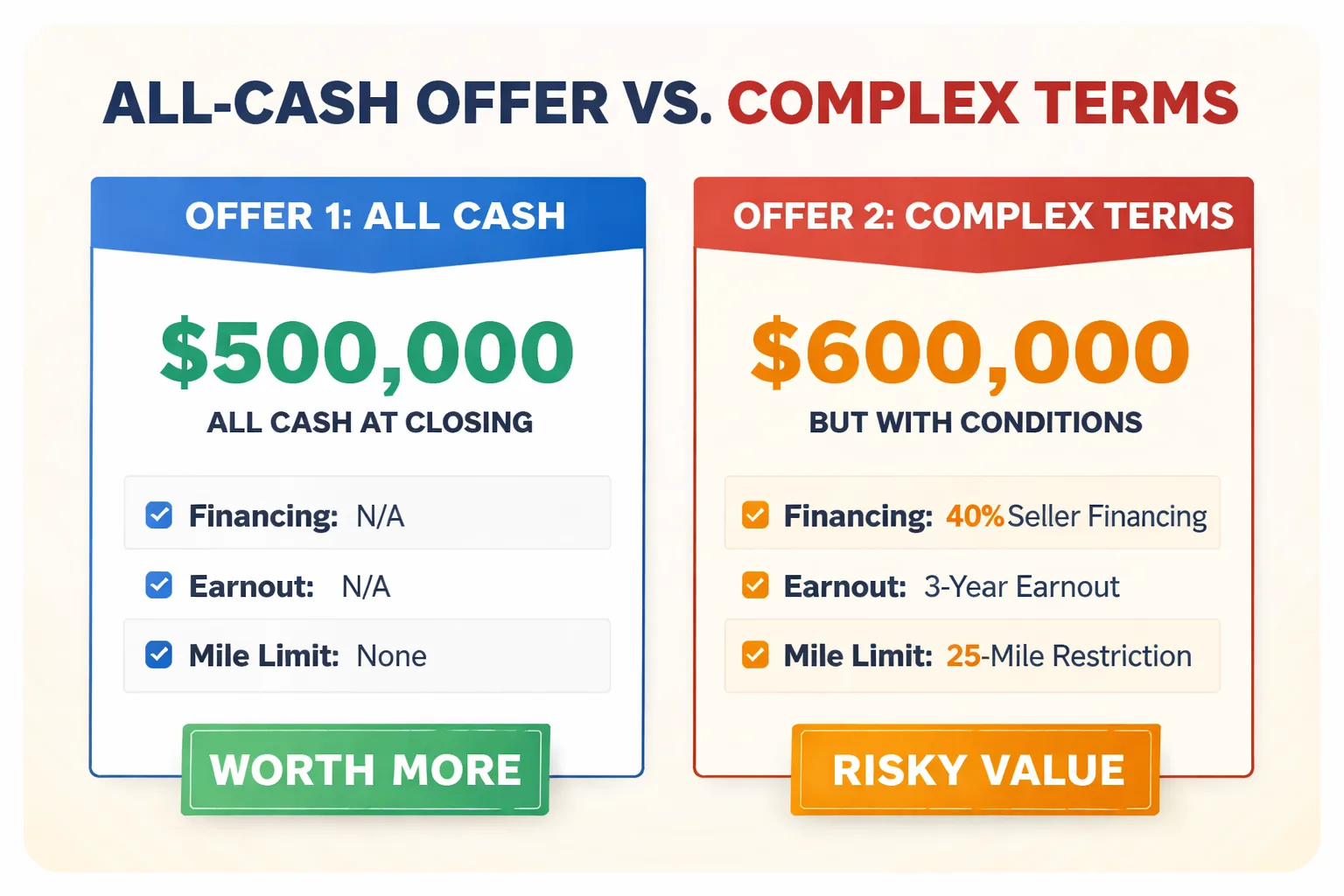
Negotiation in a business sale is not about price alone. The structure of the deal often matters more than the headline number. A $500,000 all-cash offer at closing is worth more than a $600,000 offer with 40% seller financing, a three-year earnout, and a non-compete that restricts the seller from operating within 25 miles. Yet sellers routinely accept the higher number without understanding the risk profile of the financing terms.
New Jersey's attorney review period, which is standard in residential transactions, takes on a different character in business sales. The three-day attorney review window for residential contracts does not apply in the same way to business purchase agreements, which are typically more complex and negotiated over weeks rather than days. The business purchase agreement should include specific provisions for: asset vs. stock sale structure, allocation of purchase price among tangible assets, intangible assets, and non-compete value, working capital adjustments, and a clearly defined training and transition period.
The allocation of purchase price is particularly important for tax purposes. Selling assets (equipment, inventory, goodwill) vs. selling stock or membership interests triggers different tax treatments. Sellers should engage a CPA who understands business sale taxation before signing the purchase agreement, not after.
The title fees and closing costs associated with transferring owned real estate as part of a business sale can add 2-5% to the transaction. Sellers who own their building need to factor these costs into their net proceeds calculation.
Practical tip: Include a training transition period of 30-90 days in the purchase agreement where the seller remains available to train the buyer on operations, supplier relationships, and customer introductions. This period is typically compensated separately from the purchase price and helps ensure business continuity.
Common mistake: Accepting the first offer without understanding the terms. A seller who receives an offer within the first 30 days of listing often assumes the broker underpriced the business. In reality, a well-priced business with clean financials and a strong broker network can attract serious buyers quickly. The seller's job is to evaluate the terms, not just the number.
The purchase agreement's working capital adjustment is a provision that catches sellers off guard. This clause adjusts the purchase price based on the business's working capital (current assets minus current liabilities) at closing compared to a target level established in the agreement. If the business's working capital drops between the signing of the agreement and closing (because the seller took excess inventory or delayed paying suppliers), the purchase price is reduced dollar-for-dollar. Sellers must maintain normal operating levels throughout the sale process or face a price reduction at closing.
The non-compete agreement is another negotiated term that has both legal and financial implications. NJ courts enforce non-competes that are reasonable in scope, duration, and geographic restriction. A non-compete that prohibits the seller from operating a similar business within 10 miles for two years is likely enforceable. A non-compete that covers the entire state for five years is likely not. The value assigned to the non-compete in the purchase price allocation affects the seller's tax treatment, because non-compete payments are taxed as ordinary income while goodwill payments may qualify for capital gains treatment.
The escrow and holdback provisions also matter. Many purchase agreements include a holdback of 10-15% of the purchase price in escrow for 6-12 months to cover any post-closing discoveries (undisclosed liabilities, revenue discrepancies, equipment failures). The seller should understand exactly what conditions trigger a claim against the escrow and what the process is for releasing the funds. A well-negotiated escrow provision includes specific time limits, clear claim procedures, and a mechanism for dispute resolution.
What to Look for in a NJ Commercial Real Estate Broker
Selecting the right broker for a business sale in commercial real estate in nj requires looking beyond transaction volume. The specific qualifications that matter for business transfers differ from what matters in property sales.
First, verify the broker holds an active New Jersey real estate license with commercial transaction authority. This is the baseline. A broker who primarily handles residential transactions in markets like Closter vs Tenafly may understand those local housing markets but lack the framework for valuing a business, structuring an asset sale, or coordinating with SBA lenders.
Second, look for demonstrated experience with the specific business type. A broker who has closed three restaurant transfers in the last 18 months understands health department transfer requirements, grease trap compliance, and CO (certificate of occupancy) nuances that a generalist will miss. The same applies to retail businesses with inventory valuation challenges, service businesses with customer contract assignments, or manufacturing businesses with equipment appraisals.
Third, assess the broker's buyer network. The most valuable broker is not the one with the most listings. It is the one with the deepest pool of pre-qualified buyers who are actively looking for a business like yours. Ask how many buyers in their database match your business profile. A broker who says "we'll find the right buyer" is telling you they do not have one yet.
Fourth, for Chinese-American sellers, bilingual capability is essential. The broker should be able to conduct business in Mandarin or Cantonese, understand Chinese business cultural norms around negotiation, and have connections within the Chinese-American business community in NJ. This is not about comfort. It is about reaching the buyer pool that will understand and value the business.
Fifth, evaluate the broker's marketing approach. Do they use blind listings on business-for-sale platforms? Do they maintain a confidential buyer database? Do they have a process for NDAs and buyer qualification? A broker who says they will "put it on MLS" does not understand business sale confidentiality.
The interview process should include a request for a sample confidential business review (CBR) from a past transaction. A well-prepared CBR demonstrates that the broker knows how to present financial information, describe the business opportunity, and highlight value drivers without revealing the business identity. A broker who cannot produce a sample CR has either never prepared one or does not consider it important. Either answer is a red flag.
For businesses in specific submarkets, local expertise is non-negotiable. Commercial real estate in newark nj operates under different zoning, permitting, and economic development incentive structures than jersey city nj commercial real estate. A broker who has worked in Newark understands the city's business license transfer process, the Essex County health department requirements, and the specific challenges of operating in neighborhoods with varying foot traffic patterns. A broker who has worked in Jersey City understands the impact of the PATH train schedule on customer flow, the rent differential between downtown and Journal Square, and the city's increasingly competitive food service market.
Similarly, commercial real estate in monmouth county nj serves a fundamentally different market. Shore-town seasonality, the impact of tourism on revenue patterns, and the different demographic profile of Monmouth County customers all affect business valuation. A bubble tea shop in Red Bank has different revenue patterns than one in Fort Lee. The broker must understand these local dynamics to price the business accurately.
How Long Does It Take to Sell a Business in NJ?
The honest answer is six to nine months for a well-priced, well-prepared business with clean financials and a qualified broker. Complex deals involving real estate transfer, liquor licenses, or SBA financing can take nine to eighteen months. Underprepared businesses with disorganized financials or unresolved lease issues can take over a year or never sell at all.
Here is a realistic timeline breakdown by business type:
Small retail or food service (bubble tea shop, deli, small restaurant): 4-8 months from listing to close, assuming a clean lease, transferable licenses, and organized financials. These businesses appeal to first-time buyers who often need SBA financing, which adds 60-90 days to the closing timeline after the purchase agreement is signed.
Mid-size service business (dry cleaner, auto repair, professional practice): 6-12 months. These businesses often involve customer relationship transfer, equipment appraisal, and sometimes real estate. The buyer pool is smaller and more specialized.
Business with owned real estate: 8-15 months. The real estate component requires separate appraisal, environmental assessment (for certain property types), and a more complex closing process. The new condo developments near me market has shown that property transfers involve their own timeline pressures, and business-plus-property sales compound that complexity.
Distressed or underperforming business: 12+ months, if it sells at all. The Pepperdine data showing 21% of deals failing because "no real market exists for the business" is most relevant here. A business with declining revenue, unresolved compliance issues, or an expiring lease may not find a buyer at any price.
The timeline also depends on the seller's preparation. A business with three years of clean tax returns, a current equipment list, a transferable lease with renewal options, and all licenses current can move quickly once a buyer is identified. A business where the seller needs six weeks to gather documents before listing has already extended the timeline before the clock starts.
Breaking down the timeline further, the phases of a typical sale look like this. Phase one, preparation and valuation, takes 2-4 weeks if the seller has organized records and 6-8 weeks if they do not. Phase two, confidential marketing and buyer search, takes 60-120 days depending on market conditions and the broker's buyer network. Phase three, buyer due diligence, takes 30-45 days after the purchase agreement is signed. Phase four, SBA loan processing (if applicable), takes 60-90 days and runs partially in parallel with due diligence. Phase five, closing and license transfers, takes 15-30 days after all contingencies are removed. Understanding these phases helps sellers set realistic expectations and avoid the pressure of accepting a low offer just to close faster.
Seasonal timing also affects the sale timeline. Food service businesses in NJ shore towns should not be listed in November when revenue is at its lowest. The trailing twelve months of financials will look weaker, and buyers will negotiate based on that weakness. Listing in March or April, when the business is entering its high season, allows the seller to present stronger recent financials and gives buyers confidence in the revenue trajectory. Similarly, businesses near universities should account for the academic calendar. A coffee shop near Rutgers that lists in June misses the fall semester rush, which is a key selling point.
NJ Business Sale Tax Implications You Need to Understand
The tax consequences of a business sale in New Jersey can consume 20-40% of the proceeds if not structured properly. This is not a topic to leave until closing. The purchase price allocation in the agreement determines how each dollar is taxed, and once the agreement is signed, changing the allocation requires both parties to agree (which they rarely will, because what helps the seller hurts the buyer and vice versa).
In an asset sale (the most common structure for small business sales), the purchase price is allocated among tangible assets (equipment, inventory), intangible assets (goodwill, customer lists, brand name), and the non-compete agreement. Each category has different tax treatment. Tangible assets are subject to depreciation recapture, which is taxed as ordinary income. Goodwill is taxed as a capital gain, which currently carries a lower federal rate. The non-compete portion is taxed as ordinary income to the seller.
New Jersey does not have a capital gains tax rate separate from its income tax rate. All gains, whether from asset sales or stock sales, are taxed at the NJ income tax rate, which ranges from 1.4% to 10.75% depending on income level. For a business sale generating $500,000 in gains, the NJ state tax alone could be $37,625 to $53,750. Sellers should consult a NJ-licensed CPA who specializes in business sale taxation before accepting any purchase price allocation.
The sale of owned real estate as part of a business sale triggers additional considerations. If the property has been held for more than one year and is sold at a gain, the federal capital gains rate applies to the appreciation. But NJ's real property transfer fee, which is based on the sale price, adds another cost. For a commercial property selling for $800,000, the state transfer fee is approximately $5,580. Counties and municipalities may add additional fees.
The NJ property tax rates by town affect the ongoing carrying costs if the property does not sell immediately or if the seller is holding the property after the business sale. Property tax rates vary dramatically across NJ municipalities, and a business owner who retains their building after selling the business needs to factor these costs into their post-sale cash flow.
Sellers who have operated their business as an S-Corporation or LLC should understand that the sale of business assets by a pass-through entity flows through to the owner's personal tax return. The entity itself does not pay tax, but the owner faces the full tax burden on the gain. This can push the owner into a higher tax bracket for the year of sale, affecting the overall tax rate on both the business sale gain and their other income.
Common Mistakes That Kill NJ Business Sales
Three specific mistakes account for most failed business sales in New Jersey. Each one is preventable with proper preparation, but each one requires the seller to do work before listing rather than during the sale process.
Mistake 1: Not securing lease assignment rights before listing. Commercial leases in NJ typically require landlord consent for assignment. Some landlords use this as an opportunity to renegotiate rent, remove renewal options, or require personal guarantees from the buyer. A seller who discovers this after accepting an offer has lost negotiating leverage. The fix: review the lease assignment clause before listing and obtain a preliminary indication from the landlord that they will cooperate with a qualified buyer transfer.
The landlord's perspective matters here. A landlord who learns their tenant is selling may see an opportunity to increase rent to market rate, especially if the current lease is below market. In NJ's competitive commercial real estate market, where retail vacancy rates in some submarkets are low, landlords hold significant leverage. A seller who approaches the landlord proactively, with a qualified buyer in hand and a plan for seamless transition, is in a stronger position than one who springs the sale on the landlord at the last minute. Some landlords may require a lease modification or an assignment fee of $2,000-$5,000. Sellers should budget for these costs and negotiate them as part of the sale terms.
Mistake 2: Letting licenses and permits lapse during the sale process. Health permits, food handler certifications, and business operation licenses have expiration dates that do not pause for a sale. A deal that takes eight months to close may span two permit renewal cycles. Sellers who let a health permit expire three days before closing (and yes, this happens) give the buyer grounds to walk or renegotiate. The fix: calendar every license and permit expiration at the start of the sale process and renew proactively, even if the sale seems imminent.
The specific licenses that commonly cause problems include: NJ Department of Health food establishment permits (annual renewal), local municipal business licenses (vary by town), ABC liquor licenses (annual renewal with strict transfer requirements), and professional licenses for certain service businesses. Each has its own renewal timeline and transfer process. A liquor license transfer in NJ can take 90-120 days and requires municipal approval, background checks on the buyer, and a public hearing. Sellers with liquor licenses should begin the transfer process before listing, not after finding a buyer.
Mistake 3: Commingling personal and business finances. Buyers and their lenders need clean financial statements that show the true earning power of the business. Personal expenses run through the business (family cell phones, personal vehicle payments, non-business travel) distort the financial picture and make valuation harder. A seller who has been running $30,000 of personal expenses through the business financials will either need to restate those financials (which raises questions) or accept a lower valuation based on the reported numbers. The fix: clean up the financials at least 12 months before listing. Separate personal and business accounts. Stop running personal expenses through the business.
The commingling problem is particularly acute in family-owned businesses where multiple family members are on the payroll. A buyer's due diligence will question whether each family member actually performs work commensurate with their salary. If the seller's spouse is paid $50,000 per year for "bookkeeping" but the buyer plans to handle that function themselves, that $50,000 is an add-back to SDE. But if the seller's son is the head barista and actually runs the daily operations, his salary is a legitimate business expense that the buyer will need to replace. Sellers must be prepared to defend each add-back with documentation.
Thinking about selling your NJ business? Get a confidential valuation first.
What This Won't Fix
This four-step process works for operational, profitable businesses with transferable leases and clean financials. It does not fix three specific situations.
First, a business with declining revenue. If the trailing twelve months show a 20%+ revenue decline from the prior year, no amount of preparation or broker expertise will command a premium price. Buyers discount heavily for declining trends, and lenders will not finance a business with negative trajectory. The seller's best option in this case is to stabilize revenue before listing, even if that means operating for another six to twelve months.
Second, a business with an expiring lease and no renewal option. Without lease security, the business has no guaranteed future. Buyers will either walk or offer a price that reflects asset value only (equipment and inventory), which is typically 20-30 cents on the dollar of the business's going-concern value. The seller must negotiate a lease renewal before listing.
Third, a business where the owner is the business. If all customer relationships, supplier relationships, and operational knowledge reside exclusively with the owner, the business has no transferable value beyond its physical assets. A buyer is purchasing a job, not a business. The seller needs to systematize operations, delegate customer relationships to staff, and document procedures before the business has saleable value.
Ready to Transfer Your NJ Business? Here's Your Next Step
The difference between a business that sells for full value and one that sits on the market for 18 months comes down to preparation and representation. The four steps outlined above are not theoretical. They are the exact process that separates successful sales from the 34% of deals that never close.
For sellers in New Jersey's Chinese-American business community, the bilingual and bicultural representation matters. Understanding the nuances of a bubble tea shop transfer, a restaurant sale with liquor license complications, or a retail business with inventory valuation challenges requires a broker who has been through these specific transactions. The Westchester County homes for sale market and the broader NJ/NY commercial real estate landscape each have their own dynamics, and the right broker navigates both.
The first step is a confidential consultation. Before any listing, before any marketing, before any buyer contact, a qualified commercial broker reviews the business financials, lease terms, license status, and operational structure. This review identifies deal killers before they kill the deal. It establishes a realistic valuation based on market data, not hope. And it builds the strategy for confidential marketing that protects the business throughout the sale process.
Selling a business is not a do-it-yourself project. The data is clear. The 34% failure rate, the 24% valuation gap, the 21% no-market statistic. These numbers describe what happens when sellers go it alone or work with the wrong representation. The right steps, executed with the right broker, change those odds dramatically.
The commercial real estate nj market rewards preparation. Sellers who arrive with clean financials, a transferable lease, current licenses, and a qualified bilingual broker close deals. Sellers who do not become statistics in the next Pepperdine report.
FAQ
What is the average timeline to sell a small business in New Jersey?
A well-prepared small business in NJ typically takes 4-8 months from listing to closing. Businesses requiring SBA financing add 60-90 days. Complex deals involving real estate or liquor licenses can extend to 9-15 months. Underprepared businesses with disorganized financials may take over a year or fail to sell entirely.
Do I need a commercial real estate broker to sell my NJ business?
Yes, if the sale involves a lease assignment, owned property, or equipment valuation. A commercial broker understands business valuation, buyer confidentiality, and license transfer requirements that residential agents do not. The 21% of deals that fail because "no real market exists" often trace back to inadequate broker marketing and buyer networks.
How is a business valued differently from real estate?
Business valuation is based on Seller's Discretionary Earnings (SDE) or EBITDA multiplied by an industry-specific factor, typically 1.5-3.5x for small businesses. Real estate valuation uses comparable sales and cap rates. When a business owns its property, both methods apply and must be calculated separately to avoid conflating asset values.
Can I sell my NJ business if my lease is expiring soon?
It is possible but significantly harder. Buyers want lease security. A lease with less than 12 months remaining gives buyers little runway to recoup their investment. Sellers should negotiate a renewal option with their landlord before listing, or structure the sale as an asset purchase without the lease (which typically reduces the sale price by 40-60%).
What documents do I need to prepare before selling my business?
Gather three years of tax returns, 12 months of bank statements, year-to-date profit and loss statements, a current equipment list with replacement values, the lease agreement with renewal options, and all current business licenses and permits. Having these organized before listing signals competence to buyers and can increase the final sale price.
How does SBA financing affect my business sale?
SBA 7(a) loans are the most common financing for small business acquisitions. The buyer must qualify personally, and the business must generate sufficient cash flow to cover debt service. SBA loans add 60-90 days to the closing timeline and require the seller to carry a standby note on any seller financing portion. The SBA also requires a personal guarantee from the buyer and may require the seller to remain involved during a transition period.
About the Author
Judy Zhou, Coldwell Banker Realtor®
Judy Zhou is a top-ranked Coldwell Banker Realtor® serving New Jersey and New York, recognized in the top 7% of agents internationally with prestigious awards like the International Diamond Society and President's Elite. Licensed in both NJ and NY, she specializes in luxury homes, investment properties, and commercial real estate, offering seamless bilingual English-Chinese service.
Schedule a confidential consultation with a bilingual commercial real estate broker who has closed NJ business transfers and knows exactly what your business is worth.