How Hard Is It to Become a Real Estate Agent in NY?
By Judy Zhou, Coldwell Banker Realtor®
Key Takeaways
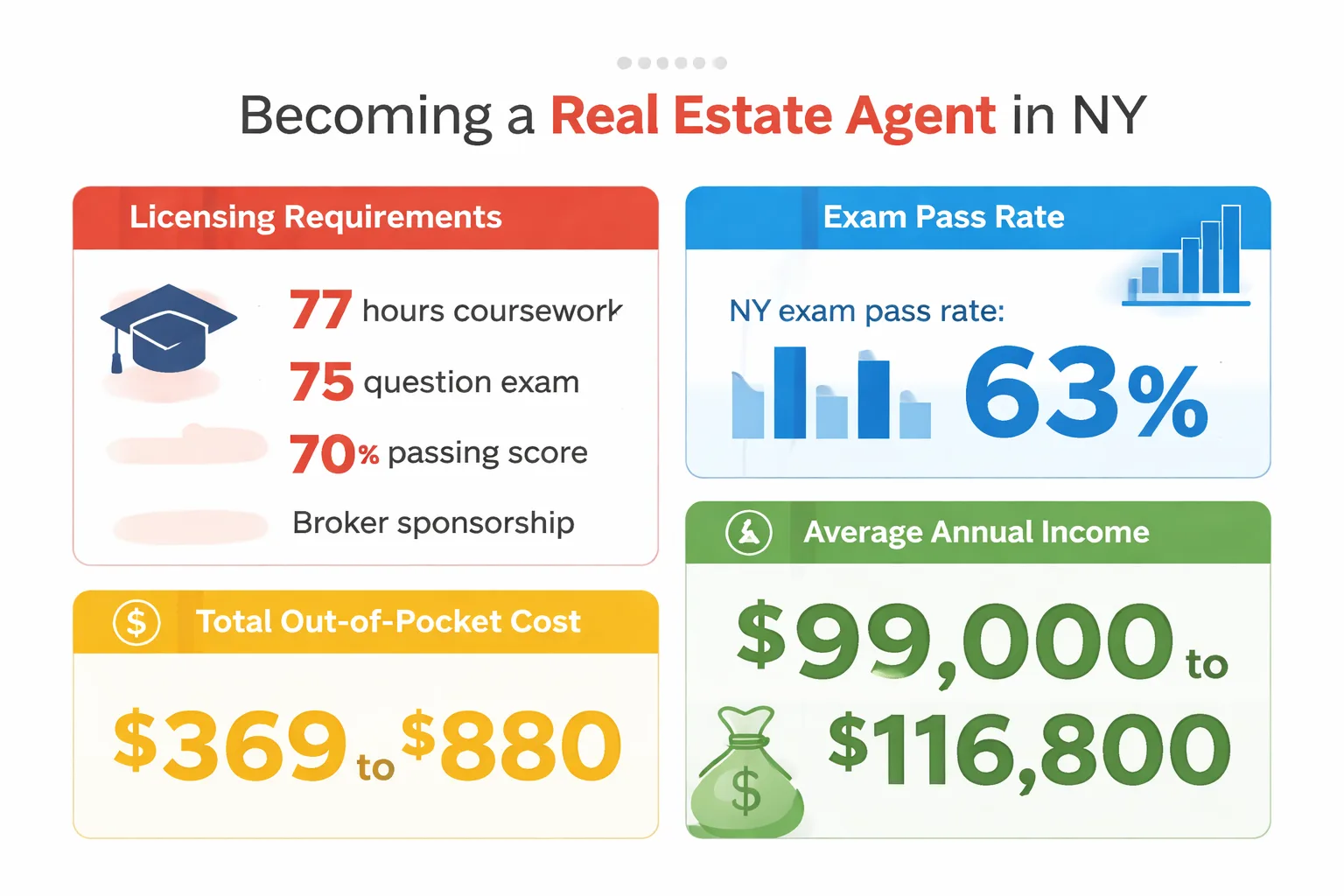
- Complete the 77-hour pre-licensing course, pass the 75-question exam at 70%, and obtain broker sponsorship to earn your NY salesperson license in 3-4 months.
- Budget $369-$880 total for licensing, knowing the NY exam pass rate is 63% so roughly one-third of first-time test-takers fail.
- Target average earnings of $99,000-$116,800 per year as a licensed NY agent, with top earners exceeding $210,000 in a commission-only market.
- Treat the exam as a filter rather than the finish line by preparing in advance, since the financial barrier is low but building income after licensing is the real challenge.
Maria signed up for her 77-hour pre-licensing course on a Monday night in January, wedging it between her day job in Midtown and her commute back to Queens. By March, she had her New York salesperson license. By June, she'd closed her first deal. A one-bedroom in Astoria that had been sitting on the market for weeks. Her path wasn't lucky or unusual. It was the result of understanding exactly what the licensing process required and executing it step by step, without wasted time or second-guessing.
The process requires 77 hours of coursework, a 75-question exam with a 70% passing score, and broker sponsorship. Data indicates the NY exam pass rate sits at 63%, meaning roughly one in three first-time test-takers fails. Total out-of-pocket cost runs $369 to $880 depending on course provider and format. Average annual income for a licensed NY agent is approximately $99,000 to $116,800, with top earners exceeding $210,000. The barrier to entry is low financially. The real difficulty begins after the exam, when new agents face a commission-only market with no guaranteed income.
The recurring pattern among successful agents is preparation. They treat the licensing process as a filter, not a finish line. The exam is passable. The course is manageable. The career is hard.
What Are the Basic Requirements to Get Licensed in NY?
New York State sets a low barrier to entry. Applicants must be at least 18 years old, hold a valid NYS photo ID, and be a legal U.S. resident. There is no college degree requirement. No prior real estate experience is needed. The NY Department of State administers the entire process through its eAccessNY portal.
The educational mandate is specific. According to the NYSDOS salesperson FAQ, candidates must complete 77 hours of qualifying education from a state-approved school. This includes a 75-hour core salesperson course plus 2 hours of agency-related instruction. A separate 2-hour Fair Housing and implicit bias training component is also required, reflecting the state's push to address discrimination in housing transactions.
One detail that trips people up: criminal history. The state requires full disclosure of any convictions. Failure to disclose even a minor offense is grounds for immediate denial. Certain felonies may disqualify an applicant entirely, though a case-by-case character and fitness review exists for borderline situations. The state does not guarantee outcomes for applicants with records, so transparency is the only viable strategy.
New York has no reciprocity agreements with any other state as of 2026. An agent licensed in New Jersey, Connecticut, or Pennsylvania cannot transfer their credentials. They must complete the full 77-hour course, pass the NY exam, and apply from scratch. This matters for anyone considering a real estate agent ny license who already holds credentials elsewhere.
Step-by-Step: From Application to First Commission
The path from zero to licensed follows six concrete steps. Each has a specific cost, timeline, and failure mode. Understanding these before starting prevents wasted months.
1. Meet Basic Eligibility Requirements
Confirm age (18+), legal U.S. residency, and clean criminal history. This step costs nothing but time. The eligibility check is self-administered. The state does not pre-screen applicants. Issues surface during the background check phase, which happens after the exam. Waiting until then to discover a disqualifying conviction means wasted course tuition and exam fees.
2. Complete the 77-Hour Pre-Licensing Course
This is where most of the time and money goes. Course costs range from $99 for budget online providers to $800 for premium in-person programs. Bundled packages averaging $369 to $571 represent the middle ground most applicants choose.
The curriculum covers real estate principles, contract law, agency relationships, and NY-specific regulations. The NYSDOS requires a school-administered proctored final exam in addition to the state exam. This catches people off guard. They assume the course is just watching videos. It is not. The proctored exam must be passed before the state allows registration for the official licensing exam.
Course formats matter. Self-paced online programs offer flexibility for working professionals. In-person classes provide structure and networking. The tradeoff is speed versus depth. Online students can finish in 4-6 weeks. In-person cohorts run 8-12 weeks on fixed schedules.
Education credentials are valid for two years. If an applicant fails to pass the state exam within that window, they must retake the entire 77-hour program. This expiration catches procrastinators.
3. Pass the NY State Real Estate Salesperson Exam
The exam is 75 multiple-choice questions administered through the eAccessNY system. Candidates have 90 minutes. The passing score is 70%. Each attempt costs $15.
The NY pass rate is 63%. That means 37% of test-takers fail on their first try. The exam covers both national real estate concepts and NY-specific law. Questions on agency disclosure, fair housing, and state-specific contract requirements tend to trip up candidates who focused only on general real estate principles.
Retakes are available after 24 hours. But here is the critical rule: three failed attempts trigger a mandatory full course retake. This is not a slap on the wrist. It means paying for and completing the entire 77-hour program again before being allowed to sit for the exam a fourth time. Thorough preparation with practice tests is not optional. It is the difference between a $15 retake and a $400+ course redo.
4. Find a Sponsoring Broker
A NY real estate salesperson cannot operate independently. The license is inactive until a sponsoring broker authorizes the application in eAccessNY. This is both a legal requirement and a practical one. The sponsoring broker provides supervision, mentorship, and the infrastructure to conduct business.
Choosing a broker is the single most consequential career decision a new agent makes. Commission splits range from 50/50 at traditional brokerages to 90/10 at high-volume teams with monthly desk fees. Some brokerages offer training programs specifically for new agents. Others throw them into the deep end.
Red flags to watch for: brokerages that charge exorbitant desk fees without providing leads, cultures that pressure agents into unethical practices, and sponsorship agreements with non-compete clauses that restrict future moves. New agents should interview multiple brokers, ask about training programs, lead generation support, and the average time-to-first-deal for new hires.
5. Submit Your License Application via eAccessNY
With exam passed and broker secured, the application goes through the eAccessNY portal. The state application fee runs approximately $50 to $65. A background check costs roughly $60. Total state fees hover around $125 to $140.
The application requires proof of completed education, exam results, broker sponsorship authorization, and valid ID. Processing times vary. Applicants should plan for potential delays before they can legally begin working. Any undisclosed criminal conviction discovered during the background check results in immediate denial.
The license is issued for a 2-year term from the date of approval. At that point, the agent is legally authorized to represent buyers and sellers in real estate transactions across New York State.
6. Close Your First Deal
This is where the licensing process ends and the career begins. New agents typically spend 3 to 6 months building a pipeline before closing their first transaction. The commission on a single NYC transaction can recoup the entire licensing investment.
First deals rarely come from cold leads. They come from the agent's personal network. Friends, family, and colleagues who know the agent just got licensed are the most likely first clients. This is why agents who start building their network during the pre-licensing course have a head start.
How Much Do Real Estate Agents Make in NY?
Income data for NY agents reveals a wide spread. The average annual income is reported at approximately $99,000 to $116,800. The top 10% of NY agents earn $210,000 to $326,267 or more. The bottom quartile earns significantly less, often below $40,000 in their first year.
The average NY real estate agent earns approximately $99,000 to $116,800 annually, with top earners exceeding $210,000.
This income is entirely commission-based. There is no salary. No guaranteed paycheck. No paid time off. New agents should plan for 6 to 12 months of living expenses before relying on real estate income.
Commission structures vary by brokerage. A standard residential transaction in NYC might generate a 5-6% total commission, split between buyer's and seller's agents. The brokerage then takes its cut before paying the agent. A new agent on a 50/50 split with their broker nets roughly 1.25% of the sale price. On a $500,000 apartment, that is $6,250 before taxes.
Specialization dramatically affects earnings. Agents working in Manhattan luxury apartments handle transactions in the millions. A single $3M luxury condo closing at a 2.5% net commission generates $75,000 for the agent. That is one deal replacing months of volume in the entry-level market.
Bilingual capabilities create a competitive moat. Agents who serve Chinese-American buyers and international investors tap into a client pool that English-only agents cannot reach. These clients often purchase investment properties and luxury homes in cash, with transaction sizes well above the regional median. The bilingual agent is not just translating. They are bridging cultural expectations around negotiation, property evaluation, and closing customs.
How Long Does the Whole Process Actually Take?
The realistic timeline from enrollment to licensed status is 3 to 6 months. This breaks down into specific phases with predictable durations.
The pre-licensing course takes 4 to 8 weeks depending on format. Self-paced online students who dedicate 10-15 hours per week can finish in 4 weeks. In-person cohorts follow fixed schedules that run 8 to 12 weeks. The proctored school exam adds another week of preparation.
State exam scheduling typically takes 1 to 2 weeks from course completion. The exam itself is 90 minutes. Results are available immediately. If passed, the broker sponsorship and application process takes another 1 to 3 weeks depending on how quickly the broker authorizes in eAccessNY and how fast the background check clears.
The total minimum timeline for a motivated applicant is approximately 6 to 8 weeks. This requires online coursework at an aggressive pace, immediate exam scheduling, and a pre-identified sponsoring broker. More realistically, candidates who work full-time and study part-time should expect 4 to 6 months from start to license in hand.
Accelerating the process comes down to three factors: choosing a self-paced online course, preparing for the exam during the course (not after), and interviewing brokers before the exam so sponsorship is ready immediately. Agents who line up their broker during the course typically activate their license 2 to 3 weeks faster than those who wait.
Thinking about getting licensed in NY or NJ? Get personalized guidance on choosing the right brokerage and niche.
Is a NY License Enough, or Do You Also Need NJ?
New York has no reciprocity with any state as of 2026. This means a NY license alone restricts an agent to New York transactions. For agents serving the greater NYC metro area, this is a significant limitation.
The NYC metro area spans two states. Clients looking for homes in Bergen County, NJ or Westchester County, NY often want an agent who can show properties on both sides of the Hudson. A NY-only agent loses those clients to dual-licensed competitors.
New Jersey requires 75 hours of pre-licensing education (2 hours fewer than NY), a separate state exam, and its own broker sponsorship. The NJ exam fee is $55 compared to NY's $15. The NJ pass rate is 48%, significantly lower than NY's 63%. NJ total licensing costs typically run $300 to $600.
Holding both licenses requires meeting each state's independent continuing education and renewal requirements. NY requires 22.5 hours of CE every two years. NJ has its own CE mandate. Dual-licensed agents manage two renewal cycles, two fee schedules, and two sets of regulatory requirements.
The payoff justifies the complexity. Agents licensed in both NY and NJ serve a broader client base, handle cross-state transactions, and position themselves as metro-area experts rather than single-market agents. For agents targeting investment properties or luxury homes across the tri-state area, dual licensing is not a luxury. It is a competitive necessity.
Agents holding both NY and NJ licenses can serve the entire NYC metro area, capturing clients who cross state lines for the right property.
How Do I Become a Real Estate Agent in NY?
The process starts with confirming eligibility (18+, legal U.S. resident, clean background), then completing a 77-hour pre-licensing course from a NYSDOS-approved school. After passing the school's proctored exam, candidates register for the 75-question state exam through eAccessNY. A 70% score is required to pass. Once the exam is cleared, candidates secure a sponsoring broker who authorizes the license application. The final step is submitting the application online with proof of education, exam results, and broker sponsorship. The entire process typically takes 3 to 6 months and costs $369 to $880.
This is the most common phrasing of the question. The answer is straightforward because the steps are sequential and well-documented by the NY Department of State. The difficulty is not in understanding the steps. It is in executing them while managing a job, family, and the financial pressure of a commission-only career ahead.
How to Become a Real Estate Agent in NY State: County-Level Considerations
Licensing requirements are uniform across New York State. The process is identical whether an agent plans to work in Manhattan, Buffalo, Rochester, or Yonkers. The 77-hour course, 75-question exam, and broker sponsorship requirements do not change by county.
What changes dramatically is the market. A real estate agent in brooklyn ny operates in a market with median sale prices exceeding $800,000 and rental inventory that turns over constantly. A real estate agent in buffalo ny works in a market where median home prices hover around $200,000, requiring higher volume to match Brooklyn-level income.
A real estate agent in rochester ny serves a smaller market with less competition but also fewer high-value transactions. A real estate agent yonkers ny bridges the Westchester County and NYC markets, often working with buyers priced out of Manhattan who want suburban access.
The license is the same. The business model is not. Agents should research their target market's median price points, average days on market, and competition density before committing to a niche. The Open Data NY dataset of active licensees provides a window into how many agents already operate in each region.
How to Become Real Estate Agent NY: Choosing Your Niche
A single NY salesperson license covers residential, commercial, investment, and luxury property transactions. No additional licensing is required to specialize. The choice of niche determines earning trajectory, client type, and day-to-day work.
Residential sales represent the entry point for most new agents. The transaction volume is high. The learning curve is steep but manageable. Commission per deal is moderate. This is where agents build fundamental skills: buyer representation, listing presentations, contract negotiation, and closing coordination.
Commercial real estate operates on a different model. Transactions are larger, cycles are longer, and clients are investors rather than owner-occupants. A commercial real estate broker nyc might spend 6 months on a single lease negotiation for a retail space. The commission on that deal can exceed an entire year of residential volume.
Luxury real estate demands market knowledge, discretion, and a client network that takes years to build. Manhattan luxury apartments priced above $3M require agents who understand co-op board packages, private financing structures, and the expectations of ultra-high-net-worth buyers. New agents do not start here. They transition after building a track record and referral base.
Investment properties require analytical skills that residential agents often lack. Cap rates, cash-on-cash returns, 1031 exchanges, and rent roll analysis are the vocabulary of investment transactions. Agents who master these concepts serve a client base that buys repeatedly, building a portfolio over years rather than transacting once.
Optional designations add credibility. The CCIM (Certified Commercial Investment Member) designation signals commercial expertise. The GRI (Graduate, REALTOR Institute) designation demonstrates advanced residential training. These cost $300 to $2,000+ and are not required by the state. Their ROI depends entirely on the target market and client base.
How to Become Real Estate Agent in NY: The First-Year Reality Check
Most aspiring agents ask how to become real estate agent in ny and expect a mechanical answer. The steps are mechanical. The reality of the first year is not. Understanding the gap between getting licensed and earning a living is the single most important preparation a candidate can undertake.
New agents enter a market saturated with experienced competitors. The Open Data NY licensee dataset shows tens of thousands of active salespersons. A newly licensed agent is competing against veterans with decades of relationships, established brokerages with massive lead pipelines, and a market where clients can find listings on their phone.
The first year is brutal. Income is unpredictable. Deals fall through. Clients ghost. The agents who survive treat the first 12 months as an unpaid internship. They build systems, prospect daily, learn their market at a granular level, and leverage every personal connection. The agents who fail expected the license to generate business. It does not. The license is permission to work. The work itself is entirely on the agent.
This is why broker selection matters more than exam prep. A brokerage with a structured training program, reasonable splits, and a culture of mentorship can compress the time-to-first-deal from 6 months to 2. A brokerage that takes 50% of commissions and provides nothing in return extends that timeline indefinitely.
How to Become a Real Estate Agent NY: Maintaining Your License
Getting licensed is the first hurdle. Staying licensed requires ongoing compliance. New York mandates 22.5 hours of state-approved continuing education every two-year renewal cycle.
The CE curriculum is not elective fluff. Specific topics are required: 3 hours of fair housing and discrimination, 2 hours of cultural competency, 2 hours of implicit bias, 2.5 hours of ethical business practices, 1 hour of recent legal matters, and 2 hours of agency instruction. The remaining hours come from approved electives.
The renewal fee is $65 every two years. CE course costs vary by provider, typically $50 to $200 for the full 22.5-hour package. Reminders are sent via email and mail approximately 3 months before expiration.
First-time renewers face additional agency-instruction requirements that differ from standard renewal cycles. Missing the deadline means the license expires. An expired license means the agent cannot legally practice. Reactivating an expired license requires completing additional coursework and paying reinstatement fees.
The state does not grant extensions for CE completion. Agents who procrastinate on their CE until the final month risk losing their license if courses fill up or technical issues delay completion. The professionals who avoid this problem treat CE as a year-round activity, completing a few hours each quarter rather than cramming in the final weeks.
The Real Difficulty Is Not the Exam
Here is the contrarian take. Most aspiring agents obsess over the exam. They buy practice tests, memorize flashcards, and stress about the 63% pass rate. The exam is the easiest part of this process.
The real difficulty is what happens after the license arrives. New York has one of the most saturated real estate markets in the country. The Open Data NY licensee dataset shows tens of thousands of active salespersons. A new agent is competing against veterans with decades of relationships, established brokerages with massive lead pipelines, and a market where clients can find listings on their phone.
The first year is brutal. Income is unpredictable. Deals fall through. Clients ghost. The agents who survive treat the first 12 months as an unpaid internship. They build systems, prospect daily, learn their market at a granular level, and leverage every personal connection. The agents who fail expected the license to generate business. It does not. The license is permission to work. The work itself is entirely on the agent.
This is why broker selection matters more than exam prep. A brokerage with a structured training program, reasonable splits, and a culture of mentorship can compress the time-to-first-deal from 6 months to 2. A brokerage that takes 50% of commissions and provides nothing in return extends that timeline indefinitely.
Breaking Into Luxury and Investment Real Estate
New agents often wonder how to transition from general residential sales into high-value niches. The transition is not automatic. It requires deliberate positioning, specific knowledge, and a network that trusts the agent with larger transactions.
Luxury real estate in Manhattan operates on relationships and discretion. A $5M co-op transaction involves board packages that can run 100+ pages, requiring financial statements, reference letters, and sometimes years of tax returns. Agents who handle these transactions understand the unwritten rules of co-op boards: which buildings want liquidity, which care about celebrity status, and which reject buyers for reasons they never have to explain. This knowledge comes from apprenticing under an established luxury agent or joining a team that specializes in high-end Manhattan properties.
Investment real estate requires a different skill set entirely. The client is an investor, not an owner-occupant. They care about cap rates, cash-on-cash returns, 1031 exchange timelines, and rent roll analysis. An agent who cannot discuss these metrics fluently will lose the client to someone who can. The tri-state area's investment property market rewards agents who understand these concepts and can identify properties with genuine upside rather than just listing history.
Commercial real estate brokerage in NYC involves lease negotiations, business sales, and investment property transactions. The complexity is higher. The timelines are longer. The commissions are larger. An agent considering this path should understand that a single commercial lease negotiation can take 6 to 12 months. The payoff is that one deal can generate more commission than a year of residential sales.
For agents serving the Chinese-American community or international investors, bilingual capability is a significant advantage. These clients often purchase properties in cash, value long-term investment over quick flips, and prefer working with agents who understand cultural nuances around negotiation and property evaluation. The bilingual agent is not just translating. They are building trust in a market where trust is the primary currency.
What This Actually Means
Becoming a real estate agent in NY is not hard in the way most people expect. The requirements are clear. The course is accessible. The exam is passable with preparation. The total investment of $369 to $880 is modest compared to most professional credentials.
The difficulty is career-level, not credential-level. The exam filters out people who cannot study. The market filters out people who cannot sell, cannot build relationships, and cannot survive months without income. The 63% exam pass rate is a speed bump. The first-year agent attrition rate is the actual wall.
For agents willing to specialize, the opportunity is real. Luxury transactions in Manhattan generate commissions that dwarf residential volume. Commercial deals in NYC involve dollar amounts that change careers. Bilingual agents serving international and Chinese-American investors operate in a market with less competition and higher trust barriers to entry. The tri-state area's investment property market rewards agents who understand cap rates and cash flow analysis, not just curb appeal.
The process is knowable. The steps are finite. The career is what you make of it. Understanding how to become a real estate agent in ny is the easy part. Building a career worth having is the work that begins the day the license arrives.
FAQ
Can you get a NY real estate license with a felony conviction?
It depends on the nature of the conviction. NYSDOS requires full disclosure of all criminal history. Certain felonies may disqualify an applicant, but a case-by-case character and fitness review exists. The critical rule is disclosure. Failing to disclose any conviction, even a minor one, results in automatic denial. Applicants with records should consult with an attorney specializing in professional licensing before investing in coursework.
How much does the entire NY licensing process cost?
The total investment ranges from $369 to $880. This includes the 77-hour pre-licensing course ($99 to $800 depending on provider), the state exam ($15 per attempt), the application fee ($50 to $65), and the background check ($60). Continuing education for renewal adds $50 to $200 every two years, plus the $65 renewal fee.
Do NY real estate courses expire?
Completed education credentials are valid for two years from the date of completion. Candidates must pass the state exam within that two-year window. If the exam is not passed within two years, the entire 77-hour course must be retaken. This is why scheduling the exam immediately after course completion is advisable.
Can I take the pre-licensing course online?
Yes. NYSDOS approves fully online, self-paced courses from licensed providers. Online courses offer flexibility for working professionals and can be completed in as little as 4 weeks. In-person options are also available at approved schools statewide. The curriculum and hour requirements are identical regardless of format.
What happens if I fail the NY real estate exam three times?
Three failed attempts trigger a mandatory retake of the full 77-hour pre-licensing course. This is not optional. The candidate must complete the entire program again before being allowed to register for a fourth exam attempt. This rule makes thorough preparation essential, as the cost of a course retake far exceeds the $15 exam fee.
Is the NY or NJ real estate exam harder?
The NJ exam has a lower pass rate. NJ's pass rate is 48% compared to NY's 63%. NJ requires 75 hours of pre-licensing education versus NY's 77 hours. Both require broker sponsorship and continuing education. Agents serving the full NYC metro area often hold both licenses, despite the added cost and complexity of maintaining dual credentials.
About the Author
Judy Zhou, Coldwell Banker Realtor®
Judy Zhou is a top-ranked Coldwell Banker Realtor® serving New Jersey and New York, recognized in the top 7% of agents internationally with prestigious awards like the International Diamond Society and President's Elite. Licensed in both NJ and NY, she specializes in luxury homes, investment properties, and commercial real estate, offering seamless bilingual English-Chinese service.
Start your real estate career with a broker who understands luxury, commercial, and investment markets across NY and NJ. Schedule a consultation today.