New Luxury Homes in NJ: What Buyers Actually Get in 2026
By Judy Zhou, Keller Williams Realtor®
Key Takeaways
- New luxury homes in NJ start at $1.8 million—30% below Manhattan’s $2.62 million threshold—and deliver 5,000+ square feet on half-acre lots with builder warranties.
- Expect annual property taxes above $25,000 plus closing costs of 2-5% when buying NJ luxury homes priced up to $8 million.
- International buyers must secure bilingual specialists to handle FIRPTA withholding and financing rules that can otherwise derail NJ purchases.
- Local expertise prevents overpaying by $40,000, as NJ buyers gain more space and customization than Manhattan equivalents for the same budget.
Marcus had spent eighteen months touring Manhattan luxury apartments, each one immaculate and each one smaller than the last. Then his NJ real estate agent scheduled a single Saturday in Rumson. By noon, he was standing on a wraparound terrace overlooking the Navesink River, inside a newly built home with a home theater, a wellness spa, and a four-car garage. By Monday, he'd made an offer. His story isn't unique. It's becoming the defining narrative of the 2026 luxury market in New Jersey.
New luxury homes in NJ start around $1.8 million and run well past $8 million for waterfront or estate properties, with the entry point sitting roughly 30% below Manhattan's $2.62 million luxury threshold (Realtor.com Research). Nationally, the 90th-percentile luxury price was about $1.25 million as of early 2026, down 2.9% year-over-year (Realtor.com Luxury Report). New Jersey's luxury corridor delivers 5,000+ square feet, half-acre lots, and builder warranties that existing stock can't match. The trade-off: NJ property taxes routinely exceed $25,000 annually on luxury properties, and closing costs add 2-5% to the purchase price (NJ Property Tax Rates by Town). International and Chinese-American buyers face FIRPTA withholding rules and financing hurdles that demand bilingual, specialist representation.
The data points to a clear pattern. Buyers who cross the Hudson get meaningfully more house, more land, and more customization for less money. But they also face a market where local expertise determines whether they overpay by $40,000 or negotiate a fair deal. The recurring pattern is that the NJ luxury market rewards preparation and punishes assumptions.
What Counts as a New Luxury Home in NJ Right Now
The term "luxury" gets thrown around carelessly in real estate marketing. Developers slap the label on anything with stainless steel appliances and a lobby fountain. That is not what defines new luxury homes in NJ in 2026.
Real luxury in the New Jersey market means specific, measurable criteria. The price floor for a genuine luxury home starts around $1.8 million in most premium NJ suburbs and climbs past $5 million in top-tier waterfront and estate communities. Square footage matters: anything under 4,000 square feet is a premium home, not a luxury property. True luxury homes in 2026 deliver 5,000 to 12,000+ square feet of living space, situated on lots of at least half an acre, with many estate properties spanning two to five acres or more.
The finishes separate luxury from premium. Hardwood floors throughout (not just the living areas), chef's kitchens with dual islands, Wolf or Sub-Zero appliance packages, custom millwork, imported stone slabs, and primary suites with sitting rooms and spa-quality bathrooms. Smart home integration is baseline, not a differentiator: whole-house automation controlling lighting, climate, security, and audiovisual systems from a single interface. The homes that genuinely stand out in 2026 add wellness infrastructure: indoor pools, cryotherapy rooms, infrared saunas, home gyms with specialized flooring, and air purification systems integrated into the HVAC.
New construction carries a distinct premium in this market. Buyers pay 15-30% more for a newly built luxury home versus a comparable existing property, but they get structural warranties (typically 10 years on major structural elements), energy-efficient building envelopes, and the ability to customize finishes during the build process. The distinction between "new construction" and "newly renovated" matters enormously. A gut-renovated 1980s colonial with $800,000 in updates is not the same product as a 2026 ground-up build with modern engineering, current code compliance throughout, and no legacy structural issues lurking behind fresh drywall.
The location premium is real and quantifiable. A 6,000-square-foot new build in Tenafly commands a different price than the same home in a less established town 15 minutes away. Waterfront locations on the Navesink, Shrewsbury, or Atlantic coast add 40-100% premiums. Proximity to Manhattan (under 30 minutes by car or direct bus route) is the single biggest location driver for the NYC-commuter buyer segment that dominates this market.
Which NJ Towns Have the Most New Luxury Inventory in 2026
Bergen County is the epicenter of New Jersey's new luxury home market, and the concentration of inventory there is no accident. Towns like Tenafly, Demarest, Englewood Cliffs, and Closter sit within 20-30 minutes of the George Washington Bridge, making them the natural landing spot for buyers who want Manhattan proximity without Manhattan density. These communities have spent decades building the infrastructure that luxury buyers expect: top-ranked public school districts, established zoning that protects large-lot residential character, and municipal services that support high-end property values.
Tenafly leads the pack with new luxury listings regularly entering the market between $2.5 million and $6 million. The town's zoning favors larger lots (many at half-acre or more), and teardown-rebuild activity has been steady for the past five years. Builders know they can justify premium pricing here because the school system and commute are strong enough to support it. Englewood Cliffs offers a slightly different value proposition: smaller lot sizes but exceptional proximity to the bridge, with new luxury homes typically priced from $2 million to $4 million. The town's commercial corridor along Sylvan Avenue also attracts buyers who value business proximity alongside residential luxury.
Demarest and Closter round out the northern Bergen County luxury cluster. Both towns offer larger average lot sizes than Tenafly, with new construction frequently hitting 6,000-8,000 square feet on one-acre-plus parcels. Pricing in these towns tends to run slightly lower than Tenafly for comparable square footage, which creates opportunity for buyers who prioritize space over school-district rankings. For a detailed comparison of these two markets, the Closter vs. Tenafly analysis breaks down price-per-square-foot differences, tax rates, and commute times.
Essex County tells a different story. Short Hills and Millburn represent the established-luxury end of the spectrum, where new construction is rare because the inventory of existing luxury homes is deep and the lots are already built out. When new builds do appear here, they command top-tier pricing ($3-8 million+) because the land itself carries enormous value. The trade-off is less new inventory but stronger resale liquidity, as the Short Hills/Millburn market has a deeper pool of established buyers.
The Jersey Shore market has shifted dramatically since 2020. Rumson, Fair Haven, and parts of Monmouth County now compete directly with Bergen County for new luxury construction. Waterfront and water-adjacent properties in these towns regularly list from $3 million to $10 million, and the pandemic-era migration that started the trend has solidified into permanent demand. The commute to Manhattan is longer (60-90 minutes by ferry or car), but buyers get waterfront living that Bergen County cannot offer.
Days-on-market data tells the real story. Well-priced new luxury homes in Tenafly and Closter sell in 25-45 days. Overpriced listings sit for 90-120 days and typically require price reductions of 5-10% before finding a buyer. The market is efficient enough to punish greed but forgiving enough to reward accurate pricing. Understanding these town-level dynamics is essential context for the broader 2026 New Jersey housing market outlook, which tracks statewide trends affecting luxury pricing.
New Construction vs. Existing Luxury: What the Numbers Say
The decision between buying new construction and purchasing an existing luxury home is the single biggest fork in the NJ luxury market. Each path carries distinct financial implications, lifestyle trade-offs, and risk profiles that data can quantify.
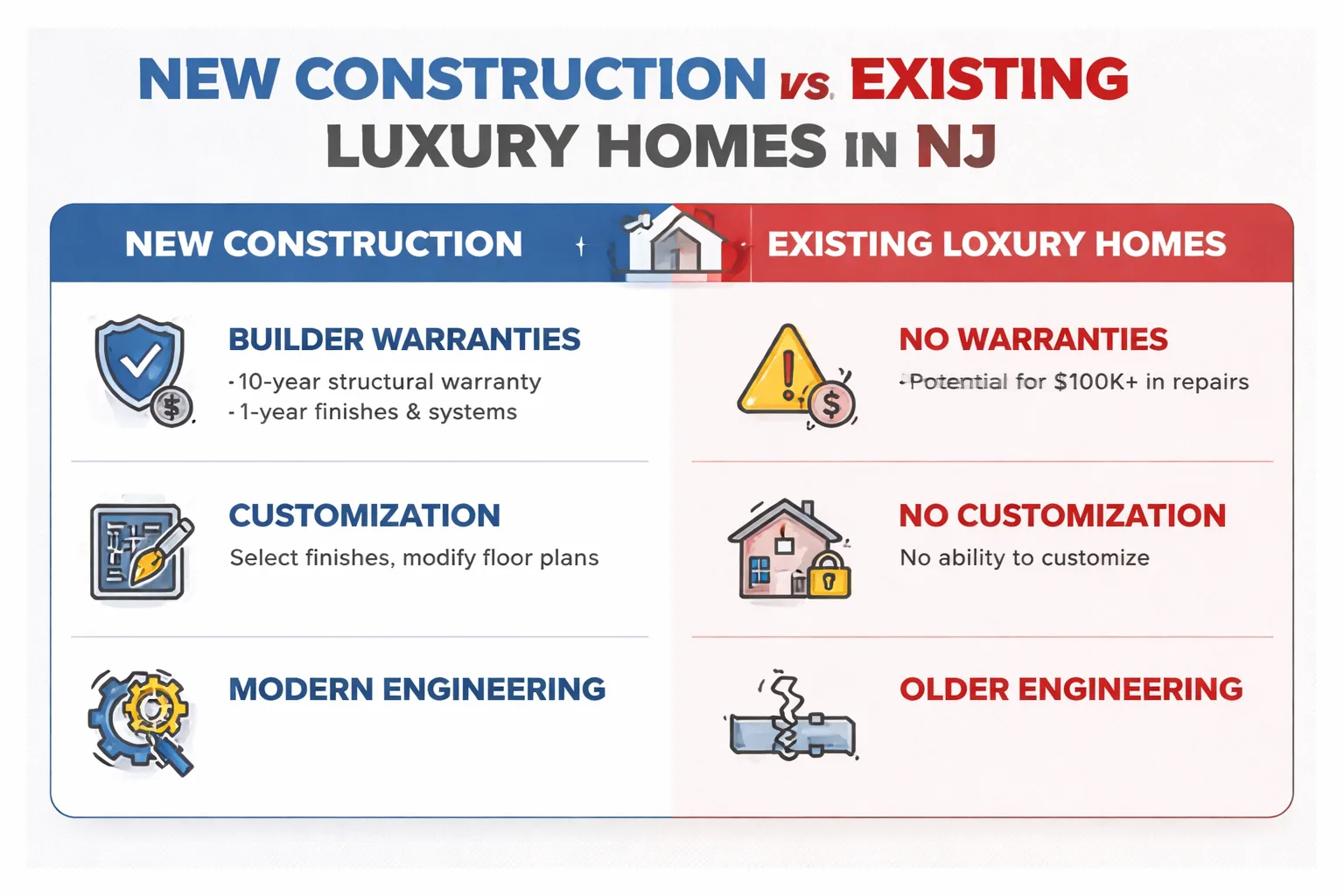
New construction delivers three things existing homes cannot: builder warranties, customization, and modern engineering. The warranty alone has real value. A 10-year structural warranty from a reputable builder covers foundation issues, framing defects, and major structural failures that would cost hundreds of thousands to repair in an older home. One-year warranties cover finishes and systems, meaning the first year of ownership carries minimal surprise repair costs. For buyers coming from Manhattan apartments where maintenance is handled by building staff, this transition period matters.
Customization is where new builds shine. Buyers who contract early in the construction process can select finishes, modify floor plans, and add features that would be prohibitively expensive to retrofit. A home theater room added during construction costs $50,000-100,000. Adding one to an existing home after purchase easily runs $150,000-250,000 after demolition, structural modification, and finish work. The same math applies to wellness rooms, wine cellars, and integrated smart-home infrastructure.
Existing luxury homes counter with three advantages: established landscaping, larger lots, and negotiating room. A 30-year-old luxury home on two acres with mature trees, established gardens, and a pool that's been operational for a decade offers an immediate lifestyle that new construction cannot match for 5-10 years. The lot sizes tend to be larger because older subdivisions were platted when land was cheaper and zoning was less restrictive. And sellers of existing luxury homes have more flexibility on price and terms than builders, who need to maintain per-square-foot pricing to protect their development pro forma.
The financial math favors existing homes on price-per-square-foot but favors new construction on total cost of ownership. Existing luxury homes in Bergen County typically trade at $350-500 per square foot. New construction runs $450-650 per square foot. But existing homes often need $200,000-500,000 in updates (roof, HVAC, kitchen, bathrooms, windows) within the first five years of ownership, which narrows the gap considerably. Property taxes can also differ significantly by town and assessment, making it essential to review NJ property tax rates by town before comparing options.
The risk profile differs too. New construction carries builder risk: if the developer has financial trouble, projects stall. The Kushner family's One Journal Square project in Jersey City is a cautionary tale. Despite luxury positioning, the project stalled due to mayoral opposition to tax abatements and controversies surrounding the EB-5 program. EB-5 investors who relied on the project for green cards saw their investment returns and immigration goals become uncertain. Local politics and regulatory changes can derail even the most promising-looking investments. Existing homes carry inspection risk: hidden structural issues, underground oil tanks, outdated electrical systems, and foundation problems that only surface after closing.
The recurring pattern is that new construction buyers pay a 15-30% premium but get predictability, while existing-home buyers get more land and character but absorb renovation and repair risk. Neither path is objectively better. The right choice depends on the buyer's timeline, risk tolerance, and whether customization or established character matters more.
What International and Chinese-American Buyers Should Know
International buyers entering the NJ luxury market face a layer of complexity that domestic buyers never encounter. The regulatory landscape, financing structures, and cultural considerations demand specialist representation, not a generalist agent who occasionally handles high-end transactions.
The first consideration is FIRPTA, the Foreign Investment in Real Property Tax Act. When a foreign person sells U.S. real estate, the buyer is required to withhold 15% of the sales price and remit it to the IRS. This is not the seller's tax liability; it is a withholding that the seller can later reclaim by filing a U.S. tax return. But the practical effect is that foreign sellers often price their properties with this withholding in mind, which can create negotiating dynamics that a knowledgeable buyer's agent can leverage. For international buyers purchasing (not selling), FIRPTA does not directly apply, but understanding it matters because it affects the resale market and the behavior of competing buyers.
Financing is the bigger hurdle. Foreign nationals without U.S. credit histories face stricter lending requirements, higher down payments (typically 30-40% versus 20% for domestic buyers), and interest rates that run 0.5-1.5 percentage points above domestic rates. Some international buyers bypass U.S. lenders entirely and purchase in cash, which simplifies the transaction but ties up capital. Chinese-American buyers who hold permanent residency or citizenship face fewer hurdles but still encounter situations where their income sources (particularly if derived from overseas business interests) require specialized lender relationships to underwrite properly.
The EB-5 visa program remains relevant for some Chinese-national buyers, though it carries risks that the One Journal Square case made painfully clear. EB-5 investors put capital at risk in exchange for a path to permanent residency, but the program ties immigration outcomes to project completion. When projects stall, investors face uncertainty on both their capital and their immigration status. Buyers considering EB-5-linked real estate should treat the investment decision and the real estate decision as separate analyses, not a bundled package.
Bilingual representation is not a convenience feature. It is a due-diligence necessity. Real estate transactions in NJ involve legal documents (attorney review period contracts, inspection reports, title commitments, mortgage disclosures) that contain language with specific legal meaning. A buyer who relies on their own translation of these documents, or on an agent who is not fully fluent in both languages, risks missing critical clauses. The NJ attorney review period, which gives buyers three business days to cancel a contract after signing, is a protection that only works if the buyer understands what they are reviewing.
Cultural factors also shape the transaction. Chinese-American buyers often prioritize specific property features: south-facing entrances (feng shui considerations), proximity to Chinese cultural resources and grocery stores, and school districts with strong academic reputations. Towns like Tenafly, Englewood Cliffs, and parts of Edison and Princeton have established Chinese-American communities, which creates a support network that makes the transition smoother for relocating families. An agent who understands these preferences can filter listings more efficiently and avoid showing properties that will never meet the buyer's criteria.
The value of working with a bilingual agent who understands both the U.S. real estate process and the cultural context of the buyer cannot be overstated. Miscommunication in a multi-million-dollar transaction is not an inconvenience. It is a financial liability. The NJ home buying process involves multiple stages where clear communication determines outcomes: offer structuring, inspection negotiation, attorney review, and closing. Each stage has decision points where a misunderstanding about timing, contingencies, or contract terms can cost tens of thousands of dollars.
How to Move Fast Without Overpaying in a Competitive Market
Speed and accuracy are not opposites in the NJ luxury market. The buyers who win are the ones who move quickly because they have already done the preparation. The buyers who overpay are the ones who confuse urgency with panic.
Pre-approval at the luxury tier is step one, and it is not the same as a standard mortgage pre-approval. Luxury-tier financing often involves jumbo loans, asset-based lending, or portfolio loans that private banks hold on their own books rather than selling to Fannie Mae or Freddie Mac. A pre-approval from a mass-market lender carries less weight in a luxury transaction than a commitment letter from a private bank that has already verified assets and income. Sellers of luxury homes want to see proof that the buyer can close, not just a credit pull and a debt-to-income calculation. Buyers should have their lender prepare a custom pre-approval package that speaks to the specific property and price range, not a generic letter.
Working with a specialist agent is the highest-leverage decision a luxury buyer makes. The cost of a bad agent is not the commission. It is the overpayment, the missed red flags, and the contract terms that favor the seller. A case in point: a buyer in Bergen County was recently advised to offer full asking price on a $1.15M home. The agent missed that the property had been on the market for 23 days, while comparable homes in the area were selling in an average of 9 days. The buyer overpaid by at least $40,000 because the agent did not interpret the days-on-market signal correctly. In the luxury tier, the stakes are higher and the same mistake costs proportionally more.
A specialist agent brings three things: market data depth, contract expertise, and negotiation strategy. Market data depth means knowing not just the list prices but the actual sale prices, the price reductions, the days-on-market trends, and the inventory absorption rate for the specific town and price band. Contract expertise means understanding the NJ attorney review period, dual agency risks (where one agent represents both buyer and seller, creating inherent conflicts), and the specific clauses that protect buyers in luxury transactions (inspection contingencies, financing contingencies, appraisal contingencies). Negotiation strategy means knowing when to push, when to concede, and when to walk.
Escalation clauses are a tool that competitive buyers use in multiple-offer situations, but they are poorly understood and often misused. An escalation clause states that the buyer will pay a specific amount above the next highest offer, up to a cap. For example: "Buyer will pay $10,000 above the next highest bona fide offer, up to a maximum of $5,200,000." The risk is that escalation clauses can push buyers past their actual comfort zone if the competing offer is higher than expected. They also reveal the buyer's maximum price to the seller, which eliminates negotiating leverage. In the luxury market, where offers are often reviewed individually rather than in a bidding war, escalation clauses are sometimes unnecessary. A strong clean offer at the right price beats a complicated escalation structure.
Knowing when to walk away is the most underrated skill in luxury real estate. The market has enough inventory that no single property is worth overpaying for. If the numbers don't work, if the inspection reveals structural issues the seller won't address, if the property taxes make the carrying costs unsustainable, or if the commute doesn't actually work for the buyer's daily life, the right answer is to move on. The emotional attachment that drives overpayment usually comes from scarcity thinking ("there won't be another property like this") rather than market reality. In 2026, the NJ luxury market has enough new construction and existing inventory that patience is a viable strategy.
The closing process itself involves costs that surprise unprepared buyers. Title insurance, transfer taxes, attorney fees, and recording fees add 2-5% to the purchase price on a luxury home. On a $3 million purchase, that is $60,000-150,000 in closing costs. Understanding these costs before making an offer prevents the scenario where a buyer stretches to the top of their budget on the purchase price and then cannot cover the transaction costs. The title fees and closing costs breakdown provides a detailed framework for estimating these expenses across different price points.
Why New Jersey Luxury Outperforms Manhattan for Space-Seeking Buyers
The comparison between NJ luxury homes and Manhattan luxury apartments is not apples-to-apples. It is apples-to-a-different-food-group entirely. But buyers who are deciding between a $3 million Manhattan apartment and a $3 million New Jersey luxury home need to understand what each dollar buys.
In Manhattan, $3 million typically buys a two-bedroom condo in a full-service building, roughly 1,400-1,800 square feet. Maintenance and common charges add $3,000-6,000 monthly. The buyer gets Manhattan location, building amenities (gym, doorman, possibly a pool), and the cultural density of New York City. What they do not get is private outdoor space, a private garage, more than two bedrooms without a significant price jump, or control over their living environment (building rules, board approval for renovations, neighbor noise through shared walls).
In New Jersey, $3 million buys a 5,000-6,000 square foot new construction home on a half-acre lot, with four-plus bedrooms, a three-car garage, private yard, and no monthly maintenance charges beyond property taxes. The buyer gives up Manhattan proximity and building amenities but gains roughly three times the living space, private outdoor space, and autonomy over their property.
The investment profiles differ too. Manhattan luxury condos have shown strong long-term appreciation, with prices per square foot rising from approximately $480 in 1999 to projections exceeding $1,900 by mid-2026. But the data also shows that roughly one in three luxury condo sales in Manhattan occurs at a loss. High carrying costs, limited secondary buyer pools, and market timing all contribute to this. NJ luxury homes, particularly in established Bergen County towns, have shown steadier appreciation with lower volatility, though they also lack the upside spikes that Manhattan occasionally delivers.
For buyers whose primary goal is lifestyle (space, privacy, autonomy), NJ wins decisively. For buyers whose primary goal is investment return with liquidity, the calculus is more complex and depends on the specific property, location, and holding period. Investors considering NJ properties alongside other investment vehicles should evaluate the full range of options, including commercial real estate in NJ, which offers different risk-return profiles than residential luxury.
The Manhattan market also faces a structural challenge that benefits NJ. For years, new developments were designed as glass boxes optimized for a capital flight thesis, catering to foreign cash buyers. Those buyers have largely stopped showing up, leaving inventory that doesn't resonate with current domestic buyers. Many of these units lack livability, storage, and neighborhood integration. This mismatch has led to new development inventory sitting and concessions climbing. Developers built for a market that peaked years ago, and the resulting inventory mismatch pushes space-seeking buyers directly to New Jersey.
Looking at new luxury homes in NJ but unsure which town fits your budget and commute?
The Hidden Costs Every Luxury Buyer Must Calculate
The purchase price is the beginning of the cost conversation, not the end. Luxury homes in NJ carry ongoing costs that can exceed $50,000 annually, and buyers who only calculate the mortgage payment are setting themselves up for cash flow surprises.
Property taxes are the largest line item. New Jersey has the highest property taxes in the nation, and luxury homes bear the brunt. A $3 million home in Tenafly can carry annual property taxes of $30,000-40,000. In Short Hills, the same home might see taxes of $35,000-50,000. The tax rate varies by municipality, and towns with higher assessed values sometimes have lower nominal rates but higher absolute tax bills. The NJ property tax rates by town resource provides town-by-town breakdowns that buyers should review before making an offer. Property taxes are not negotiable, and they increase over time as municipalities reassess and raise rates.
Insurance on luxury homes runs higher than standard homeowners policies. High-value home insurance (for homes above $1 million in replacement cost) typically runs $3,000-8,000 annually depending on location, construction type, and coverage limits. Waterfront properties add flood insurance, which can run $5,000-15,000 annually depending on FEMA flood zone designation and elevation. New construction generally qualifies for better insurance rates because modern building codes and materials reduce risk.
Utilities and maintenance on a 6,000-square-foot home are not trivial. Heating and cooling alone can run $500-1,200 monthly depending on system efficiency and insulation quality. Landscaping maintenance on a half-acre or larger lot runs $1,500-4,000 monthly during growing season. Pool maintenance adds $200-500 weekly. A home management system (security, smart home, audiovisual) requires annual maintenance contracts of $2,000-5,000. When these costs are annualized, the total carrying cost of a luxury home (excluding mortgage) can easily reach $60,000-100,000 per year.
New construction helps with some of these costs. Modern building envelopes with spray foam insulation, high-efficiency HVAC systems, and smart climate control reduce energy costs by 30-50% compared to older homes of similar size. Builder warranties cover the first year of systems, meaning minimal repair costs in the initial ownership period. But the property tax assessment on a new build is typically based on the full market value of the completed property, which means no historical assessment to grandfather in a lower rate.
The closing costs on the purchase itself add another layer. Transfer taxes in NJ run approximately 1% of the purchase price (the state transfer tax is $1.00 per $500 of value, or 0.2%, but municipalities can add their own). Title insurance on a $3 million home runs $3,000-5,000. Attorney fees for a luxury transaction typically run $2,500-5,000. Recording fees and miscellaneous closing costs add another $1,000-2,000. The total closing cost burden on a luxury purchase is typically 2-5% of the purchase price, which means $60,000-150,000 on a $3 million home.
Where the NJ Luxury Market Is Heading Next
The trajectory of New Jersey's luxury market through the late 2020s is shaped by three forces: migration patterns from New York, construction cost inflation, and demographic shifts in the buyer pool.
The migration pattern that started in 2020 has not reversed. Remote and hybrid work arrangements have solidified, meaning the commute penalty of living in NJ versus Manhattan is less severe than it was pre-pandemic. Buyers who need to be in Manhattan two or three days per week can tolerate a 45-60 minute commute from Bergen County. This structural shift has permanently expanded the buyer pool for NJ luxury homes.
Construction cost inflation is constraining new supply at the luxury tier. Lumber, steel, and labor costs have all risen significantly since 2020, and the per-square-foot cost of building a luxury home in NJ has increased from approximately $250-300 to $350-450. This means builders need to sell at higher prices to justify new construction, which supports existing home values. It also means the supply of new luxury homes will remain constrained, particularly on premium lots in established towns where land acquisition costs are high.
The buyer pool is diversifying. The traditional NJ luxury buyer was a domestic move-up buyer trading from a smaller NJ home or a Manhattan condo owner seeking space. The pool now includes more international buyers (particularly from China and other Asian markets), tech-industry professionals who can work remotely, and empty-nesters downsizing from larger estates into newly built luxury homes with main-floor primary suites and lower maintenance requirements. Each segment has different priorities, which creates a market where no single property type dominates.
For investors, the NJ luxury market offers a different value proposition than New York investment properties or commercial real estate. Residential luxury in NJ is primarily a lifestyle asset with appreciation potential, not a cash-flow investment. Rental yields on luxury homes are low (typically 2-4% gross) because the tenant pool for $10,000-25,000 monthly rent is thin. Buyers who want investment returns should consider whether commercial real estate or multi-family properties better serve their goals, while treating luxury home purchases as lifestyle decisions with long-term appreciation upside.
The 2026 market is not a bubble. Prices have stabilized after the 2020-2023 surge, inventory is adequate but not oversupplied, and buyer demand is steady without being frantic. The conditions support deliberate, well-informed purchasing rather than the competitive frenzy that characterized the immediate post-pandemic period. Buyers who do their homework, work with specialist representation, and understand the full cost picture can acquire new luxury homes in NJ at fair prices with confidence in long-term value.
Frequently Asked Questions
What is the average price of a new luxury home in NJ?
New luxury homes in NJ typically start around $1.8 million and range up to $8 million or more for waterfront or large estate properties. The median new luxury listing in Bergen County towns like Tenafly and Closter falls between $2.5 million and $4 million. Pricing depends heavily on town, lot size, square footage, and waterfront proximity.
How long do luxury homes stay on the market in NJ?
Well-priced new luxury homes in top NJ towns sell in 25-45 days. Overpriced listings typically sit for 90-120 days before price reductions. The market punishes unrealistic pricing but rewards accurate positioning. Days-on-market is one of the strongest signals for whether a listing is priced correctly.
Are property taxes higher on new construction luxury homes?
Yes, typically. New construction is assessed at full market value upon completion, meaning there is no historical lower assessment to grandfather in. A $3 million new build in Tenafly can carry $30,000-40,000 in annual property taxes. Buyers should review town-specific tax rates before making an offer.
Can international buyers get mortgages for NJ luxury homes?
Yes, but with stricter requirements. Foreign nationals typically need 30-40% down payments and face interest rates 0.5-1.5 percentage points above domestic rates. Some international buyers purchase in cash to simplify the transaction. Chinese-American buyers with permanent residency or citizenship face fewer hurdles but may need specialized lenders if income is derived from overseas sources.
Is it better to buy new construction or an existing luxury home?
New construction offers builder warranties, customization, and modern engineering at a 15-30% premium. Existing luxury homes offer larger lots, established landscaping, and more negotiating room. The right choice depends on whether the buyer prioritizes predictability and customization or space and character.
What should I look for in a NJ luxury real estate agent?
Market data depth (actual sale prices, not just list prices), contract expertise (attorney review, dual agency risks, contingency clauses), and negotiation strategy. The cost of a bad agent is not the commission. It is the overpayment and missed red flags that cost tens of thousands. For international buyers, bilingual fluency is a due-diligence necessity, not a convenience.
About the Author
Judy Zhou, Keller Williams Realtor®
Judy Zhou is a Realtor® with Keller Williams Town Life Realty in Tenafly, NJ, serving New Jersey and New York with $35M+ in sales volume. Licensed in both NJ and NY, she specializes in luxury homes, investment properties, and commercial real estate, offering seamless bilingual English-Chinese service. Before joining Keller Williams, she earned Coldwell Banker's International President's Elite (2024) and International Diamond Society (2025) awards.
Get a personalized luxury home strategy session with a bilingual NJ-NY licensed Realtor who knows every new construction project in Bergen County.