How to Work With a Chinese Real Estate Agent in NJ: 5 Steps

By Judy Zhou, Keller Williams Realtor®
Key Takeaways
- Roughly one-third of Chinese-American buyers in NJ report that "something felt off" with their previous agent after the first transaction, showing language skills alone fail to prevent losses.
- Choose an agent who can spot a $40,000 overpricing and explain the three-day attorney review clause clause-by-clause before you sign any contract.
- Verify the agent's NJ transaction history first, then align communication protocols and confirm which documents require certified translation versus direct explanation.
- Evaluate fit only after a consultation that tests negotiation of inspection credits and drafting of addenda, not just school-district small talk in Mandarin.
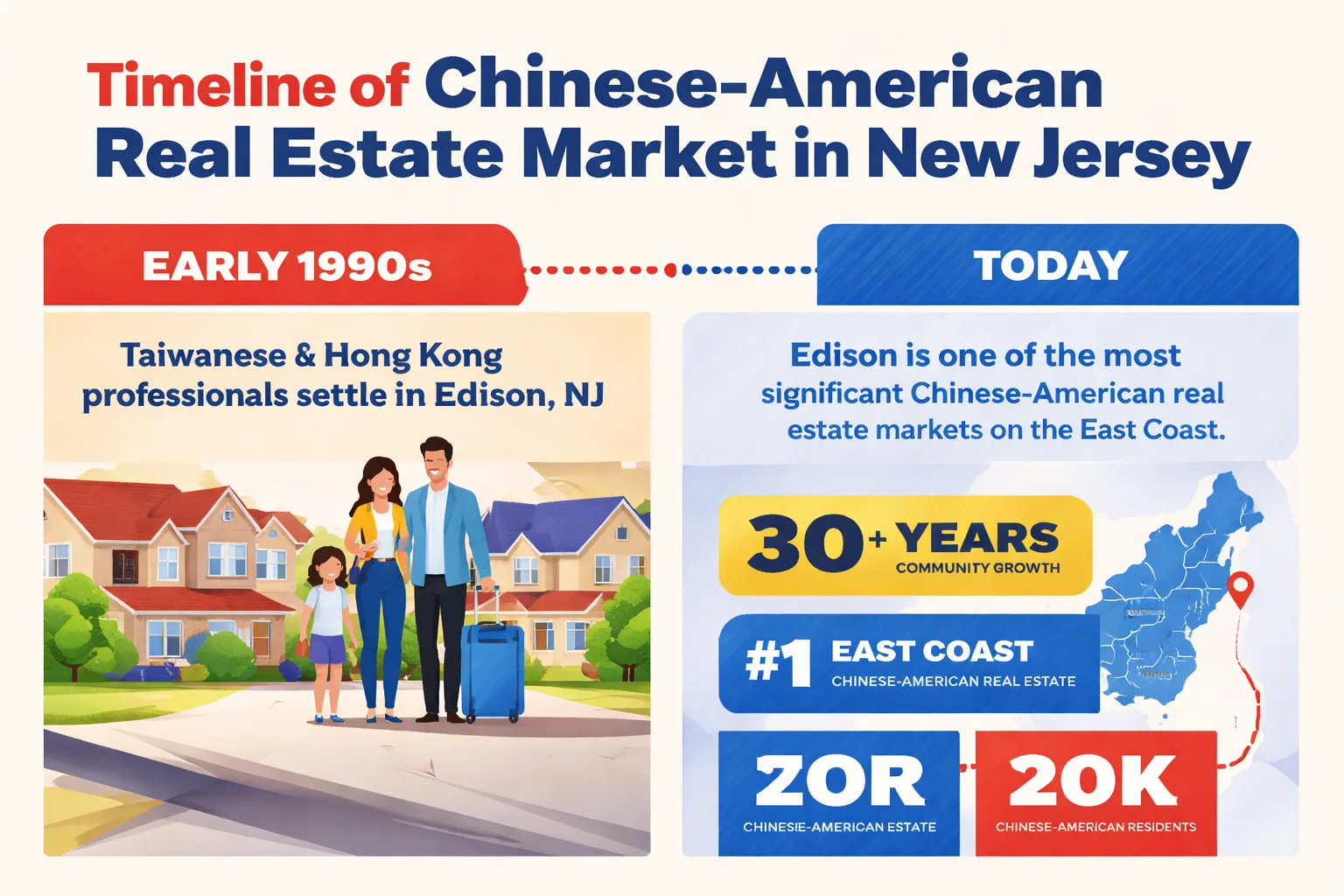
In the early 1990s, a small but steady wave of Taiwanese and Hong Kong professionals began settling in Edison, New Jersey, drawn by its strong school districts, proximity to Manhattan, and emerging Chinese business community along Route 27. What started as a tightly knit enclave has since grown into one of the most significant Chinese-American real estate markets on the East Coast. Today, working with a chinese real estate agent new jersey means tapping into more than thirty years of accumulated community knowledge, investment patterns, and cross-cultural property expertise built into the fabric of the state.
Finding a bilingual agent who speaks Mandarin or Cantonese is the easy part. Finding one who can negotiate hard, explain NJ attorney review clause by clause, and spot a $40,000 overpricing before you sign is where most buyers lose money. The data shows that roughly a third of Chinese-American buyers in NJ report that "something felt off" with their previous agent after their first transaction. Language alone does not protect you. The five steps below cover what actually matters: verifying transaction history, aligning communication protocols, understanding which documents need certified translation, and evaluating fit before you commit.
Step 1. Define What 'Bilingual Service' Actually Means for Your Deal
A bilingual realtor nj who can chat about school districts in Mandarin is not the same as one who can negotiate inspection credits, draft addenda, and explain the three-day attorney review period in precise legal Chinese. The distinction matters more than most buyers realize.
Conversational fluency covers showing appointments, neighborhood orientation, and basic property descriptions. Transactional fluency covers contract terms, contingency clauses, mortgage commitment deadlines, and the specific legal mechanics of New Jersey's attorney review process. A new jersey chinese speaking real estate agent who lacks transactional fluency will default to explaining complex terms in English, then translating the summary. That gap is where misunderstandings compound. A buyer who thinks they understand the inspection contingency but actually conflates it with the appraisal contingency can miss a critical deadline and lose their earnest money deposit.
Before the first call, buyers should write down three deal-specific terms they need explained in Chinese. If the agent cannot clearly explain attorney review, earnest money, and contingency removal in Chinese without reverting to English, that agent provides conversational service, not transactional service. For investment property buyers, the bar is even higher. The agent needs to explain cap rate calculations, NOI adjustments, and lease assignment language in Chinese. A residential agent who speaks Mandarin cannot necessarily do this.
The practical test is simple. Ask the agent to explain NJ attorney review in Chinese on the spot. If they hesitate, switch to English, or give a vague summary instead of a precise breakdown of the three-day window and what it allows either party to do, the bilingual service is conversational. That may be sufficient for a straightforward purchase in a familiar neighborhood. For anything involving negotiation, contingencies, or investment analysis, it is not.
The difference between these two levels of service has real financial consequences. Consider a buyer in Bergen County whose agent explained the inspection contingency in general terms but never clarified that the contingency deadline is tied to the attorney review modification timeline. The buyer assumed they had ten days to complete inspections. The contract actually allowed five. On day seven, the seller's attorney notified the buyer that the contingency had expired and the earnest money was at risk. The buyer had to accept the property as-is or lose the deposit. A transactionally fluent agent would have walked through the deadline in Chinese, confirmed the buyer understood the specific date, and documented the conversation in writing. A conversationally fluent agent summarized it and moved on.
For buyers coming from the Manhattan market, the distinction is even more important. In New York, attorney review works differently. There is no automatic three-day window. The contract is not binding until both attorneys sign off. A buyer who previously purchased in Manhattan and assumes NJ works the same way will be surprised when the seller's attorney locks in terms on day four. The bilingual agent needs to explain this difference in Chinese before the buyer signs the NJ contract, not after.
Step 2. Verify Local Market Knowledge Beyond Language
A shared language creates trust. It does not create competence. The most expensive mistake Chinese-American buyers make in NJ is assuming that a Mandarin-speaking agent also has deep local expertise in the specific town, county, or property type they are targeting.
New Jersey real estate is hyperlocal. Property tax rates can vary by as much as 1% between adjacent towns. On a $1 million home, that is $8,000 to $10,000 per year in additional holding costs. An agent who specializes in Edison's school district dynamics may not understand Bergen County's luxury market, where a home sitting 23 days longer than the market average of 9 days signals a pricing problem and a negotiation opportunity. The 2026 New Jersey Housing Market Outlook shows that inventory and pricing trends diverge sharply between counties. An agent without current data for the specific county is flying blind.
Buyers should ask for specific transaction history. How many deals closed in the target town in the last 12 months? What price range? Were any of them luxury waterfront real estate or investment properties? An agent who has closed three transactions in Tenafly at the $1.2M to $1.8M range has relevant expertise for that market. An agent who closed fifteen transactions but all in a different county and price bracket does not. Volume in the wrong market is not expertise.
For buyers considering commercial real estate, the vetting is even more critical. A residential agent recommended through a WeChat group may not understand lease assignment clauses, health permit transfers, or the difference between gross and net leases. When the NJ home buying process involves commercial or mixed-use property, the agent's lack of commercial training can cause deals to collapse during due diligence.
The verification process is straightforward. Ask for the agent's license number, then check it against the New Jersey Real Estate Commission's licensing database. NJ requires 75 hours of prelicensure education for salespersons and 150 hours for brokers, including specific coursework on agency relationships and ethics. Confirm the license is active and check for any disciplinary history. Then ask for three recent references from buyers who purchased in the same town and price range. An agent who cannot provide them is not the right fit.
The county-level expertise question deserves more attention than it typically gets. Bergen County, Essex County, and Hudson County each have distinct market dynamics that affect valuation, negotiation, and closing logistics. Bergen County commands the highest median home prices in NJ, with towns like Tenafly, Closter, and Alpine attracting luxury buyers who prioritize school districts and lot size. Essex County offers a mix of urban and suburban properties, with Maplewood and South Orange appealing to buyers who want commute access to Manhattan at a lower price point. Hudson County, including Jersey City and Hoboken, caters to buyers who want urban density and direct PATH train access. An agent who excels in one county may not understand the pricing dynamics of another.
The school district question is particularly important for Chinese-American buyers, who often prioritize education quality above almost every other factor. But school district boundaries in NJ do not always follow town lines. Some towns send students to regional high schools. Some districts have magnet programs that require application. An agent who cannot explain the difference between the Tenafly school district and the Northern Valley regional district in Chinese is not equipped to advise a family whose purchase decision hinges on school quality.
For international buyers, there is an additional layer of verification. Does the agent understand the financing requirements for foreign nationals? Most conventional lenders require 30% to 40% down for foreign buyers, and some require a higher credit score equivalent or additional asset verification. An agent who has never worked with international buyers may not know which lenders offer foreign national programs, what documentation is required, or how to structure the offer to account for the longer underwriting timeline. This is where the Investment Real Estate Agency resource becomes relevant for buyers who need an agent with cross-border experience.
Step 3. Align on Communication Style and Availability
WeChat is the dominant communication platform for Chinese-American buyers and overseas investors. But WeChat groups are also where misinformation spreads fastest. An agent who communicates primarily through WeChat group chats may not maintain the documentation trail that a complex transaction requires.
The conversation about communication protocols should happen before the buyer's agreement is signed. Which platform for routine updates? Which platform for contract documents? How quickly will the agent respond during business hours, and what is the policy for evenings and weekends? For overseas buyers in a different time zone, the question is whether the agent will take a call at 9 PM Eastern to discuss an offer that needs to go out before midnight.
Email matters for the paper trail. Contract addenda, inspection reports, mortgage commitments, and closing disclosures should all go through email, not WeChat. WeChat messages can be deleted, lost in group chat noise, or unavailable on a device switch. A competent bilingual agent will use WeChat for relationship-building and quick updates, then route every document and every material decision through email or a transaction management platform.
Response-time expectations should be explicit. The standard in NJ real estate is same-day response during business hours, and within four hours for time-sensitive matters like a counteroffer with an expiration deadline. If an agent cannot commit to that, the buyer needs to know before they are in a multiple-offer situation where a two-hour delay costs them the property.
For buyers working with international funds, communication about wire transfers and timing is critical. Cross-border transfers can take three to five business days, and the agent needs to coordinate with the title company and the buyer's bank to ensure funds arrive before the closing deadline. An agent who has never handled an international wire transfer may not understand the timing constraints, which can derail a closing.
The time-zone issue deserves specific attention. Buyers in Shanghai are 12 hours ahead of Eastern Time. When it is 9 AM in New Jersey, it is 9 PM in Shanghai. A buyer who works during the day in China may only be available to discuss offers at what is late evening for the NJ agent. The agent's willingness to accommodate this schedule should be confirmed before the buyer's agreement is signed. If the agent is unavailable evenings and weekends, and the buyer is only available evenings and weekends due to the time zone difference, the transaction will stall at every decision point.
The documentation protocol should also address how the agent handles offer submissions. In NJ's competitive markets, particularly in Bergen County and Hudson County, offers may need to go out within hours of a property listing. The buyer needs to know that the agent can prepare, send, and negotiate an offer without waiting 24 hours for a response. This is especially important for buyers targeting luxury real estate brokerages listings, where competition among buyers is intense and speed matters.
Step 4. Understand the NJ Transaction Process in Both Languages
New Jersey's transaction process has specific stages that differ from New York and other states. Understanding which documents a bilingual agent can explain versus which require a certified translator or bilingual attorney is essential for avoiding costly misunderstandings.
The NJ process moves through five stages: contract signing, attorney review, inspection period, mortgage commitment, and closing. Each stage has specific documents and deadlines. The title fees and closing costs in NJ differ from NY, and buyers crossing the Hudson need to understand the distinction.
A bilingual agent can and should explain the following in Chinese: the structure of the purchase contract, what attorney review means (the three-business-day window where either party can cancel for any reason), what the inspection contingency covers, the mortgage commitment deadline, and what happens at the closing table. This is transactional fluency in action. The agent should walk through each document clause by clause, not summarize in broad strokes.
However, a bilingual agent cannot provide certified translations of legal documents. If a lender, attorney, or title company requires a certified translation of the purchase contract, the buyer's financial statements, or any legal filing, that requires a certified translator or a bilingual attorney. The agent's explanation is for the buyer's understanding. It is not a legal translation and should not be relied upon as one.
The attorney review period is where cultural differences in negotiation style become most visible. In Chinese business culture, negotiation often involves indirect communication and relationship-based concessions. In NJ real estate, attorney review is a formal, deadline-driven process where the buyer's attorney can modify or cancel the contract within three business days. A buyer who expects the agent to negotiate informally through relationships, rather than through the attorney review process, will be frustrated. The agent's job is to explain this difference before the contract is signed, not after.
For buyers considering new construction, the new condo developments near me resource provides context on developer reputation and project timelines. A bilingual agent should be able to explain the developer's track record, the offering plan, and the warranty provisions in Chinese, but the offering plan itself is a legal document that should be reviewed by an attorney.
The inspection stage deserves particular attention from bilingual buyers. The home inspection report is typically 30 to 50 pages of technical English, covering structural issues, electrical systems, plumbing, HVAC, roof condition, and environmental hazards like radon or mold. The agent can summarize the major findings in Chinese, but the buyer should also request the inspector's direct contact information for any clarifying questions. If the inspection reveals a structural issue that requires a specialist evaluation, the agent should explain the options: request a credit from the seller, request the seller complete repairs before closing, or cancel the contract during the inspection contingency period. Each option has different financial and timeline implications, and the buyer needs to understand all three in Chinese before making a decision.
The mortgage commitment stage is another area where bilingual service matters. The mortgage commitment letter specifies the loan amount, interest rate, term, and any conditions the borrower must satisfy before closing. If the agent cannot explain the conditions in Chinese, the buyer may miss a requirement like providing additional asset documentation or paying off a contingent liability. For foreign national buyers using cross-border financing, the mortgage commitment may include currency exchange rate clauses or repatriation restrictions that need careful explanation.
The closing itself involves a stack of documents that the buyer signs at the title company. The HUD-1 settlement statement, the deed, the mortgage note, and the truth-in-lending disclosure are all in English. The agent can explain each document's purpose in Chinese before the closing, but at the closing table, the title company representative will walk through the documents in English. A buyer who is not comfortable signing English documents without full understanding should hire a bilingual attorney or a certified translator to be present at closing.
Are you working with an agent who can explain attorney review in Chinese?
Step 5. Evaluate Fit After the First Consultation
The first consultation is a diagnostic. Within 45 minutes, a buyer should know whether this agent has the expertise, communication style, and market knowledge to represent them well. The checklist below separates green flags from red flags.
Green flags: the agent asks specific questions about the buyer's timeline, budget, school district requirements, and investment goals. The agent volunteers information about property tax differences between towns. The agent explains attorney review without being prompted. The agent provides recent transaction references in the target town. The agent discusses dual agency and the conflict of interest it creates without being asked. The agent has a clear communication protocol that distinguishes between WeChat updates and email documentation.
Red flags: the agent steers every conversation toward their transaction volume rather than the buyer's needs. The agent cannot name the average days on market in the target town. The agent glosses over attorney review or says "the attorney handles that." The agent does not mention property tax rates or school district boundaries. The agent pushes for a buyer's agreement before discussing the buyer's goals. The agent cannot explain the difference between a salesperson license and a broker license in NJ.
Buyers who skip the vetting process and rely solely on WeChat recommendations can overpay by $40,000 or more, based on cases where the previous agent missed a 23-day market time red flag that signaled an obvious pricing negotiation opportunity. The agent's job is not just to find properties. It is to protect the buyer from overpaying, to identify risks the buyer cannot see, and to negotiate terms that reflect actual market conditions.
The approach at Keller Williams Town Life Realty addresses these pain points directly. The focus is on identifying specific risks that Chinese buyers often overlook: dual agency conflicts, property tax rate variations between towns, and the gap between asking price and market value when days on market exceeds the local average. The bilingual service covers transactional fluency, not just conversation. Each client receives a market analysis for the target town before making an offer, including comparable sales, days on market, and property tax implications.
For buyers evaluating luxury properties, the Closter vs Tenafly comparison illustrates how two adjacent Bergen County towns can have different price points, school ratings, and tax structures. An agent who understands these differences can save a buyer tens of thousands of dollars, not just on the purchase price but on long-term holding costs.
The consultation should also cover the agent's approach to negotiation. In NJ, the listing price is a starting point, not a fixed price. An agent who understands the local market will know whether a property is priced above, at, or below market value based on comparable sales, days on market, and the seller's motivation. The seller's motivation is not always public information, but an experienced agent can often infer it from the listing history, price reductions, and the listing agent's remarks. A bilingual agent who can explain this analysis in Chinese gives the buyer a negotiation advantage that a conversationally fluent agent cannot.
For buyers targeting the luxury market, the consultation should include a discussion of the agent's experience with luxury real estate agency transactions. Luxury properties in NJ are not always listed on the MLS. Some are marketed privately through broker networks. An agent with luxury experience will have access to these networks and can identify properties that never reach the public market. This is particularly relevant for buyers seeking waterfront luxury real estate in Bergen County or Hudson County, where inventory is limited and competition is high.
Where This Process Breaks Down
This five-step process assumes the buyer is dealing with a licensed, competent agent. In three specific scenarios, the advice above does not work as intended.
First, when the buyer is working with a relative or family friend who holds a real estate license. The social relationship makes objective vetting nearly impossible. Buyers will not ask a family friend for three references or question their attorney review explanation. The result is that the agent's gaps go unexamined until they cost money. Second, when the transaction involves a For Sale By Owner property where no agent represents the buyer at all. The steps above presuppose agent representation. Without it, the buyer is self-represented and needs a real estate attorney from day one. Third, when the agent is primarily a commercial broker being asked to handle a residential purchase. Commercial and residential transactions in NJ have different contracts, different contingencies, and different closing norms. A commercial expert is not automatically a residential expert, and the reverse is equally true.
What This Won't Fix
Finding the right agent does not fix macroeconomic conditions. If interest rates spike or lending tightens, even the best agent cannot make a deal work that the numbers do not support. The right agent identifies the problem early and helps the buyer pivot. The wrong agent discovers it at the closing table.
The right agent also cannot override a buyer's own poor judgment. If a buyer insists on waiving inspection to win a bidding war, the agent's role is to document the recommendation against it and proceed. The five steps above help identify an agent who will give that advice. They do not guarantee the buyer will take it.
For investors looking at commercial real estate as an investment, the agent selection process is similar but the expertise required is different. A residential bilingual agent, no matter how skilled, is not the right partner for a multi-tenant retail acquisition. The five-step framework still applies, but the questions change: cap rate analysis instead of school districts, lease audit instead of inspection, and DSCR calculations instead of mortgage pre-qualification.
How Does Dual Agency Affect Chinese-American Buyers?
Dual agency occurs when one agent represents both the buyer and the seller in the same transaction. In NJ, dual agency is legal but requires written consent from both parties. The conflict of interest is inherent: the agent cannot fully advocate for the buyer's price and terms while also representing the seller's interest in maximizing the sale price.
For Chinese-American buyers, dual agency is particularly problematic because of cultural norms around trust and relationship. Many buyers assume that an agent introduced through a community connection will advocate for them. When that same agent is also representing the seller, the buyer's interests are compromised. The agent is legally required to remain neutral and cannot disclose the seller's motivation or the buyer's maximum budget to either party.
A bilingual agent should explain dual agency in Chinese before the buyer signs a consent form. The explanation should cover what the agent can and cannot do in a dual agency relationship, how it differs from exclusive buyer representation, and what the buyer gives up by agreeing to it. If the agent downplays the conflict or frames it as a routine formality, that is a red flag. Buyers should know that they can refuse dual agency and request that a different agent within the same brokerage represent them.
The financial impact of dual agency can be significant. In one case, a buyer in Bergen County agreed to dual agency without understanding the implications. The property had been on the market for 23 days, well above the local average of 9 days. A buyer's agent with exclusive representation would have flagged this as a pricing problem and recommended an offer below asking. In a dual agency relationship, the agent remained neutral and did not provide this guidance. The buyer paid full asking price. The difference between the recommended offer and the accepted price was approximately $40,000.
When Should You Hire a Bilingual Attorney?
A bilingual agent and a bilingual attorney serve different functions in a NJ real estate transaction. The agent finds properties, negotiates price and terms, and guides the transaction through closing. The attorney reviews the contract, modifies terms during attorney review, and provides legal counsel that the agent cannot.
NJ is an attorney state, meaning that real estate attorneys are involved in virtually every residential transaction. The buyer's attorney reviews the contract after signing, proposes modifications during the three-day attorney review period, and handles the closing. Having a bilingual attorney is valuable when the buyer needs legal advice in Chinese, when the transaction involves unusual contract terms, or when the buyer is not comfortable understanding legal documents in English.
For standard transactions, a bilingual agent who provides transactional fluency may be sufficient if the buyer's attorney is English-speaking. The agent explains the contract in Chinese, the attorney handles the legal modifications, and the agent translates the attorney's explanations for the buyer. This works when the agent is transactionally fluent and the attorney is accessible.
For complex transactions, a bilingual attorney is essential. Investment properties with existing leases, commercial transactions, or properties with title issues require legal counsel that goes beyond what an agent can provide. If the buyer cannot understand the attorney's advice in English, a bilingual attorney is the right solution. The agent cannot substitute for the attorney, and the attorney cannot substitute for the agent.
Why Do NJ Property Taxes Vary So Much Between Towns?
NJ has the highest property taxes in the nation, and the variation between towns is dramatic. Two towns in Bergen County, separated by less than two miles, can have tax rates that differ by 0.5% to 1% of assessed value. On a $1 million home, that is $5,000 to $10,000 per year in additional holding costs.
The variation comes from several factors: municipal budget requirements, school district funding, county taxes, and the local tax base. Towns with strong commercial tax bases, like Paramus or Edgewater, can offset residential tax burdens. Towns that are primarily residential, like Tenafly or Alpine, rely almost entirely on residential property taxes to fund schools and municipal services.
For Chinese-American buyers, the property tax question is often overlooked because the focus is on the purchase price and school district quality. But the annual tax cost affects the total cost of ownership over the holding period. A $1 million home in a town with a 2.5% effective tax rate costs $25,000 per year in taxes. The same home in a town with a 1.5% rate costs $15,000. Over a ten-year holding period, the difference is $100,000.
A bilingual agent should explain the property tax implications of each town the buyer is considering, in Chinese, before the buyer makes an offer. The agent should also explain how property taxes are calculated in NJ (assessed value times the general tax rate), how reassessments work, and whether the town has a history of tax appeals. This information affects the buyer's long-term investment return and should be part of the agent's standard consultation.
The Westchester County homes for sale resource provides a comparison point for buyers who are also considering NY suburbs. Westchester's property tax structure differs from NJ's, and buyers crossing state lines need to understand both systems.
How to Verify NJ Real Estate License Status
The NJ Real Estate Commission maintains an online database where anyone can verify an agent's license status. The process takes less than five minutes and should be the first step in vetting any agent.
Enter the agent's name or license number. The database shows the license type (salesperson or broker), the expiration date, the brokerage affiliation, and any disciplinary history. A salesperson license requires 75 hours of prelicensure education. A broker license requires 150 hours, including 90 hours of general real estate coursework plus two 30-hour modules on agency/ethics and office management. Brokers must also have three years of full-time experience as a licensed salesperson.
The distinction between a salesperson and a broker matters. A salesperson must work under a broker's supervision and cannot operate independently. A broker can own a brokerage, supervise salespersons, and handle trust accounts. For buyers, working with a broker means the agent has additional training and experience. Working with a salesperson is fine for standard transactions, but the buyer should know which license type the agent holds.
Disciplinary history is public. If the database shows a complaint, suspension, or revocation, the buyer should ask the agent to explain the circumstances before proceeding. Some disciplinary actions are minor (late continuing education completion) and some are serious (trust fund violations, misrepresentation). The buyer has the right to understand the full picture before signing a buyer's agreement.
For buyers who want to verify an agent's transaction history beyond the license database, the agent should provide a list of recent closings. The list should include the town, sale price, and date. The buyer can cross-reference this with public MLS data or county property records to confirm accuracy. An agent who refuses to provide transaction history or whose claims cannot be verified is a red flag.
FAQ
What is the difference between a bilingual agent and a bilingual attorney in NJ real estate?
A bilingual agent can explain contract terms, negotiate on the buyer's behalf, and guide the transaction in Chinese. A bilingual attorney provides legal counsel, reviews or drafts contract modifications during attorney review, and can represent the buyer in legal matters. The agent cannot give legal advice. The attorney cannot show properties or negotiate price. Most transactions need both.
How do I verify a Chinese-speaking agent's NJ license?
Use the New Jersey Real Estate Commission's online license lookup. Enter the agent's name or license number. Confirm the license is active and check for any disciplinary actions. NJ requires 75 hours of prelicensure for salespersons and 150 hours for brokers, so verify whether the agent is a salesperson or broker, since brokers have additional training and can operate independently.
Should I use WeChat or email for contract documents?
Email for all contract documents, addenda, inspection reports, and closing disclosures. WeChat for quick updates and relationship communication. Contract documents sent through WeChat can be lost, deleted, or buried in group chat noise. Email creates a searchable, permanent record that the title company, attorney, and lender can all reference.
Can a bilingual agent translate my financial documents for the lender?
No. If the lender requires certified translations of financial statements, tax returns, or any legal document, the agent's translation does not qualify. The agent can explain the documents to the buyer in Chinese for understanding purposes. Certified translation requires a professional translator or a bilingual attorney.
What should I do if my agent cannot explain attorney review in Chinese?
Find a different agent. Attorney review is the most critical consumer protection in NJ real estate. If the agent cannot explain the three-business-day window, what it allows either party to do, and how the buyer's attorney can modify the contract during that period, the agent does not have transactional fluency. This is the single most important test of whether a bilingual agent can protect the buyer's interests.
Is dual agency common in NJ, and should I agree to it?
Dual agency, where one agent represents both buyer and seller, is legal in NJ but creates an inherent conflict of interest. The agent cannot fully advocate for either party. Buyers should understand what dual agency means before signing anything. A bilingual agent should explain the implications in Chinese without being asked. If the agent downplays the conflict or does not disclose dual agency status, that is a red flag.
What are the property tax differences between Bergen County towns?
Property tax rates in Bergen County can vary by 0.5% to 1% between adjacent towns. On a $1 million home, that translates to $5,000 to $10,000 per year. The variation comes from municipal budgets, school district funding, and the local commercial tax base. A bilingual agent should explain these differences in Chinese before the buyer selects a target town.
About the Author
Judy Zhou, Keller Williams Realtor®
Judy Zhou is a Realtor® with Keller Williams Town Life Realty in Tenafly, NJ, serving New Jersey and New York with $35M+ in sales volume. Licensed in both NJ and NY, she specializes in luxury homes, investment properties, and commercial real estate, offering seamless bilingual English-Chinese service. Before joining Keller Williams, she earned Coldwell Banker's International President's Elite (2024) and International Diamond Society (2025) awards.
Schedule a consultation with a bilingual Realtor who has closed $35M+ across NJ and NY, and get a town-specific market analysis before you make an offer.