How to Find a Chinese-Speaking NJ Realtor in 5 Clear Steps

How to Find a Chinese-Speaking NJ Realtor in 5 Clear Steps
By Judy Zhou, Keller Williams Realtor®
Key Takeaways
- Hiring a Chinese-speaking NJ realtor provides negotiating leverage that directly affects offer strategy and final closing numbers in high-stakes deals like Bergen County homes or Manhattan luxury properties.
- Buyers who pick agents solely through WeChat recommendations or language matching risk overpaying by $40,000 or more when the agent misses stale listings or mispriced comps.
- A Chinese-speaking agent without deep Bergen County micro-market knowledge is a liability, not an asset, especially amid the inventory shifts detailed in the 2026 New Jersey Housing Market Outlook.
- Verify any candidate against the three-day attorney review period and the mandatory buyer agency agreements required under the Real Estate Consumer Protection Enhancement Act effective August 1, 2024.
Hiring a Chinese-speaking NJ realtor is not about cultural comfort. It is about cold, hard negotiating leverage. Many buyers treat language-matched representation as a nice-to-have, a soft preference they list somewhere below location and commission rate. That framing is wrong. In high-stakes transactions involving commercial real estate in NJ, Manhattan luxury apartments, or New York investment properties, the ability to communicate with precision in your primary language directly affects your offer strategy, your due diligence, and ultimately the final number on the closing statement.
The question 想在新泽西买房,哪些房产经纪人比较好 (which real estate agents are good for buying a house in New Jersey) gets asked constantly in WeChat groups, community forums, and family dinner tables. The answers that come back are almost entirely wrong. They default to "ask around" or "find someone who speaks Chinese." Buyers who follow that advice can overpay by $40,000 or more on a single transaction, based on documented cases where language-matched agents lacked the local market expertise to flag stale listings, mispriced comps, or structural red flags. The 2026 New Jersey Housing Market Outlook shows inventory shifts that make agent selection more consequential than ever. A Chinese-speaking agent without deep Bergen County micro-market knowledge is a liability, not an asset. The five-step framework below is built to separate genuine expertise from surface-level language matching.
Why Language and Cultural Fit Matter in NJ Real Estate
New Jersey real estate transactions operate under legal structures that are confusing even for native English speakers. The three-day attorney review period, dual agency disclosures, mandatory buyer agency agreements under the Real Estate Consumer Protection Enhancement Act (effective August 1, 2024), and town-by-town property tax variations create a landscape where miscommunication translates directly into financial loss. For Chinese-speaking buyers, especially those navigating cross-border fund transfers or purchasing their first U.S. property, the friction compounds.
A bilingual agent does more than translate documents. They bridge the gap between Chinese negotiation culture, which tends to emphasize relationship-building and indirect communication, and the American transactional system, which rewards directness, speed, and contractual precision. When a seller's counteroffer arrives with a 24-hour expiration, an agent who can explain the implications in Mandarin while simultaneously strategizing in English has a material advantage. They can assess whether the counter reflects genuine interest or a fishing tactic, advise on escalation clauses, and draft a response that protects the buyer's position without offending the seller.
Property tax rates in New Jersey can vary by as much as 1% between adjacent towns. On a $1 million home, that difference amounts to $8,000 to $10,000 annually in holding costs. An agent who understands Chinese buyers' investment horizons (often 5-10 years rather than the American norm of 3-5) will factor long-term tax burden into the town selection process from day one. An agent who merely speaks the language will not.
The recurring pattern is clear. Buyers who select agents based on language alone, without verifying local expertise, end up with representation that feels comfortable but performs poorly. They miss school district nuances in Bergen County. They accept stale listings at face value. They sign contracts during attorney review without understanding the contingencies they just waived. Language fit is the floor, not the ceiling.
Consider a concrete scenario that plays out regularly. A buyer tours a home listed at $1.15M in a competitive Bergen County town. The listing has been active for 23 days, well above the 9-day market average for that price tier. An agent without micro-market data awareness would take the listing price at face value and advise the buyer to offer close to ask. An agent tracking days-on-market trends would recognize the 23-day signal immediately and build a negotiation strategy around it. The result is a $40,000 to $70,000 swing on the final purchase price. That is not a rounding error. It is the difference between an agent who reads the market and one who reads the script.
The attorney review period in New Jersey is unique. Unlike most states where the contract is binding upon signature, New Jersey provides a three-day window during which either party can cancel for any reason. This period is where deals are won or lost. An agent who cannot clearly explain what contingencies to negotiate during this window (inspection clauses, mortgage commitments, radon testing, underground oil tank discovery) is setting the buyer up for a painful discovery after the contingency period expires.
For international Chinese buyers, the friction extends further. Cross-border fund transfers from China to the U.S. are subject to foreign exchange controls, documentation requirements, and timing constraints that can take 2-6 weeks to resolve. An agent who has never navigated this process cannot advise the buyer on timing the offer to align with fund availability. Deals collapse regularly because the agent assured the buyer that "the money can come through in a few days" when the reality involves compliance reviews at both Chinese and American banking institutions.
Step 1-2: Define Your Needs and Search the Right Channels
Before contacting any agent, the buyer must define what they are actually buying. This sounds obvious. It is not.
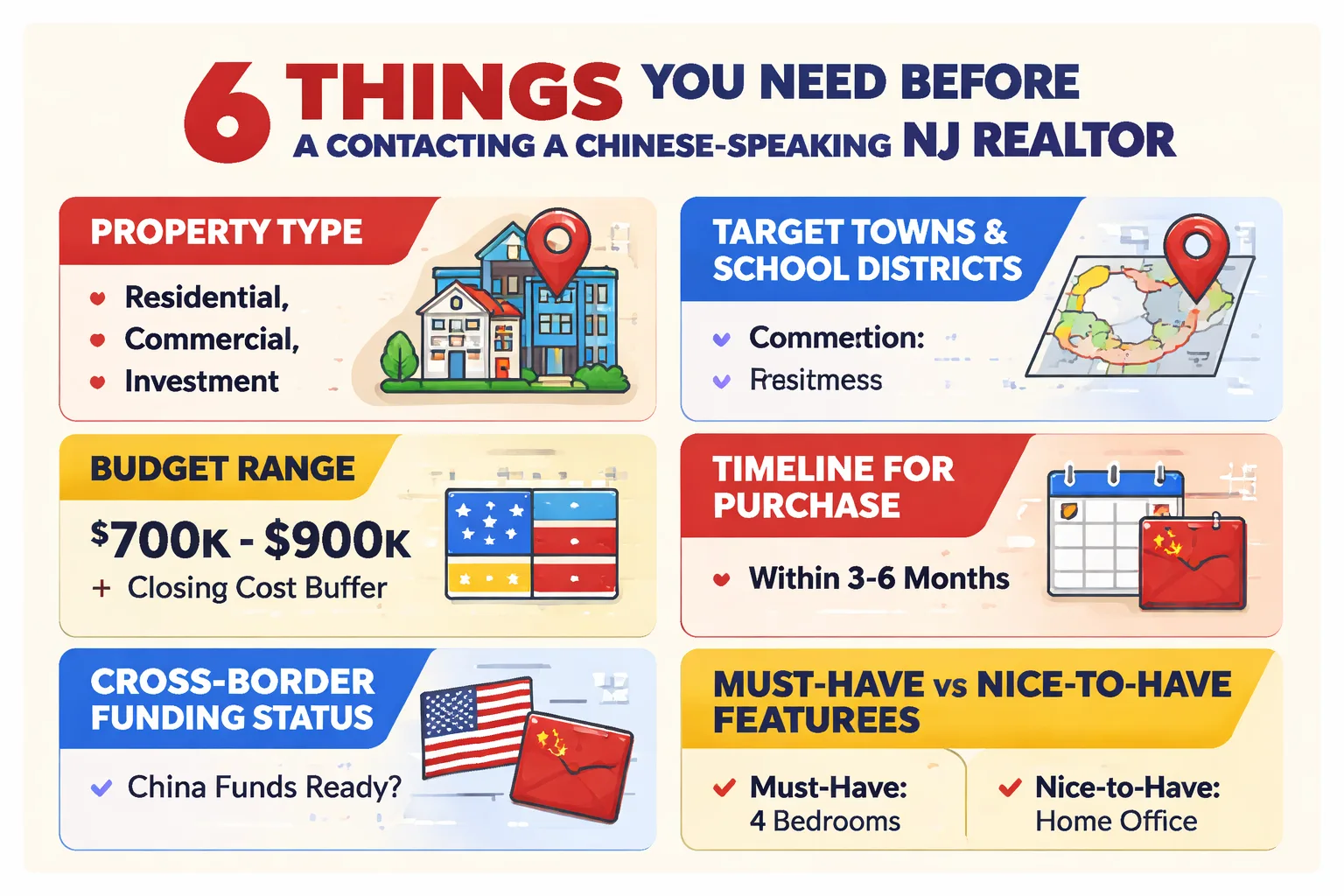
Chinese-speaking buyers in New Jersey typically fall into one of four categories. First, primary residence buyers focused on school districts and community, often targeting Fort Lee, Englewood, or Edison. Second, luxury condo buyers looking at NJ luxury condos near Manhattan with commuter access. Third, investment property buyers seeking rental yield in emerging markets. Fourth, commercial real estate buyers looking at mixed-use or retail space. Each category requires a different agent profile.
An agent who excels at residential transactions in Metuchen may have zero experience with commercial real estate in NJ. An agent who closes Manhattan luxury apartments may not understand Bergen County school district boundaries. The buyer's first step is writing down their property type, target towns, budget range, and timeline. This document becomes the filter for every agent conversation that follows.
The category definition matters more than buyers realize because it determines which data points the agent needs to command. A residential buyer in Tenafly needs an agent who can cite days-on-market averages, school district OPA (Overall Performance Index) scores, and recent comparable sales within a 0.5-mile radius. A commercial buyer looking at a mixed-use property in Jersey City needs an agent who understands cap rates, NOI (Net Operating Income) calculations, lease structures (triple net vs gross), and zoning classifications. An agent who switches between these categories without deep specialization in either is a generalist, and generalists cost buyers money in specialized transactions.
For buyers specifically exploring investment properties, the needs definition should include target cap rate, desired hold period, and whether the buyer intends to self-manage or hire a property management firm. These parameters shape which markets and property types make sense. An agent who does not ask these questions before showing properties is working from their own inventory preferences, not the buyer's investment thesis.
Where to Search Beyond Zillow
Zillow and Redfin are starting points, not ending points. They list agents who pay for placement, not agents who perform. The search channels that actually matter for Chinese-speaking buyers are:
WeChat groups and Chinese community organizations. These are where referrals happen, but they require heavy filtering. A recommendation from a WeChat group should be treated as a lead, not a decision. The person recommending may have different priorities (price, speed, school district) than the buyer. About a third of new clients who come through community referrals express that "something felt off" with their previous agent after their first collaboration. The issues usually stem from misunderstanding contract terms, cultural clashes in negotiation style, or the agent lacking deep local knowledge.
The WeChat ecosystem deserves a closer look. Chinese community groups on WeChat can have hundreds of members, and agent recommendations flow through these networks rapidly. The problem is that the recommendation chain is opaque. Person A recommends Agent B because Agent B helped Person A's cousin buy a house in 2019. Person C sees the recommendation and assumes Agent B is qualified for their commercial real estate purchase in 2026. The transaction type, market conditions, and agent experience level may have shifted entirely. A referral from 2019 in a buyer's market tells the buyer nothing about the agent's ability to negotiate in a 2026 seller's market with rising inventory constraints.
Bilingual agent directories. Professional directories maintained by brokerages like Keller Williams, Coldwell Banker, and Sotheby's allow filtering by language capability. These directories verify licensing status and brokerage affiliation, which WeChat recommendations do not.
Direct brokerage contact. Calling a brokerage's office and asking for their Chinese-speaking agents with specific transaction experience (commercial, luxury, investment) produces more targeted results than any online portal. The receptionist can usually identify which agents have closed transactions in the buyer's target price range and town.
The two largest pools of Mandarin- and Cantonese-speaking agents in New Jersey are concentrated in Bergen County and Middlesex County, according to practitioner guides on Chinese-speaking realtor selection in New Jersey. This geographic concentration reflects where Chinese-American communities have established roots, but it does not guarantee quality. A high concentration of Chinese-speaking agents in a town means more options, not better options.
Bergen County's Chinese-speaking communities are concentrated in towns like Fort Lee, Englewood Cliffs, Tenafly, and Palisades Park. Middlesex County's concentrations center around Edison, East Brunswick, and Plainsboro. Each of these towns has distinct market dynamics, school district configurations, and property tax structures. An agent who serves both counties may lack depth in either. The buyer's search should prioritize agents who have closed at least 5-10 transactions in the specific target town within the past 12 months.
For buyers who also need representation in New York, the search expands. A chinese speaking real estate agent nj who is also licensed in New York can handle transactions spanning both states, which is particularly valuable for buyers comparing Manhattan luxury apartments with NJ luxury condos. The dual-license capability eliminates the need to onboard a second agent, repeat the buyer's financial profile, and coordinate competing advice.
Step 3-4: Interview Candidates and Verify Their Track Record
This is where most buyers fail. They schedule one phone call, feel comfortable because the agent speaks Mandarin, and sign the buyer agency agreement. That decision can cost tens of thousands of dollars.
The interview process should cover five specific areas. Each question has a right answer and a red-flag answer.
Question 1: What was your transaction volume last year, and what percentage was in my target town?
Transaction volume matters, but not in the way most buyers think. A high-volume agent who closes 40 transactions across 15 towns may have less micro-market expertise than an agent who closes 20 transactions concentrated in three towns. The right answer includes specific numbers for the buyer's target area. The red flag is a vague "I do a lot of business in Bergen County" without town-level specifics.
The buyer should ask for the exact number of transactions closed in the target town in the past 12 months, the price range of those transactions, and the average listing-to-sale price ratio. An agent who closes deals at 98% of listing price in a market where the average is 102% is leaving money on the table for their clients. An agent who consistently negotiates below listing price in a seller's market is demonstrating a skill that directly benefits the buyer's bottom line.
Question 2: Can you explain the current inventory situation in my target town?
This tests whether the agent actually knows the market. The right answer includes days on market averages, listing-to-sale price ratios, and recent comparable sales. For example, in Bergen County, the average days on market can be as low as 9 in hot micro-markets. A property sitting for 23 days is a signal, not a coincidence. An agent who cannot cite these numbers is not tracking the market closely enough to negotiate effectively.
The agent should be able to answer without looking anything up. If the agent says "let me check and get back to you," that is acceptable for highly specific data points (like the exact number of active listings in a particular price band), but not for general market conditions. An agent who does not know whether it is currently a buyer's or seller's market in their primary service area is not monitoring the market daily.
Question 3: What is your experience with dual agency, and how do you handle the conflict of interest?
Dual agency (where one agent represents both buyer and seller) is legal in New Jersey but creates inherent conflicts. The right answer is a clear explanation of the risks and a preference for exclusive buyer representation. The red flag is an agent who downplays the conflict or pushes dual agency as a convenience. Under the Real Estate Consumer Protection Enhancement Act, buyers must sign agency agreements before touring properties. Understanding representation is more critical than ever.
Dual agency scenarios are particularly common in Chinese-speaking communities because the pool of bilingual agents is smaller. An agent who lists a property in Fort Lee may also have Chinese-speaking buyers interested in that same property. The temptation to represent both sides is high because the agent doubles their commission. But the buyer loses their advocate in the negotiation. The agent cannot advise the buyer on offer strategy, cannot reveal the seller's motivation, and cannot negotiate against their own listing. The buyer should explicitly ask: "Will you ever represent me on a property you have listed?" The right answer is "no, I will refer you to another agent." The red flag is "it depends on the situation."
Question 4: Can you provide references from Chinese-American clients who bought similar properties?
A request for references from clients with similar profiles (same language preference, same property type, same price range) tests whether the agent has relevant experience. The right answer is immediate willingness to connect the buyer with past clients. The red flag is hesitation or offering only generic testimonials.
The buyer should request references specifically from clients who purchased in the same town and price range within the past 18 months. A reference from a client who bought a $400K condo in Jersey City five years ago tells the buyer nothing about the agent's ability to negotiate a $1.5M luxury home in Tenafly today. The buyer should call at least one reference and ask: "Did the agent identify any issues with the property that you would have missed on your own?" If the answer is no, the agent may be functioning as a tour guide rather than an advisor.
Question 5: How do you handle cross-border fund transfers and attorney coordination?
For international buyers, this is the make-or-break question. Transferring funds from China to the U.S. involves regulatory hurdles, timing constraints, and documentation requirements. The right answer includes specific experience with wire transfers, familiarity with the three-day attorney review period, and established relationships with real estate attorneys who understand cross-border transactions. The red flag is "I have not done that before but I can figure it out."
The agent should be able to explain the typical timeline for cross-border transfers (2-6 weeks depending on the banking institution and amount), the documentation required (source of funds verification, anti-money laundering compliance forms), and the strategy for timing the offer to align with fund availability. They should also have relationships with real estate attorneys who are familiar with the concerns of international buyers, including foreign investor tax implications and FIRPTA (Foreign Investment in Real Property Tax Act) considerations.
Verifying the Track Record
Answers during the interview are claims, not facts. Verification means checking the New Jersey Real Estate Commission licensee database to confirm active licensing, searching public MLS records (where accessible) for recent transactions, and calling at least one reference before signing any agreement.
The brokerage backing matters here. Agents at established brokerages like Keller Williams have access to MLS systems, attorney networks, mortgage contacts, and compliance oversight that independent or small-brokerage agents may lack. The brokerage is the infrastructure behind the agent's promise.
For buyers specifically interested in top real estate agents in New Jersey, the verification process should also include checking whether the agent has been recognized by industry awards or publications. Recognition does not guarantee competence, but it does indicate peer validation.
The verification step is where buyers who skipped the structured interview process get caught. An agent who sounded confident on the phone may have a license that lapsed six months ago. An agent who claimed "extensive commercial experience" may have only closed residential transactions. The New Jersey Real Estate Commission's online database is free, public, and takes less than five minutes to search. There is no excuse for skipping this step.
For buyers considering agents who also hold a New York license, the New York Department of State maintains a similar database. Dual-licensed agents should be verified in both states. An agent whose New Jersey license is active but whose New York license is suspended or expired is not the representative a buyer wants for a cross-state transaction.
Step 5: Confirm Brokerage Support and Legal Compliance
The agent is the face. The brokerage is the engine. Buyers who skip this step are buying a car without checking what is under the hood.
Brokerage infrastructure affects three critical areas. First, MLS access determines how quickly the agent can identify new listings and pull comparable sales data. A brokerage with robust MLS participation gives the agent real-time market intelligence. Second, attorney and mortgage networks determine how smoothly the transaction progresses from contract to closing. An agent at a well-connected brokerage can recommend real estate attorneys, mortgage brokers, and title companies that have successfully closed transactions for Chinese-speaking buyers. Third, compliance oversight protects the buyer. Brokerages are responsible for ensuring their agents follow fair housing laws, disclosure requirements, and contract regulations.
The legal landscape in New Jersey has shifted. The Real Estate Consumer Protection Enhancement Act, effective August 1, 2024, mandates written buyer agency agreements before an agent can show properties. This means buyers are committing to representation earlier in the process. The agreement specifies the agent's duties, the commission structure, and the duration of the relationship. Understanding these terms before signing is essential. An agent who cannot clearly explain the buyer agency agreement in the buyer's preferred language is not qualified to represent them.
The buyer agency agreement is not a formality. It is a binding contract that obligates the buyer to work with the agent for a specified period (typically 3-6 months) and may require the buyer to pay the agent's commission if the seller does not offer a cooperating commission. Buyers should read every clause, understand the termination provisions, and negotiate the duration before signing. An agent who pressures the buyer to sign without explaining the terms is already demonstrating the kind of representation the buyer will receive throughout the transaction.
Red flags at the brokerage level include: the agent cannot name their broker of record, the brokerage has no physical office in New Jersey, the agent pressures the buyer to sign an agency agreement before discussing terms, or the brokerage has disciplinary actions on file with the New Jersey Real Estate Commission. Any of these signals should end the conversation.
For commercial transactions, the brokerage requirements are even more stringent. A commercial real estate broker in NYC or NJ needs access to commercial MLS platforms, relationships with developers and investors, and experience with complex financing structures. Residential agents who occasionally handle commercial deals are not the same as dedicated commercial brokers.
The distinction between residential and commercial brokerage infrastructure is stark. Residential brokerages optimize for volume: fast transactions, standardized contracts, retail mortgage lenders. Commercial brokerages optimize for complexity: extended due diligence periods, environmental assessments, tenant lease assignments, and commercial financing through banks, credit unions, or private lenders. An agent operating in both worlds needs brokerage infrastructure that supports both transaction types. Keller Williams Town Life Realty, for example, provides access to both residential MLS systems and commercial networks, which is why agents at this brokerage can legitimately serve buyers across both categories.
Title and closing costs represent another area where brokerage infrastructure matters. Buyers should review title fees and closing costs before making an offer, and the agent's brokerage should have established relationships with title companies that can handle the specific needs of Chinese-speaking buyers, including translation of closing documents and coordination with international banks for wire transfers.
How Does a Buyer Assess Commercial vs. Residential Agent Capability?
The line between residential and commercial real estate expertise is not a gradient. It is a wall. Agents who claim to do both equally well usually do neither exceptionally.
For Chinese-speaking buyers evaluating whether an agent can handle commercial transactions in New Jersey, the assessment comes down to three specific capabilities. First, does the agent understand investment metrics? A commercial agent should immediately discuss cap rates, cash-on-cash return, internal rate of return (IRR), and debt service coverage ratio (DSCR) when presented with a property. If the agent responds to a commercial inquiry with language about "how nice the building looks" or "the neighborhood is improving," they are thinking like a residential agent.
Second, does the agent have commercial transaction experience? The buyer should ask for the number of commercial transactions closed in the past 24 months, the property types (retail, office, industrial, mixed-use, multifamily), and the average deal size. A residential agent who closed one commercial deal last year for a $300K mixed-use property is not the right representative for a $3M retail portfolio acquisition.
Third, does the agent have commercial brokerage infrastructure? This means access to CoStar or LoopNet data, relationships with commercial lenders, and connections to commercial real estate attorneys who understand commercial lease structures, environmental due diligence, and zoning compliance.
For buyers specifically exploring New York investment properties, the agent assessment should also cover their familiarity with New York City's commercial market dynamics, which differ significantly from New Jersey's. New York City commercial transactions involve different contract structures (LOI-based rather than MLS-based), different closing timelines (60-90 days vs. 30-45 days in NJ), and different financing norms.
What Sets a Truly Qualified Chinese-Speaking NJ Realtor Apart
The market is saturated with agents who speak Chinese. It is not saturated with agents who speak Chinese AND have the transaction volume, local expertise, and brokerage infrastructure to deliver superior outcomes.
Consider the benchmark. An agent with $35M+ in sales volume, licensed in both New Jersey and New York, specializing in luxury homes, investment properties, and commercial real estate, backed by Keller Williams Town Life Realty in Tenafly, NJ. This profile combines bilingual English-Chinese service with demonstrated cross-market expertise. The dual licensing matters because many Chinese-speaking buyers in New Jersey also explore Manhattan luxury apartments or New York investment properties. An agent who can represent the buyer in both states eliminates the friction of coordinating two separate representation teams.
Prior recognition matters. Awards like Coldwell Banker's International President's Elite (2024) and International Diamond Society (2025) indicate that the agent's performance has been validated by a major brokerage's internal metrics. These are not self-claimed credentials. They are awarded based on production thresholds that place the agent in the top tier of the brokerage's agent network.
The practical difference shows up in specific scenarios. When a buyer is considering a $1.15M offer on a property in a hot Bergen County market, an experienced agent pulls comparable sales showing similar homes selling at $1.08M in the same period. That $70,000 gap is not theoretical. It is the difference between an agent who prioritizes a quick close and one who prioritizes the buyer's financial outcome. When a buyer is evaluating investment properties in NJ, an agent with commercial experience can assess rental yield, cap rates, and exit strategies that a purely residential agent cannot.
The bilingual capability extends beyond translation. It includes understanding Chinese buyers' typical concerns: proximity to Chinese communities, school district quality (not just ratings but specific programs like Mandarin immersion or gifted and talented tracks), feng shui considerations, and the logistics of cross-border fund transfers. These factors influence purchase decisions in ways that a non-Chinese agent, however well-intentioned, will not think to address.
The benchmark also includes intangible qualities that are difficult to quantify but easy to recognize in practice. An agent who proactively identifies an underground oil tank before the inspection period, who flags a shared driveway easement that could limit future renovations, or who recognizes that a property's assessed value is significantly below market value (triggering a tax reassessment risk after purchase) is providing representation that goes beyond opening doors and submitting offers.
For buyers who have had a previous negative experience with a Chinese-speaking agent, the benchmark provides a concrete comparison point. The question is not "does this agent speak Chinese?" but "does this agent meet the standard of bilingual capability plus $35M+ in sales volume plus dual-state licensing plus brokerage backing plus demonstrated expertise in my property type?" If the answer to any of these criteria is no, the buyer is settling for less than the market's best representation.
Are you verifying your agent's track record or just trusting a referral?
When This Framework Fails
This five-step process assumes the buyer has time to research, interview, and verify. In a hyper-competitive market where properties receive multiple offers within 48 hours of listing, the luxury of a deliberate agent search can feel impossible. Buyers under time pressure tend to skip Steps 3-4 and default to whoever answers the phone first.
The framework also assumes the buyer can accurately assess an agent's answers during the interview. A buyer new to U.S. real estate may not know whether an agent's market data is accurate or fabricated. The question "can you explain the current inventory situation" only works if the buyer can evaluate the response. For first-time buyers, bringing a trusted advisor (an attorney, a family member with U.S. real estate experience, or a financial advisor) to the interview can compensate for knowledge gaps.
Finally, this process does not fix bad timing. Even the best agent cannot recover from a buyer who starts the search too late, has not secured financing, or is emotionally attached to a specific property before evaluating the market. Agent selection is one variable in a larger equation. It is the most controllable variable, but it is not the only one.
How Do NJ and NY Licensing Requirements Affect Agent Selection?
Buyers evaluating a chinese speaking real estate agent nj who also operates in New York should understand the licensing landscape. New Jersey requires 75 hours of pre-licensing education (the nj real estate license 75-hour course online is the standard pathway), followed by a state exam. New York has its own requirements, typically 77 hours of qualifying education plus a state exam. An agent who holds both licenses has invested in the education and examination requirements of both states, which signals commitment to cross-market competence.
The licensing distinction matters because real estate law, contract structures, and transaction norms differ between the states. New Jersey's three-day attorney review period does not exist in New York City residential transactions, where contracts are typically binding upon execution with minimal contingency windows. An agent who only knows the New Jersey system will struggle to advise a buyer on the risks of a New York contract that lacks an attorney review safety net. Conversely, an agent who only knows the New York system will not understand New Jersey's property tax structure or the nuances of the attorney review period.
For buyers who are evaluating New York market conditions alongside New Jersey opportunities, working with a dual-licensed agent provides continuity. The agent can compare properties across both markets using consistent criteria, advise on the tax implications of purchasing in each state, and coordinate transactions that may involve selling a New York property to fund a New Jersey purchase (or vice versa).
What Are the Common Mistakes Chinese Buyers Make?
The most common mistake is treating agent selection as a referral decision rather than a qualification decision. Chinese culture places high value on relationships and trust built through personal networks. This cultural tendency, while valuable in many contexts, works against the buyer in real estate transactions where the agent's competence matters more than their connection to the buyer's social circle.
The second mistake is prioritizing transaction volume over transaction quality. An agent who closes 50 transactions per year but negotiates at 100% of listing price is not delivering value to the buyer. An agent who closes 25 transactions per year but consistently negotiates 3-5% below listing price is saving their clients significantly more money. The buyer should ask for the agent's average listing-to-sale price ratio, not just their transaction count.
The third mistake is underestimating the importance of the buyer agency agreement. Under the Real Estate Consumer Protection Enhancement Act, this document is now mandatory before touring properties. Many buyers sign it without reading it, without understanding the commission obligations, and without negotiating the term length. The agreement may lock the buyer into working with an underperforming agent for 3-6 months. If the buyer becomes dissatisfied, terminating the agreement requires the broker's written consent, which is not always forthcoming.
The fourth mistake is failing to verify the agent's claims independently. An agent who says "I specialize in luxury homes in Bergen County" should have verifiable MLS data supporting that claim. An agent who says "I have experience with commercial real estate" should be able to name specific commercial transactions. The buyer who takes these claims at face value is relying on the agent's self-reporting, which is not subject to any verification standard until the buyer checks the licensing database and calls references.
What This Actually Means
The question 想在新泽西买房,哪些房产经纪人比较好 has a simple answer that most buyers refuse to accept. The best agent is not the one who speaks your language, comes recommended by a friend, or has the most transactions. The best agent is the one who combines bilingual capability with verifiable local expertise, demonstrated negotiation skill, and brokerage infrastructure that protects your interests from contract to closing.
The five-step framework exists because the default process (ask around, find a Chinese speaker, sign the agreement) produces predictable failures. Buyers overpay. They miss red flags. They sign contracts they do not understand. They discover property tax surprises after closing. Each of these outcomes is preventable with a structured agent selection process.
New Jersey's real estate market in 2026 rewards preparation. Inventory shifts, interest rate volatility, and regulatory changes (the buyer agency agreement mandate) have raised the stakes of agent selection. The buyer who invests two weeks in the five-step process will outperform the buyer who skips it. The difference is measured in tens of thousands of dollars, not in comfort or convenience.
For buyers evaluating 新泽西华人房产经纪人 (Chinese real estate agents in New Jersey), the standard is clear: language fit plus local expertise plus transaction volume plus brokerage support. Anything less is a gamble with significant capital at stake.
The question 想在新泽西买房,哪些房产经纪人比较好 deserves a better answer than "ask your friends." It deserves a structured, verifiable, five-step process that separates genuine expertise from comfortable familiarity. The buyer who follows this framework will not just find a Chinese-speaking NJ realtor. They will find the right one.
FAQ
Why does language matching matter more than comfort in NJ real estate deals?
Language precision directly shapes offer strategy, due diligence, and final closing numbers in high-stakes transactions like commercial properties or Manhattan-linked investments. NJ's complex legal structures, including the three-day attorney review and new buyer agency rules, require clear communication that casual language matching often fails to deliver.What risks come with choosing a Chinese-speaking agent based only on recommendations from WeChat or family?
Buyers can overpay by $40,000 or more when agents lack deep local market knowledge to spot stale listings or mispriced comps. Surface-level language fit without Bergen County expertise turns the agent into a liability rather than an asset.How do recent NJ market changes affect the need for specialized realtor selection?
The 2026 New Jersey Housing Market Outlook highlights inventory shifts that make agent expertise more critical than ever. Relying on generic advice like "find someone who speaks Chinese" ignores these dynamics and increases the chance of poor outcomes.What makes the five-step framework different from standard advice for finding Chinese-speaking NJ realtors?
It separates genuine market expertise from simple language matching by focusing on micro-market knowledge and negotiating leverage. This approach avoids the common pitfalls that lead to overpayment and weak representation in competitive NJ transactions.About the Author
Judy Zhou, Keller Williams Realtor®
Judy Zhou is a Realtor® with Keller Williams Town Life Realty in Tenafly, NJ, serving New Jersey and New York with $35M+ in sales volume. Licensed in both NJ and NY, she specializes in luxury homes, investment properties, and commercial real estate, offering seamless bilingual English-Chinese service. Before joining Keller Williams, she earned Coldwell Banker's International President's Elite (2024) and International Diamond Society (2025) awards.
Get bilingual representation with proven $35M+ results and Keller Williams backing behind every transaction.